Popular Pets
🐶 Dog 🐱 Cat 🐰 Rabbit 🐹 Hamster 🐾 Guinea Pig 🦜 Parrot 🦡 Ferret 🐀 Rat 🐭 Chinchilla 🦔 Hedgehog 🐟 Goldfish 🦜 Macaw
Farm & Large Animals
🐴 Horse 🐄 Cow 🐄 Highland Cow 🐷 Pig 🐑 Sheep 🐐 Goat 🐴 Donkey 🦙 Alpaca 🐐 Mountain Goat 🐔 Chicken 🦆 Duck 🦃 Turkey
Wild Animals
🐘 Elephant 🦁 Lion 🐯 Tiger 🐆 Leopard 🐺 Wolf 🐻 Bear 🐻‍❄️ Polar Bear 🦍 Gorilla 🐒 Chimpanzee 🦧 Orangutan 🦘 Kangaroo 🐾 Capybara 🦒 Giraffe 🦊 Fox 🦅 Raptor 🦉 Owl 🐧 Penguin 🦩 Flamingo 🐾 Hyena 🐾 Meerkat 🦥 Sloth 🦡 Badger 🐾 Wolverine 🐾 Armadillo
Ocean & Aquarium
🦈 Shark 🐋 Orca 🐬 Dolphin 🐋 Whale 🐋 Blue Whale 🐳 Beluga Whale 🦄 Narwhal 🐋 Bowhead Whale 🐾 Manatee 🐟 Manta Ray 🐟 Freshwater Fish 🐠 Saltwater Fish 🐴 Seahorse 🐟 Koi
Exotic & Weird
🐍 Snake 🐍 Ball Python 🦎 Bearded Dragon 🦎 Iguana 🦎 Komodo Dragon 🦎 Chameleon 🦎 Leopard Gecko 🐢 Tortoise 🐢 Snapping Turtle 🐢 Sea Turtle 🐊 Crocodilian 🕷️ Tarantula 🦎 Axolotl 🐙 Octopus 🌊 Jellyfish 🦞 Lobster 🐚 Quahog 🔬 Tardigrade
Info
About FAQ Contact
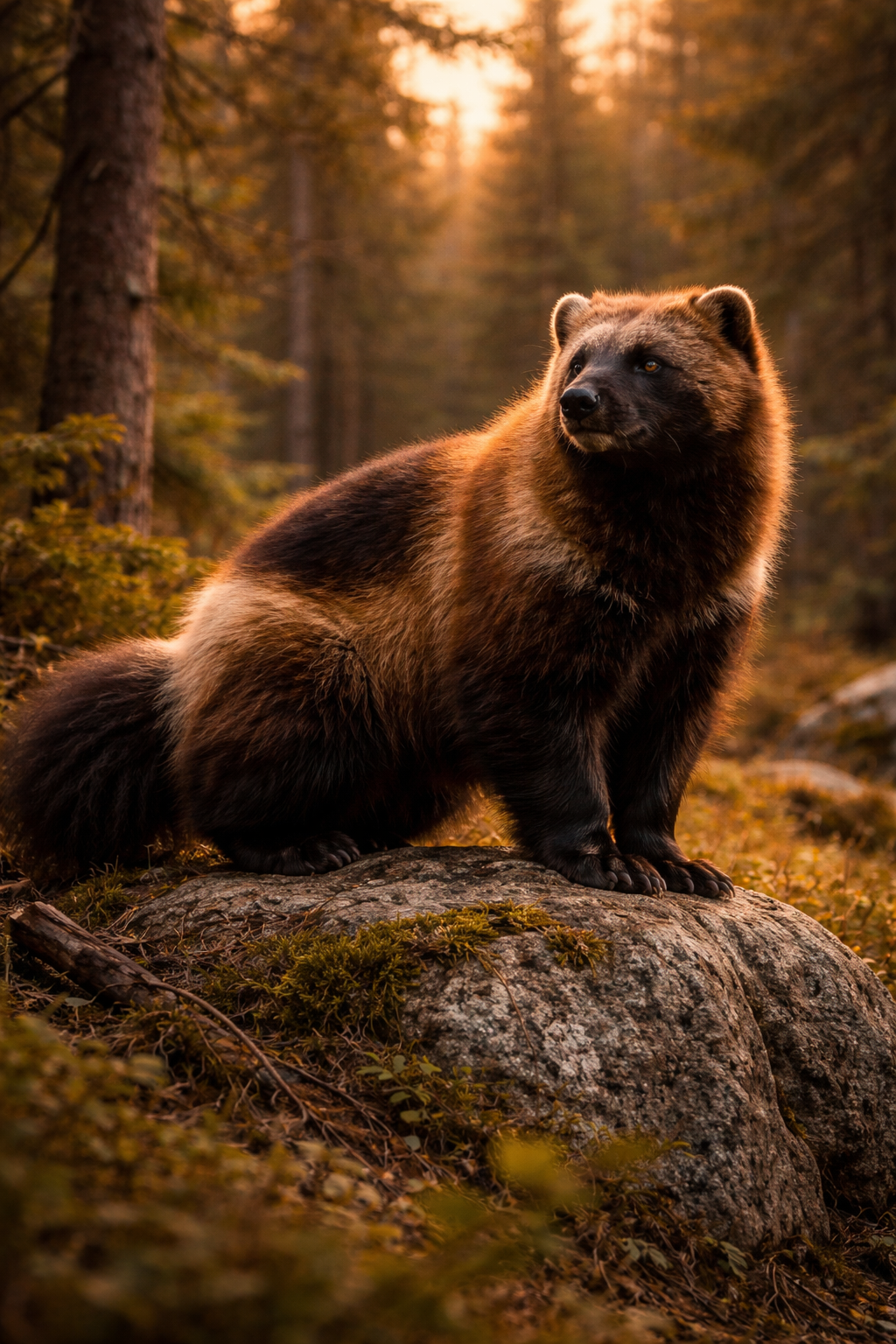
Photorealistic painting of a wolverine perched on a boulder in a boreal forest at golden hour
🦡 Wild Animals

How Old Is a Wolverine in Human Years?

📅 Updated March 2026 🌲 Boreal forests & Arctic tundra 🦡 Lifespan: 7–17 years

The wolverine weighs up to 18kg — roughly the size of a medium dog. It has driven grizzly bears off kills. It travels 40km a day through deep snow in temperatures of −40°C. It bites through frozen bone. It is, pound for pound, the most ferocious predator on Earth — and one of the least studied.

Calculate Wolverine Age →
🦡 Wolverine Age in Human Years
in human years
Wolverine age
Life stage
Type
🦡 What this age means

The Life Stages of a Wolverine

Wolverines are born in late winter or early spring in a den dug deep into a snowbank — the female requires persistent, deep snowpack for successful denning, which is why climate change and retreating snowlines are a direct threat to wolverine reproduction. Kits are born blind and helpless but develop quickly. By summer they are following the mother across vast distances, learning the survival skills of one of Earth's harshest environments.

0–8 weeks
Kit (Newborn)
Born in a snow den in February or March — white-furred, blind, and entirely dependent. Litters are typically 2–3 kits. The den is often dug 10+ metres into a snowpack, providing insulation against Arctic temperatures. The mother nurses and guards the kits while the male patrols the territory. Deep, stable snowpack is essential — if the den collapses or floods, the litter is lost. This is why persistent spring snow is critical to wolverine reproduction.
2–6 months
Kit (Growing)
By spring the kits emerge from the snow den — now dark-furred, eyes open, and intensely curious. They follow the mother on foraging trips, learning the immense territory she patrols. The adult dark coat with its distinctive pale facial mask and tawny stripes is developing. At this stage, kits are already playing with food, practising the bone-crushing bites and powerful digging techniques that define wolverine predation and scavenging.
6–18 months
Juvenile
Travelling increasingly independently alongside the mother across her vast territory. Learning to locate and access cached food — wolverines bury surplus meat in deep snow and permafrost, returning to caches months later. The juvenile must learn to identify carcasses under snow, dig efficiently through hard-packed ice, and assess the risk of approaching a kill that may already have attracted wolves or bears. Every lesson is survival-critical in the boreal winter.
1.5–2 yrs
Sub-Adult
Dispersing from the mother's territory — often travelling extraordinary distances to establish their own range. Young males may disperse hundreds of kilometres. The new territory must be found, scent-marked, and defended against resident wolverines. This is an exhausting, dangerous period — the sub-adult must establish itself while learning to survive boreal winters entirely alone. Those that succeed emerge as fully independent wolverines, ready to patrol territories that would cover an entire national park.
2–9 yrs
Prime Adult
The apex of wolverine life. A prime adult male patrols a territory of 500–1,000 km², overlapping with several female territories. The crushing bite is at full power — capable of processing entire frozen carcasses including bones. The wolverine knows every cache site, every carcass location, and every rival's scent boundary. It may share a brief mating interaction with a female in its territory each spring, otherwise living entirely alone across a wilderness that few other creatures can navigate.
9–17 yrs
Senior / Elder
Wild wolverines rarely reach double digits — the boreal wilderness is unforgiving. Those that do are exceptional survivors. Captive wolverines regularly reach 15–17 years with documented cases approaching 18. An elder wolverine slows its territorial range and may struggle with frozen bone as tooth wear accumulates. But its deep territorial knowledge — every cache, every game trail, every competitor's boundary — remains valuable to the end. A wolverine that reaches 10 in the wild has outlasted almost everything the North can throw at it.

Wolverine Age to Human Years Conversion Table

Wolverine AgeWild WolverineCaptive WolverineLife StageKey Milestone
BirthNewbornNewbornNewborn kitBorn in snow den, blind
2 months~5 yrs~3 yrsGrowing kitEyes open; emerging from den
6 months~12 yrs~7 yrsJuvenileTravelling with mother
1 year~18 yrs~12 yrsSub-adultDispersal begins
2 years~28 yrs~20 yrsYoung adultTerritory established
4 years~44 yrs~32 yrsPrime adultFull territorial range
7 years~62 yrs~48 yrsMature adultSenior in the wild
10 years~76 yrs~60 yrsElder (wild)Rare wild survivor
15 years~80 yrsElder (captive)Captive record territory

🦡 Wolverines are one of the least studied large carnivores in North America and Eurasia — their vast territories, remote habitat, and low population densities make long-term field research extraordinarily difficult. The Wolverine Foundation and the Wildlife Conservation Society are among the organisations running multi-year GPS tracking studies to better understand wolverine movement ecology, territory size, and the impacts of climate change on wolverine denning success.

Things About Wolverines That Will Actually Surprise You

💪 Drives Bears Off Kills — Documented
The wolverine's reputation for fearlessness is not mythological — it is documented by researchers and camera traps. Wolverines have been filmed and directly observed driving grizzly bears, black bears, and mountain lions off carcasses. The strategy relies on relentless, ferocious aggression — attacking the larger animal repeatedly and targeting sensitive areas (face, nose, genitals) until the predator decides the injury risk outweighs the food reward. Research by the Wolverine Foundation documents wolverines following wolves for extended periods and regularly appropriating wolf kills. Size is entirely irrelevant to a wolverine's threat assessment.
🗺️ 40km a Day — Extraordinary Endurance
Wolverines have been GPS-tracked covering more than 40km in a single day, through deep snow, over mountain passes, and across terrain that would stop most other mammals. Male territory size averages 500–1,000 km² — larger than many US counties. This extraordinary travel capacity is a necessity: wolverine habitat is so food-scarce that an animal must patrol vast areas to find enough to eat. GPS tracking studies have recorded wolverines crossing the Continental Divide in a single night — ascending and descending thousands of metres of vertical gain while covering horizontal distances that would exhaust a human athlete over multiple days.
❄️ Born in Snow — Climate Vulnerable
Female wolverines require deep, stable snowpack to den successfully — they dig maternity dens up to 15 metres into avalanche debris or deep drifts, providing insulation and protection. This makes them one of the species most directly vulnerable to climate change: as spring snowpacks shrink and melt earlier across the American West and Scandinavia, wolverine denning habitat is disappearing. A study in Science projected that wolverine range in the contiguous United States could contract by more than 60% by 2100 under medium warming scenarios — driven almost entirely by snowpack loss rather than direct temperature effects.
🦷 Bone Crusher of the North
The wolverine's back molars — called carnassials — are rotated 90 degrees relative to those of other mustelids, generating crushing force rather than shearing. This allows wolverines to bite through frozen bone — consuming entire carcasses, including the skeletal elements that other carnivores leave behind. In winter, when food is scarce, this ability to access the frozen remains of wolf or bear kills is a critical survival advantage. Wolverines also use their powerful claws and semi-plantigrade feet (walking flat-footed like bears) to dig through hard-packed snow and ice to reach buried carcasses.
🧪 Musk — Natural Chemical Weapon
Wolverines possess large musk glands that produce a pungent, persistent secretion used for scent marking their vast territories — and, critically, for food preservation. Wolverines spray cached food with musk, which deters most other animals from consuming it (the smell is reportedly overwhelming even to wolves and bears). This means the wolverine's food cache is effectively private — protected by chemistry rather than physical guarding. The musk earned wolverines the alternative name "skunk bear" in parts of North America. Indigenous peoples of the subarctic regarded wolverine musk as one of the most powerful and persistent natural odours in the boreal ecosystem.
🐾 Largest Land Mustelid
The wolverine is the largest land-dwelling member of Mustelidae — the weasel family — which includes otters, badgers, martens, mink, stoats, and ferrets. Despite weighing only 9–18kg, wolverines fill the ecological niche of a large predator in environments too harsh for actual large predators to patrol year-round. The IUCN lists the wolverine as Least Concern globally but notes significant regional population declines, particularly in the contiguous United States (where fewer than 300 individuals remain) and parts of Scandinavia. Their low reproductive rate (typically 2–3 kits every other year) makes population recovery from declines very slow.

🦡 The wolverine's scientific name is Gulo gulo — from the Latin gulo, meaning glutton. The name references the wolverine's extraordinary capacity to consume massive quantities of food at a single sitting — up to one-third of its body weight — a physiological adaptation to a boom-and-bust food supply in boreal and arctic environments. When a large carcass is available, a wolverine will gorge, cache the remainder under snow or permafrost, and return to it repeatedly over weeks. Nothing is wasted. Nothing is left for rivals.

Wolverine vs Other Mustelids

The wolverine is the largest land mustelid, but it shares the family with some remarkable animals. Here's how it compares to its weasel relatives.

SpeciesWeightHabitatNotable TraitWild Lifespan
Wolverine9–18 kgBoreal/ArcticDrives bears off kills; 40km/day travel7–13 yrs
Honey Badger7–16 kgAfrica/AsiaAlso fearless; immune to some venoms~24 yrs
European Badger7–17 kgEurope/AsiaBuilds extensive sett systems; omnivore~14 yrs
Giant Otter22–32 kgS. America riversLargest mustelid overall; apex aquatic predator~8 yrs
Fisher2–6 kgN. American borealOnly regular predator of porcupines~7 yrs
Stoat (Ermine)0.1–0.4 kgHolarcticTurns white in winter; kills prey 10× its size~4 yrs

Other Wild Animals on PawClocks

Frequently Asked Questions

Yes — this is documented behaviour, not folklore. Wolverines have been observed and camera-trapped driving grizzly bears, black bears, and mountain lions off kills. The strategy relies on ferocity and persistence rather than physical superiority — the wolverine attacks relentlessly, aiming for sensitive areas, and most predators judge the injury risk not worth a meal they didn't hunt. Wolverines have also been documented following wolves for days to scavenge from their kills, occasionally harassing the wolves themselves.
Wolverines have been GPS-tracked covering more than 40km in a single day, through deep snow and over mountain passes. Male territories average 500–1,000 km² — larger than many US counties. This extraordinary travel capacity is a necessity: wolverine habitat is so food-scarce that they must patrol vast areas to survive. GPS studies have recorded wolverines crossing the Continental Divide in a single night.
The wolverine's back molars are rotated 90 degrees relative to other mustelids, generating crushing force rather than shearing. This allows wolverines to bite through frozen bone — consuming entire carcasses, including skeletal elements that other carnivores leave behind. In winter, this ability to access frozen remains of wolf or bear kills is a critical survival advantage. The wolverine can consume an entire large carcass over time, wasting nothing.
Wolverines inhabit boreal forests, subarctic tundra, and alpine zones of the Northern Hemisphere — primarily Canada, Alaska, Russia, Scandinavia, and mountainous regions of the western United States. They are strongly associated with deep, persistent snow, which they use for denning and food storage. Climate change is reducing wolverine habitat by shrinking the persistent snowpacks they depend on for denning.
No — despite the name, wolverines are not related to wolves. They are the largest land-dwelling member of Mustelidae — the weasel family — which includes otters, badgers, martens, mink, and ferrets. Their closest large relatives are badgers. Wolves are canids, an entirely separate family. The wolverine's bear-like appearance is the result of convergent evolution, not any close relationship to bears or wolves.
The IUCN lists wolverines as Least Concern globally, but regional populations face serious pressure. In the contiguous United States, fewer than 300 wolverines remain — primarily in Montana, Idaho, Wyoming, and Washington. In 2023, the US Fish and Wildlife Service listed the wolverine as Threatened under the Endangered Species Act, citing climate change-driven snowpack loss as the primary threat. Scandinavian populations are also under pressure from habitat fragmentation and historical persecution by reindeer herders.
Wolverines have large musk glands that produce a pungent, persistent secretion — earning them the nickname "skunk bear" in parts of North America. The musk serves two functions: scent marking their vast territories (communicating presence and identity to other wolverines) and food preservation (spraying cached food to deter thieves). The smell is reportedly overwhelming even to wolves and bears, making the wolverine's food cache effectively private. The musk is described as more intense than skunk spray and far more persistent.