Popular Pets
🐶 Dog 🐱 Cat 🐰 Rabbit 🐹 Hamster 🐾 Guinea Pig 🦜 Parrot 🦡 Ferret 🐀 Rat 🐭 Chinchilla 🦔 Hedgehog 🐟 Goldfish 🦜 Macaw
Farm & Large Animals
🐴 Horse 🐄 Cow 🐄 Highland Cow 🐷 Pig 🐑 Sheep 🐐 Goat 🐴 Donkey 🦙 Alpaca 🐐 Mountain Goat 🐔 Chicken 🦆 Duck 🦃 Turkey
Wild Animals
🐘 Elephant 🦁 Lion 🐯 Tiger 🐆 Leopard 🐺 Wolf 🐻 Bear 🐻‍❄️ Polar Bear 🦍 Gorilla 🐒 Chimpanzee 🦧 Orangutan 🦘 Kangaroo 🐾 Capybara 🦒 Giraffe 🦊 Fox 🦅 Raptor 🦉 Owl 🐧 Penguin 🦩 Flamingo 🐾 Hyena 🐾 Meerkat 🦥 Sloth 🦡 Badger 🐾 Wolverine 🐾 Armadillo
Ocean & Aquarium
🦈 Shark 🐋 Orca 🐬 Dolphin 🐋 Whale 🐋 Blue Whale 🐳 Beluga Whale 🦄 Narwhal 🐋 Bowhead Whale 🐾 Manatee 🐟 Manta Ray 🐟 Freshwater Fish 🐠 Saltwater Fish 🐴 Seahorse 🐟 Koi
Exotic & Weird
🐍 Snake 🐍 Ball Python 🦎 Bearded Dragon 🦎 Iguana 🦎 Komodo Dragon 🦎 Chameleon 🦎 Leopard Gecko 🐢 Tortoise 🐢 Snapping Turtle 🐢 Sea Turtle 🐊 Crocodilian 🕷️ Tarantula 🦎 Axolotl 🐙 Octopus 🌊 Jellyfish 🦞 Lobster 🐚 Quahog 🔬 Tardigrade
Info
About FAQ Contact
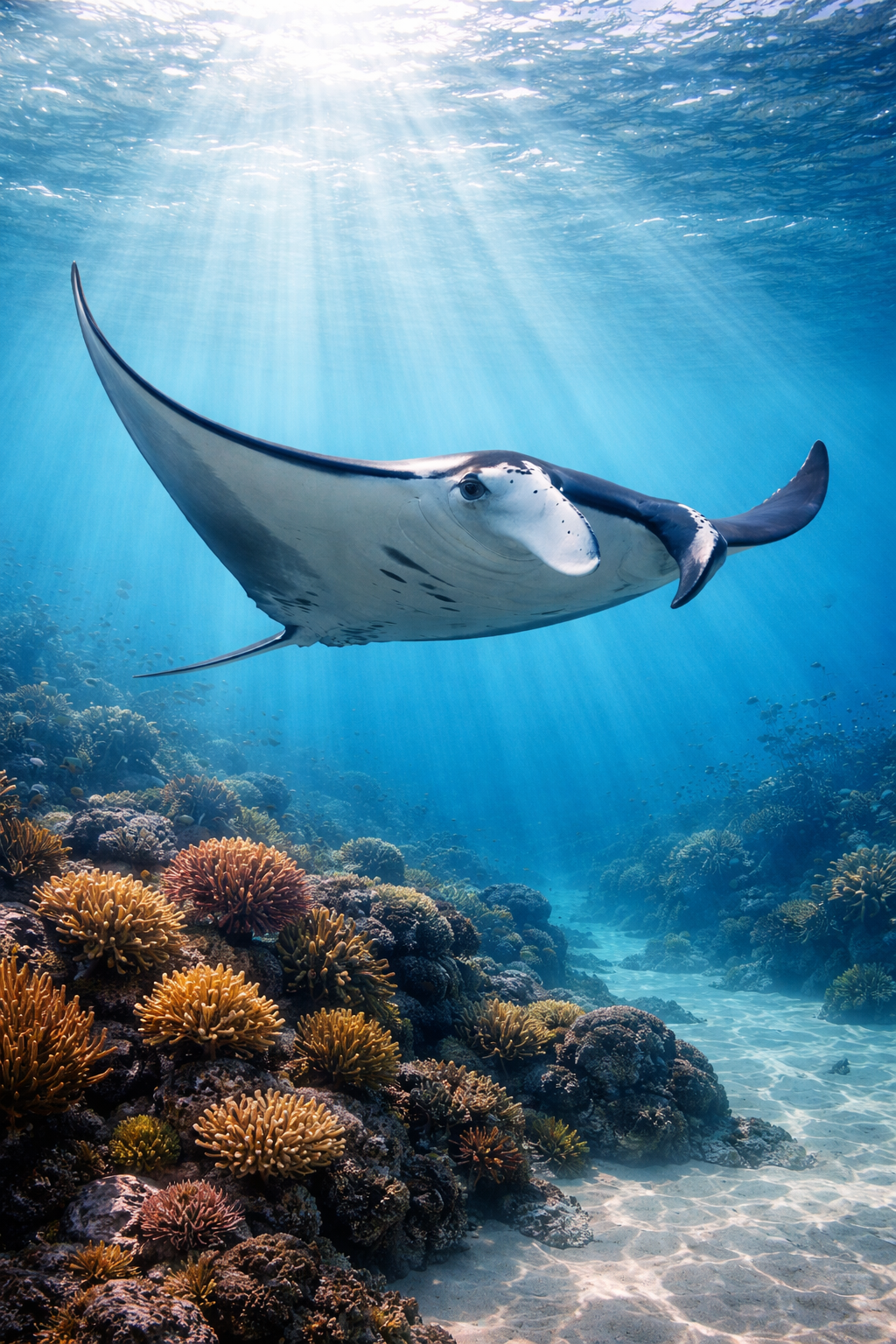
Photorealistic painting of a reef manta ray gliding over a coral reef in clear tropical ocean
🐟 Wild Animals

How Old Is a Manta Ray in Human Years?

📅 Updated March 2026 🌊 Tropical & Subtropical Oceans 🐟 Lifespan: 40–50+ years

Manta rays have the largest brain-to-body ratio of any fish. They pass the mirror self-recognition test. They dive to 1,250 metres — three-quarters of a mile down — apparently to build mental maps of the ocean for navigation. They are among the most cognitively sophisticated fish on Earth. And they are being killed in their hundreds of thousands every year.

Calculate Manta Age →
🐟 Manta Ray Age in Human Years
in human years
Manta age
Life stage
Species
🐟 What this age means

The Life Stages of a Manta Ray

Manta rays are among the most K-selected animals in the ocean — they invest heavily in very few offspring, growing slowly and living long. A female manta ray produces only one pup every 2–5 years, after a 12–13 month gestation. This extraordinarily low reproductive rate means that manta populations are exceptionally vulnerable to elevated mortality from fishing — even modest levels of bycatch can push a population into decline that takes decades to recover from.

0–2 years
Pup
Born live — viviparous — as a single pup after a 12–13 month gestation, rolled up like a burrito inside its egg case, then unfurling as it emerges. Pups are fully formed miniature mantas at birth, immediately able to swim and filter feed. In reef mantas, nursery grounds such as South Florida's Palm Beach County are critical habitat — shallow, protected coastal areas where pups are safer from large predators. Pups are extremely vulnerable to boat strikes and fishing entanglement in their first years.
2–8 years
Juvenile
Growing rapidly but still far from mature. Juvenile mantas are developing the foraging behaviours, cleaning station routines, and social patterns that will define their adult lives. Reef mantas at this stage begin visiting cleaning stations where wrasse and other small fish remove parasites from their skin — a behaviour that appears to be partly learned from observing adults. In some populations, juvenile mantas form small social groups, swimming together and appearing to play — behaviours that have only recently been documented through systematic observation.
8–15 years
Sub-Adult
Approaching sexual maturity — females typically mature between 8–10 years; males somewhat earlier. Disc width continues growing; the sub-adult is now recognisably large to divers. The individual's spot pattern — unique to each manta, used by researchers for photo-identification — is fully established. For reef mantas, site fidelity to a home reef system is solidifying; individuals begin to be recognisable to regular divers at the same sites. The intelligence that makes mantas distinctive is fully operational: problem-solving, individual recognition, social learning.
15–35 years
Prime Adult
Sexually mature and reproductively active. Females produce one pup every 2–5 years — a lifetime output of perhaps 10–12 pups. Prime adult reef mantas are deeply embedded in their reef ecosystem: regular visitors to specific cleaning stations, participants in courtship trains during mating season (where males follow females in extended pursuit groups), and experienced filter feeders who know the productive feeding currents of their home range. Oceanic mantas at prime make the extreme deep dives that may help them navigate across open ocean.
35–50+ years
Mature Adult / Elder
Long-lived and deeply embedded in the reef ecosystem. Elder reef mantas are known individuals to researchers who have documented them for decades — recognised by their unique spot patterns, scars, and distinctive injuries. Some individuals have been continuously monitored for 20+ years. These elder mantas carry the accumulated experience of decades of reef navigation, productive feeding areas, seasonal patterns, and predator avoidance. Their low reproductive rate means every individual that survives to this age represents significant ecological value to the population's future.

Manta Ray Age to Human Years Conversion Table

Manta AgeReef MantaOceanic MantaLife StageKey Milestone
BirthNewbornNewbornPupBorn rolled up; unfurls immediately
2 years~8 yrs~7 yrsJuvenileFilter feeding established; cleaning station visits begin
5 years~17 yrs~15 yrsJuvenileSocial behaviours developing
10 years~30 yrs~27 yrsSub-adult/Young adultSexual maturity approaching; spot pattern fixed
15 years~40 yrs~37 yrsPrime adultFull reproductive capacity; first pup possible
25 years~56 yrs~53 yrsMature adultDecades of reef knowledge; several pups produced
40 years~76 yrs~73 yrsElderLong-term individual; known to researchers
50+ years~85 yrs~82 yrsRecord territoryExceptional individual longevity

🐟 Manta rays are individually identified by researchers using photo-identification of their unique belly spot patterns — as distinctive as a human fingerprint. The Manta Trust and citizen science platforms like Wildbook for Sharks & Rays maintain databases of thousands of identified individuals, allowing researchers to track specific mantas over decades. Some individuals have been continuously monitored for over 20 years — providing an extraordinary window into individual life histories of a species that produces fewer than 12 offspring in a lifetime.

Manta Rays — Under Pressure, Making Headlines

Manta rays have been the subject of an unusual burst of research and conservation news in 2025 — revealing both the depth of the threat they face and the remarkable biology that makes them so extraordinary.

📰 November 2025 — Alarming New Research
259,000 Manta and Devil Rays Killed Per Year — Far More Than Anyone Knew

A landmark global assessment published in Biological Conservation in November 2025 found that over 259,000 manta and devil rays are killed in fisheries annually — a figure far exceeding previous estimates and likely still an undercount due to widespread data gaps and under-reporting.

The study, drawing on data from 99 countries, found that small-scale fisheries account for 87% of global mortality, with India, Indonesia, Sri Lanka, Myanmar, and Peru identified as the highest-risk hotspots. Long-term data revealed severe population declines: manta sightings dropped by 81–99% over 21 years in Mozambique, 89% in Costa Rica, and 80% in the Philippines over 16 years.

The researchers noted that many declines were only recently detected because systematic monitoring began very late, and that few governments prioritise dedicated data collection on manta rays. The uplisting of all manta and devil ray species to CITES Appendix I in 2023 — banning international commercial trade — was identified as a crucial step, but national-level enforcement and gear reforms are urgently needed to reduce mortality.

📰 November 2025 — New Research
Mantas Dive Nearly a Mile Deep — To Build Mental Navigation Maps

A first-of-its-kind study published in Frontiers in Marine Science tracked 24 oceanic manta rays with satellite tags between 2012 and 2022 off Peru, Indonesia, and New Zealand — and made an astonishing discovery. Mantas regularly dive to 1,250 metres (three-quarters of a mile) into the ocean's "midnight zone" — a depth where temperatures hover near freezing, pressures would crush a human, and no light reaches.

The extreme dives appeared most often just before mantas embarked on long ocean crossings of over 200 kilometres. The researchers propose that the mantas are using the stable deep-ocean environment — where temperature, oxygen levels, and possibly Earth's magnetic field provide more reliable signals than at the constantly turbulent surface — to build mental navigation maps for crossing vast featureless stretches of open ocean.

"No one ever dreamed mantas would go this deep," said co-author Mark Erdmann of Re:wild. "It shows that manta rays use far more of the ocean than we ever realized, including deep offshore waters that are rarely protected." The finding has significant conservation implications — manta protection zones focused only on surface feeding and cleaning station areas may miss critical deep-water habitat.

📰 October 2025 — Conservation Innovation
Fishers and Scientists Invent a Manta-Saving Grid for Tuna Nets

Around 60% of tropical tuna is caught using purse seine nets that encircle entire schools — and any manta or devil ray in the area gets caught too. Over 13,000 manta and devil rays are caught as bycatch in purse seine nets annually. When crews try to rescue them by grabbing their eye sockets or wing tips, they often cause injuries that prove fatal.

A creative solution — inspired by the fishers themselves — was published in Conservation Biology in October 2025. Marine ecologist Melissa Cronin of Duke University spent four months at sea on tuna vessels, working with crews who had already devised a bamboo sorting grid to catch mantas while letting tuna slide through. Scientists and fishers collaborated to build a durable stainless steel version — a grid that catches the ray flat, like a pizza, preventing wing damage, before a crane lifts it overboard.

Testing across 12 vessels found the grid safely released larger rays within minutes — a task that had previously resulted in serious injuries. The collaboration model — scientists embedded on working vessels, building on fishers' practical knowledge — is being held up as a template for bycatch reduction worldwide.

📰 July 2025 — New Discovery
Third Manta Ray Species Discovered in the Atlantic Ocean

Scientists announced in July 2025 that a previously unrecognised third species of manta ray has been identified in the Atlantic Ocean. The discovery, confirmed through genetic analysis and morphological study by the Marine Megafauna Foundation, means the genus Mobula now contains three distinct manta species rather than two.

The new Atlantic species had previously been classified under the existing oceanic manta ray, but genetic and physical differences have now established it as a separate species. The discovery has immediate conservation implications — species-level protection requires species-level identification, and populations that were managed as part of a broader global species may now need distinct conservation assessments and protections of their own.

Things About Manta Rays That Will Actually Surprise You

🧠 Largest Brain-to-Body Ratio of Any Fish
Manta rays have the largest brain-to-body ratio of any fish — and their brains are structured similarly to those of mammals, with a large and well-developed telencephalon associated with complex cognition. Research published in Biology Letters found that manta rays pass a version of the mirror self-recognition test — responding to their own reflection with investigation rather than aggression or social display, suggesting awareness that the reflection is themselves. This test, previously passed only by great apes, elephants, dolphins, and a handful of other species, places manta rays in an exclusive group of cognitively sophisticated animals.
🎭 Unique Fingerprints
Every manta ray has a unique pattern of spots on its belly — as distinctive as a human fingerprint and stable throughout the animal's life. Researchers use underwater photographs of manta bellies to individually identify thousands of animals across global databases, building multi-decade records of individual mantas' movements, injuries, reproductive histories, and life events. The Manta Trust's photo-ID database contains records of individual mantas that have been continuously monitored for over 20 years — providing an extraordinary window into the life history of one of the ocean's most mysterious large animals.
🐙 Born Rolled Up Like a Burrito
Manta rays are born live — viviparous — after a 12–13 month gestation. The pup develops inside an egg case within the mother's uterus, nourished by uterine secretions in addition to the yolk sac. It is born rolled up like a burrito — wings folded tightly around its body — and then unfurls into its full wing-spreading form as it emerges. The pup is a fully functional miniature manta from the moment of birth, immediately able to swim and feed. Females produce only one pup every 2–5 years — one of the lowest reproductive rates of any marine animal, making every individual's survival critical to population health.
🧲 Deep Diving for Navigation
New research published in 2025 found that oceanic manta rays dive to 1,250 metres — into the ocean's midnight zone — apparently to gather navigational information from the stable deep-ocean environment. Temperature, oxygen levels, and possibly Earth's magnetic field are more consistent at depth than at the turbulent surface, allowing mantas to build precise mental maps for navigating across vast, featureless stretches of open ocean. These extreme dives occur most often just before long ocean crossings — a pre-journey calibration that nobody suspected until satellite tags revealed mantas plunging nearly a mile into cold darkness before embarking on 200+ kilometre crossings.
🐠 Mobile Ecosystems
Young manta rays create mobile ecosystems as they swim — attracting groups of remoras, jacks, cobia, and other fish species that shelter in the manta's slipstream, feed on scraps, or hitch rides. A 2025 study from the University of Miami analysed 465 videos of juvenile Caribbean manta rays in South Florida and found that four families of fish regularly associate with them, creating small, moving communities that travel with the manta. Remoras attach directly to the manta's skin; jacks and cobia school nearby. The manta is not merely an animal passing through the reef ecosystem — it is a travelling habitat in its own right.
💉 Gill Plates Worth More Than Meat
Manta rays are targeted primarily not for their meat but for their gill plates — the comb-like filter structures that strain zooplankton from the water. Dried manta gill plates are sold in traditional Chinese medicine markets as "peng yu sai", claimed to detoxify the blood and boost immune function, despite no scientific evidence for any medicinal effect. The gill plate trade drove the massive expansion of targeted manta fishing in the early 2000s. At their peak, gill plates sold for up to $500 USD per kilogram. The CITES Appendix II listing in 2013 and Appendix I in 2023 have helped reduce international trade, but demand in some markets persists.

🐟 The word "manta" comes from the Spanish for cloak or blanket — a reference to the animal's broad, flat shape and the way its pectoral fins wrap around it like a cloak. The two horn-like cephalic fins on either side of the mouth — which channel water into the filter-feeding mouth — give manta rays the alternative name "devil fish" in some cultures, though the association with evil is entirely undeserved. These fins are flexible and can be rolled up when the manta is not feeding, giving them a more compact profile. A manta hovering motionless at a cleaning station, cephalic fins unfurled and gill slits exposed to the cleaner fish, is one of the most serene and extraordinary encounters available to underwater observers.

Reef vs Oceanic Manta Ray

The two main manta species occupy different ecological niches and face somewhat different conservation pressures.

FeatureReef Manta (Mobula alfredi)Oceanic Manta (Mobula birostris)
Max wingspan~5.5 metres~7 metres
HabitatTropical coastal reefs and lagoonsOpen tropical and subtropical ocean
Site fidelityHigh — returns to same reef systems for yearsLower — wide-ranging migrations
Max dive depth~400 metres~1,250 metres (confirmed 2025)
IUCN statusVulnerableVulnerable
Primary threatBycatch, boat strikes, targeted fishingTargeted fishing for gill plates; bycatch
Photo-ID feasible?Yes — strong site fidelity aids researchMore challenging — wide-ranging
Cleaning station useRegular and predictableOccasional; less predictable

Other Ocean Animals on PawClocks

Frequently Asked Questions

Yes — manta rays are among the most cognitively sophisticated fish known. They have the largest brain-to-body ratio of any fish and pass a version of the mirror self-recognition test — one of the key indicators of self-awareness. They demonstrate problem-solving, individual recognition, and social learning. Their cognitive abilities are thought to be comparable to those of dolphins and great apes in some respects — remarkable for an animal so distantly related to mammals.
Both manta ray species are listed as Vulnerable on the IUCN Red List. A 2025 global assessment found over 259,000 manta and devil rays are killed in fisheries annually — far more than previously understood. Population declines of 51–99% have been documented across multiple countries over 15–20 years. All manta and devil ray species were uplisted to CITES Appendix I in 2023, banning international commercial trade. Many countries have established national manta sanctuaries, but enforcement remains inconsistent.
Cleaning stations are specific reef sites where small fish — particularly cleaner wrasse — remove parasites, dead skin, and debris from larger animals. Manta rays visit these stations regularly, hovering motionless for extended periods while cleaner fish work. Reef mantas show strong site fidelity to their preferred cleaning stations, returning to the same locations year after year. Cleaning stations are ecologically critical for mantas — their health deteriorates measurably when station access is disrupted.
Manta rays eat almost exclusively zooplankton — tiny crustaceans, small fish larvae, and other microscopic organisms — filtered from the water through their gill plates as they swim with their mouths open. Despite their enormous size (up to 7 metres wingspan), they feed on some of the smallest organisms in the ocean. New research has found that oceanic mantas also make extreme deep dives to feed on mesopelagic zooplankton in the midnight zone — prey that was not previously known to form a significant part of their diet.
The reef manta ray (Mobula alfredi) is smaller (wingspan up to ~5.5m), typically found in tropical coastal and reef environments, and shows strong site fidelity — staying close to specific reef systems for years or decades. The oceanic manta ray (Mobula birostris) is larger (wingspan up to ~7m), wide-ranging across tropical and subtropical oceans, makes deeper and longer migrations, and was found in 2025 to dive to 1,250 metres. A third manta species in the Atlantic was identified in July 2025.
Not at all — manta rays have no stinging spine (unlike stingrays) and are famously gentle around divers and snorkellers. They are naturally curious and will often approach humans, circling divers and making eye contact in what observers describe as distinctly investigative behaviour. Many divers report being "inspected" by mantas hovering in front of them and making deliberate eye contact — behaviour consistent with the individual recognition and social curiosity documented in their cognitive research. The greatest danger associated with manta rays is accidental collision with a boat propeller — which harms the manta, not the humans.
Dried manta gill plates are sold in traditional Chinese medicine markets as "peng yu sai," claimed to detoxify blood and boost immune function. There is no scientific evidence for any medicinal benefit. The gill plate trade drove a massive expansion of targeted manta fishing from the early 2000s, with prices reaching up to $500 per kilogram at peak demand. The CITES uplisting to Appendix I in 2023 bans international commercial trade, but demand in some markets persists. Conservation organisations work to reduce demand through education and promotion of alternatives.