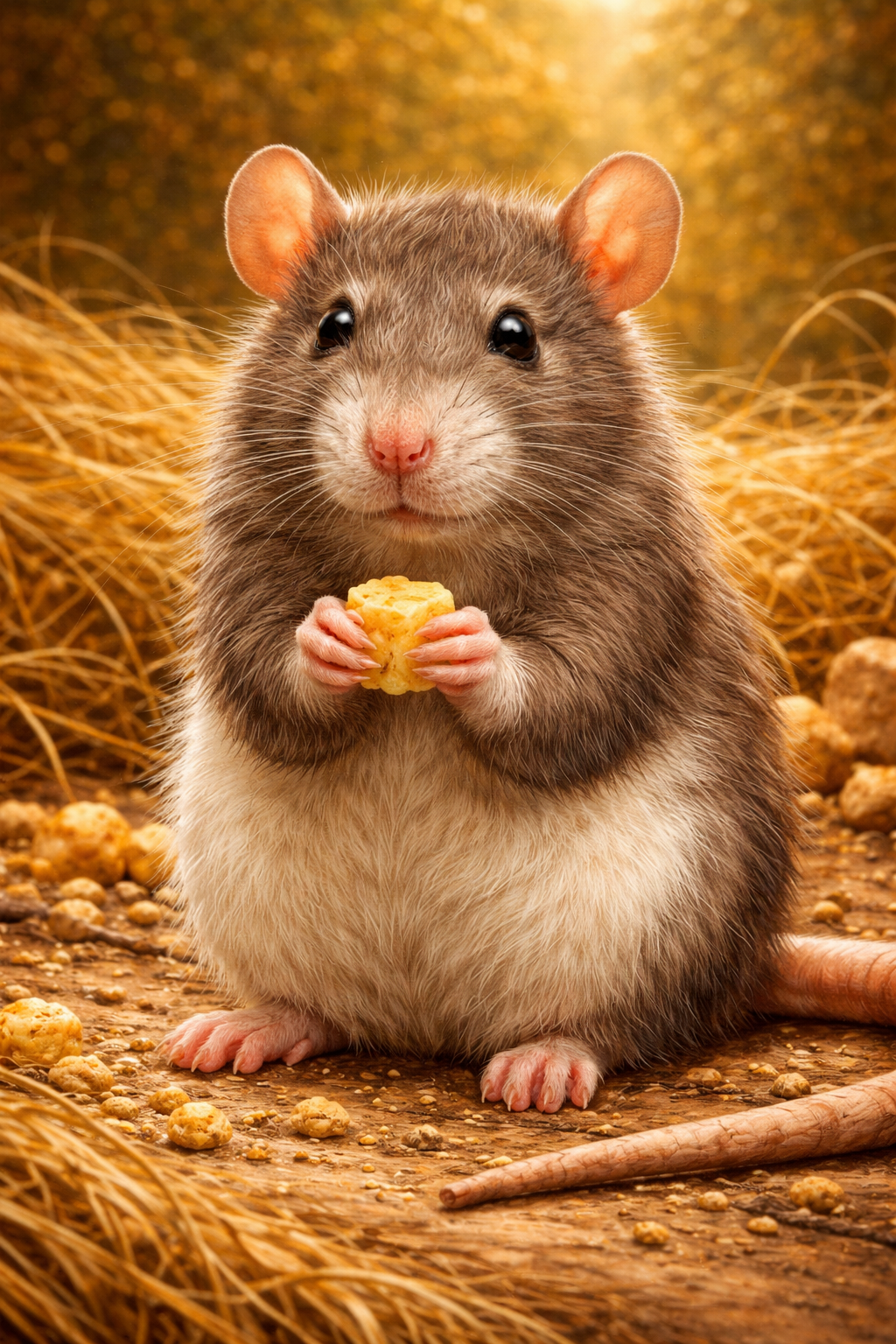
Rats laugh at 50kHz — ultrasonic giggles inaudible to humans, triggered by play and tickling. They are highly social, genuinely affectionate, and among the most intelligent small pets. At 18 months they are already middle-aged.
Rats age much faster than humans, especially in their first year. The rate of ageing slows somewhat after year one, but a 2-year-old rat is already in the senior category.
Rat Age
Human Equivalent
Life Stage
What's Happening
1 month
~2 yrs
Kitten (pup)
Eyes open at 2 weeks; weaned at 3–4 weeks
2 months
~8 yrs
Juvenile
Sexual maturity approaching (5–6 weeks in females)
3 months
~14 yrs
Adolescent
Fully grown body; personality establishing
6 months
~18 yrs
Young adult
Prime physical condition; peak energy
1 year
~30 yrs
Adult
Fully mature; may show first signs of age in less active breeds
18 months
~45 yrs
Middle age
Slowing slightly; tumour risk increases
2 years
~60 yrs
Senior
Senior; quality of life care becomes priority
3 years
~80 yrs
Elder
Elder; exceptional longevity for the species
7 yrs 4 mo
~100+ yrs
World record
Rodney — Guinness World Record
🐀 The Guinness World Record for the oldest rat was Rodney, owned by Rodney Mitchell of Tulsa, Oklahoma, USA, who lived to 7 years and 4 months and died in May 1990. Most pet rats live 2–3 years, with well-cared-for individuals reaching 3.5–4 years. Wild brown rats (Rattus norvegicus) typically live around 1 year in nature due to predation, disease, and environmental pressures. Females tend to live slightly longer than males in captivity on average.
🤝 Rats Must Never Live Alone — It's a Welfare Issue
Rats are highly social colony animals. A rat kept alone will experience chronic stress that manifests as stereotypic behaviours (repetitive pacing, bar-chewing), reduced immune function, higher rates of tumour development, and measurably shorter lifespan. Switzerland made it illegal to keep a rat alone in 2008 — one of the first countries to codify the social needs of a small pet into law. The minimum is a bonded pair; a group of 2–4 same-sex rats is ideal. Introductions require a quarantine period and neutral-territory introductions, but rats generally accept new companions readily, unlike some other rodents. If one rat in a pair dies, the surviving rat should ideally be introduced to a new companion as soon as practically possible.
Fascinating Facts
Things About Rats That Will Actually Surprise You
🧠 Metacognition — Knowing What You Don't Know
In a landmark study, rats demonstrated metacognition — the ability to assess their own uncertainty. Presented with a difficult discrimination task, rats chose to decline the test (accepting a smaller certain reward) rather than attempt a test they were likely to fail. This had previously been thought to require higher-order cognition seen only in primates and some birds. Further research has shown rats demonstrate regret — measurable neural and behavioural signatures of having made the wrong choice — and plan for the future in ways that suggest mental time travel.
😄 Rats Laugh — Ultrasonically
Rats produce ultrasonic vocalisations at 50 kHz during play and tickling that are functionally analogous to laughter — they are pleasure calls associated with positive emotional states. Researcher Jaak Panksepp discovered that young rats actively seek out tickling and produce these calls in anticipation of play. Rats also produce distinct distress calls at 22 kHz. The 50 kHz call is used by rat keepers as a positive welfare indicator — a rat that chirps during handling and play is communicating contentment. These calls are inaudible to humans without specialist equipment.
❤️ Empathy Toward Other Rats
In a now-famous 2011 study at the University of Chicago, free rats chose to free their cagemates from restraint — ignoring a container of chocolate chips (a preferred food) to first release a trapped companion, then share the chocolate. This was the first demonstration of empathy-driven helping behaviour in rodents. Subsequent studies showed rats are more likely to help other rats they know, and that stressed rats show measurable physiological responses (mirroring) when they witness another rat in pain — a phenomenon called emotional contagion.
💊 Medical Hero — Mine Detection
African giant pouched rats (Cricetomys ansorgei) have been trained by the Belgian NGO APOPO to detect landmines and tuberculosis bacteria by scent. A rat can screen a 200m² field for mines in 30 minutes — a task that would take a human with a metal detector 4 days. They are light enough not to trigger mines and are trained using a clicker-based system. The same rats can detect tuberculosis in sputum samples with higher sensitivity than standard microscopy. These "HeroRATs" have helped clear over 100,000 landmines across Mozambique, Angola, Cambodia, and Zimbabwe.
🧭 Spatial Memory Rivals Primates
Rats have place cells and grid cells in their hippocampus — the same neural system that underlies spatial navigation in humans and other mammals. John O'Keefe's discovery of place cells in rats (alongside May-Britt and Edvard Moser's grid cells) won the 2014 Nobel Prize in Physiology or Medicine. Rats construct detailed mental maps of their environment and can navigate novel shortcuts and detours — evidence of a cognitive map rather than simple route memorisation. Their spatial memory is comparable to that of much larger-brained mammals.
🦷 Self-Sharpening, Constantly Growing Teeth
Rat incisors grow continuously throughout life — approximately 2mm per week — and never stop. The outer surface is hard orange-pigmented enamel (the colour comes from iron compounds); the inner surface is softer dentine. Because the outer surface wears more slowly, the teeth naturally self-sharpen to a chisel edge. A rat deprived of things to gnaw will develop overgrown incisors that can cause serious injury. Rats are compelled to gnaw — it is not a behaviour to discourage but a biological necessity to manage. Providing safe gnawing materials is one of the most fundamental enrichment needs.
🐀 Rats are one of the most extensively studied mammals in biomedical research — their physiology, genetics, and cognitive processes are remarkably similar to humans in many key respects. Approximately 95% of all laboratory animals used in research are rats or mice. The rat genome was fully sequenced in 2004 and has since enabled thousands of studies into cancer, cardiovascular disease, addiction, depression, and neurological conditions. The same intelligence and social complexity that makes them excellent research subjects also makes them exceptional pets — they are genuinely curious about the world, recognise their owners, and can learn their names.
A 2-year-old rat is roughly equivalent to a 60-year-old human — firmly in senior territory for this species. By this point a rat may be showing visible signs of age: reduced activity, some greyening around the muzzle, and increased susceptibility to the health issues common in older rats (respiratory infections, tumours, hind limb degeneration). A 2-year-old rat who is healthy and active has been very well cared for, and with continued attentive care may have another 6–18 months ahead. Quality of life — warmth, easy access to food and water, comfortable sleeping spots, gentle handling, and companionship — becomes the priority.
The three most common health issues in pet rats are respiratory infections (mycoplasmosis), tumours, and hind limb degeneration (HLD). Mycoplasmosis, caused by Mycoplasma pulmonis, is endemic in most rat populations and causes chronic respiratory disease — rats with recurring sneezing, laboured breathing, or a crackling sound ("rattling") should see a vet. Tumours are extremely common in domestic rats, particularly in females — mammary tumours are the most frequent type and are often benign but grow quickly. Surgical removal is often straightforward and successful if caught early. HLD is a progressive neurological condition causing weakness and paralysis of the hind limbs, typically appearing in rats over 18 months; it is not painful but requires environmental adaptations as it progresses.
Rats are omnivores with highly varied nutritional needs. The best base diet is a high-quality rat block or pellet (not a seed mix — rats selectively eat the high-fat components of seed mixes, leaving the nutritious parts). This should be supplemented daily with a small amount of fresh food: cooked chicken, egg, fish, small amounts of grain or cooked pasta, and a variety of fresh vegetables and occasional fruit. Protein should make up around 14–16% of the diet for adults (higher for young or pregnant rats). Foods to avoid include citrus (can cause kidney damage in males), raw sweet potato, blue cheese, raw beans, and green parts of potatoes. Fresh water should always be available — preferably from both a bottle and a bowl to accommodate different drinking preferences.
Yes — rats are naturally clean animals that prefer to defecate in specific locations. Litter training takes advantage of this natural tendency. Place a small litter tray (a corner tray works well) in the area of the cage where they already toilet most frequently, fill it with a different substrate to the bedding (paper-based cat litter works well — avoid clay or clumping litters), and place a few droppings in it to encourage association. Most rats will begin using it reliably within a few days. Litter-trained rats also tend to use designated spots during free-roaming time. This significantly reduces cage cleaning frequency and makes out-of-cage time much more practical.
Fancy rats are domesticated descendants of the brown rat (Rattus norvegicus), selectively bred for temperament, colour, and coat type over around 200 years. The first recorded fancy rat keeper was Jack Black, rat catcher to Queen Victoria in the 1840s, who began selectively breeding unusual-coloured rats he caught. Fancy rats are smaller, calmer, more trusting of humans, and available in dozens of colour varieties (including albino, agouti, black, blue, and many more) and coat types (standard, rex, satin, hairless, dumbo). Wild brown rats are considerably more wary of humans and more physically robust. Despite centuries of selective breeding, fancy rats retain essentially all of the cognitive sophistication of their wild counterparts — it is only temperament and appearance that have been selectively shaped.