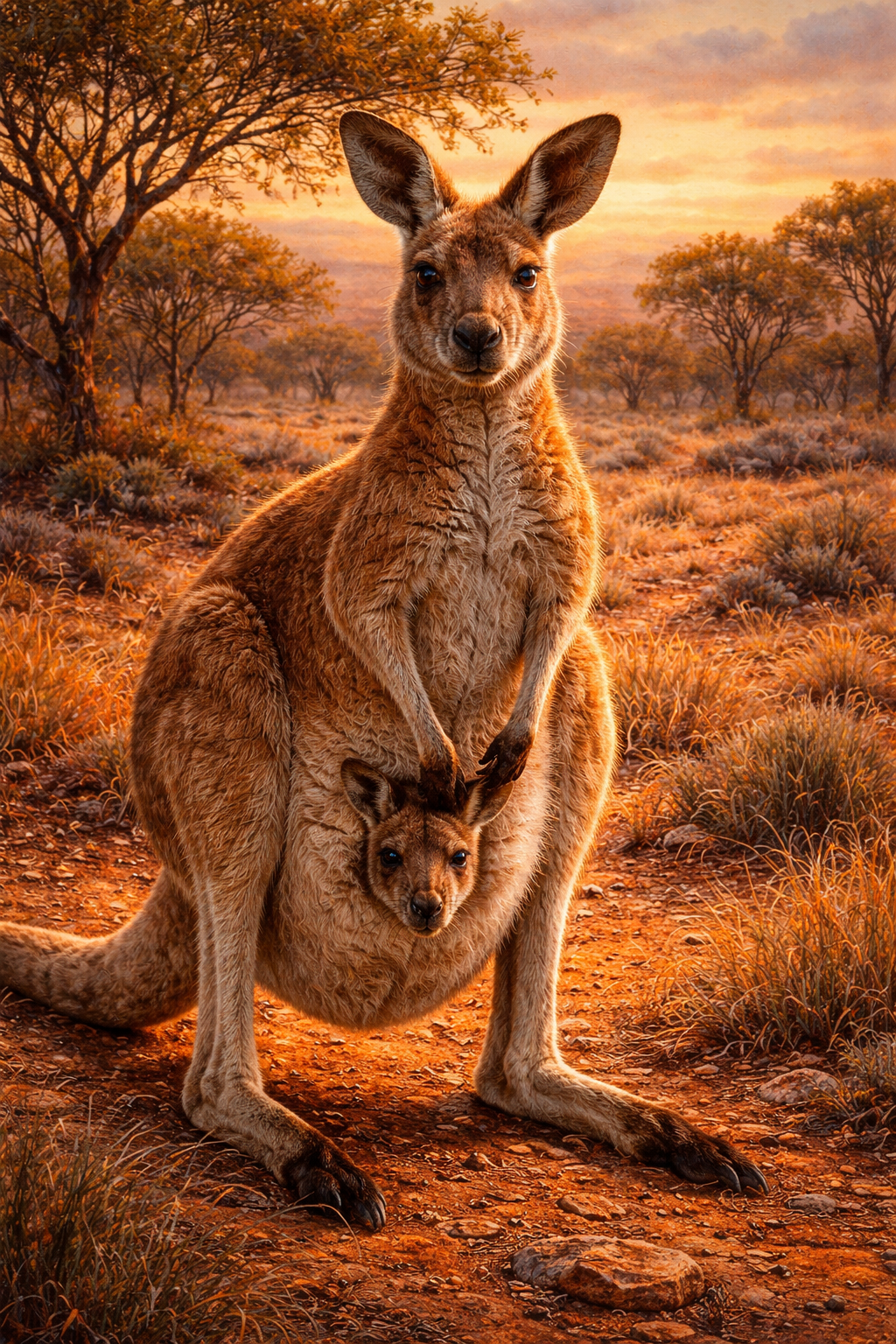
📅 Updated 🔬 All 4 species covered🦘 50 million in Australia
A kangaroo is born the size of a jellybean and climbs unaided into the pouch. A female can carry three joeys at different life stages simultaneously. A red kangaroo gets more efficient the faster it runs. And they are Australia's most numerous large mammal — by a factor of two.
"Kangaroo" refers specifically to the four largest members of the family Macropodidae. All four are found in Australia; one (the antilopine) also ranges into New Guinea. They are distinct species separated by habitat, colouration, size, and behaviour.
🦘 Red Kangaroo
Osphranter rufus
Wild lifespan12–18 yrs
Max size (male)1.8m tall; 90 kg
HabitatArid / semi-arid interior
StatusLeast Concern
🦘 Eastern Grey
Macropus giganteus
Wild lifespan10–20 yrs
Max size (male)1.7m tall; 66 kg
HabitatEastern Australia — woodland/grassland
StatusLeast Concern
🦘 Western Grey
Macropus fuliginosus
Wild lifespan10–15 yrs
Max size (male)1.6m tall; 54 kg
HabitatSouthern/western Australia
StatusLeast Concern
🦘 Antilopine Kangaroo
Osphranter antilopinus
Wild lifespan~10 yrs
Max size (male)1.8m tall; 70 kg
HabitatTropical monsoonal N. Australia
StatusLeast Concern
Age Chart
Red Kangaroo Age to Human Years
Age
Human Equivalent
Life Stage
What's Happening
Birth (day 0)
~Newborn
Neonate
0.75g, 2.5cm — climbing to pouch
4 months
~2 yrs
Pouch joey
Eyes open; fur appearing; still in pouch
8 months
~5 yrs
Joey
First exits from pouch; returns when alarmed
1 year
~9 yrs
Juvenile
Fully weaned; independent but stays near mob
2 years
~16 yrs
Sub-adult
Growing rapidly; approaching sexual maturity
3 years
~22 yrs
Young adult
Sexually mature; females may have first joey
6 years
~38 yrs
Prime adult
Full size in males; peak reproductive success
10 years
~55 yrs
Mature
Senior male; still breeding but dominance declining
15+ years
~68 yrs
Elder
Very old in wild terms; exceptional survival
🦘 A remarkable feature of kangaroo reproduction is embryonic diapause — a female can have three joeys at different life stages simultaneously: a juvenile at foot still occasionally suckling, a young pouch joey attached to a nipple, and a dormant blastocyst (fertilised egg) on pause in the uterus. The blastocyst only resumes development when the pouch joey exits. If conditions deteriorate — drought, food shortage — the female can terminate the blastocyst's development, pausing reproduction until conditions improve. This is one of the most sophisticated reproductive systems of any mammal.
Life Stages
The Life Stages of a Kangaroo
Kangaroo development is among the most extraordinary in the mammal world. They are born at an almost embryonic stage — climbing unaided into the pouch to complete development externally. The pouch is a second womb, and the joey's transformation inside it — from a 0.75g blind jelly-bean to a fur-covered, fully formed joey — is one of the most remarkable developmental stories in biology.
Birth–1 day
Embryonic Joey
Born after just 33 days gestation — 0.75g, blind, hairless, hind limbs undeveloped. Front limbs and claws fully formed. Crawls unaided 15cm through the mother's fur to the pouch in approximately 3 minutes — one of the most remarkable feats of any newborn animal. The mother licks a trail through her fur to guide the journey.
0–6 mo
In-pouch Joey
Attached to a teat that swells in the mouth to lock it in place. Eyes, ears, and limbs develop in sequence. First fur appears around 4 months. Meanwhile, a second embryo (blastocyst) may be held in diapause — paused and waiting for this joey to leave the pouch before development resumes.
6–12 mo
At-foot Joey
Beginning to exit the pouch for short excursions — often returning head-first with legs dangling comically outside. Still nursing from the pouch teat. Increasingly exploratory but returns to the pouch at any alarm. The mother can simultaneously produce two different milk compositions from two different teats for two joeys at different stages.
12–18 mo
Juvenile
Permanently out of the pouch. Still occasionally nursing. Learning mob dynamics, water source locations, seasonal movement patterns, and predator alarm signals from older mob members. This knowledge transfer from experienced adults is critical for survival.
18 mo–3 yrs
Sub-adult
Approaching sexual maturity — females around 18 months, males 2 years. Males begin establishing dominance through ritualised boxing and grappling. The Achilles tendons are developing the elasticity that will define their adult locomotion efficiency. Still growing substantially in body mass.
3–10 yrs
Prime Adult
Full size and social establishment. Dominant boomers weigh 80–90 kg and stand 1.8m — the largest marsupials on Earth. Females cycle through successive joeys with extraordinary reproductive efficiency. This is the peak of the kangaroo's physical and social power.
10–28 yrs
Senior / Elder
Male kangaroos grow throughout their entire lives — so the oldest males are often the largest and most dominant. They carry irreplaceable spatial memory of water sources, drought refuges, and seasonal routes. The oldest captive kangaroo reached 28 years. Wild elders are extraordinary survivors of drought, predation, and Australia's harsh interior.
Fascinating Facts
Things About Kangaroos That Will Actually Surprise You
⚡ More Efficient the Faster They Go
Every other large land animal — horses, dogs, humans — uses more energy per kilometre the faster it moves. Kangaroos are the sole exception among large mammals. The Achilles tendon acts as a biological spring, storing elastic energy on each landing and releasing it on the next bound. Above approximately 15 km/h, the energy recovered from the tendon exceeds the muscular energy input — meaning energy cost per kilometre actually drops as speed increases. A 2019 study in Science confirmed the kangaroo's hopping gait is among the most energetically efficient locomotion strategies of any animal. At 40 km/h a kangaroo uses less fuel than at 20. A red kangaroo can sustain 40–45 km/h indefinitely and reach 70 km/h in short bursts, covering 9 metres per leap. The tradeoff: they cannot reverse or walk slowly — efficiency only kicks in above the threshold.
🥊 Tail-Balancing Kick Combat
Male kangaroos fight by grappling with their forelimbs, shifting their full body weight onto their tail as a third support leg, and delivering simultaneous two-footed kicks with both hind legs. The kick uses the full mechanical force of their leg muscles and reinforced tendons — powerful enough to disembowel a rival or eviscerate a pursuing dog. This combat posture — tail-stand, forelimb lock, double kick — is unique to macropods and represents a highly specialised fighting technique. The tail's role as a fifth limb (also used for slow "pentapedal" locomotion when grazing) takes on its most extreme form in these fights. Large boomers develop massively muscled chests and forearms from years of sparring — in older dominant males, this musculature can be as visually striking as the silverback of a gorilla.
💧 Outback Survival — Forearm Licking & Diapause
Red kangaroos survive in some of Earth's harshest arid environments through a suite of remarkable adaptations. They lick their forearms — which have a dense network of superficial blood vessels — to cool circulating blood through evaporative cooling, a highly efficient thermoregulation method. They are largely crepuscular and nocturnal, avoiding peak midday heat. They extract moisture from vegetation and can survive extended periods without free water. Most extraordinarily, during severe drought, females terminate their dormant blastocyst's development entirely via embryonic diapause — pausing reproduction until conditions improve. According to Australian Government wildlife data, this makes kangaroos among the most drought-resilient large mammals on Earth.
👶 Born at 0.75g — The Jellybean Journey
After just 33 days of gestation — shorter than any eutherian mammal of comparable adult size — the red kangaroo joey is born weighing 0.75 grams (approximately the weight of a raisin) and measuring 2.5cm. It is born blind, hairless, and with vestigial hind limbs. But its forelimbs and claws are fully formed and functional — it uses them to crawl unaided through the mother's fur from the birth canal to the pouch over approximately 3 minutes, navigating entirely by smell and gravity. Inside the pouch it finds a teat, locks onto it (the teat swells inside its mouth to secure the attachment), and begins the external gestation phase that will last 6–8 months. The biology of marsupial reproduction represents one of the most elegant evolutionary solutions to the challenge of live birth in challenging environments.
🌿 Mob Dynamics — Collective Intelligence
Kangaroos live in mobs of 10–100 individuals. Mob structure is fluid — composition shifts seasonally and with resource availability. Critically, mobs provide collective predator surveillance: each individual can spend less time scanning for threats because the group collectively maintains vigilance. When alarmed, kangaroos thump the ground with powerful hind feet — a signal that carries through the earth and warns the entire mob. Older males carry accumulated spatial knowledge of their range: water sources, shade refuges, escape routes, seasonal food distribution. This knowledge is not genetically transmitted — it is learned and represents a genuine form of cultural information in the mob. The IUCN classifies all four kangaroo species as Least Concern, partly due to this social resilience.
🔢 50 Million Kangaroos — More Than People
Australia's kangaroo population is estimated at 42–50 million — roughly double the human population — according to Australian Government monitoring. This is partly a consequence of European agricultural development: permanent water sources (stock troughs, dams) and cleared grassland have significantly improved kangaroo habitat over the past 200 years. Under a federal government quota system, approximately 1.5–2 million kangaroos are commercially harvested annually for meat and leather — making Australia the only country that commercially harvests its national emblem animal. Kangaroo meat is exceptionally lean (under 2% fat), high in protein, and produces a fraction of the methane emissions of cattle — it is increasingly promoted as a sustainable protein source.
Reproductive Biology
Three Joeys at Once — Embryonic Diapause Explained
🦘 A female red kangaroo can simultaneously carry three offspring at entirely different life stages: a juvenile at foot still occasionally nursing, a pouch joey attached to a teat, and a dormant blastocyst (fertilised egg, paused at 100 cells) in the uterus. This is embryonic diapause — one of the most sophisticated reproductive systems of any mammal.
Immediately after giving birth, the female mates again. The resulting embryo develops to the blastocyst stage — around 100 cells — and then pauses. It enters a state of suspended animation, held there by hormonal signals from the active pouch joey's suckling. As long as the joey is nursing, the blastocyst waits.
When the pouch joey grows large enough to leave, suckling decreases, the hormonal brake releases, and the blastocyst resumes development. It is born approximately 33 days later — just as the pouch becomes vacant. The system is a biological production line that maximises reproductive output while never overwhelming the mother's resources.
The drought override is the most extraordinary feature: if food or water becomes critically scarce, the female can terminate the dormant blastocyst entirely by reabsorbing it. Reproduction pauses until conditions improve. When the drought breaks, she mates again. This gives kangaroos a reproductive flexibility that no eutherian (placental) mammal possesses — they can ramp reproduction up or down in response to environmental conditions within weeks.
📊 The Three-Stage System
Stage 1: Dormant blastocyst (~100 cells) paused in uterus. Stage 2: Pouch joey attached to teat, developing over 6–8 months. Stage 3: At-foot juvenile still occasionally nursing from a different teat producing different-composition milk simultaneously. The mother's body produces two different milk types from two different nipples at the same time — each calibrated to the developmental stage of the joey using it.
🔬 The Science Behind It
Embryonic diapause is regulated by prolactin — the same hormone that suppresses ovulation in nursing human mothers. In kangaroos, prolactin from the pouch joey's suckling holds the blastocyst in stasis. The mechanism was first described in detail by reproductive biologists studying Australian marsupials in the 1950s–60s and remains one of the most studied examples of hormonally regulated reproductive pause in any vertebrate.
🌧️ Drought Response
During severe drought, a female kangaroo can permanently terminate the dormant blastocyst by reabsorbing it — effectively pausing reproduction until conditions improve. This is the inverse of the normal system: rather than waiting for a joey to leave the pouch, the female actively shuts down the waiting embryo. When the drought breaks and food availability recovers, she mates again within weeks. This drought-responsive reproductive system is one reason kangaroos have thrived in Australia's unpredictable climate for millions of years.
Marsupial Comparison
Kangaroos Among the Marsupials
Kangaroos belong to the order Diprotodontia — the largest order of marsupials. Here's how they compare to other well-known marsupials across key biological metrics.
Species
Gestation
Wild Lifespan
Adult Weight
Range
IUCN Status
Red KangarooOsphranter rufus
33 days
12–18 yrs
Up to 90 kg
Arid/semi-arid Australia
Least Concern
Eastern Grey KangarooMacropus giganteus
36 days
10–20 yrs
Up to 66 kg
E. Australia, Tasmania
Least Concern
Common WombatVombatus ursinus
20–21 days
~15 yrs
25–40 kg
SE Australia, Tasmania
Least Concern
KoalaPhascolarctos cinereus
35 days
13–18 yrs
4–15 kg
E. and SE Australia
Vulnerable
Tasmanian DevilSarcophilus harrisii
21 days
~6 yrs
6–14 kg
Tasmania only
Endangered
QuokkaSetonix brachyurus
27 days
~10 yrs
2.5–5 kg
SW W. Australia, Rottnest Is.
Vulnerable
Virginia OpossumDidelphis virginiana
13 days
1–2 yrs
0.5–6 kg
North & Central America
Least Concern
🦘 The Virginia Opossum has the shortest gestation of any marsupial — just 13 days — and the shortest lifespan of any mammal of its size. The red kangaroo, at 90 kg, is the largest marsupial alive today. The extinct Diprotodon optatum — a giant wombat relative the size of a rhinoceros — was the largest marsupial that ever lived, roaming Australia until approximately 40,000–46,000 years ago, when it was likely hunted to extinction by early humans.
Red kangaroos are the world's largest marsupial. Large males (boomers) stand up to 1.8 metres tall and weigh up to 90 kg, with exceptional individuals reaching 100 kg. Females are significantly smaller — typically 25–35 kg and 1.1 metres tall, reflecting one of the most pronounced sexual size dimorphisms of any mammal. Eastern grey kangaroos are slightly lighter than reds but can be similarly tall. Male kangaroos continue growing throughout their lives, so very old males are also typically the largest animals in a mob — size is a direct indicator of both age and dominance. A dominant boomer at peak size is an impressive animal by any measure.
The primary natural predators of kangaroos are dingoes (Canis lupus dingo), which hunt cooperatively and primarily target juveniles, females, and sick or injured adults. Wedge-tailed eagles (Aquila audax) — Australia's largest bird of prey — take joeys and juveniles. Goannas and other large lizards raid pouches and take small joeys. Before European colonisation, Tasmanian tigers (thylacines) and marsupial lions were likely significant kangaroo predators, but both are now extinct. Today, vehicle strikes are one of the leading causes of kangaroo mortality, particularly along country roads at dawn and dusk when kangaroos are most active. The decline of dingo populations in some regions due to culling has led to kangaroo population explosions in those areas.
Yes — kangaroos are capable swimmers and will enter water readily when pursued or during extreme heat. In water, they use an alternating leg movement rather than their usual hopping gait. They are strong enough swimmers to potentially drown pursuing dogs by holding them underwater with their forepaws — a defensive behaviour that has been documented. Kangaroos have been observed swimming across rivers and coastal inlets in Australia. While they don't naturally frequent water, they are not limited by it.
This is a common misconception that conflates male and female anatomy. Male kangaroos have one penis. Female kangaroos have three vaginas — two lateral vaginas through which sperm travel, and a central pseudo-vagina (birth canal) through which joeys are born. They also have two uteri. This is the standard marsupial female reproductive anatomy, not something specific to kangaroos. The "two penises" claim is incorrect; it may arise from confusion about the bifurcated penis of some other marsupials like the short-beaked echidna. Male kangaroos also have a bifurcated (forked) glans penis in some species, which may contribute to the confusion.