Popular Pets
🐶 Dog 🐱 Cat 🐰 Rabbit 🐹 Hamster 🐾 Guinea Pig 🦜 Parrot 🦡 Ferret 🐀 Rat 🐭 Chinchilla 🦔 Hedgehog 🐟 Goldfish 🦜 Macaw
Farm & Large Animals
🐴 Horse 🐄 Cow 🐄 Highland Cow 🐷 Pig 🐑 Sheep 🐐 Goat 🐴 Donkey 🦙 Alpaca 🐐 Mountain Goat 🐔 Chicken 🦆 Duck 🦃 Turkey
Wild Animals
🐘 Elephant 🦁 Lion 🐯 Tiger 🐆 Leopard 🐺 Wolf 🐻 Bear 🐻‍❄️ Polar Bear 🦍 Gorilla 🐒 Chimpanzee 🦧 Orangutan 🦘 Kangaroo 🐾 Capybara 🦒 Giraffe 🦊 Fox 🦅 Raptor 🦉 Owl 🐧 Penguin 🦩 Flamingo 🐾 Hyena 🐾 Meerkat 🦥 Sloth 🦡 Badger 🐾 Wolverine 🐾 Armadillo
Ocean & Aquarium
🦈 Shark 🐋 Orca 🐬 Dolphin 🐋 Whale 🐋 Blue Whale 🐳 Beluga Whale 🦄 Narwhal 🐋 Bowhead Whale 🐾 Manatee 🐟 Manta Ray 🐟 Freshwater Fish 🐠 Saltwater Fish 🐴 Seahorse 🐟 Koi
Exotic & Weird
🐍 Snake 🐍 Ball Python 🦎 Bearded Dragon 🦎 Iguana 🦎 Komodo Dragon 🦎 Chameleon 🦎 Leopard Gecko 🐢 Tortoise 🐢 Snapping Turtle 🐢 Sea Turtle 🐊 Crocodilian 🕷️ Tarantula 🦎 Axolotl 🐙 Octopus 🌊 Jellyfish 🦞 Lobster 🐚 Quahog 🔬 Tardigrade
Info
About FAQ Contact
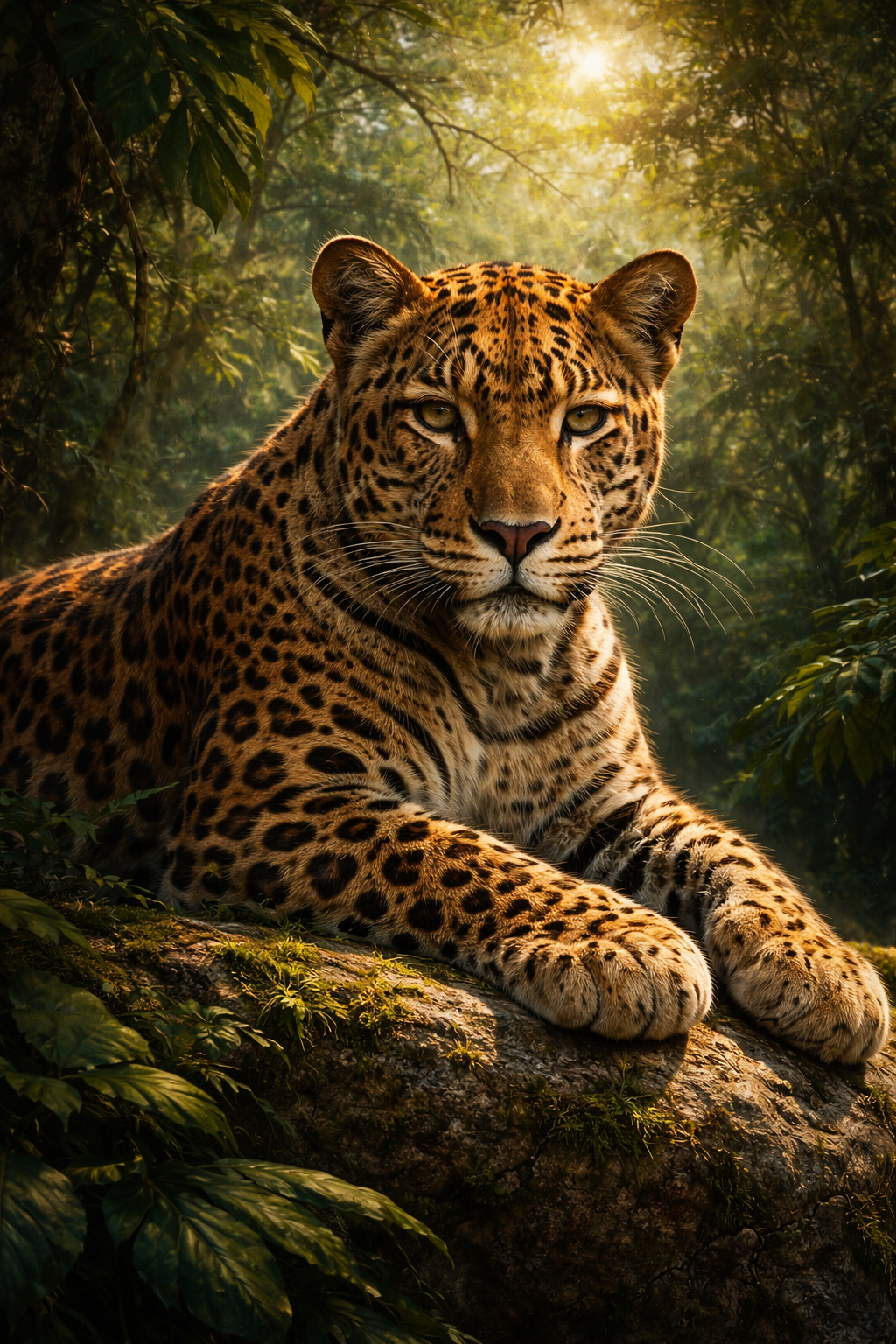
Leopard resting on a mossy rock in a jungle, staring directly at the viewer
🐆 Wild Animals

How Old Is a Leopard in Human Years?

📅 Updated 🔬 Wild & captive data 🐆 Leopard vs Jaguar vs Panther

The leopard is the most adaptable of the big cats — found from sub-Saharan Africa to the Russian Far East, from rainforest to desert. It is also the most persecuted. Some subspecies have fewer than 100 individuals left. A 10-year-old wild leopard is already in the final chapter.

Calculate Leopard Age →
🐆 Leopard Age in Human Years
in human years
Animal age
Life stage
Species
🐆 What this age means

Leopard vs Black Panther vs Jaguar

All three are frequently confused — and the black panther in particular is widely misunderstood. Here's how they actually compare.

🐆
Leopard
Panthera pardus
RangeAfrica & Asia
Weight30–90 kg
Wild lifespan10–15 years
IUCN statusVulnerable
RosettesOpen, no inner spots
Key traitClimbs with kills; solitary
🖤
Black Panther
Panthera pardus or P. onca
What it isMelanistic leopard or jaguar
Gene typeRecessive (leopard) / dominant (jaguar)
LifespanIdentical to base species
Spots visible?Yes — in direct light
Own species?No — colour variant only
Most common inSE Asia (leopard), S. America (jaguar)
🐆
Jaguar
Panthera onca
RangeAmericas (mainly Amazon)
Weight55–100 kg
Wild lifespan10–12 years
IUCN statusVulnerable
RosettesHave spots inside them
Key traitPowerful swimmer; ambush predator
🖤 What is a black panther, really?
A black panther is not a separate species. It is a melanistic (dark-pigmented) individual of either a leopard or a jaguar. The dark colouration comes from a condition called melanism — excess production of the pigment melanin, causing the normally golden/tawny coat to appear black. The spots are still there — they are visible as darker patterns within the black coat under certain lighting, called "ghost spots." In leopards, melanism is caused by a recessive gene mutation; in jaguars, it is caused by a dominant gene, making it more common in jaguar populations. The two can appear in the same litter as their spotted siblings. Black panthers in Africa and Asia are melanistic leopards; those in the Americas are melanistic jaguars. Their lifespan, behaviour, diet, and territory size are identical to non-melanistic individuals of the same species.

Nine Subspecies — From 250,000 to Fewer Than 100

The leopard (Panthera pardus) has nine recognised subspecies ranging from the abundant African leopard to the critically endangered Amur and Arabian leopards. The divergence between them illustrates both the species' adaptability and the uneven pressure of human encroachment across its range.

SubspeciesRangeEst. PopulationIUCN Status
African Leopard (P. p. pardus)Sub-Saharan Africa~250,000–700,000Vulnerable
Indian Leopard (P. p. fusca)Indian subcontinent~12,000–14,000Vulnerable
Javan Leopard (P. p. melas)Java, Indonesia~250–350Critically Endangered
Arabian Leopard (P. p. nimr)Arabian Peninsulafewer than 200Critically Endangered
Amur Leopard (P. p. orientalis)Russian Far East, NE China~100–110Critically Endangered
Persian Leopard (P. p. saxicolor)Central Asia, Iran~871–1,290Endangered
North Chinese Leopard (P. p. japonensis)Northern Chinaunknown — very lowVulnerable
Indochinese Leopard (P. p. delacouri)Southeast Asia~973–2,503Critically Endangered
Sri Lankan Leopard (P. p. kotiya)Sri Lanka~700–950Vulnerable

🐆 The Amur leopard is one of the rarest wild cats on Earth — with only around 100 individuals remaining in the Russian Far East and northeast China, it has been called the world's most endangered big cat. By contrast, the African leopard remains relatively widespread, though populations are declining across its range due to habitat loss, prey depletion, and human-wildlife conflict. The IUCN lists the species overall as Vulnerable, with population trend: decreasing.

Leopard Age to Human Years

AgeWild LeopardCaptive LeopardWild JaguarLife Stage
1 year~7 yrs~5 yrs~7 yrsCub / sub-adult
2 years~14 yrs~9 yrs~14 yrsYoung adult / dispersal
3 years~22 yrs~13 yrs~22 yrsEstablishing territory
5 years~35 yrs~22 yrs~36 yrsPrime adult
8 years~52 yrs~33 yrs~54 yrsMature
10 years~63 yrs~40 yrs~67 yrsSenior (wild)
13 years~80 yrs~51 yrsElderElder (wild)
17 yearsRecord+~65 yrsSenior (captive)
23 years~88 yrsRecord territory

🐆 The oldest documented wild leopard was a female in Kruger National Park, South Africa, estimated at over 17 years — remarkable given that most wild leopards die from starvation (tooth wear), territorial conflict, or human-wildlife conflict before age 12. The oldest captive leopard on record lived to 23 years. Captive jaguars have reached 22 years. The enormous lifespan gap between wild and captive individuals reflects the brutal attrition of territorial competition, injury, and food insecurity in the wild.

The Life Stages of a Leopard

Leopards are solitary from early adulthood and must establish their own territory before they can begin reproducing — a dangerous and often fatal process in areas where territories are already claimed. A leopard's life is defined by secrecy, adaptability, and the constant management of a vast, overlapping home range.

0–3 mo
Cub
Born blind in litters of 1–3, hidden in dense cover. Mother moves cubs frequently to avoid predators. Cubs begin following mother at 3 months. Mortality is very high — lions, hyenas, and male leopards all pose lethal threats.
3–12 mo
Juvenile
Learning to hunt by accompanying mother. Beginning to develop adult coat and rosette pattern. Still fully dependent — a cub orphaned at this stage rarely survives without intervention.
12–24 mo
Sub-adult
Increasingly independent but still within maternal range. Beginning to test territory boundaries. Males start to disperse — sometimes travelling hundreds of kilometres before establishing their own range.
2–6 yrs
Young Adult
Establishing territory. First reproduction for females at around 2.5–3 years. Males compete intensely for range — fights can be fatal. This is the highest-risk period of a leopard's life outside cubhood.
6–12 yrs
Prime Adult
Peak physical condition. Established territory. Experienced hunter capable of taking prey up to 3× their own bodyweight. Dominant individuals in their range. Most productive reproductive years.
12–17 yrs
Senior
Slowing physically. Harder to defend territory against younger rivals. Tooth wear reduces hunting efficiency on large prey — sometimes shifting to smaller animals or livestock, increasing human conflict risk.

Things About Leopards That Will Actually Surprise You

🌍 The Most Widespread Big Cat
The leopard has the largest range of any wild cat — from sub-Saharan Africa through the Middle East, South Asia, and Southeast Asia to the Russian Far East. They inhabit rainforests, deserts, mountains, savannas, and suburban fringes. This adaptability makes them the most successful of the big cats at living alongside humans — but it also makes their decline harder to track. While the African leopard is Vulnerable, several Asian subspecies are Critically Endangered, with the Amur leopard numbering only around 100 wild individuals.
🌳 Hoisting Kills Into Trees
Leopards are renowned for carrying prey heavier than themselves up into trees to protect kills from lions, hyenas, and wild dogs. A leopard weighing 60 kg has been documented hoisting a 90 kg impala carcass up 6 metres into an acacia tree. This feat is made possible by exceptionally powerful neck and shoulder muscles. The habit also demonstrates sophisticated planning — a leopard that fails to cache its kill risks losing it entirely to competitors that vastly outnumber and outweigh it.
🌑 Melanism — The Black Panther Gene
Black panthers are significantly more common in dense rainforest environments — in the Malay Peninsula, an estimated 50% of leopards are melanistic. In open savanna environments, melanism is rare. The leading hypothesis is that dark colouration provides better camouflage in low-light, dense vegetation environments. Crucially, melanistic leopards in the same habitat as spotted leopards do not appear to have different territory sizes, prey preferences, or reproductive success — the trait appears to be genuinely neutral in most contexts.
🔊 Sawing Call
The leopard's primary territorial call is a rasping, rhythmic cough described as the sound of a saw cutting through wood — a sound that carries over 2–3 km through dense bush. It is quite unlike the roaring of lions or tigers. Leopards also produce chuffing sounds during social interactions and purring-like noises with cubs. Their vocalisations are generally more varied and subtle than other big cats, reflecting their more solitary and secretive lifestyle.
🐆 vs 🐆 Spot the Difference
The key to telling leopards and jaguars apart is in the rosettes. Jaguar rosettes contain small black spots inside them — leopard rosettes do not. Jaguars are also significantly more muscular, with broader heads, shorter tails relative to body length, and a stockier build. Jaguars are powerful swimmers and actively enter water; leopards avoid it. The jaguar was once found from the American Southwest to Patagonia; its range has contracted by over 40%. Both are Panthera species, and both can produce melanistic (black panther) offspring.
🏙️ Urban Leopards
Mumbai, India — a city of 20+ million people — is home to an estimated 35–40 leopards living within Sanjay Gandhi National Park, a forest reserve embedded in the urban fabric. These leopards regularly move through residential areas at night. Remarkably, despite this extreme human proximity, leopard attacks on humans are rare — the leopards' primary prey is stray dogs (an estimated 1,500+ stray dogs per year). Research suggests urban leopards may actually reduce human rabies risk by controlling the dog population. Mumbai's leopards are one of the world's most studied examples of urban apex predator coexistence.

🐆 The Amur leopard (Panthera pardus orientalis) of the Russian Far East is the rarest wild cat on Earth. At its lowest, the population fell to approximately 30 individuals in the early 2000s. Intensive conservation — anti-poaching patrols, prey species restoration, corridor protection — has brought the number to approximately 100 wild individuals as of the most recent census, plus a further 180+ in captivity. It is one of conservation's modest successes, though the population remains precariously small and geographically constrained to a narrow strip of coastal Russian territory near the Chinese border.

Other Wild Animals

Frequently Asked Questions

Leopards and cheetahs are commonly confused but are quite distinct. Cheetahs have solid black spots (not rosettes), a more slender greyhound-like build, non-retractable claws (like a dog), distinctive black "tear marks" running from eye to mouth, and are built for speed — not power. Leopards are heavier, more muscular, have rosette patterns, fully retractable claws, and are climbers. Cheetahs are diurnal (day-active); leopards are largely nocturnal. Cheetahs are significantly rarer — approximately 7,000 remain — while African leopards number in the hundreds of thousands (though declining). Cheetahs cannot roar; leopards can. Cheetahs do not hoist kills into trees.
Yes — in direct sunlight or with photographic flash, the rosette pattern is clearly visible through the dark coat as darker shapes within the black. These are called "ghost spots" and are visible to the naked eye under the right lighting conditions. The spots are there — they are simply hidden by the excess melanin produced in the coat. Wildlife photographers in Southeast Asia regularly capture images showing the full rosette pattern of melanistic leopards when light conditions are right. The pattern is identical in placement and structure to that of a spotted leopard of the same individual — it is purely a pigmentation difference, not a structural one.
The overall species (African leopard and general Asian populations) is listed as Vulnerable. However, the picture at the subspecies level is far grimmer. The Amur leopard (Russian Far East) has around 100 wild individuals and is Critically Endangered — the rarest wild cat on Earth. The Arabian leopard (Arabian Peninsula) has fewer than 200 wild individuals and is Critically Endangered. The Persian leopard (Iran/Central Asia) is Endangered. The Sri Lanka leopard is Endangered. The North Chinese leopard is Endangered. The Javan leopard is Critically Endangered with fewer than 350 individuals. The broad Vulnerable listing for the species as a whole obscures the genuine crisis at the subspecies level.
This is the clearest field identification mark. Jaguar rosettes contain one or more small black spots inside the ring — this gives the rosette a more complex, flower-like appearance. Leopard rosettes are plain rings with no interior spots — simpler and more uniform. Jaguars are also significantly stockier and heavier (55–100 kg vs leopard's 30–90 kg), have shorter, broader heads, shorter tails relative to body length, and a more powerful, barrel-chested build. Their geographic ranges do not overlap — leopards are found in Africa and Asia; jaguars in the Americas — so location is also a reliable identifier in the wild.
Both species show remarkable tolerance for human-modified landscapes when prey is available and persecution is low. Mumbai's leopards are the most famous example — dozens of leopards living within one of the world's most densely populated cities. In Africa, leopards regularly use farmland, plantations, and scrubland adjacent to human settlement. In the Amazon, jaguars persist in mosaic landscapes of forest and cattle ranching, though they are frequently killed in retaliation for livestock predation. The primary driver of conflict in both species is livestock predation, which triggers retaliatory killing. Conservation programs that compensate farmers for livestock losses have proven effective at reducing retaliatory killing in multiple countries.