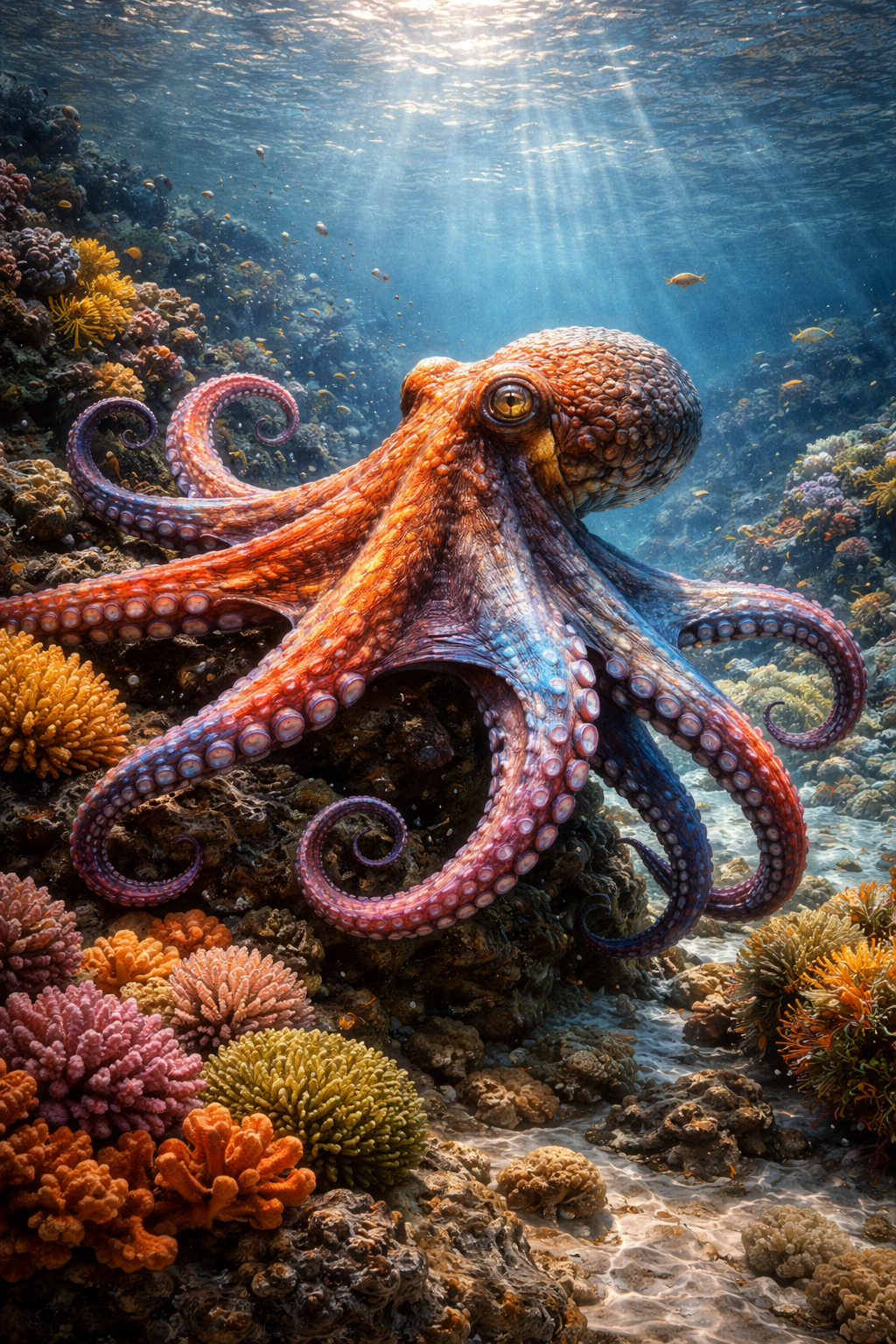
In 2020, Netflix released a documentary that did something almost no nature film had ever done — it made millions of people grieve for the death of a single wild invertebrate.
My Octopus Teacher, directed by Pippa Ehrlich and James Reed, follows South African filmmaker Craig Foster as he free-dives daily in the cold kelp forests of False Bay near Cape Town, South Africa. Over the course of a year, he forms a remarkable relationship with a wild common octopus (Octopus vulgaris) — a small female who, despite having no evolutionary reason to trust a large mammal, gradually allows Foster into her world.
The octopus learns to recognise him. She hides from other predators by draping kelp over herself as camouflage — a tool use behaviour documented on camera. She loses an arm to a pyjama shark, regenerates it, outwits the shark on a subsequent encounter by riding on its back to avoid the striking angle, and eventually — as octopuses do — she lays eggs, guards them without eating, and dies.
The film won the Academy Award for Best Documentary Feature in 2021 and is widely credited with transforming public and scientific awareness of octopus cognition, emotion, and individuality. Craig Foster subsequently co-founded the Sea Change Project to protect the Great African Sea Forest.
If you haven't seen it — watch it. It is one of the most quietly extraordinary films ever made about the natural world.
Octopus Age to Human Years — By Species
Octopuses are among the fastest-developing intelligent animals on Earth. The common octopus reaches sexual maturity at around 6 months — equivalent to a human teenager. Research from The Marine Biological Laboratory and the Monterey Bay Aquarium Research Institute provides the biological basis for these developmental equivalencies.
| Octopus Age | Common Octopus | Giant Pacific | Life Stage |
|---|---|---|---|
| 1 month | ~4 yrs | ~2 yrs | Paralarvae / juvenile |
| 3 months | ~12 yrs | ~6 yrs | Growing juvenile |
| 6 months | ~22 yrs | ~12 yrs | Sub-adult / near maturity |
| 9 months | ~32 yrs | ~18 yrs | Young adult |
| 12 months | ~44 yrs | ~24 yrs | Prime adult |
| 18 months | ~62 yrs | ~36 yrs | Senior (common); prime (giant) |
| 24 months | ~80 yrs | ~48 yrs | Elder (common); mature (giant) |
| 36 months | — | ~68 yrs | Senior (giant Pacific) |
| 48 months | — | ~82 yrs | Elder (giant Pacific) |
300+ Species — Six to Know
There are approximately 300 recognised species of octopus worldwide, found in every ocean from shallow tide pools to abyssal depths of over 4,000 metres. They range in size from the 1-cm star-sucker pygmy octopus to the giant Pacific octopus with an arm span of over 4 metres.
The Life Stages of an Octopus
An octopus lives its entire life on fast-forward. From hatching to sexual maturity to death — all in a time span that a human might use to complete high school. The tragedy of octopus intelligence is that it is housed in an animal with almost no time to use it.
Things About Octopuses That Will Actually Surprise You
🐙 There are approximately 300 recognised species of octopus, all belonging to the order Octopoda within the class Cephalopoda. The global octopus fishery catches approximately 350,000 tonnes per year — making it one of the most heavily fished cephalopod groups globally. No octopus species is currently listed as endangered by the IUCN, though population data is limited for most species.
How We Calculate Octopus Age
Octopus aging is front-loaded and species-dependent. All species mature rapidly in their first few months, but lifespan varies considerably — from around 12 months for mimic and day octopuses to 3–5 years for the giant Pacific. The conversion maps developmental milestones (hatching, benthic settlement, sexual maturity, peak cognitive period, senescence) onto equivalent human life stages.
- Months 0–3: approximately 4× human development rate (paralarvae to juvenile)
- Months 3–9: approximately 3.5× human rate (juvenile to young adult)
- Months 9+: approximately 3× human rate (adult to senescence)
The species selector adjusts the conversion curve to account for the significant lifespan differences between species. A 12-month-old giant Pacific octopus is only at the beginning of adulthood; a 12-month-old common octopus is already elderly.
💡 Octopus age is one of the most difficult to verify in wild animals — their soft bodies leave no fossil record, and the only reliable ageing method in dead specimens is counting statolith growth rings (calcified balance organs analogous to tree rings). Long-term study of wild individuals like the octopus in My Octopus Teacher — tracked over a full year through daily observation — remains one of the richest sources of developmental data for the species.