Popular Pets
🐶 Dog 🐱 Cat 🐰 Rabbit 🐹 Hamster 🐾 Guinea Pig 🦜 Parrot 🦡 Ferret 🐀 Rat 🐭 Chinchilla 🦔 Hedgehog 🐟 Goldfish 🦜 Macaw
Farm & Large Animals
🐴 Horse 🐄 Cow 🐄 Highland Cow 🐷 Pig 🐑 Sheep 🐐 Goat 🐴 Donkey 🦙 Alpaca 🐐 Mountain Goat 🐔 Chicken 🦆 Duck 🦃 Turkey
Wild Animals
🐘 Elephant 🦁 Lion 🐯 Tiger 🐆 Leopard 🐺 Wolf 🐻 Bear 🐻‍❄️ Polar Bear 🦍 Gorilla 🐒 Chimpanzee 🦧 Orangutan 🦘 Kangaroo 🐾 Capybara 🦒 Giraffe 🦊 Fox 🦅 Raptor 🦉 Owl 🐧 Penguin 🦩 Flamingo 🐾 Hyena 🐾 Meerkat 🦥 Sloth 🦡 Badger 🐾 Wolverine 🐾 Armadillo
Ocean & Aquarium
🦈 Shark 🐋 Orca 🐬 Dolphin 🐋 Whale 🐋 Blue Whale 🐳 Beluga Whale 🦄 Narwhal 🐋 Bowhead Whale 🐾 Manatee 🐟 Manta Ray 🐟 Freshwater Fish 🐠 Saltwater Fish 🐴 Seahorse 🐟 Koi
Exotic & Weird
🐍 Snake 🐍 Ball Python 🦎 Bearded Dragon 🦎 Iguana 🦎 Komodo Dragon 🦎 Chameleon 🦎 Leopard Gecko 🐢 Tortoise 🐢 Snapping Turtle 🐢 Sea Turtle 🐊 Crocodilian 🕷️ Tarantula 🦎 Axolotl 🐙 Octopus 🌊 Jellyfish 🦞 Lobster 🐚 Quahog 🔬 Tardigrade
Info
About FAQ Contact
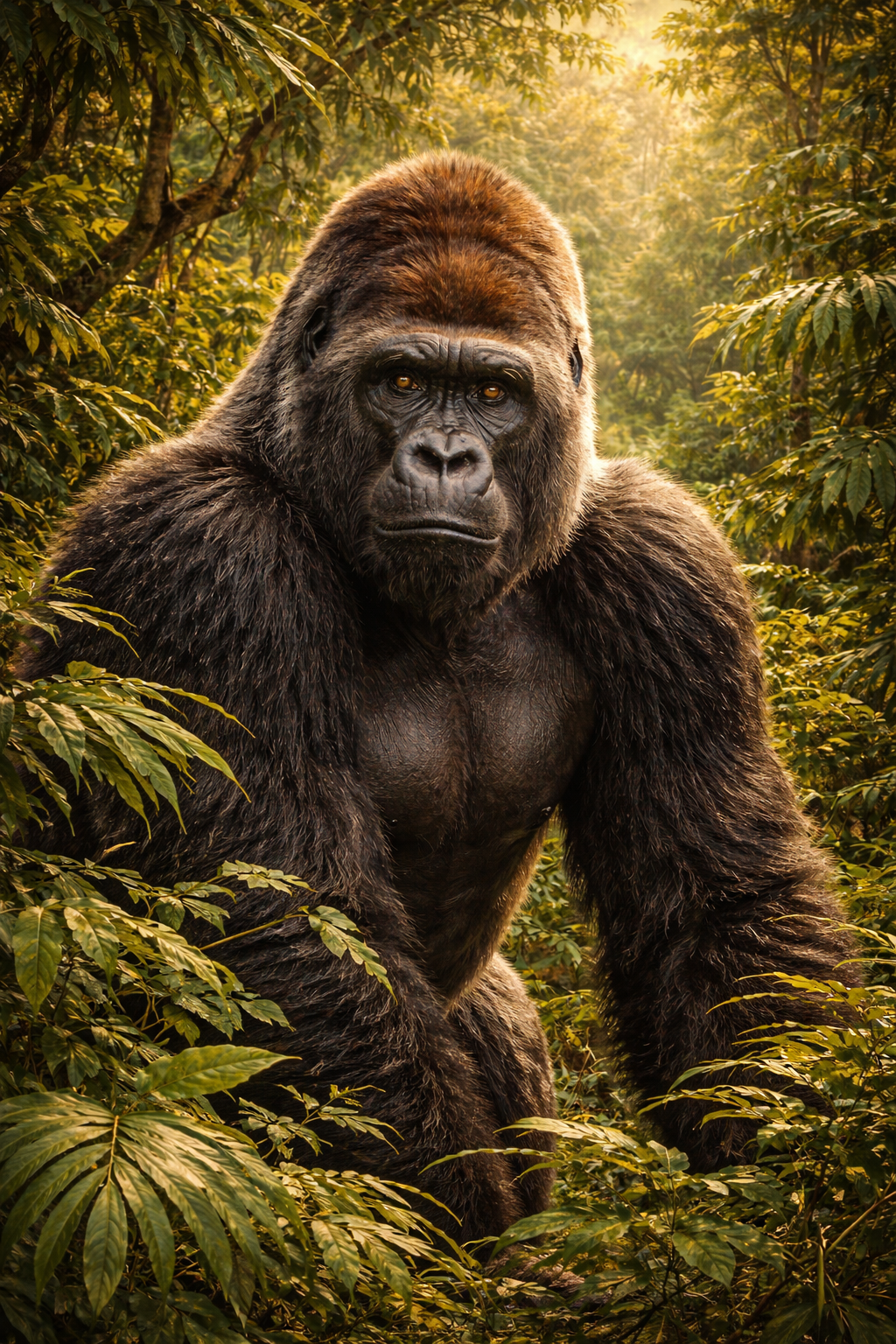
Photorealistic painting of a gorilla
🦍 Wild Animals

How Old Is a Gorilla in Human Years?

📅 Updated 🧬 98.3% shared DNA 🦍 All 4 subspecies covered

Gorillas are the largest living primates — and among the gentlest. They live in close families, mourn their dead, play with their young, and the oldest known gorilla just turned 67. The silverback's power is rarely used. His role is protection, not violence.

Calculate Gorilla Age →
🦍 Gorilla Age in Human Years
in human years
Gorilla age
Life stage
Setting
🦍 What this age means

Four Gorilla Subspecies — All Critically Endangered

Two species, four subspecies, and every single one is Critically Endangered. Each subspecies faces a distinct combination of threats — understanding the differences matters for conservation.

🦍 Mountain Gorilla
~1,063 individuals (2018 census)
The rarest great ape. Found only in the Virunga volcanoes (DRC/Rwanda/Uganda) and Bwindi (Uganda). Uniquely, their numbers are slowly increasing thanks to sustained conservation — one of the few great apes trending upward. Prone to human respiratory diseases.
🦍 Grauer's Gorilla
~3,800 individuals (declined 77% since 1990s)
Also called Eastern Lowland Gorilla. The largest gorilla subspecies. Found in eastern DRC — a region destabilised by decades of armed conflict, which has made protection nearly impossible. One of the most dramatic population collapses of any large mammal in recent decades.
🦍 Western Lowland Gorilla
~100,000 (declining)
The most numerous — but Ebola has killed tens of thousands
The most numerous subspecies and the one most commonly seen in zoos. Found across central and west Africa. Facing severe pressure from Ebola virus (which has killed whole communities), hunting for bushmeat, and habitat loss.
🦍 Cross River Gorilla
~250–300 individuals
The rarest great ape subspecies in Africa. Scattered in small, isolated groups across the Nigeria-Cameroon border. Extreme habitat fragmentation prevents gene flow between groups. Among the most endangered animals on Earth.

Gorilla Age to Human Years

Gorilla AgeWild GorillaCaptive GorillaLife Stage
2 years~4 yrs~3 yrsInfant
5 years~10 yrs~8 yrsJuvenile
10 years~20 yrs~15 yrsAdolescent
15 years~29 yrs~22 yrsYoung adult / blackback
20 years~38 yrs~29 yrsPrime silverback
30 years~55 yrs~44 yrsMature
40 years~73 yrs~58 yrsElder (wild)/Senior (captive)
50 yearsExceptional~72 yrsElder (captive)
60+ years~87+ yrsExtraordinary

🦍 The oldest known gorilla is Fatou at Berlin Zoo, who turned 67 in April 2024 and was still living as of early 2026 — making her the oldest known gorilla on Earth. She was born in the wild in West Africa around 1957 and was brought to Berlin Zoo as an infant. She has outlived most of the humans who first cared for her.

The Life Stages of a Gorilla

Gorillas have one of the most human-like developmental arcs of any animal. They have long childhoods, extended periods of learning, identifiable adolescence, and a recognised elder phase where silverbacks serve as the social and knowledge centre of their group. We share approximately 98.3% of our DNA.

0–3 mo
Newborn
Completely dependent. Clings to mother's chest constantly. Eyes open from birth. Brain development is rapid — gorilla infants have proportionally larger brains at birth than human infants relative to adult size.
3–12 mo
Infant
Beginning to crawl and explore. Still nursing. Carried on mother's back from around 4 months. Highly playful — play is essential for social and cognitive development in gorillas.
1–3 yrs
Juvenile
Increasingly independent but staying close to mother. Learning social hierarchies, food identification, and nest-building by watching adults. Weaning typically begins around 3 years.
3–8 yrs
Sub-adult
Fully weaned. Males beginning to show early signs of physical differentiation. Learning complex social rules of the group under the silverback's authority.
8–12 yrs
Blackback / Young Adult
Males develop a black coat across their back before the silver appears — giving the "blackback" name. Females may have their first offspring around age 10. Males cannot yet compete for dominant status.
12–40 yrs
Silverback / Prime Adult
Males develop the distinctive silver saddle from around age 12. A silverback leads the group, mediates conflicts, and makes movement decisions. The oldest and most experienced silverbacks command the most respect.

Things About Gorillas That Will Actually Surprise You

💪 Strength — and Restraint
An adult male gorilla is estimated to be 6–10 times stronger than the average human, capable of lifting over 800 kg. Yet gorilla groups are almost entirely non-violent internally. Silverbacks rarely need to use their strength — their dominant presence, chest-beating displays, and charging runs are usually enough to resolve conflicts. Real physical attacks between gorillas are uncommon.
🌱 Garden Architects
Gorillas are keystone species in their forests. As they move through vegetation eating fruits, they disperse seeds across vast areas — a critical function for forest regeneration. Gorilla dung contains viable seeds that germinate after digestion, helping maintain forest diversity. The loss of gorillas from a forest doesn't just remove one species — it gradually changes the entire forest composition over generations.
🌙 Nest Builders
Every evening, gorillas build a new nest — bending and weaving branches and leaves into a sleeping platform, either on the ground or in trees. They almost never use the same nest twice. Infants sleep with their mothers until they are old enough to build their own. Researchers use abandoned nests to census gorilla populations, count individuals, and track group movements through the forest without direct contact.
🦠 Ebola Threat
Ebola virus has killed an estimated tens of thousands of western gorillas since the 1990s — potentially more than human poaching. Entire communities have been wiped out in days. The 2002–2003 Ebola outbreak in the Congo Basin killed an estimated 5,000 western lowland gorillas in Lossi Sanctuary alone. Gorillas have no natural immunity. An experimental Ebola vaccine for gorillas has been developed but large-scale deployment remains a significant challenge.
👶 Infant Development
Gorilla infants are born helpless and develop slowly — a 3-year-old gorilla infant is roughly equivalent to a human toddler. They nurse for 3–4 years and remain with their mothers for 5–7 years. The birth interval is 4–6 years, meaning a female gorilla can raise only a handful of offspring in her lifetime. This slow reproductive rate makes population recovery from losses extremely difficult — even under ideal conditions, a gorilla population can grow by only a few percent per year.
🎭 Koko & Sign Language
Koko, a western lowland gorilla born in 1971, was taught American Sign Language from age 1. By adulthood she had a working vocabulary of over 1,000 signs and reportedly understood ~2,000 spoken English words. She appeared to use signs to express grief, describe dreams, and name objects. When her kitten companion died, she signed "sad" and "cry." The scientific debate about what her signing represents linguistically continues — but her life demonstrated levels of communication and emotional expression that reshaped public understanding of gorillas.

🦍 The mountain gorilla is one of the few conservation success stories among great apes. The population declined to a low of approximately 620 individuals in 1989, and has since grown to over 1,063 as of the 2018 census. This recovery is the result of sustained ranger protection, tourism revenue funding conservation, veterinary care programs, and international pressure reducing poaching. Mountain gorillas remain Critically Endangered, but their trajectory is upward — an exceptional outcome in great ape conservation.

Gorillas in the Headlines

From population milestones to disease threats and habitat battles, gorillas have been generating significant conservation news in 2025 and 2026.

WWF Living Planet Report · 2024
Mountain Gorillas Are the Only Great Ape Globally Not in Decline
WWF's Living Planet Report confirmed that mountain gorillas — growing at roughly 3% per year since 2010 — are the only great ape population worldwide that is not declining. The report credits intensive protected area management, community engagement programs, close monitoring of habituated groups, and veterinary interventions. With just over 1,000 mountain gorillas remaining, the species remains critically endangered, but their trajectory stands in stark contrast to western lowland gorillas, whose populations have declined sharply due to poaching, disease, and habitat loss.
Read the full story →
A-Z Animals · December 2025
Cross River Gorillas: Fewer Than 300 Remain as Conservation Efforts Intensify
Cross River gorillas — the rarest gorilla subspecies, found only in a small region straddling Nigeria and Cameroon — number fewer than 300 individuals. Multiple organisations including the Cross River Gorilla Project (Newcastle University), the Wilder Institute, and the Wildlife Conservation Society are working to protect their habitat, fund graduate research, implement anti-poaching measures, and develop Community Forest Management Plans that give local communities a stake in gorilla survival. Scientists warn the subspecies remains one of the most precarious primate populations on Earth.
Read the full story →
NPR · March 2026
Colossal Biosciences and the De-Extinction Debate — What It Means for Living Primates
The announcement by Colossal Biosciences that it had created gene-edited gray wolves with dire wolf traits — sparking debate about whether "de-extinction" is science or spectacle — has refocused conservation discussions on the ethics of prioritising lost species over living endangered ones. Critics argue that the $600 million+ raised by Colossal could be redirected to protecting the great apes that still exist — including gorillas facing poaching, disease, and deforestation right now — rather than engineering approximations of species that went extinct thousands of years ago.
Read the full story →

Other Wild Animals

Frequently Asked Questions

Male gorillas go through a blackback stage (approximately ages 8–12) when they have adult-sized bodies but have not yet developed the characteristic silver saddle. The silver saddle begins developing around age 11–13 and is fully established by approximately age 15. A silverback is therefore any fully adult male gorilla — the term refers to this physical characteristic, not a social rank. However, not every silverback leads a group. Some are solitary or join other bachelor groups while building the strength and social capital needed to attract females.
By the standards of their power, yes. Gorillas are largely herbivorous, live in stable family groups, and resolve most conflicts through displays rather than violence. Silverbacks rarely attack without significant provocation. The chest-beating display — which looks aggressive — is usually a warning and communication tool, not a prelude to attack. That said, gorillas are extremely powerful wild animals. Documented attacks on humans have caused severe injuries. The "gentle giant" characterisation is relatively accurate compared to their capabilities, but they are not tame and should never be treated as such.
The collapse of Grauer's gorilla (eastern lowland gorilla) population — from an estimated 16,900 in the 1990s to approximately 3,800 today, a decline of over 77% — is directly linked to the protracted armed conflict in eastern Democratic Republic of Congo. The DRC's wars and militia activity made wildlife protection impossible, allowed bushmeat hunting at industrial scale, caused massive displacement of people who cleared forest for subsistence, and brought artisanal miners into previously remote gorilla habitat. The situation represents one of the fastest population collapses of any large mammal in recorded history, and instability in the region continues to hinder recovery efforts.
Yes — gorillas are highly susceptible to human respiratory diseases, including common colds, flu, and COVID-19. This is both why gorilla trekking tourists must maintain distance and wear masks, and why veterinary teams at mountain gorilla conservation sites must be extremely careful. A common cold introduced to a mountain gorilla group can spread rapidly and cause serious illness or death. The famous Digit Fund and subsequent organisations established by Dian Fossey partly arose from recognising this vulnerability. Zoo gorillas have been vaccinated against COVID-19.
Gorilla trekking is wildlife tourism specifically focused on visiting habituated mountain gorilla groups in Rwanda, Uganda, and DRC. Permits cost $1,500 (Rwanda) to $700 (Uganda) per person per visit. The revenue directly funds ranger salaries, park management, community development, and anti-poaching operations — creating an economic incentive for gorilla protection. Research consistently shows that gorilla tourism is a significant driver of mountain gorilla population recovery. The programme is carefully managed: maximum 8 people per group per day, 1-hour visit limits, mandatory masks, and health screening for visitors. It is one of conservation's most studied and replicated models for wildlife economics.