Popular Pets
🐶 Dog 🐱 Cat 🐰 Rabbit 🐹 Hamster 🐾 Guinea Pig 🦜 Parrot 🦡 Ferret 🐀 Rat 🐭 Chinchilla 🦔 Hedgehog 🐟 Goldfish 🦜 Macaw
Farm & Large Animals
🐴 Horse 🐄 Cow 🐄 Highland Cow 🐷 Pig 🐑 Sheep 🐐 Goat 🐴 Donkey 🦙 Alpaca 🐐 Mountain Goat 🐔 Chicken 🦆 Duck 🦃 Turkey
Wild Animals
🐘 Elephant 🦁 Lion 🐯 Tiger 🐆 Leopard 🐺 Wolf 🐻 Bear 🐻‍❄️ Polar Bear 🦍 Gorilla 🐒 Chimpanzee 🦧 Orangutan 🦘 Kangaroo 🐾 Capybara 🦒 Giraffe 🦊 Fox 🦅 Raptor 🦉 Owl 🐧 Penguin 🦩 Flamingo 🐾 Hyena 🐾 Meerkat 🦥 Sloth 🦡 Badger 🐾 Wolverine 🐾 Armadillo
Ocean & Aquarium
🦈 Shark 🐋 Orca 🐬 Dolphin 🐋 Whale 🐋 Blue Whale 🐳 Beluga Whale 🦄 Narwhal 🐋 Bowhead Whale 🐾 Manatee 🐟 Manta Ray 🐟 Freshwater Fish 🐠 Saltwater Fish 🐴 Seahorse 🐟 Koi
Exotic & Weird
🐍 Snake 🐍 Ball Python 🦎 Bearded Dragon 🦎 Iguana 🦎 Komodo Dragon 🦎 Chameleon 🦎 Leopard Gecko 🐢 Tortoise 🐢 Snapping Turtle 🐢 Sea Turtle 🐊 Crocodilian 🕷️ Tarantula 🦎 Axolotl 🐙 Octopus 🌊 Jellyfish 🦞 Lobster 🐚 Quahog 🔬 Tardigrade
Info
About FAQ Contact
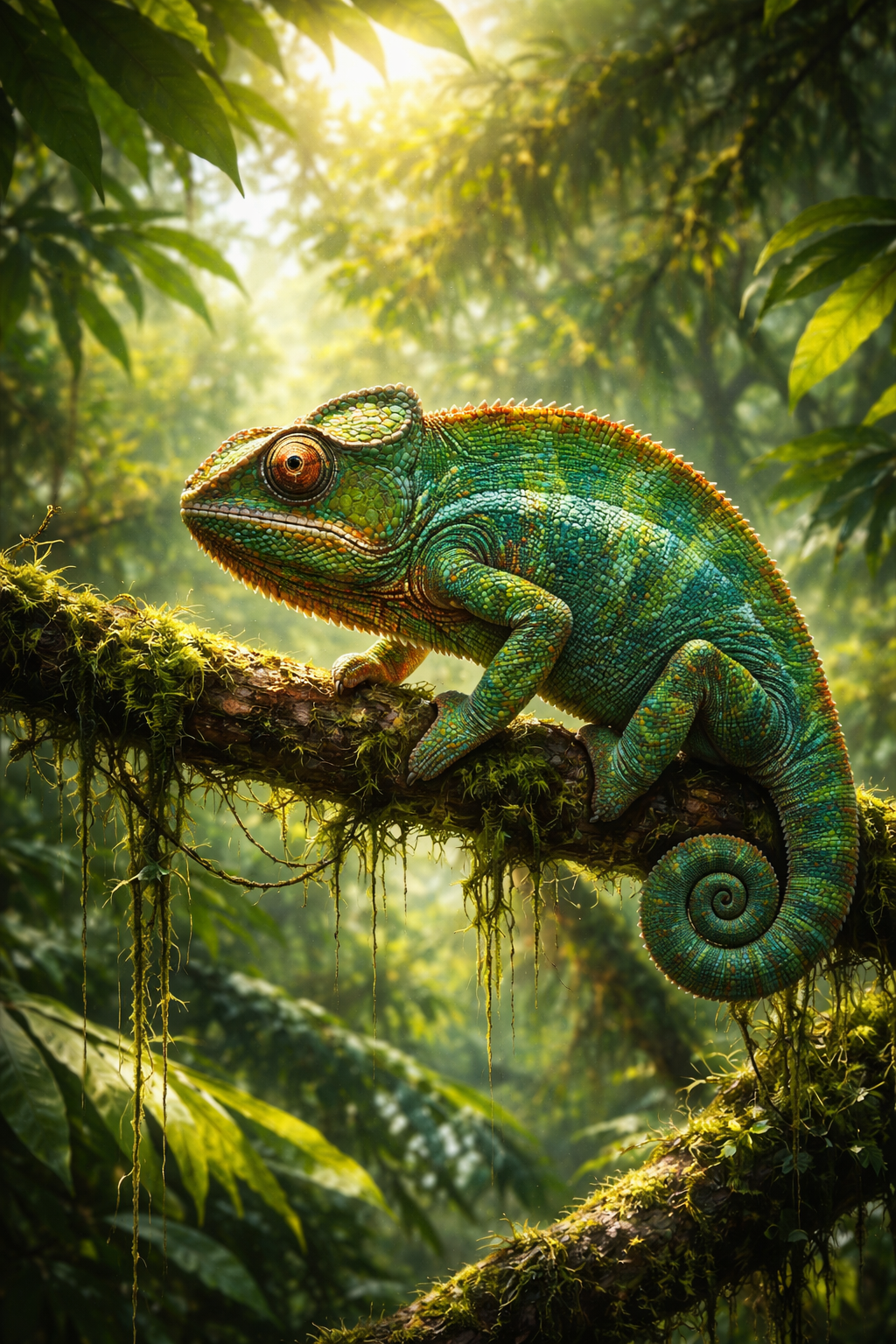
Photorealistic painting of a chameleon in rainforest
🦎 Exotic Pets

How Old Is a Chameleon in Human Years?

📅 Updated 🔬 5 species covered 🦎 ~200 species worldwide

Chameleons don't change colour to blend in — they change colour to communicate. Their tongue strikes faster than a bullet leaves a gun. Their eyes move independently and see 360 degrees. And they are among the most demanding pets in the reptile world.

Calculate Chameleon Age →
🦎 Chameleon Age in Human Years
in human years
Chameleon age
Life stage
Species
🦎 What this age means

Five Chameleon Species — How They Compare

Chameleon lifespans vary dramatically by species. Clicking a card sets the calculator above.

🦎 Veiled Chameleon (♂)
Chamaeleo calyptratus
Male lifespan6–8 yrs
Size45–60 cm
Defining featureTall casque on head
Beginner-friendly?Most forgiving of the group
🦎 Veiled Chameleon (♀)
Chamaeleo calyptratus
Female lifespan4–6 yrs
Why shorter?Egg-laying is very taxing
Clutch size20–70 eggs per clutch
Key care noteLaying site essential
🦎 Panther Chameleon
Furcifer pardalis
Lifespan3–7 yrs (males longer)
OriginMadagascar
ColourMost spectacular of any species
DifficultyIntermediate
🦎 Jackson's Chameleon
Trioceros jacksonii
Lifespan5–10 yrs
Defining featureThree horns (males)
ReproductionViviparous — live young
DifficultyIntermediate–Advanced
🦎 Parson's Chameleon
Calumma parsonii
Lifespan12–20+ yrs
SizeUp to 68 cm — world's largest
AvailabilityRare; slow to mature
DifficultyExpert only
🎨 The Colour Change Myth — What's Really Happening
Chameleons do not primarily change colour to match their background. This is one of the most repeated myths in animal biology and it has been definitively disproven by research. Their natural resting colouration already provides adequate camouflage. Colour change in chameleons is driven by three things: mood and social communication (bright, high-contrast colours in males signal dominance or readiness to mate; dark, dull colours signal submission, stress, or illness), thermoregulation (darker colours absorb more solar heat; lighter colours reflect it), and reproductive signalling (females signal receptivity through colour). The mechanism is also remarkable: chameleons don't use pigment — they have two layers of iridophore cells containing nanocrystals that reflect different wavelengths of light depending on how far apart they are. The crystals are moved by muscle action, changing colour in milliseconds without any pigment chemistry at all.

Veiled Chameleon Age to Human Years

AgeMale VeiledFemale VeiledPantherLife Stage
3 months~6 yrs~7 yrs~8 yrsHatchling
6 months~11 yrs~13 yrs~15 yrsJuvenile
1 year~15 yrs~19 yrs~22 yrsYoung adult
2 years~26 yrs~34 yrs~38 yrsPrime adult
3 years~37 yrs~50 yrs~54 yrsMature / senior (♀)
5 years~56 yrs~72 yrs~72 yrsSenior (♂) / elder (♀)
7 years~74 yrsElderElderElder (♂ veiled)
10+ yearsRecordJackson's / Parson's territory

🦎 Female veiled chameleons have significantly shorter lifespans than males because egg production is extremely physiologically costly — a female may produce clutches of 20–70 eggs multiple times per year regardless of whether mating has occurred, which places enormous strain on the body. Providing a deep laying substrate and managing lighting cycles to reduce clutch frequency is one of the most important welfare interventions for captive female veiled chameleons. Parson's chameleons are the extraordinary outliers — some captive individuals are believed to exceed 20 years.

The Life Stages of a Chameleon

Chameleons have compressed, intense lives — most species live only 2–5 years, and some of the smallest species complete their entire lifecycle in under a year. Their developmental milestones are rapid, their reproductive urgency is high, and their individuality — expressed through colour, posture, and territorial display — is present from their first weeks of life.

0–4 wks
Hatchling
Emerges from an egg buried in soil — fully independent from the moment of hatching. No parental care of any kind. Must immediately begin hunting micro-prey and thermoregulating. Colour-change ability is present from day one but limited. Many species lose 50%+ of hatchlings in the first month in the wild.
1–3 mo
Juvenile
Rapid growth. Colour-change range expanding week by week. Beginning to establish micro-territories. Learning the precise tongue-launch distances needed for different prey sizes. Still highly vulnerable — both to predation in the wild and husbandry errors in captivity.
3–6 mo
Sub-adult
Approaching sexual maturity. Males beginning to display in earnest — territorial flares at rivals, early courtship toward females. The casque, crests, and dewlap developing toward their full adult form. Every week brings visible change.
6 mo–1 yr
Young Adult
Sexually mature. First breeding season. Males deploy their full colour repertoire — threat colours for rivals, courtship colours for females, resting camouflage when inactive. The iridophore system operating at full sophistication. The most visually spectacular period of the chameleon's life.
1–4 yrs
Prime Adult
Peak physical condition, colour expression, and hunting precision. Established territory with known food sources and thermoregulation routes. For larger species like Parson's chameleon, prime adulthood extends much further — some individuals are still in prime condition at 8–10 years.
4–7 yrs
Senior
Species-dependent. Veiled chameleon males at this stage are approaching or past the species average. Panther chameleons in this range are already exceptional. Activity may slow; thermoregulation precision becomes even more critical. A chameleon reaching this stage in good health is a keeper's achievement.
7–20+ yrs
Elder
The exclusive territory of the largest species — primarily Parson's chameleons, which have been documented past 20 years in captivity. These animals are living monuments to exceptional husbandry. Their colour displays remain spectacular even at extreme age. Every year is genuinely extraordinary.

Things About Chameleons That Will Actually Surprise You

👁️ Independent Turret Eyes — 360° Vision
Each chameleon eye is mounted in its own independently rotating turret of fused eyelids, capable of rotating nearly 180° horizontally and 90° vertically. The two eyes can move in completely different directions simultaneously — one tracking a distant rival while the other watches the ground below. This gives chameleons a full 360-degree monocular field of view with no blind spots. When a target is identified, both eyes converge on it instantly, switching from panoramic surveillance to precise binocular stereoscopic targeting — allowing the chameleon to calculate the exact distance for its tongue strike without moving its body. No other vertebrate visual system works quite like it.
👅 264 g-Force Tongue — Faster Than a Bullet
A chameleon's tongue launches in under 100 milliseconds — faster than a human blink — reaching peak speeds of 8,500 cm/s (85 m/s) with accelerations of up to 264 g-forces. To put that in context: a fighter jet pulling a hard turn generates about 9 g. The tongue is launched by a hydrostatic catapult mechanism — a coiled tube of collagen and muscle that is progressively loaded with elastic energy, then released in a single explosive event. The sticky, cup-shaped tip generates suction on contact, holding prey while the entire system retracts. It can extend to twice the chameleon's body length. Per unit of mass, the tongue launch generates more power than any other known biological movement — including the mantis shrimp punch.
🔮 Nanocrystal Colour — Not Pigment
Chameleons don't change colour using pigment — they use structural colour, the same mechanism that makes morpho butterfly wings iridescent. Specialised cells called iridophores contain a lattice of nano-scale guanine crystals. The spacing between these crystals determines which wavelengths of light are reflected: compressed lattice → shorter wavelengths (blue/green); expanded lattice → longer wavelengths (red/orange/yellow). Muscles attached to the iridophore layer physically change the crystal spacing in milliseconds. This was only confirmed in 2015 by Michel Milinkovitch's lab at the University of Geneva, overturning decades of assumption that the colour change was pigment-based. Crucially, colour change is not primarily for camouflage — it is a social communication and thermoregulation system. The chameleon's resting colour already provides camouflage.
🦶 Zygodactyl Feet + Prehensile Tail
Chameleon feet are zygodactyl — the five toes are fused into two opposing bundles (front feet: 2 outer + 3 inner; rear feet: 3 outer + 2 inner), forming a powerful pincer grip precisely shaped for branches. The grip requires almost no muscular effort to maintain — a chameleon can sleep on a branch without gripping actively. Their prehensile tail functions as a fifth limb, coiling around branches independently and providing a secure anchor point that allows the chameleon to lean far out from a perch while feeding. This combination of four gripping feet and a fifth gripping tail makes them extraordinarily secure in arboreal environments — and completely helpless on flat ground, which they almost never encounter in the wild.
💧 Moving Water Only — A Hard-Wired Requirement
Chameleons have evolved in environments where water only appears as moving droplets — rain, dew, and condensation dripping from leaves. Their visual system is specifically tuned to detect the movement of water droplets, and they will not recognise still water in a dish as drinkable. A chameleon will die of dehydration next to a full water bowl. In captivity this means either a drip system (water dripping slowly from a container above), an automated misting system running 2–4 times daily, or manual misting with a spray bottle. The leaves and enclosure walls must be wet enough for the chameleon to lick droplets. Dehydration is one of the top three causes of premature death in captive chameleons — and it is entirely preventable with correct husbandry.
🏔️ Madagascar — Half of All Chameleons, One Island
Madagascar contains approximately 50% of all chameleon species on Earth — around 90–100 of the ~200 known species — despite being just 587,000 km² (roughly the size of Texas). Madagascar separated from Africa approximately 165 million years ago, allowing chameleon lineages to diversify in total isolation. The result is extraordinary: the island contains the world's smallest chameleon (Brookesia nana, 13.5mm snout-to-vent, described in 2021) and the world's largest (Calumma parsonii, up to 70cm). According to IUCN assessments, Madagascar has lost over 90% of its original forest cover — making its ongoing deforestation one of the most acute extinction crises for any single animal family on Earth. New chameleon species continue to be described from Madagascar each year, even as their habitats disappear.

🦎 The Namaqua chameleon (Chamaeleo namaquensis) of southern Africa's Namib Desert has evolved a remarkable thermoregulation strategy — it darkens its left side to face the morning sun and absorb heat rapidly, while the right side remains lighter. As the day heats up, it transitions to full pale colouration to reflect heat. This same individual can display two different colours simultaneously on its two halves — demonstrating how fine-grained the control of the iridophore system truly is.

What Chameleon Colours Actually Mean

🦎 The most persistent myth about chameleons is that they change colour to blend into their background. They don't. Their resting colour already provides camouflage. Active colour change is a communication and thermoregulation system — and once you understand the vocabulary, watching a chameleon becomes a completely different experience.

The colour language varies somewhat by species, but the broad grammar holds across the most studied captive chameleons — particularly veiled and panther chameleons. Male-to-male interactions, male-to-female courtship, thermal regulation, stress responses, and illness each produce distinct, readable colour states.

Colour / PatternMeaningContextNotes
Bright greens + blues + yellows (male)Excitement / dominance / courtshipSeeing a rival or receptive femaleMost vivid display — full iridophore activation
Dark brown / black patchesSevere stress or illnessHandling, fear, pain, or systemic illnessBlack colouration is a welfare warning sign
Dull olive / flat greenStress or submissionLow-rank male near dominant; chronic husbandry issuesProlonged dull colouration = investigate husbandry
Pale / almost white (at night)Sleep stateNormal overnight colourationNot a stress sign — completely normal
Dark base + blue spots (female veiled)Gravid / unreceptiveFemale carrying eggs; will reject mating advancesThis specific pattern is a "no" signal to males
Pale green / no blue spots (female veiled)Potentially receptiveNon-gravid female may accept matingApproach tolerance, not active invitation
Darker left side / lighter right sideThermoregulationMorning basking — dark side faces sunNamaqua chameleons show this most dramatically
Rapid colour flickeringAgitation or high alertnessDetecting a threat; intense territorial encounterFast changes = high arousal state

🦎 Panther chameleons (Furcifer pardalis) from different localities in Madagascar display such distinct colour morphs that for many years they were thought to be separate species. Males from Ambilobe display vivid reds and blues; males from Nosy Be display turquoise and green; males from Tamatave display orange and red. These locality-specific colour forms are now recognised as distinct ecotypes — the same species, shaped by different local environments and mate-preference selection over thousands of generations. Breeders track locality of origin carefully, as crossing ecotypes produces less vivid offspring.

Other Exotic Pets

Frequently Asked Questions

Chameleons are widely considered among the most demanding reptile pets and are generally not recommended for beginners. They require precise temperature gradients (a basking spot of 32–35°C, a cool end of 20–24°C), UVB lighting of appropriate intensity, humidity of 50–70% with good ventilation (high humidity combined with poor airflow causes respiratory infections), drip or misting systems for drinking, live gut-loaded and supplemented feeder insects, and an enclosure that is typically screen-sided to prevent mould and bacteria build-up. They also dislike handling intensely — most chameleons show stress responses to handling that do not diminish with time. A veiled chameleon is the most forgiving of commonly kept species, but "forgiving" is relative in this context. An experienced reptile keeper moving from bearded dragons or corn snakes is a more realistic target owner than a first-time reptile owner.
Colour meaning varies somewhat by species, but broad patterns hold across veiled chameleons — the most studied in captivity. Dark, dull browns and greens typically signal stress, illness, or submission. Black colouration often indicates severe stress or thermal challenge. Bright, high-contrast yellows, greens, and blues in males typically signal excitement, dominance, and interest in a female or in defending territory. Pale, almost white colouration during sleep is normal and not a stress signal. In female veiled chameleons, a specific blue-spotted pattern on a dark background signals that she is gravid (carrying eggs) and will reject mating advances — while females showing no such pattern may be receptive. Learning to read colour is one of the most rewarding aspects of chameleon keeping.
Chameleons have a high mortality rate in captivity compared to most reptiles, for three primary reasons. First, dehydration — they will not drink from standing water and many keepers fail to provide adequate misting. Second, metabolic bone disease from insufficient UVB lighting — chameleons have very high UVB requirements and a bulb that seems bright produces inadequate UVB if it is not the correct type or is too far from the basking spot. Third, stress — chameleons are highly sensitive to visual stressors and an enclosure placed in a high-traffic area, visible from the outside (causing the chameleon to see its reflection), or shared with another chameleon will produce chronic stress that suppresses immune function and accelerates decline. A chameleon with all three problems correct can live a full, healthy lifespan. Most captive chameleons never receive all three.
As of 2025, approximately 200 described chameleon species are recognised, though new species continue to be described — particularly small leaf chameleons from Madagascar. The family Chamaeleonidae is divided into two subfamilies: Brookesiinae (the smaller leaf and stump-tailed chameleons, primarily Malagasy) and Chamaeleoninae (the larger "true" chameleons found across Africa, Madagascar, southern Europe, and southern Asia). Madagascar is the centre of chameleon diversity with roughly 50% of all species; sub-Saharan Africa accounts for most of the remainder. The Namaqua chameleon is the only desert-adapted species. The Indian chameleon extends the range into South Asia. Most species are threatened by habitat loss.
The smallest chameleon — and one of the smallest reptiles on Earth — is Brookesia nana, described in 2021 from the rainforests of northern Madagascar. An adult male measures approximately 13.5 mm from snout to vent (21.6 mm total including tail). The female is larger at around 19 mm snout-to-vent. They are so small they can perch comfortably on a fingernail. The largest chameleon is Parson's chameleon (Calumma parsonii), also from Madagascar, which can reach 68–70 cm in total length and is among the heaviest of all chameleon species. The same island that contains the world's smallest chameleon also contains the world's largest — an extraordinary example of the evolutionary divergence that makes Madagascar unique.