Popular Pets
🐶 Dog 🐱 Cat 🐰 Rabbit 🐹 Hamster 🐾 Guinea Pig 🦜 Parrot 🦡 Ferret 🐀 Rat 🐭 Chinchilla 🦔 Hedgehog 🐟 Goldfish 🦜 Macaw
Farm & Large Animals
🐴 Horse 🐄 Cow 🐄 Highland Cow 🐷 Pig 🐑 Sheep 🐐 Goat 🐴 Donkey 🦙 Alpaca 🐐 Mountain Goat 🐔 Chicken 🦆 Duck 🦃 Turkey
Wild Animals
🐘 Elephant 🦁 Lion 🐯 Tiger 🐆 Leopard 🐺 Wolf 🐻 Bear 🐻‍❄️ Polar Bear 🦍 Gorilla 🐒 Chimpanzee 🦧 Orangutan 🦘 Kangaroo 🐾 Capybara 🦒 Giraffe 🦊 Fox 🦅 Raptor 🦉 Owl 🐧 Penguin 🦩 Flamingo 🐾 Hyena 🐾 Meerkat 🦥 Sloth 🦡 Badger 🐾 Wolverine 🐾 Armadillo
Ocean & Aquarium
🦈 Shark 🐋 Orca 🐬 Dolphin 🐋 Whale 🐋 Blue Whale 🐳 Beluga Whale 🦄 Narwhal 🐋 Bowhead Whale 🐾 Manatee 🐟 Manta Ray 🐟 Freshwater Fish 🐠 Saltwater Fish 🐴 Seahorse 🐟 Koi
Exotic & Weird
🐍 Snake 🐍 Ball Python 🦎 Bearded Dragon 🦎 Iguana 🦎 Komodo Dragon 🦎 Chameleon 🦎 Leopard Gecko 🐢 Tortoise 🐢 Snapping Turtle 🐢 Sea Turtle 🐊 Crocodilian 🕷️ Tarantula 🦎 Axolotl 🐙 Octopus 🌊 Jellyfish 🦞 Lobster 🐚 Quahog 🔬 Tardigrade
Info
About FAQ Contact
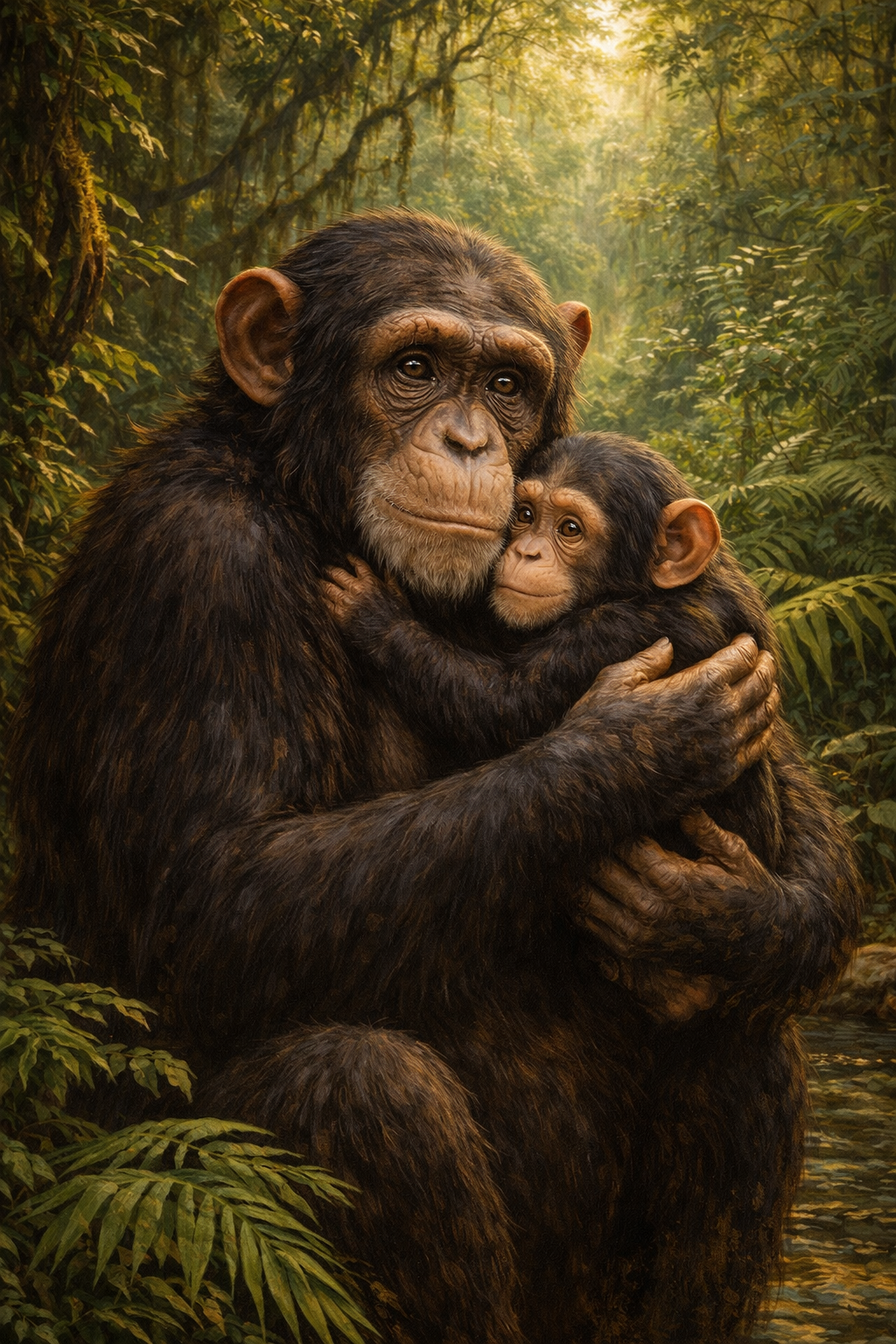
A mother chimpanzee tenderly holding her infant in a lush rainforest
🐒 Wild Animals

How Old Is a Chimpanzee in Human Years?

📅 Updated 🔬 98.7% shared DNA 🐒 Our closest living relative

Chimpanzees share 98.7% of our DNA — our closest living relatives. They wage war, mourn their dead, use tools, and pass culture between generations. A chimp can live 50+ years and remember individuals for decades.

Calculate Chimpanzee Age →
🐒 Chimpanzee Age in Human Years
in human years
Chimp age
Life stage
Setting
🐒 What this age means

Chimpanzee Age to Human Years

Chimpanzees develop more slowly than humans in early life — they are dependent on their mothers for 5–7 years. But they age faster in later life, with a wild chimp at 35 already elderly.

Chimp AgeWild ChimpCaptive ChimpLife Stage
2 years~4 yrs~3 yrsInfant
5 years~9 yrs~7 yrsJuvenile
10 years~18 yrs~14 yrsAdolescent
15 years~29 yrs~22 yrsYoung adult
20 years~37 yrs~29 yrsPrime adult
30 years~53 yrs~44 yrsMature
40 years~70 yrs~58 yrsSenior (wild elder)
50 yearsExceptional~72 yrsElder (captive)
60+ years~87+ yrsExtraordinary

🐒 The longest-lived verified chimpanzee was Little Mama at Lion Country Safari in Florida, estimated at over 70 years when she died in 2017. She was captured in the wild as a young adult in the 1950s — meaning she had lived through most of the documented history of chimpanzee research. A close second is Cheeta, the animal actor from Tarzan films, who lived to 80 according to his owner — though this claim is disputed by primatologists.

Things About Chimpanzees That Will Actually Surprise You

🧬 1.3% From Human
Chimpanzees share 98.7% of their DNA with humans — more than either species shares with gorillas. Yet that 1.3% difference translates into profound differences in language, abstract reasoning, and lifespan. Chimps and humans diverged from a common ancestor approximately 6–7 million years ago. They are not our ancestors — they are our closest living cousins, having evolved separately from the same starting point.
⚔️ The Gombe War
From 1974 to 1978, Jane Goodall documented what became known as the Gombe Chimpanzee War — a four-year conflict in which the northern Kasakela community systematically tracked down and killed every member of the southern Kahama community. This was the first documented case of sustained lethal inter-group warfare in non-human primates. Goodall described it as shattering her belief in chimpanzee innocence.
🛠️ Cultural Tool Use
Chimpanzee communities use over 65 different tool types, including stone hammers and anvils to crack nuts, sticks modified into spears for hunting, and leaf sponges to soak up drinking water. Different communities have different tool traditions — and these traditions are culturally transmitted, not genetic. A chimp from a nut-cracking community will crack nuts; one from a community that doesn't won't, even if shown how.
😢 Grief & Funerals
Chimpanzees have been documented cleaning the bodies of deceased group members, standing vigil over the dying, and carrying deceased infants for days or weeks. Mothers have been observed carrying dead infants for up to two months. In 2010, researchers filmed an entire chimpanzee community gathering silently around a dying female elder, then standing still and watching quietly as she died — behaviour that has no obvious adaptive explanation.
😂 Laughter
Chimpanzees laugh — producing a panting, breathy vocalization during play that is the evolutionary precursor to human laughter. Unlike human laughter (which occurs on exhalation), chimp laughter happens on both inhalation and exhalation — giving it a characteristic panting sound. The neurological and social contexts of chimp laughter closely mirror human laughter: it occurs in play, during tickling, and in positive social situations.
📉 Endangered & Declining
Chimpanzees are Endangered on the IUCN Red List. Wild populations have fallen from an estimated 1–2 million in 1900 to approximately 170,000–300,000 today. Habitat destruction from agriculture and logging, hunting for bushmeat, and the illegal pet trade (infant chimps are taken by killing their entire family group) are the primary drivers. All four subspecies face serious decline.

🐒 Jane Goodall's research at Gombe Stream, which began in 1960, is the longest-running study of any wild animal population in the world. Over 60+ years it has documented chimpanzee tool use, warfare, grief, culture, politics, and family bonds across multiple generations. Almost everything we know about wild chimpanzee behaviour comes from Gombe and a handful of other long-term field sites — Bossou in Guinea, Tai Forest in Côte d'Ivoire, and Budongo in Uganda. The Jane Goodall Institute continues this work today.

Other Wild Animals

Frequently Asked Questions

A 20-year-old wild chimpanzee is roughly equivalent to a 37-year-old human — a fully mature adult in their prime. In chimp social terms, a 20-year-old male is working hard to climb the social hierarchy, forming alliances, competing for status. A 20-year-old female has likely had her first offspring and is balancing motherhood with the demands of community life. Both are deeply embedded in the complex political and social world of their group.
The gap between wild (avg ~38 years) and captive (~55 years) lifespan reflects the brutal realities of wild life. Wild chimps face predation (leopards are significant predators), infectious disease, injuries from intergroup violence, food scarcity during dry seasons, and the physical cost of ranging over large territories. Captive chimps are protected from these pressures, receive medical care, and have guaranteed food. The downside of captivity is psychological — chimps are highly intelligent social animals, and inadequate social and cognitive stimulation causes serious welfare problems.
Chimpanzees cannot produce human speech — their vocal anatomy and neural control of vocalisation differ too much from ours. However, they have demonstrated significant capacity for symbolic communication. Washoe, taught American Sign Language from 1967, learned over 350 signs, used them in novel combinations, and spontaneously taught some signs to her son Loulis without human instruction. Kanzi, a bonobo (close relative) trained with lexigrams (symbols on a keyboard), demonstrated comprehension of spoken English sentences at around the level of a 2.5-year-old human child. The debate about what this means for language and cognition is ongoing.
Chimpanzee communities are organised around a dominance hierarchy topped by an alpha male. Unlike gorillas (where the silverback has near-absolute authority), chimp alpha status depends heavily on coalition politics — an alpha maintains power through alliances with other males, not brute strength alone. Smaller males can and do depose larger ones by building better coalitions. Females have a separate hierarchy. A key aspect of chimp politics is the coalitionary support system — individuals who support the alpha expect reciprocal favours. Frans de Waal's book Chimpanzee Politics (1982) documented these dynamics in detail and influenced human political science.
Adult chimpanzees are significantly more physically powerful than adult humans — they have roughly four times the upper body strength relative to body weight. Attacks by chimps on humans have caused severe and permanent injuries including the loss of hands, fingers, and facial features. The cases of people keeping chimps as pets and experiencing serious attacks are well documented. Chimps are not safe pets — they are complex, intelligent animals with adult capabilities vastly exceeding human physical strength. All reputable wildlife organisations oppose keeping chimps as pets.