Popular Pets
🐶 Dog 🐱 Cat 🐰 Rabbit 🐹 Hamster 🐾 Guinea Pig 🦜 Parrot 🦡 Ferret 🐀 Rat 🐭 Chinchilla 🦔 Hedgehog 🐟 Goldfish 🦜 Macaw
Farm & Large Animals
🐴 Horse 🐄 Cow 🐄 Highland Cow 🐷 Pig 🐑 Sheep 🐐 Goat 🐴 Donkey 🦙 Alpaca 🐐 Mountain Goat 🐔 Chicken 🦆 Duck 🦃 Turkey
Wild Animals
🐘 Elephant 🦁 Lion 🐯 Tiger 🐆 Leopard 🐺 Wolf 🐻 Bear 🐻‍❄️ Polar Bear 🦍 Gorilla 🐒 Chimpanzee 🦧 Orangutan 🦘 Kangaroo 🐾 Capybara 🦒 Giraffe 🦊 Fox 🦅 Raptor 🦉 Owl 🐧 Penguin 🦩 Flamingo 🐾 Hyena 🐾 Meerkat 🦥 Sloth 🦡 Badger 🐾 Wolverine 🐾 Armadillo
Ocean & Aquarium
🦈 Shark 🐋 Orca 🐬 Dolphin 🐋 Whale 🐋 Blue Whale 🐳 Beluga Whale 🦄 Narwhal 🐋 Bowhead Whale 🐾 Manatee 🐟 Manta Ray 🐟 Freshwater Fish 🐠 Saltwater Fish 🐴 Seahorse 🐟 Koi
Exotic & Weird
🐍 Snake 🐍 Ball Python 🦎 Bearded Dragon 🦎 Iguana 🦎 Komodo Dragon 🦎 Chameleon 🦎 Leopard Gecko 🐢 Tortoise 🐢 Snapping Turtle 🐢 Sea Turtle 🐊 Crocodilian 🕷️ Tarantula 🦎 Axolotl 🐙 Octopus 🌊 Jellyfish 🦞 Lobster 🐚 Quahog 🔬 Tardigrade
Info
About FAQ Contact
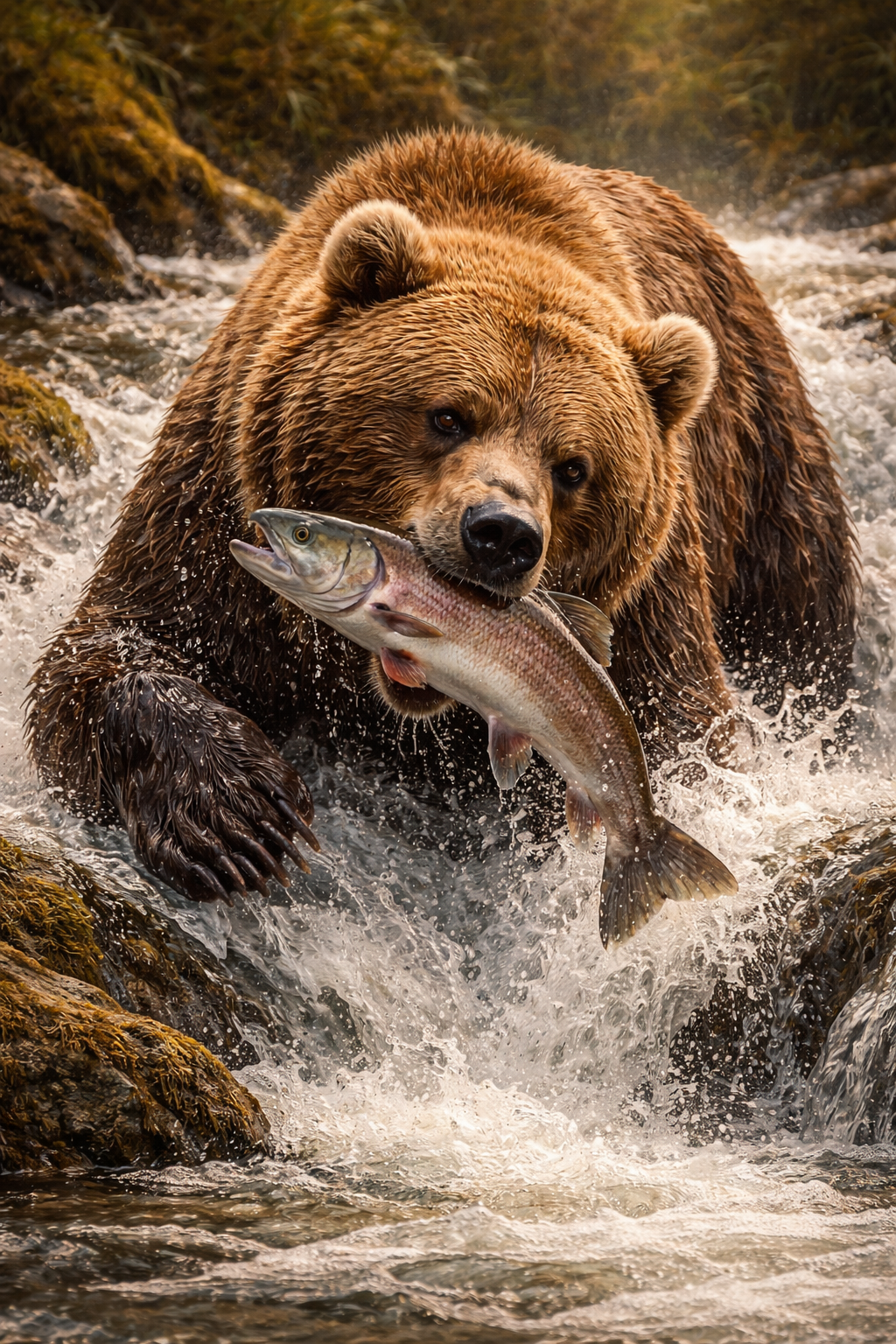
A grizzly bear catching a salmon in a rushing river
🐻 Wild Animals

How Old Is a Bear in Human Years?

📅 Updated 🔬 6 species covered 🐻 Not true hibernation

Bears don't truly hibernate — they enter torpor, a lighter sleep from which they can be roused. A mother gives birth mid-winter without waking. A grizzly can remember food locations for decades. And they can live 25–30 years in the wild.

Calculate Bear Age →
🐻 Bear Age in Human Years
in human years
Bear age
Life stage
Species
🐻 What this age means

Six Bears — From Bamboo Forests to Arctic Ice

🐻 Grizzly / Brown Bear
Wild 20–30 yrs · Captive 40+
The widest ranging bear species — found from Alaska to Russia. The distinctive shoulder hump is pure muscle. Can run 35 mph for short distances. Their sense of smell is roughly 2,100 times more powerful than a human's.
🐻 American Black Bear
Wild 18–25 yrs · Captive 30+
North America's most common bear species — approximately 800,000 individuals. Not always black: can be brown, cinnamon, or even cream coloured. Exceptionally good climbers. Generally avoids humans but habituates quickly to food sources.
🐻‍❄️ Polar Bear
Wild 15–18 yrs · Captive 25+
The largest land carnivore. Technically classified as a marine mammal. Can swim 60+ miles without rest. Their fur is not white — it's transparent and hollow, appearing white in reflected light. Vulnerable on IUCN Red List; climate change reducing sea ice and prey access.
🐼 Giant Panda
Wild 15–20 yrs · Captive 25–30
Eats bamboo for up to 16 hours a day despite having a carnivore's digestive system — absorbing only 17–20% of what they eat. Their pseudo-thumb is a modified radial sesamoid bone, not a true digit. Downlisted from Endangered to Vulnerable in 2016 thanks to conservation success.
☀️ Sun Bear
Wild 20–25 yrs · Captive 30+
The world's smallest bear — only 27–80 kg. Named for the golden chest patch. Has the longest tongue of any bear (25–30 cm) for extracting honey and insects. Found across Southeast Asia; Vulnerable on IUCN Red List due to deforestation.
👓 Spectacled Bear
Wild 18–25 yrs · Captive 30+
South America's only native bear and the only surviving short-faced bear. Named for distinctive pale markings around the eyes. Inhabits the Andes from Venezuela to Bolivia. Vulnerable on IUCN Red List. Likely the inspiration for Paddington Bear.

Grizzly Bear Age to Human Years

Bear AgeGrizzly / BrownBlack BearPolar BearLife Stage
1 year~4 yrs~4 yrs~5 yrsCub (with mother)
2 years~7 yrs~8 yrs~9 yrsCub / sub-adult
4 years~15 yrs~16 yrs~18 yrsYoung adult
7 years~26 yrs~28 yrs~31 yrsPrime adult
10 years~37 yrs~40 yrs~44 yrsPrime / Mature
15 years~54 yrs~59 yrs~65 yrsMature / Senior
20 years~71 yrs~78 yrsElderSenior / Elder
25 years~86 yrs~96 yrsElder (grizzly)
30+ yearsRecord territoryExtraordinary

🐻 The oldest verified wild grizzly was a female nicknamed Ethyl in Yellowstone, who lived to at least 34 years. The oldest known captive brown bear was Andreas at a sanctuary in Germany, who reached 47 years old. Most wild grizzlies that survive to adulthood live 20–26 years, with females typically outliving males due to lower mortality from fighting and hunting pressure.

Things About Bears That Will Actually Surprise You

❄️ Not True Hibernation — And Medical Research Gold
Bears enter torpor, not true hibernation. Their body temperature drops only 3–5°C (true hibernators drop 30°C+), they can wake relatively quickly, and pregnant females give birth and nurse cubs during torpor. Yet they do not eat, drink, urinate, or defecate for up to 7 months — and emerge with no muscle atrophy, no bone density loss, and no kidney damage from accumulated waste. Scientists studying bears' ability to prevent muscle wasting and bone loss during torpor believe it could inform treatments for osteoporosis, kidney disease, and muscle atrophy in humans.
👃 Superpower Nose
A grizzly bear's sense of smell is estimated to be 2,100 times more powerful than a human's — seven times stronger than a bloodhound. Bears can detect food from over 20 miles (32 km) away in the right conditions, locate carcasses buried under 3 feet of snow, and smell a human who walked through an area 14 hours earlier. Their nasal mucosa surface area is 100 times larger than a human's. Smell is their primary sense for navigating the world.
🐼 Bamboo Paradox
The giant panda has the digestive system of a carnivore — short intestine, no cellulose-digesting bacteria — yet survives entirely on bamboo, which is 95% of its diet. They absorb only 17–20% of what they eat, which is why they must spend 14–16 hours a day eating up to 38 kg of bamboo daily. This dietary mismatch is evolutionary — pandas' ancestors ate meat, but selection pressure (likely competition with other carnivores) shifted them to the one food source no other predator wanted.
🌊 Polar Bears — Marine Mammals
Polar bears are classified as marine mammals under US law because they depend on the marine ecosystem for survival. They are strong swimmers — documented swimming non-stop for more than 60 miles (97 km), and one female was tracked swimming 426 miles (687 km) over 9 days, losing 22% of her body weight. Their paws have rough pads and partial webbing for swimming. As sea ice retreats, they must swim longer and longer distances between ice floes — with fatal consequences for cubs.
🐻‍❄️ Polar Fur — A Common Myth Corrected
Polar bear fur is not white. Each hair shaft is actually transparent and hollow. It appears white because of the way it scatters and reflects visible light. The skin beneath is black, which absorbs solar heat effectively. A related myth that polar bear hairs act as "fibre optic cables" directing UV light to the skin has been scientifically debunked — the hollow shaft has a structural function but does not transmit UV. The fur does, however, trap an insulating air layer exceptionally effectively.
🐼 Paddington's Real Cousin
The spectacled bear (Tremarctos ornatus) of the Andes is widely believed to be the inspiration for Paddington Bear — described in Michael Bond's books as coming from "Darkest Peru," which is exactly where spectacled bears live. The spectacled bear is South America's only native bear species and the last surviving member of the short-faced bear lineage, which once included the giant short-faced bear (Arctodus simus) — the largest terrestrial mammalian carnivore that ever lived in North America.

🐻 All bear species face human pressures to varying degrees. The polar bear (Vulnerable) faces climate-driven sea ice loss. The sun bear (Vulnerable) and spectacled bear (Vulnerable) face deforestation. The Asiatic black bear (Vulnerable) faces bile farming in parts of Asia. The sloth bear (Vulnerable) faces habitat loss. The giant panda (Vulnerable) was downlisted from Endangered in 2016 after population recovery. Only the American black bear and the brown bear are listed as Least Concern — though grizzly bear subpopulations in specific regions face significant pressure.
Other Wild Animals

Frequently Asked Questions

A 10-year-old wild grizzly bear is roughly equivalent to a 37-year-old human — a prime adult in their full physical capabilities. In grizzly terms, a 10-year-old has survived the most dangerous years (juveniles suffer high mortality), is fully grown, and has several years of prime condition ahead. A 10-year-old captive grizzly is around 30 in human terms — even younger relatively, given their extended captive lifespan.
This is one of biology's most actively studied questions. During torpor, bears appear to cycle muscle proteins continuously — breaking them down and rebuilding them — rather than simply losing muscle as humans would during extended inactivity. Bears also produce a substance in their blood during torpor that actively inhibits muscle protein breakdown. Researchers at the University of Wyoming and elsewhere have identified specific molecules in hibernating bear plasma that slow cell death and preserve muscle tissue. If these mechanisms can be understood and replicated, they could potentially inform treatments for muscle wasting in bedridden patients, astronauts, and people with degenerative muscle diseases.
Yes — grizzly bears and brown bears are the same species, Ursus arctos. "Grizzly" refers specifically to the inland North American population, while "brown bear" is used for the broader species found across Alaska, Canada, Europe, and Asia. Kodiak bears (from Kodiak Island, Alaska) are also brown bears — and among the largest in the world, rivalling polar bears in size. The grizzly designation comes from the grizzled (silver-tipped) appearance of the fur, particularly around the shoulders.
Yes — grizzly bears and polar bears can produce fertile hybrids, confirmed in the wild. Nicknamed "grolar bears" or "pizzly bears," these hybrids were first documented in the wild in 2006. As climate change pushes polar bears southward and grizzly bears northward, encounters and hybridisation are increasing. The hybrids appear to combine characteristics of both parents. This is a rare example of natural hybridisation between two species that were geographically separated until recently, and scientists are monitoring it closely as a potential evolutionary response to changing habitat.
Guidelines vary by bear species and encounter type. For grizzly bears: speak calmly, make yourself appear large, back away slowly, never run (running triggers predatory pursuit instincts), and carry and know how to use bear spray (which is highly effective — more so than firearms in most encounter studies). For black bears: be more assertive — make noise, make yourself large, do not play dead (black bears are more likely to be predatory rather than defensive in attacks). In both cases, never approach cubs — a mother bear protecting cubs is the most dangerous scenario. National Park guidelines are the authoritative source for the specific area you're in.