Popular Pets
🐶 Dog 🐱 Cat 🐰 Rabbit 🐹 Hamster 🐾 Guinea Pig 🦜 Parrot 🦡 Ferret 🐀 Rat 🐭 Chinchilla 🦔 Hedgehog 🐟 Goldfish 🦜 Macaw
Farm & Large Animals
🐴 Horse 🐄 Cow 🐄 Highland Cow 🐷 Pig 🐑 Sheep 🐐 Goat 🐴 Donkey 🦙 Alpaca 🐐 Mountain Goat 🐔 Chicken 🦆 Duck 🦃 Turkey
Wild Animals
🐘 Elephant 🦁 Lion 🐯 Tiger 🐆 Leopard 🐺 Wolf 🐻 Bear 🐻‍❄️ Polar Bear 🦍 Gorilla 🐒 Chimpanzee 🦧 Orangutan 🦘 Kangaroo 🐾 Capybara 🦒 Giraffe 🦊 Fox 🦅 Raptor 🦉 Owl 🐧 Penguin 🦩 Flamingo 🐾 Hyena 🐾 Meerkat 🦥 Sloth 🦡 Badger 🐾 Wolverine 🐾 Armadillo
Ocean & Aquarium
🦈 Shark 🐋 Orca 🐬 Dolphin 🐋 Whale 🐋 Blue Whale 🐳 Beluga Whale 🦄 Narwhal 🐋 Bowhead Whale 🐾 Manatee 🐟 Manta Ray 🐟 Freshwater Fish 🐠 Saltwater Fish 🐴 Seahorse 🐟 Koi
Exotic & Weird
🐍 Snake 🐍 Ball Python 🦎 Bearded Dragon 🦎 Iguana 🦎 Komodo Dragon 🦎 Chameleon 🦎 Leopard Gecko 🐢 Tortoise 🐢 Snapping Turtle 🐢 Sea Turtle 🐊 Crocodilian 🕷️ Tarantula 🦎 Axolotl 🐙 Octopus 🌊 Jellyfish 🦞 Lobster 🐚 Quahog 🔬 Tardigrade
Info
About FAQ Contact
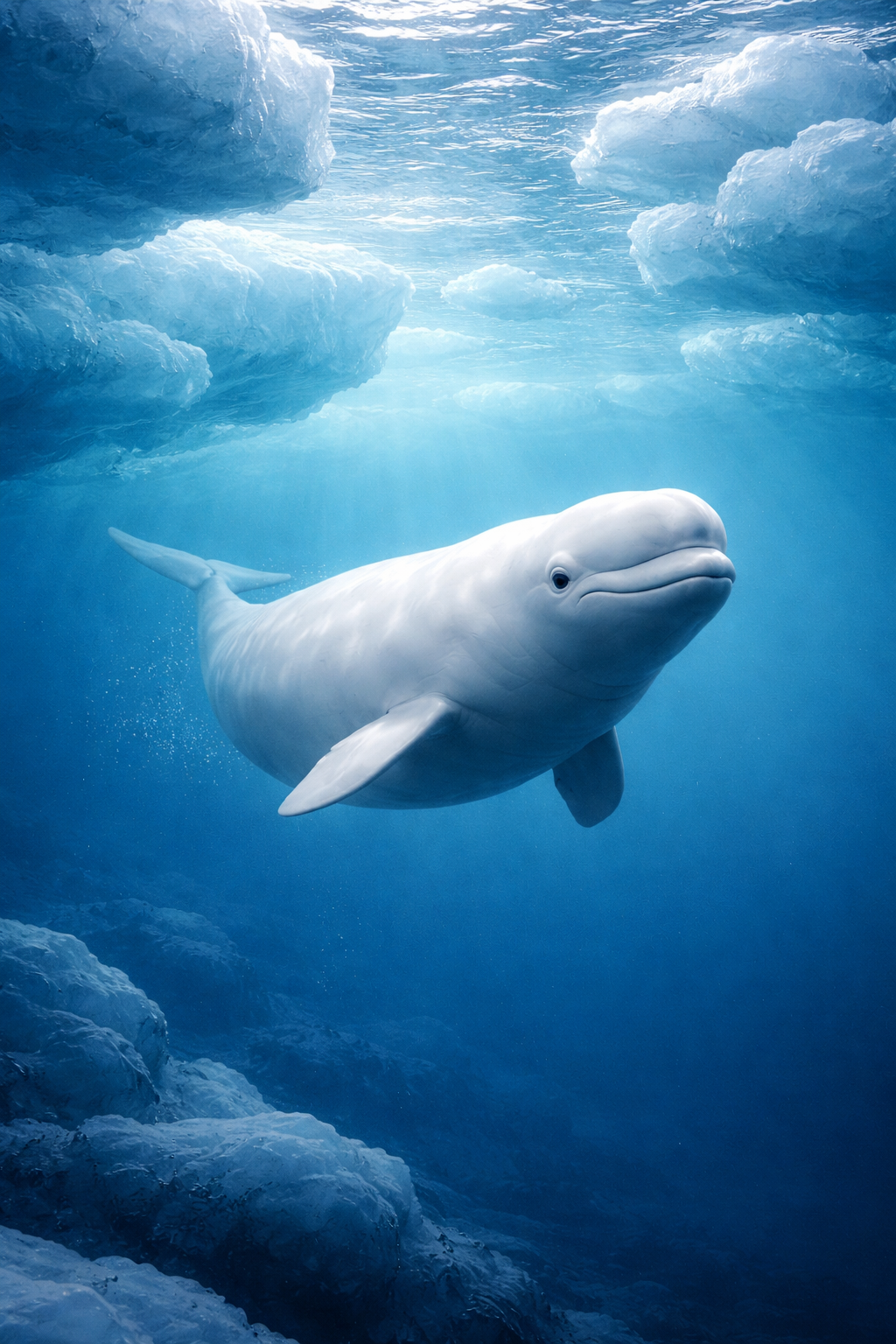
Photorealistic painting of a white beluga whale gliding through Arctic waters beneath sea ice
🐳 Wild Animals

How Old Is a Beluga Whale in Human Years?

📅 Updated March 2026 🧊 Arctic & Subarctic Oceans 🐳 Lifespan: 35–70 years

Belugas are born dark gray and spend five years slowly turning white. They are the only whale that can turn its head. They can change the shape of their forehead. They mimic human speech. And sailors on wooden ships could hear them singing through the hull — the "canaries of the sea." Meanwhile, one population in Alaska is quietly vanishing, and nobody knows why.

Calculate Beluga Age →
🐳 Beluga Whale Age in Human Years
in human years
Beluga age
Life stage
Type
🐳 What this age means

The Life Stages of a Beluga Whale

One of the most distinctive aspects of beluga development is the colour change. Calves are born dark gray — nearly charcoal — and gradually lighten through shades of blue-gray and cream over their first five years, eventually reaching the brilliant white of a fully mature adult. This gradual whitening is unique among cetaceans and gives beluga age a visible marker unlike any other whale species: the whiter the animal, the more mature it is.

0–2 years
Calf (Gray)
Born dark gray in shallow coastal waters or estuaries — often the same locations where the mother was born, generations of ancestral memory encoded in migration patterns. Calves are approximately 1.5 metres long at birth and stay close to the mother, nursing on rich milk and learning the pod's vocalisations. The mother nurses for up to two years, and the bond between mother and calf is among the most intense in cetacean life. The whole beluga pod participates in calf protection.
2–5 years
Juvenile (Blue-Gray)
The calf's coat is lightening through blue-gray toward cream. Weaned or nearly so, the juvenile is learning the full complexity of beluga social life — the pod's unique vocal dialect, migration routes, feeding grounds, and the subtle social hierarchies that govern relationships within the group. Belugas are intensely social; juvenile learning occurs within a rich social context of adults, sub-adults, and other calves whose behaviour provides constant reference points for appropriate social conduct.
5–9 years
Sub-Adult (Cream)
The coat is now cream to pale yellow — almost but not quite fully white. The sub-adult is approaching sexual maturity. Its echolocation — the sophisticated sonar system focused through the melon — is fully functional and being refined through thousands of hours of foraging. Females begin to reach sexual maturity around age 4–7; males somewhat later at 7–9 years. The sub-adult's growing vocal sophistication allows increasingly complex communication within the pod.
9–20 years
Young Adult (White)
Fully white and sexually mature. Female belugas give birth to a single calf after a 14–15 month gestation — producing one calf every 3 years on average. A young adult beluga is a fully competent member of the pod — hunter, communicator, participant in the complex social dynamics of beluga groups. Males in some populations form separate bachelor groups that travel and socialise together outside of breeding season, a social structure rarely seen in cetaceans.
20–45 years
Prime Adult
The core of the pod's social structure. Prime adults carry the accumulated knowledge of migration routes, seasonal food sources, and the vocal traditions that define their population. Females continue producing calves through their twenties and thirties. The beluga's distinctive vocal repertoire is at its most elaborate in prime adults — dozens of distinct call types used in different social contexts, from contact calls to alarm signals to mother-calf communication. Prime adult belugas are among the most acoustically sophisticated mammals on Earth.
45–80 years
Senior / Elder
Post-reproductive elder belugas remain active, vocal, and socially integrated within the pod. Like orca grandmothers, elder belugas carry knowledge of food sources and migration routes accumulated over decades — knowledge that benefits younger pod members. In captivity, belugas regularly reach 60–70 years with documented cases approaching 80. An elder beluga's white coat is often marked by the minor scars and blemishes of a long life in Arctic waters — each a record of encounters, migrations, and decades under polar ice.

Beluga Age to Human Years — With Colour Guide

Beluga AgeWild BelugaCaptive BelugaLife StageCoat Colour
BirthNewbornNewbornCalfDark gray / charcoal
1 year~6 yrs~4 yrsCalfDark gray, lightening
3 years~14 yrs~9 yrsJuvenileBlue-gray
5 years~20 yrs~13 yrsSub-adultCream / pale yellow
8 years~28 yrs~19 yrsYoung adultFully white
15 years~40 yrs~30 yrsPrime adultWhite
25 years~56 yrs~44 yrsMature adultWhite (minor scarring)
40 years~76 yrs~62 yrsSeniorWhite (experienced scarring)
60+ yearsElder~80 yrsElderWhite

🐳 The colour change from gray to white is one of the most reliable age indicators in any cetacean species. A dark gray beluga is a very young calf. A blue-gray beluga is a juvenile of 2–4 years. Cream indicates a sub-adult approaching maturity. Pure white means fully adult — at least 5 years old. This visible age marker makes it possible to estimate beluga ages from aerial photographs, which is why the colour transition is central to NOAA's beluga monitoring surveys.

Beluga Whales — A Population Vanishing in Plain Sight

While most beluga populations are globally stable, one group — the Cook Inlet belugas of Alaska — is in a category of its own. Scientists have been watching this population decline for decades with growing alarm, and recent research is beginning to reveal why recovery has proved so elusive.

📰 Ongoing — Cook Inlet Crisis
331 Belugas Left — And Scientists Don't Know Why They Won't Recover

The Cook Inlet beluga population in Alaska is one of the most intensively monitored — and most puzzling — conservation cases in marine biology. In 1979, the population was estimated at 1,293 individuals. By 2022, the latest count stood at just 331 animals — a decline of nearly 75% despite hunting having been completely banned since 2005.

The Cook Inlet belugas are listed as Endangered under the US Endangered Species Act and are one of NOAA Fisheries' designated Species in the Spotlight — reserved for animals considered most at risk of extinction and prioritised for immediate action. A comprehensive Recovery Plan with 64 specific actions was finalised in 2016.

Despite over two decades of protection and dedicated conservation effort, the population has not recovered — and the reasons remain poorly understood. Theories include noise pollution from shipping and military activity masking communication and echolocation, reduced prey availability from changing salmon runs, legacy contaminants, and climate-driven changes to their habitat. Scientists describe the situation as one of the most challenging unsolved problems in cetacean conservation.

📰 March 2024 — New Research
Beluga Metabolism Study: Their Enormous Caloric Needs May Be Part of the Problem

A study from the University of California Santa Cruz, conducted in partnership with Georgia Aquarium and published in the Journal of Experimental Biology, revealed something important about why Cook Inlet belugas may be struggling: their metabolic needs are extraordinarily high.

The research measured resting and active metabolic rates of belugas in controlled conditions — establishing baseline data that has been nearly impossible to collect in the wild. The findings showed that maintaining a cold-water Arctic lifestyle requires far more calories than previously modelled. Crucially, the researchers found that when belugas are disturbed by human activity — boats, noise, construction — they must divert calories from growth and reproduction to stress responses. In an environment already stressed by reduced salmon runs and increased shipping traffic in Cook Inlet, this energy imbalance may be tipping the population into a slow decline it cannot escape.

Lead researcher Terrie Williams put it plainly: "Wild belugas typically use calories from ingesting fish to fuel growth, activity, maintaining their health and reproducing. With increased human disturbance, calories will have to be diverted to respond to perceived threats. Such energy imbalance cannot be sustained for long periods without negative consequences."

📰 December 2024 — Conservation Technology
AI Learns to Count Belugas — Distinguishing White Whales from White Ice

One of the persistent challenges in beluga conservation has been simply counting them. Aerial surveys of Arctic waters produce thousands of images per flight, and manually identifying white belugas against white sea ice and whitecaps is extraordinarily tedious and error-prone.

Scientists at Fisheries and Oceans Canada, working with geospatial AI specialists, trained a deep learning model to automatically detect beluga whales in aerial survey imagery — achieving an 88% accuracy rate in distinguishing white belugas from sea ice and other white objects. The model, published in Remote Sensing in Ecology and Conservation in December 2024, can analyse thousands of images in hours rather than days, making large-scale Arctic surveys far more feasible.

The technology is particularly significant as beluga surveys become more urgent: belugas spend much of their time under dense Arctic ice, and as sea ice retreats due to climate change, survey methodology must evolve rapidly to track populations across newly accessible but poorly mapped waters.

📰 Ongoing — Climate Threat
Sea Ice Retreat Is Exposing Belugas to Orca Predation

Belugas have relied on dense Arctic sea ice as protection from orcas for millions of years — orcas cannot navigate under pack ice, giving belugas a refuge that no predator can follow them into. As Arctic sea ice retreats at unprecedented rates due to climate change, that refuge is disappearing.

Recent genomic research on Canadian beluga populations found that changes in beluga aggregation behaviour are directly linked to rising sea surface temperatures — whales are shifting their distribution in ways that may expose them to increased orca encounters. The same research noted that as orca populations expand northward into newly ice-free Arctic waters, belugas face a predation pressure they have not encountered in their evolutionary history and for which they have no established defensive response.

The collision of a retreating ice refuge with an expanding orca range represents one of the most concrete and immediate climate change impacts on Arctic marine mammal populations documented by researchers.

Things About Beluga Whales That Will Actually Surprise You

🎵 Canaries of the Sea
Belugas produce one of the widest vocal repertoires of any cetacean — clicks, whistles, chirps, squeals, twitters, and bell-like tones that are audible above the water surface. Early sailors on wooden-hulled ships could hear them singing through the hull, earning the nickname "canaries of the sea." Their calls function in echolocation, social bonding, mother-calf communication, and possibly individual identification. Research published in Current Biology documented a captive beluga producing vocalisations that closely matched human speech rhythms — a remarkable demonstration of vocal learning ability that has been recorded in only a handful of non-human species.
🔄 The Only Whale That Can Turn Its Head
Belugas have unfused cervical vertebrae — unlike virtually all other whales and dolphins, whose neck vertebrae are fused into a rigid structure. This gives belugas the ability to turn their heads independently of their bodies, nod, and look around in ways no other cetacean can. Combined with their flexible, changeable melon and expressive facial musculature, this makes belugas uniquely capable of directed, face-to-face social interaction — possibly contributing to the sophistication of their social lives and their apparent responsiveness to human presence that makes them so popular in aquarium settings.
🧊 Built for Arctic Life
Belugas are among the most specialised Arctic mammals. They lack a dorsal fin — allowing them to swim directly under sea ice without obstruction. They have an exceptionally thick blubber layer (up to 15cm) for insulation in near-freezing water. Their white colouration provides camouflage against ice. They can break through ice up to 5cm thick to create breathing holes. And their melon — the echolocation organ — is particularly sophisticated, allowing precise navigation in the complex acoustic environment beneath sea ice, where sound reflects and bounces unpredictably. Research has found that belugas can adjust their echolocation beam width — a capability previously thought impossible for toothed whales.
🕵️ Hvaldimir — The Russian Spy Whale
In April 2019, a beluga whale appeared off the coast of Norway wearing a harness labelled "Equipment St. Petersburg." Norwegian fishermen removed the harness; the whale — quickly named Hvaldimir — was sociable, apparently trained, and appeared to have been released from or escaped Russian military custody. Russian naval forces are known to train marine mammals including belugas and dolphins for tasks including equipment recovery, harbour patrol, and potentially attaching devices to ship hulls. Hvaldimir spent subsequent years along the Norwegian and Swedish coasts, becoming something of a celebrity — approaching boats and fishermen with apparent curiosity and playfulness. His story remains one of the most unusual episodes in modern marine mammal history.
🧠 Memory & Social Intelligence
Belugas are highly intelligent with complex social lives. They form fluid, multi-level social networks — stable core groups embedded within larger, shifting associations that researchers have compared to human social network structures. They cooperate in hunting, share information about food locations, and appear to maintain long-term social relationships. Studies of captive belugas have demonstrated impressive cognitive abilities including mirror self-recognition (indicating self-awareness), problem-solving, and the ability to learn and retain novel tasks over extended periods. Their vocal learning — the ability to acquire new sounds by imitation — is among the most developed of any non-human animal.
🌊 River Whales
Belugas are one of the few whale species that regularly enters freshwater rivers — ascending rivers to calving grounds and summer feeding areas in ways that no other large cetacean does routinely. St. Lawrence Estuary belugas enter river systems; Arctic belugas travel up rivers to give birth in warm, shallow water protected from orcas. This river-going behaviour has deep evolutionary roots and is a critical part of their reproductive biology — but it also makes belugas uniquely vulnerable to freshwater pollution, river traffic, and the industrial development of river systems that other whale species never encounter. The St. Lawrence beluga population, once hunted heavily and now exposed to PCB contamination from industrial runoff, remains listed as Endangered in Canada.

🐳 The beluga's melon — the rounded, bulbous forehead — is not merely decorative. It is a sophisticated echolocation organ filled with lipid-rich tissue that focuses and directs sonar clicks produced in the nasal passages. What makes the beluga's melon extraordinary is that it can change shape — the beluga can alter the geometry of the melon using muscular control, adjusting the direction and beam width of its echolocation with a precision that researchers are still working to fully understand. This gives belugas among the most flexible and powerful biosonar systems of any toothed whale — essential for navigating the acoustically complex environment beneath Arctic sea ice.

Beluga vs Other Arctic Cetaceans

Belugas share the Arctic with a small number of other cetacean species. Here's how they compare.

SpeciesSizeRangeLifespanNotable Trait
Beluga Whale3–5.5m, ~1,500kgArctic & Subarctic35–70 yrsOnly whale that can turn its head; born gray, turns white
Narwhal4–6m, ~1,600kgHigh Arctic~50 yrsSpiralled tusk (modified tooth); most ice-dependent cetacean
Bowhead Whale14–18m, ~100 tonnesArctic200+ yrsLongest-lived mammal; breaks ice with head to breathe
Orca6–9m, up to 5.4 tonnesAll oceans incl. ArcticUp to 90 yrsApex predator; beluga's primary predator; expanding Arctic range
Harbour Porpoise1.4–1.9m, ~55kgTemperate/Subarctic~20 yrsSmallest cetacean in the North Atlantic; frequent coastal bycatch victim

Other Ocean Animals on PawClocks

Frequently Asked Questions

Belugas are born dark gray and gradually lighten over their first five years, becoming the characteristic pure white of a mature adult. The white coloration provides camouflage against Arctic sea ice. The gradual whitening is driven by melanin reduction as the whale matures. A gray beluga is therefore a young one; a blue-gray beluga is a juvenile; cream indicates a sub-adult; and pure white means fully adult — at least 5 years old.
Belugas are unique among cetaceans in having unfused neck vertebrae that allow them to turn their heads — other whales cannot do this. Their melon (the rounded forehead organ) can also change shape using muscular control. Combined with expressive facial musculature, this creates the impression of varied expressions including the famous beluga "smile." The smile is partly anatomical — the structure of the beluga's jaw — but belugas are genuinely highly social animals with rich emotional lives.
The global beluga population is listed as Least Concern by the IUCN, with 150,000–200,000 individuals worldwide. However, specific populations face very different situations. The Cook Inlet beluga population in Alaska is Endangered — with only 331 individuals in 2022, down from 1,293 in 1979. Despite hunting being banned since 2005, this population has not recovered. The St. Lawrence Estuary population in Canada is also listed as Endangered.
Belugas produce an extraordinary range of sounds — clicks, whistles, chirps, squeals, twitters, and bell-like tones audible above the water surface. Early sailors on wooden-hulled ships could hear them singing through the hull, earning the nickname "canaries of the sea." A captive beluga has even been documented producing vocalisations matching human speech rhythms — one of very few non-human animals to demonstrate this level of vocal learning.
The melon is the rounded, bulbous forehead that gives belugas their characteristic profile. It is a specialised organ filled with lipid-rich tissue that focuses and directs echolocation clicks. What makes the beluga's melon unique is that it can change shape — allowing the whale to precisely direct echolocation beams in different directions. This flexibility makes belugas one of the most sophisticated echolocators among cetaceans. Changes in melon shape also contribute to the impression of varied facial expressions.
In April 2019, a friendly beluga whale appeared off northern Norway wearing a harness labelled "Equipment St. Petersburg." Norwegian fishermen removed the harness; the whale — named Hvaldimir — was clearly accustomed to humans and appeared to have been trained. Russian naval forces are known to train marine mammals for military purposes. Hvaldimir spent subsequent years along the Norwegian and Swedish coasts, becoming famous for approaching fishing boats and playing with objects thrown into the water. His story is one of the most unusual episodes in modern marine mammal history.
Yes — belugas regularly enter freshwater rivers, making them one of the very few whale species to do so. Arctic belugas travel up rivers to give birth in warm, shallow water that is safer from orca predation. St. Lawrence Estuary belugas use river estuaries as core habitat. This river-going behaviour makes them uniquely vulnerable to freshwater pollution, river traffic, and industrial development — threats that no purely marine whale ever encounters.