🌊 Seahorse Age in Human Years
—
in human years
—
—
Seahorse age
—
Life stage
—
Species
🌊 What this age means
—
Species Guide
Four Seahorse Types
🌊 Common Seahorse
Hippocampus erectus / kuda
Lifespan3–5 yrs wild
SizeUp to 17 cm
RangeAtlantic, Indo-Pacific
StatusVulnerable
🌊 Big-belly Seahorse
Hippocampus abdominalis
LifespanUp to 10 yrs captive
SizeUp to 35 cm — largest species
RangeAustralia, New Zealand
StatusData Deficient
🌊 Dwarf Seahorse
Hippocampus zosterae
Lifespan~1 yr wild
Size2.5 cm — world's smallest
Speed1.5 m/hr — world's slowest fish
RangeGulf of Mexico, Bahamas
🌊 Captive Seahorse
Various Hippocampus spp.
Lifespan3–7 yrs with good care
DietLive/frozen mysis shrimp
DifficultyAdvanced — specialist care
NoteCaptive-bred only recommended
Fascinating Facts
Things About Seahorses That Will Actually Surprise You
🤰 The Pregnant Male
The seahorse is the only animal in the world where the male carries a true pregnancy and gives birth. The female deposits her eggs into the male's specialised brood pouch on his abdomen — he fertilises them internally, and the pouch provides everything the embryos need: oxygen, nutrients, regulated salinity, and immune protection. Gestation lasts 10–45 days depending on species and water temperature. The male gives birth through muscular contractions, sometimes ejecting hundreds of miniature, fully-formed seahorses in a single event. Within hours of giving birth he can become pregnant again. This role reversal is believed to have evolved because it allows the female to produce the next batch of eggs while the male is gestating — maximising reproductive output for both partners.
💑 Morning Greetings
Seahorses are monogamous — they form pair bonds that last for the breeding season and in many species for life. Each morning the bonded pair performs a greeting ritual: they change colour, intertwine their tails, and swim together in a coordinated display that can last up to an hour. Researchers believe this daily ritual reinforces the pair bond and allows each partner to assess the other's health and reproductive readiness. Females visit males in their territory once per day during this ritual. If a partner dies, the surviving seahorse may enter a prolonged mourning period before accepting a new mate — sometimes refusing to breed for weeks.
🍽️ No Stomach
Seahorses have no stomach — food passes directly from mouth through a short intestine and out. This means digestion is extremely inefficient and nutrients are absorbed poorly. To compensate, seahorses must eat almost constantly — up to 3,000 brine shrimp per day. They are ambush predators, using their prehensile tails to anchor themselves to seagrass and coral, then waiting motionlessly for tiny crustaceans to drift past. They strike with one of the fastest feeding movements in the animal kingdom — the head snaps forward with a sucking action that draws prey in before it can react. Their tube-shaped snout can rotate to increase strike range.
🐢 World's Slowest Fish
The dwarf seahorse holds the Guinness World Record as the slowest fish — it moves at a maximum speed of approximately 1.5 metres per hour. Seahorses swim upright, propelled by a tiny dorsal fin that beats up to 35 times per second and steered by small pectoral fins near the head. Their body shape — evolved for camouflage and ambush hunting, not speed — makes them energetically costly swimmers. They solve this problem elegantly: rather than swimming to food, they anchor themselves with their prehensile tail and wait for food to come to them. In currents too strong to resist, they simply grip on and hold until conditions change.
🎭 Master of Disguise
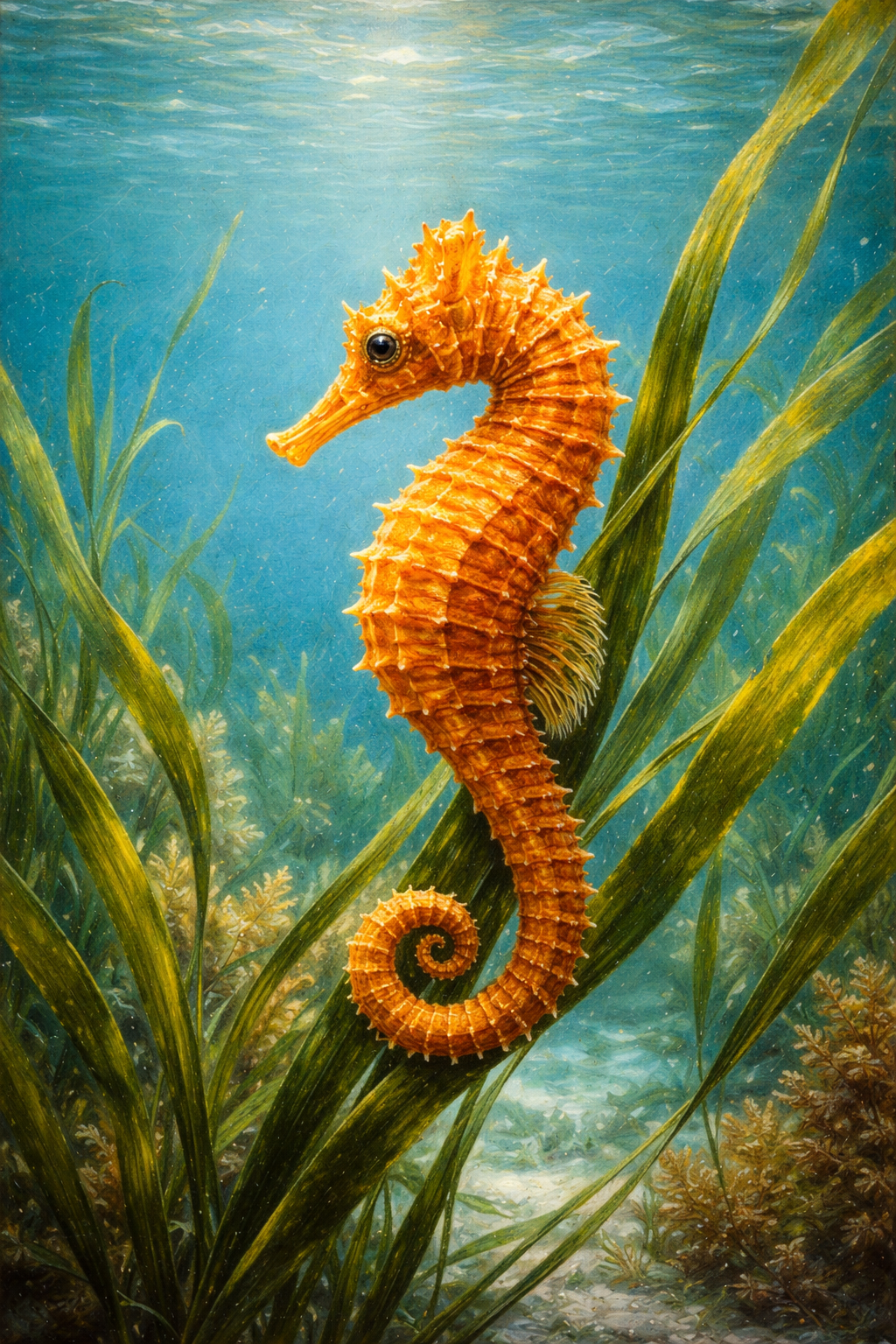
Seahorses are extraordinary camouflage artists — they can change colour and skin texture to match their surroundings with remarkable precision. Pygmy seahorses (some under 1cm long) match their host gorgonian coral so perfectly that they were essentially unknown to science until the 1960s, despite living in heavily dived areas. Their skin contains chromatophores (colour-changing cells) and they can also grow skin filaments that mimic the texture of seagrass and algae. A seahorse sitting motionlessly in seagrass is virtually invisible to both predators and prey. Despite this camouflage, they are still heavily predated — crabs, tuna, rays, and penguins all take them.
💊 The Trade Crisis
An estimated 150 million seahorses are traded annually — the vast majority dried for use in traditional Chinese medicine (TCM), where they are prescribed for a range of conditions. Seahorses are also sold as curios, aquarium fish, and in some regions as food. All seahorse species are listed under CITES Appendix II, requiring export permits, but enforcement is inconsistent and illegal trade continues at scale. Habitat destruction — particularly seagrass meadow loss and coral reef degradation — compounds the pressure from direct harvest. Project Seahorse estimates that several species have declined by over 50% in recent decades. The combination of slow reproduction, monogamy, and low population density makes seahorses particularly vulnerable to harvest pressure.
More Animals
More Weird & Viral Animals
FAQ
Frequently Asked Questions
Seahorses can be kept in aquariums but they are considered advanced-level marine animals requiring specialist care. They need a species-only or very carefully chosen tank (most fish outcompete them for food or harass them), live or frozen mysis shrimp fed multiple times daily, excellent water quality, low water flow, and plenty of hitching posts. They are highly susceptible to bacterial infections and stress-related illness. Only captive-bred seahorses should be purchased — wild-caught individuals are far harder to transition to captive food sources and their collection depletes already stressed wild populations. Captive-bred seahorses from reputable specialist breeders are typically already eating frozen mysis and are much more robust. Lifespan in captivity with excellent care is 3–6 years for most species.
The number of young produced per birth varies enormously by species and the size of the male's brood pouch. Small species like the dwarf seahorse typically give birth to 5–50 young per brood. Medium species like the lined seahorse produce 100–300 young. Large species like the big-belly seahorse can give birth to over 1,000 miniature seahorses in a single event. Despite these large numbers, juvenile survival rates in the wild are extremely low — most estimates suggest fewer than 1 in 1,000 juveniles survives to breeding age, due to predation, currents, and starvation. The high birth numbers compensate for the very high early mortality rate.
Yes — seahorses are true fish, belonging to the family Syngnathidae (which also includes pipefish and sea dragons). They have a swim bladder for buoyancy control, breathe through gills, and are cold-blooded. Their bony external skeleton (made of interlocking plates rather than scales) and upright posture are unusual among fish but don't change their fundamental classification. They are most closely related to pipefish — elongated, tube-snouted fish that share the same male pregnancy strategy. Sea dragons (leafy and weedy) are also closely related and similarly spectacular. The genus Hippocampus contains approximately 46 recognised species, ranging from the 2.5cm dwarf seahorse to the 35cm big-belly seahorse.