Popular Pets
🐶 Dog 🐱 Cat 🐰 Rabbit 🐹 Hamster 🐾 Guinea Pig 🦜 Parrot 🦡 Ferret 🐀 Rat 🐭 Chinchilla 🦔 Hedgehog 🐟 Goldfish 🦜 Macaw
Farm & Large Animals
🐴 Horse 🐄 Cow 🐄 Highland Cow 🐷 Pig 🐑 Sheep 🐐 Goat 🐴 Donkey 🦙 Alpaca 🐐 Mountain Goat 🐔 Chicken 🦆 Duck 🦃 Turkey
Wild Animals
🐘 Elephant 🦁 Lion 🐯 Tiger 🐆 Leopard 🐺 Wolf 🐻 Bear 🐻‍❄️ Polar Bear 🦍 Gorilla 🐒 Chimpanzee 🦧 Orangutan 🦘 Kangaroo 🐾 Capybara 🦒 Giraffe 🦊 Fox 🦅 Raptor 🦉 Owl 🐧 Penguin 🦩 Flamingo 🐾 Hyena 🐾 Meerkat 🦥 Sloth 🦡 Badger 🐾 Wolverine 🐾 Armadillo
Ocean & Aquarium
🦈 Shark 🐋 Orca 🐬 Dolphin 🐋 Whale 🐋 Blue Whale 🐳 Beluga Whale 🦄 Narwhal 🐋 Bowhead Whale 🐾 Manatee 🐟 Manta Ray 🐟 Freshwater Fish 🐠 Saltwater Fish 🐴 Seahorse 🐟 Koi
Exotic & Weird
🐍 Snake 🐍 Ball Python 🦎 Bearded Dragon 🦎 Iguana 🦎 Komodo Dragon 🦎 Chameleon 🦎 Leopard Gecko 🐢 Tortoise 🐢 Snapping Turtle 🐢 Sea Turtle 🐊 Crocodilian 🕷️ Tarantula 🦎 Axolotl 🐙 Octopus 🌊 Jellyfish 🦞 Lobster 🐚 Quahog 🔬 Tardigrade
Info
About FAQ Contact
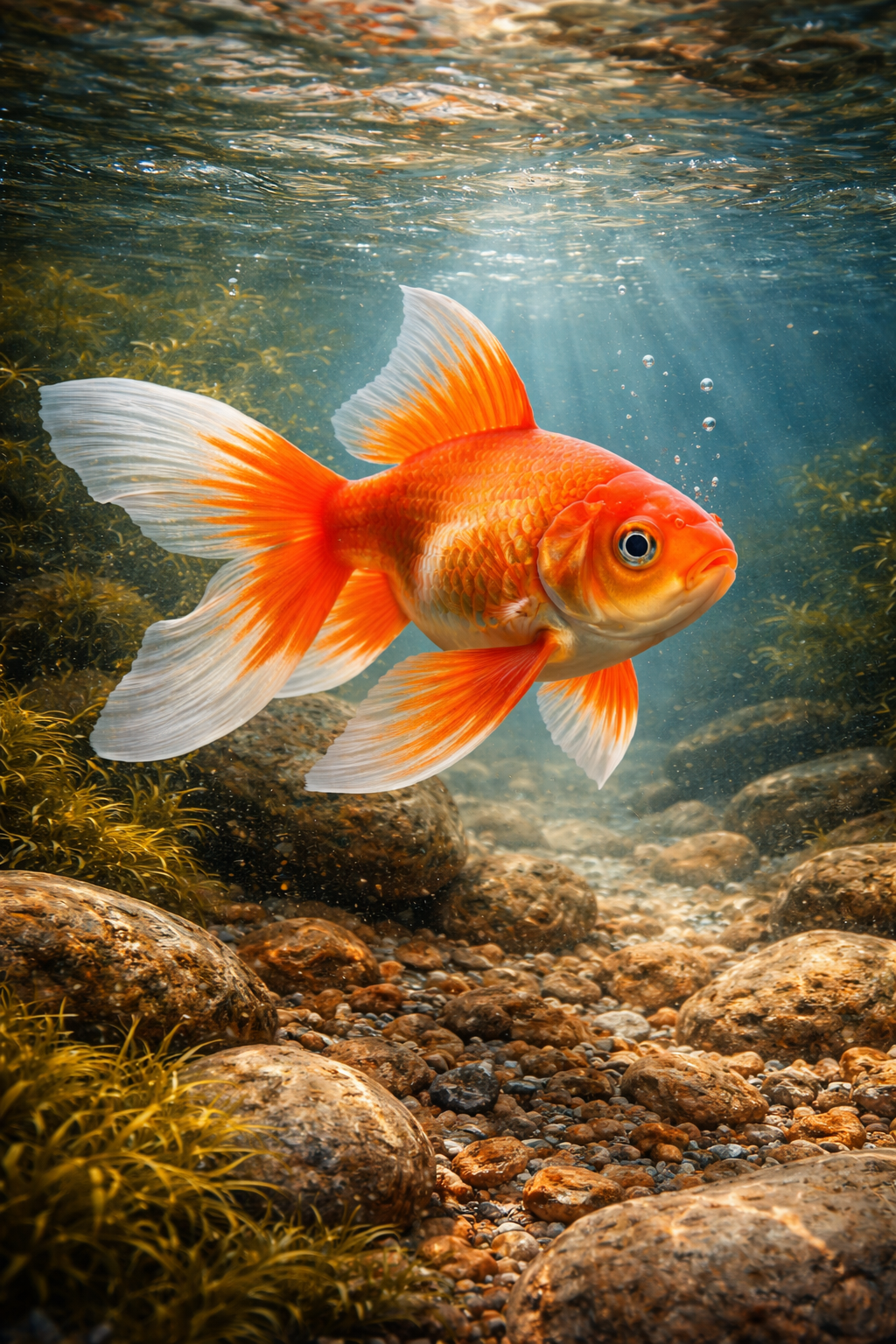
A vivid orange goldfish swimming in clear water with light rays from the surface
🐠 Popular Pets

How Old Is Your Goldfish in Human Years?

📅 Updated 🔬 Verified lifespan data 🐠 Memory longer than 3 seconds

The 3-second memory is a myth. Goldfish can remember things for months, recognise their owners, and navigate mazes. They can also live over 20 years — far longer than most people expect from a fish in a bowl.

Calculate My Goldfish's Age →
🐟 Fish Age in Human Years
in human years
Fish age
Life stage
Species
🐟 What this age means

Common Aquarium Fish — Lifespan Guide

Most pet store fish are sold with little information about lifespan expectations. Here's what the science actually shows — and why "starter fish" is often a misleading label.

🐟
Goldfish
Carassius auratus
Avg lifespan10–15 yrs
Record43 years
Tank size needed75L+ per fish
Common myth3-second memory — false
🐠
Betta / Siamese Fighting Fish
Betta splendens
Avg lifespan2–5 yrs
Record~10 years
Sold at6–12 months old
Common mythHappy in tiny cups — false
🐟
Guppy
Poecilia reticulata
Avg lifespan1.5–3 yrs
Record~5 years
NoteProlific breeders
Tank size40L minimum
🐟
Neon Tetra
Paracheirodon innesi
Avg lifespan3–5 yrs (up to 10)
Wild lifespanUp to 10 yrs
School size6+ minimum
Tank size60L minimum
🐟
Oscar / Cichlid
Astronotus ocellatus
Avg lifespan10–15 yrs
Record20+ years
Adult size30–45 cm
Tank size needed400L+
🐟
Common Pleco
Hypostomus plecostomus
Avg lifespan10–15 yrs
Adult size30–60 cm
Common mistakeBought to "clean" tank
Tank size needed380L+
🐟
Angelfish
Pterophyllum scalare
Avg lifespan8–12 yrs
Record~15 years
NoteMay eat smaller tankmates
Tank size120L+ tall tank
🐟
Molly / Platy
Poecilia sphenops
Avg lifespan3–5 yrs
NoteHardy, good for beginners
BreedingLivebearers — breed easily
Tank size60L minimum
🐠 The Betta Truth — What Pet Stores Don't Tell You
Bettas sold in pet stores are typically 6–12 months old already — meaning a "new" betta may already be close to the midpoint of its 2–5 year lifespan. The tiny cups they're sold in are shipping containers, not appropriate housing — a betta in a cup is under extreme stress. Bettas need a minimum 20-litre heated, filtered tank with a gentle flow (their long fins are easily damaged by strong currents), hiding places, and ideally some plants. Males cannot be kept together (hence "Siamese fighting fish"), but females can form groups called "sororities" in large enough tanks. With proper care, bettas can reach 5–7 years. Most live 1–2 years because of poor conditions. The betta is arguably the most consistently mistreated fish in the aquarium trade, due to misinformation about its needs.

Goldfish Age to Human Years

Goldfish AgeHuman EquivalentBetta EquivalentLife Stage
3 months~2 yrs~8 yrsFry / juvenile
6 months~4 yrs~16 yrsYoung fish
1 year~8 yrs~28 yrsYoung adult
2 years~15 yrs~55 yrsAdult
5 years~30 yrsElderPrime adult
8 years~45 yrsMature
12 years~62 yrsSenior
20 years~88 yrsElder
43 yearsRecordWorld record goldfish

🐟 The oldest verified goldfish was Tish, owned by the Herd family in Thirsk, North Yorkshire, UK, who won Tish at a fairground in 1956 and died in 1999 aged 43 years. The oldest koi on record was Hanako, a Japanese koi who died in 1977 aged 226 years — confirmed by annual growth rings in her scales, the same method used to age trees. Age determination from scale rings (sclerology) is the standard method for ageing fish.

Things About Goldfish That Will Actually Surprise You

🧠 The 3-Second Memory Myth
The 3-second memory claim has no scientific basis whatsoever. Goldfish have been trained to push levers for food, navigate mazes, and respond to specific signals — all of which they retained over weeks and months of repeated testing. In 2008, 15-year-old Rory Stokes demonstrated through a school project that goldfish remembered a route through a maze for at least a month. The myth likely arose from the observation that goldfish don't flee repeated stimuli, which is habituation — a sign of memory functioning normally, not absence of it.
🔴 No Red in Their Vision
Goldfish can see a broader spectrum of light than humans, including ultraviolet light that is invisible to us. However, their colour vision differs significantly from ours. They are tetrachromats — possessing four types of colour receptors compared to humans' three. They are particularly sensitive to changes in UV light patterns, which affects how they perceive their environment. This is one reason why the colour of aquarium lighting matters for goldfish wellbeing — not just for our aesthetic appreciation of their colour.
📏 Tank Size Matters — A Lot
Goldfish do not "grow to the size of their tank." This is a myth. Goldfish in small tanks remain stunted but are experiencing organ compression and chronic stress, not healthy small growth. A single common goldfish needs a minimum 75-litre tank; fancy (double-tailed) goldfish need similar volumes with lower oxygen requirements. Goldfish produce more ammonia waste per body weight than most aquarium fish and require excellent filtration. The idea that a small bowl is adequate for a goldfish has caused the premature death of countless animals.
🌊 Wild Goldfish
Domestic goldfish are descended from wild carp (Carassius auratus) selectively bred in China for over 1,000 years — one of the oldest examples of ornamental selective breeding. Released goldfish revert toward wild-type colouration within a few generations — their orange/gold colour is the result of selective breeding, not natural camouflage. In Australia, escaped goldfish have become a significant ecological pest in river systems, growing to 50+ cm, destroying aquatic vegetation, and destabilising riverbeds through their bottom-feeding behaviour.
🥊 Betta Combat & Territoriality
Male betta fish are highly aggressive toward other males due to intense sexual selection pressure in their native slow-moving Thai and Southeast Asian waterways. In the wild, males establish territories in small areas. Captive male bettas will fight to the death if housed together — hence "Siamese fighting fish." Bettas have been selectively bred for aggression and fin display in Thailand for centuries, with betting on betta fights documented as early as the 13th century. Female bettas can coexist in groups of 5+ in a suitably large tank, known as a sorority, though introductions require careful management.
🌬️ Labyrinth Organ
Bettas and other labyrinth fish (gouramis, paradise fish) have a specialised breathing organ called the labyrinth organ — a chamber above the gills filled with folded membranes that allows them to extract oxygen directly from air at the water's surface. This adaptation evolved in warm, oxygen-depleted rice paddies and shallow pools of Southeast Asia. It means bettas must have access to the water's surface to breathe — covering the tank completely can be fatal. It also means they can tolerate lower oxygen levels than most fish, though this is regularly misused to justify poor housing conditions.

🐟 Common plecos (Hypostomus plecostomus) are sold as "algae eaters" to "clean" tanks, but the reality is that adult common plecos reach 30–60 cm in length and require tanks of 380 litres or more. They produce enormous amounts of waste, making water quality worse, not better. A bristlenose pleco (Ancistrus sp.) is a far more appropriate algae-eating species for home aquariums — maxing out at 12–15 cm and manageable in 80-litre tanks. The common pleco is one of the most consistently over-sold and under-informed purchases in the aquarium trade, resulting in massive numbers of fish being surrendered or flushed as they outgrow their tanks.

Other Aquatic & Exotic Pets

Frequently Asked Questions

A 5-year-old goldfish is roughly equivalent to a 30-year-old human — well into prime adult life. By this point a goldfish with good care is established in its environment, fully coloured, and potentially approaching peak size. A goldfish reaching 5 years is doing reasonably well — though with good conditions (proper tank size, water quality, temperature, and diet) they should have another decade or more ahead of them.
In genuinely good conditions — a heated 20+ litre tank with a gentle filter, stable water chemistry, quality food, and no tankmate stress — bettas regularly live 4–5 years and sometimes reach 7. The average betta lives 1–2 years, primarily because of inadequate housing. The small cup bettas are sold in is a temporary transport container that creates severe stress through temperature fluctuation, ammonia build-up, and isolation stress. A betta purchased from a pet store at 6–12 months old and given proper care immediately can expect a 3–5 year lifespan from purchase. The species record is around 10 years.
Yes — with appropriate care, goldfish regularly live 15–20 years, and verified records go to 43 years. The key factors are: adequate tank volume (75+ litres per fish, not a bowl), excellent filtration (goldfish produce significantly more ammonia than most tank fish), appropriate temperature (goldfish are cold-water fish — they do not want tropical tank temperatures), a varied quality diet, and minimal stress from overcrowding. Most pet store goldfish live 2–4 years because they are housed in undersized, under-filtered tanks at inappropriate temperatures. The goldfish's potential lifespan and its typical realised lifespan are very different numbers.
Yes — neon tetras are often marketed as beginner fish, but they are actually quite sensitive to water quality. They require soft, slightly acidic water (pH 6.0–7.0) and are highly susceptible to "neon tetra disease" (caused by a microsporidian parasite, Pleistophora hyphessobryconis) and ich (white spot). They are schooling fish that should be kept in groups of at least 6, preferably 10+. In a well-maintained tank with appropriate water parameters, neon tetras can live 5–8 years. Most only live 1–2 years in captivity due to water quality issues or disease. Cardinal tetras (visually similar, slightly larger) are generally more robust.
Among true "aquarium fish," goldfish and oscars can live 15–20 years with good care. Koi, kept in outdoor ponds rather than tanks, regularly live 25–35 years and can exceed 200 years — the famous Hanako koi was verified at 226 years by scale ring analysis. Among freshwater species more broadly, some large catfish (such as the redtail catfish or Arapaima) can exceed 20 years. In marine aquariums, the freshwater eel-like moray and some marine angelfish can live 20+ years. The longest-lived fish overall is the ocean quahog clam — not a fish — and among vertebrates, the Greenland shark which may live 400+ years.