🦈 Shark Age in Human Years
—
in human years
—
—
Shark age
—
Life stage
—
Species
🦈 What this age means
—
Species Guide
Six Sharks, Six Completely Different Clocks
Shark lifespans vary more wildly than almost any other group of animals. A hammerhead shark lives 30 years. A Greenland shark may live 500. Understanding the species is everything.
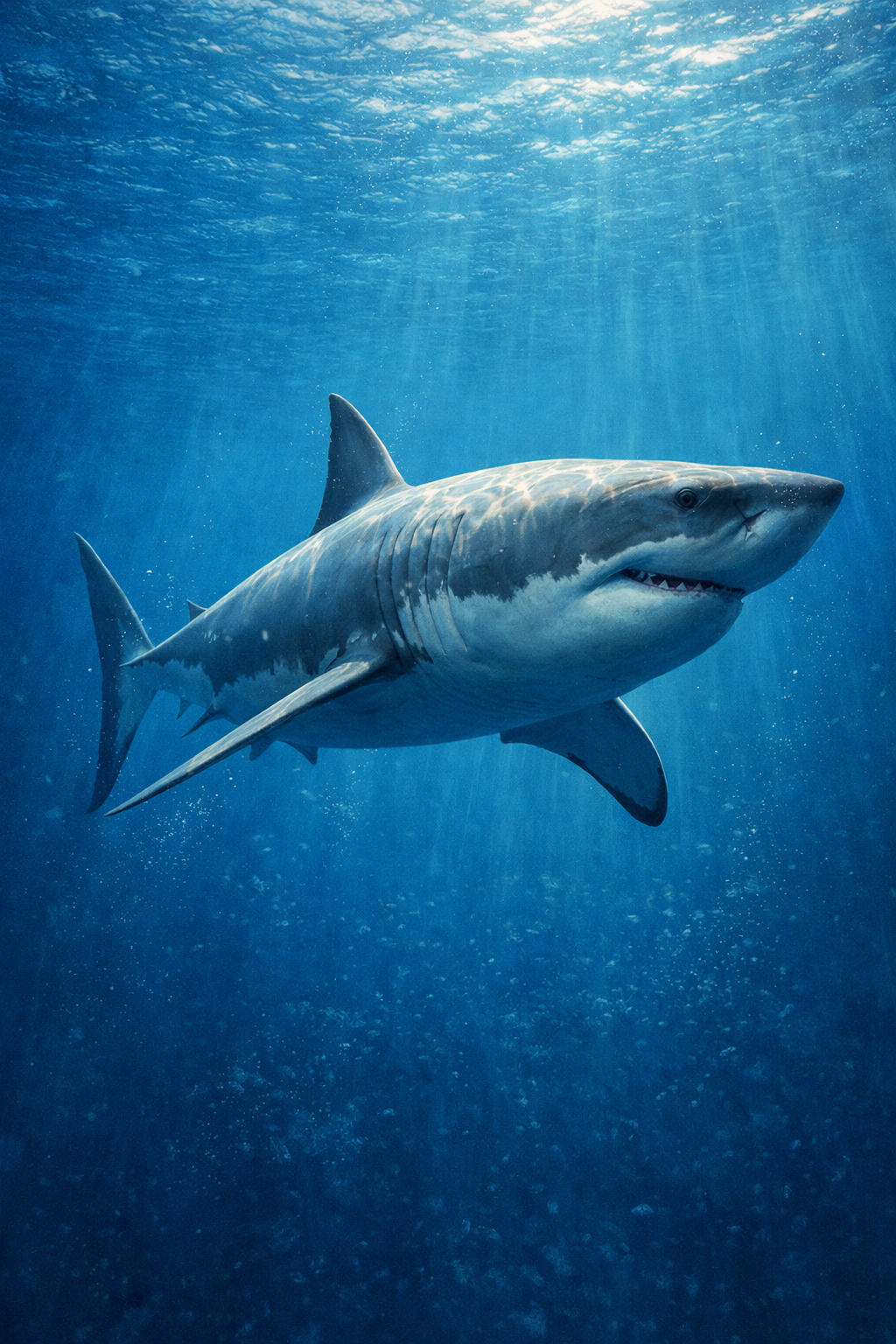
🦈 Great White Shark
70+ years — previously thought to be 25
Scientists dramatically revised great white lifespan upward in 2014. A 70-year-old great white is entirely possible — and terrifying to contemplate. Listed as Vulnerable by the IUCN.
🧊 Greenland Shark
272–512 years (estimated)
The longest-lived vertebrate on Earth. They reach sexual maturity at around 150 years old. One specimen was estimated to be 392 years old — born around 1627. They grow at just 1 cm per year.
🐋 Whale Shark
80–130 years (estimated)
The largest fish on Earth — up to 40 feet long — and one of the most peaceful. They filter-feed on plankton. Their exact lifespan is still being researched; estimates keep increasing.
🐯 Tiger Shark
40–50 years avg
One of the most dangerous sharks to humans — second only to great whites in unprovoked attacks. Eat almost anything, including licence plates. Near Threatened on the IUCN Red List.
🔨 Hammerhead Shark
25–35 years avg
The distinctive hammer-shaped head provides 360-degree vertical vision — they can see above and below simultaneously. Most hammerhead species are Endangered or Critically Endangered.
⚡ Shortfin Mako
28–35 years avg
The fastest shark on Earth — up to 45 mph. Warm-blooded like great whites. Listed as Endangered on the IUCN Red List due to heavy fishing pressure. Leaps out of the water when hooked.
The Greenland Shark in History
What a 400-Year-Old Shark Has Lived Through
The oldest Greenland shark ever estimated was born around 1627. Here's what was happening in the world during its lifetime — a shark that is, in human terms, not yet elderly.
~1627
Born. The Thirty Years' War is raging in Europe. Shakespeare has been dead for 11 years. The Mayflower landed just 7 years ago. The shark enters the North Atlantic.
~1700
~73 years old. Isaac Newton has just published his laws of motion. The shark is still a juvenile — decades from sexual maturity. Peter the Great is modernizing Russia.
~1776
~149 years old. America declares independence. The shark is just reaching sexual maturity. Mozart is 20 years old.
~1865
~238 years old. The American Civil War ends. The shark is fully adult, in prime condition. Charles Darwin published On the Origin of Species 6 years ago.
~1969
~342 years old. Humans land on the Moon. The shark continues its slow patrol of the Arctic deep. The Beatles release Abbey Road. The shark is, by human standards, middle-aged.
~2026
~399 years old. Possibly still alive right now, somewhere in the North Atlantic. In human years — approximately 75. A senior, but not ancient. Still hunting. Still patient.
Fascinating Facts
Things About Sharks That Will Actually Surprise You
🌍 Global Population & Threat
There are approximately 500 species of sharks. According to the IUCN Red List, over one-third of all shark and ray species are threatened with extinction. An estimated 100 million sharks are killed by humans each year — overwhelmingly for their fins.
🔬 How Scientists Date Sharks
For most sharks, scientists count growth bands in vertebrae — like tree rings. For Greenland sharks, which lack calcified vertebrae, researchers used radiocarbon dating of the eye lens nucleus — tissue formed at birth that never changes. This 2016 study in Science produced the 272–512 year estimates.
🧬 Older Than You Think
Great white shark lifespan was dramatically revised from 25 to 70+ years in a 2014 study using radiocarbon dating of vertebrae. The original 25-year estimate was based on growth band counting — a method that was simply miscounting. Their slow growth and late sexual maturity (around 15 years) make them especially vulnerable to overfishing.
🦷 Teeth That Never Run Out
Sharks are polyphyodonts — they grow new teeth continuously throughout their lives. A great white may go through 30,000 teeth in a lifetime, replacing lost ones in as little as 8 days. Shark teeth are the most common vertebrate fossil found because they shed them constantly.
⚡ Electroreception
Sharks can detect the electrical fields generated by other animals' muscle contractions through organs called the ampullae of Lorenzini. This allows them to detect prey hiding under sand and navigate using Earth's magnetic field. Great whites can sense electrical fields as weak as one-billionth of a volt.
📊 Attacks vs. Reality
Worldwide, sharks kill an average of 5–10 humans per year. Humans kill approximately 100 million sharks per year. You are more likely to be killed by a vending machine, a champagne cork, or a cow than by a shark. The fear is dramatically disproportionate to the actual risk.
Age Comparison
Greenland Shark Age in Human Years
Using proportional lifespan mapping against a human lifespan of 80 years, with a maximum Greenland shark lifespan of 400 years. Note how the comparison reframes time completely.
| Greenland Shark Age | Human Equivalent | Historical Context |
|---|---|---|
| 50 years | ~10 yrs | A child — still growing slowly in the Arctic dark |
| 100 years | ~20 yrs | Teenager — still decades from sexual maturity |
| 150 years | ~30 yrs | Young adult — just reaching reproductive age |
| 200 years | ~40 yrs | Prime adult — born around the American Revolution |
| 275 years | ~55 yrs | Mature — the minimum estimated lifespan per the 2016 Science study |
| 350 years | ~70 yrs | Senior — born when Shakespeare's works were being first published |
| 400 years | ~80 yrs | Elder — born before the Thirty Years' War ended |
| 512 years | ~100 yrs | Maximum estimate — born around the time Columbus reached America |
In the News
Sharks in the Headlines
From groundbreaking eDNA detection to Mediterranean poaching and climate resilience research, sharks have been generating major scientific news in 2025 and 2026.
Journal of Experimental Biology · March 2026
Great Hammerheads Are Masters of the "Thermal Hustle" in Warming Oceans
New FIU research published in the Journal of Experimental Biology found that great hammerhead sharks maintain near-peak hunting performance across a surprisingly wide range of ocean temperatures — unlike most predators, which slow significantly when temperatures shift from their optimum. Biologging data from nine hammerheads off Florida and the Bahamas showed their performance decline outside optimal temperatures is minimal, suggesting the critically endangered species may tolerate climate-driven ocean warming better than previously feared.
Read the full story →
ScienceDaily · November 2025
eDNA Test Detects Endangered Hammerhead Sharks from Seawater Alone
A Florida International University scientist developed a revolutionary environmental DNA test that detects critically endangered hammerhead shark species using only seawater samples — no netting, tagging, or even sighting required. The test identifies genetic traces naturally shed by the sharks and can pinpoint conservation hotspots along their Pacific coast range. The technique could transform how researchers monitor rare and elusive shark populations worldwide.
Read the full story →
AA News · December 2025
Illegal Fishing Pushes Mediterranean Great White Sharks Toward Extinction
Monitoring of fishing ports along North Africa's Mediterranean coast revealed that at least 40 great white sharks were killed there in 2025 alone — despite being protected under international law across the region. Researchers warned that intense industrial fishing is driving a sharp decline in Mediterranean white shark populations, raising the risk of regional extinction in the near future. Great whites are among more than 20 shark species that are legally protected in the Mediterranean but continue to be caught, landed, and sold.
Read the full story →
More Calculators
Other Long-Lived Animals
FAQ
Frequently Asked Questions
Greenland sharks live in the near-freezing waters of the Arctic and North Atlantic, where their metabolism runs at an extraordinarily slow rate. They grow at approximately 1 cm per year — one of the slowest growth rates of any vertebrate. Their cold, slow, deep-water existence essentially puts biological aging in slow motion. They reach sexual maturity at around 150 years old — longer than most animals live at all.
The 2016 study published in Science used radiocarbon dating of the eye lens nucleus and is considered rigorous. The estimates carry a margin of error — the most famous specimen was estimated at 392 years with a possible range of 272–512 years. Even the lower bound of 272 years makes the Greenland shark the longest-lived vertebrate ever documented. The upper bound means some alive today may have been born before the Mayflower sailed.
Before 2014, scientists estimated great white shark lifespan at around 25 years — based on growth band counting in vertebrae. A landmark study using radiocarbon dating revised this dramatically upward to 70+ years for males and potentially longer for females. This means great whites were being managed as a fast-reproducing species when they are actually slow-reproducing — with serious conservation implications.
The risk is dramatically overstated. Globally, sharks kill an average of 5–10 people per year. By comparison, humans kill approximately 100 million sharks per year. The species most likely to be involved in an unprovoked attack on humans are great whites, tiger sharks, and bull sharks — and even these encounters are extraordinarily rare. You are statistically more likely to die from a bee sting or a lightning strike than a shark attack.
Many species are severely threatened. The IUCN Red List classifies the great white shark as Vulnerable, the oceanic whitetip as Critically Endangered (populations have declined by over 95% in parts of their range), and most hammerhead species as Endangered or Critically Endangered. The primary drivers are targeted fishing for shark fins, bycatch in longline fisheries, and habitat degradation.