Popular Pets
🐶 Dog 🐱 Cat 🐰 Rabbit 🐹 Hamster 🐾 Guinea Pig 🦜 Parrot 🦡 Ferret 🐀 Rat 🐭 Chinchilla 🦔 Hedgehog 🐟 Goldfish 🦜 Macaw
Farm & Large Animals
🐴 Horse 🐄 Cow 🐄 Highland Cow 🐷 Pig 🐑 Sheep 🐐 Goat 🐴 Donkey 🦙 Alpaca 🐐 Mountain Goat 🐔 Chicken 🦆 Duck 🦃 Turkey
Wild Animals
🐘 Elephant 🦁 Lion 🐯 Tiger 🐆 Leopard 🐺 Wolf 🐻 Bear 🐻‍❄️ Polar Bear 🦍 Gorilla 🐒 Chimpanzee 🦧 Orangutan 🦘 Kangaroo 🐾 Capybara 🦒 Giraffe 🦊 Fox 🦅 Raptor 🦉 Owl 🐧 Penguin 🦩 Flamingo 🐾 Hyena 🐾 Meerkat 🦥 Sloth 🦡 Badger 🐾 Wolverine 🐾 Armadillo
Ocean & Aquarium
🦈 Shark 🐋 Orca 🐬 Dolphin 🐋 Whale 🐋 Blue Whale 🐳 Beluga Whale 🦄 Narwhal 🐋 Bowhead Whale 🐾 Manatee 🐟 Manta Ray 🐟 Freshwater Fish 🐠 Saltwater Fish 🐴 Seahorse 🐟 Koi
Exotic & Weird
🐍 Snake 🐍 Ball Python 🦎 Bearded Dragon 🦎 Iguana 🦎 Komodo Dragon 🦎 Chameleon 🦎 Leopard Gecko 🐢 Tortoise 🐢 Snapping Turtle 🐢 Sea Turtle 🐊 Crocodilian 🕷️ Tarantula 🦎 Axolotl 🐙 Octopus 🌊 Jellyfish 🦞 Lobster 🐚 Quahog 🔬 Tardigrade
Info
About FAQ Contact
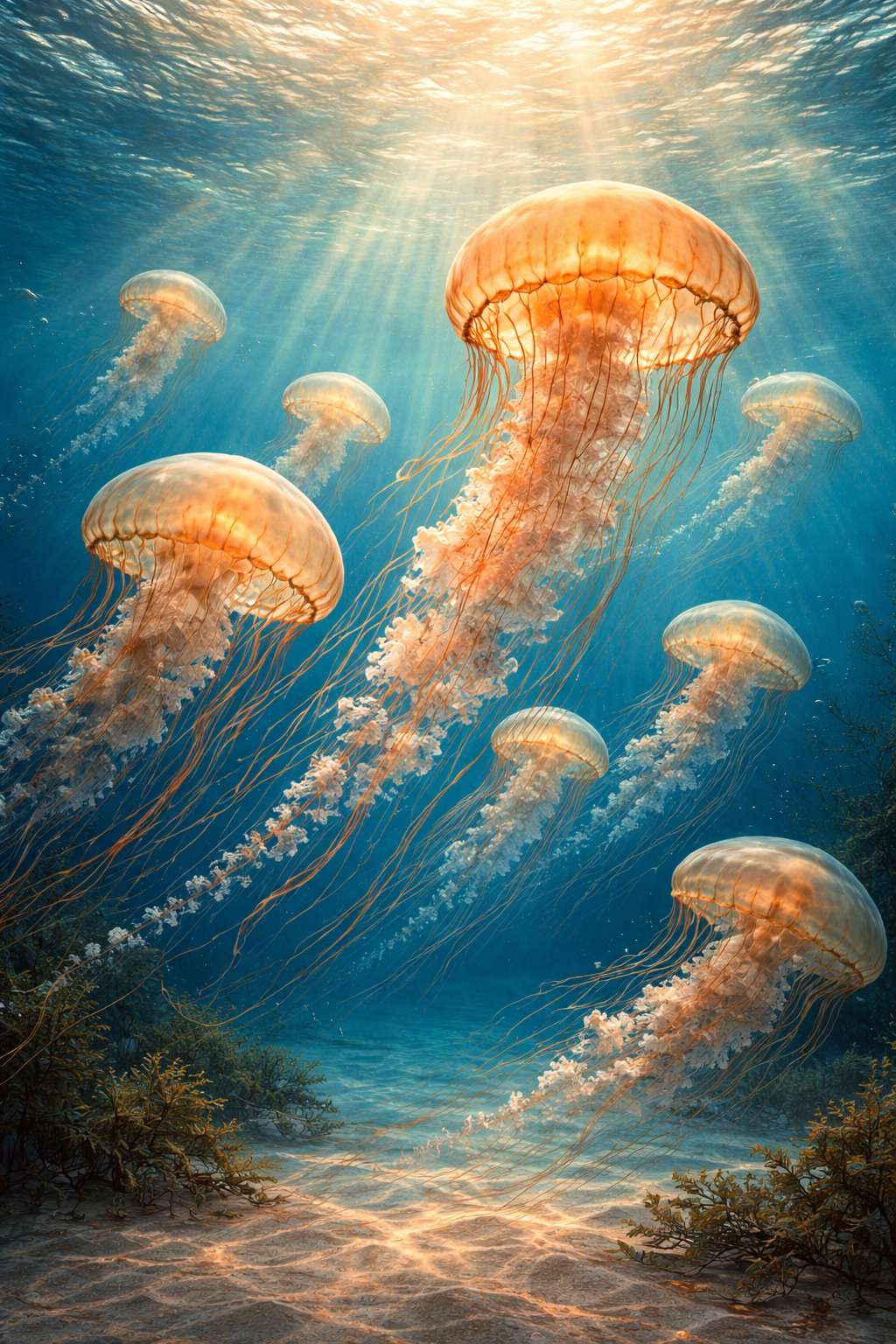
Bloom of jellyfish drifting through blue water with golden light rays from above
🪼 Weird & Viral

How Old Is a Jellyfish in Human Years?

📅 Updated ♾️ One species is immortal 🪼 10,000+ species worldwide

Most jellyfish live just months to a few years. But one species — Turritopsis dohrnii — can revert to its juvenile stage after reaching adulthood, potentially cycling its life indefinitely. We have no idea if there is any biological upper limit. It may be the only genuinely immortal animal on Earth.

Calculate Jellyfish Age →
🪼 Jellyfish Age in Human Years
♾️ Potentially Immortal
Turritopsis dohrnii — the immortal jellyfish — can revert to its juvenile polyp stage after reaching sexual maturity. This process, called transdifferentiation, allows it to cycle through its life indefinitely.

There is no known biological age limit. The concept of "old age" does not apply to this animal in the way it does for any other species on Earth. It can still die from disease, predation, or physical damage — but not from aging itself.

Enter an age below to calculate where it would fall in a mortal cycle — but understand that this animal may be on its 50th cycle by now.
in human years
Jellyfish age
Life stage
Species
🪼 What this age means

10,000+ Species — From Harmless to Lethal

There are estimated to be over 10,000 species of jellyfish worldwide (including medusozoa broadly defined), though only a small fraction are well-studied. Here are the species most likely to affect humans — rated by danger level.

🌕 Moon Jellyfish
~12 months avg lifespan
⬤ Danger: Minimal
The most recognisable jellyfish worldwide. Identified by four horseshoe-shaped pink gonads visible through its translucent bell. Sting barely perceptible to most humans — mild itching at worst. The icon of jellyfish-kind.
Found: Every ocean, worldwide. Common in harbours and beaches globally.
🦁 Lion's Mane Jellyfish
1–3 years avg lifespan
⬤ Danger: Moderate–Painful
Largest jellyfish on Earth — bell up to 2.4m across, tentacles over 36m long (longer than a blue whale). Sting causes painful welts and can trigger allergic reactions. Not typically life-threatening for healthy adults, but tentacles can trail 10m+ invisibly through water.
Found: Cold northern waters — North Atlantic, North Pacific, Arctic.
📦 Box Jellyfish (Chironex fleckeri)
~12 months avg lifespan
⬤ DANGER: POTENTIALLY LETHAL — SEEK EMERGENCY CARE
The most venomous animal on Earth. Venom attacks heart, nervous system, and skin simultaneously — cardiac arrest possible within 2–5 minutes of a major sting. Has 24 eyes but no brain. Actively hunts prey. An antivenom exists. Time is critical.
Found: Indo-Pacific coastal waters — northern Australia, Philippines, Southeast Asia. Peak risk: Oct–May in Australia.
🔲 Irukandji Jellyfish
~12 months avg lifespan
⬤ DANGER: POTENTIALLY LETHAL — SEEK EMERGENCY CARE
Tiny — only 1–2cm bell — virtually invisible in water. Causes "Irukandji syndrome": severe pain, vomiting, cramps, hypertension, and a distinct feeling of impending doom (a recognised medical symptom). Delayed onset of 20–30 minutes makes victims unaware they've been stung. Rare fatalities documented.
Found: Australian waters primarily, but now spreading as oceans warm. Also reported in Florida and Caribbean.
🫧 Portuguese Man O' War
~12 months avg lifespan
⬤ Danger: Severe — Medical attention advised
Technically not a jellyfish but a siphonophore — a colonial organism of many individual animals. Tentacles trail up to 10m+ and are nearly invisible. Sting causes intense pain, welts, and can trigger anaphylaxis in sensitive individuals. Rarely fatal but hospitalisations occur. Tentacles sting hours after death.
Found: Open Atlantic, Pacific, Indian Oceans. Washed ashore regularly on Atlantic-facing beaches worldwide.
🪷 Cannonball Jellyfish
~6 months avg lifespan
⬤ Danger: Mild
Round, firm-belled jellyfish with no trailing tentacles. Sting is mild — mainly causes irritation if mucous membranes are exposed (eyes, mouth). Commercially fished in large quantities in Asia — one of the primary jellyfish eaten as food. Huge blooms common off southeastern US coasts.
Found: Atlantic and Pacific coasts of North America, widely in Asia.
♾️ Immortal Jellyfish (Turritopsis dohrnii)
Potentially unlimited — no known maximum
⬤ Danger: Negligible
Only 4.5mm across. Tiny, harmless sting. Can revert from sexually mature adult back to juvenile polyp through transdifferentiation — the only animal known to do this. Spreading globally as ocean temperatures rise. You may have swum near one without knowing.
Found: Originally Mediterranean; now documented in oceans worldwide due to range expansion.
🌊 Barrel Jellyfish
~1 year avg lifespan
⬤ Danger: Mild
One of Europe's largest jellyfish — up to 1m across and 35kg. Sting is weak and rarely felt. Commonly washed ashore on British and European beaches in summer, alarming beachgoers despite being essentially harmless. A favourite food of leatherback sea turtles.
Found: Northeast Atlantic, Mediterranean. Common off British Isles in summer.

Stung by a Jellyfish? What to Do — and What Not to Do

🚨 If stung by a box jellyfish (Chironex fleckeri) or Irukandji in Indo-Pacific waters — call emergency services immediately. These stings can be fatal. Do not wait for symptoms to develop. Apply vinegar to the sting site if available (vinegar deactivates unfired box jellyfish nematocysts). Keep the person calm and still. Administer CPR if needed.

For all other jellyfish stings — follow these steps:

1
Leave the water calmly
Get out of the water without thrashing — movement can push tentacles further into skin.
2
Rinse with seawater
Use seawater — NOT fresh water. Fresh water changes the osmotic balance and can cause unfired nematocysts to discharge, worsening the sting.
3
Remove tentacles carefully
Use tweezers, a card, or stick — never bare fingers. Tentacle fragments continue stinging on contact.
4
Apply heat
Immerse in hot water (as hot as tolerable — around 45°C/113°F) for 20 minutes. Heat denatures jellyfish venom proteins more effectively than ice.
5
Monitor for reactions
Watch for signs of allergic reaction: difficulty breathing, swelling of throat, chest tightness. Seek medical attention if symptoms worsen or if stung on face or neck.

❌ Things people do that make it worse:

Don't urinate on it
This is a persistent myth. Human urine is hypotonic and can actually trigger more nematocyst discharge. It does not help.
Don't rub with sand
Rubbing spreads nematocysts across a wider skin area and breaks them open, causing additional stings.
Don't use fresh water
Counterintuitive but true — fresh water (including tap water) can cause unfired nematocysts to discharge. Always use seawater first.
Don't touch a beached jelly
Dead jellyfish retain functional nematocysts for hours or even days after death. Tentacles separated from the bell can still deliver a full sting.

🏖️ On the beach: If you see jellyfish washing ashore, give them at least 1–2 metres clearance — tentacles may extend far beyond the bell. Do not allow children or pets to handle or poke beached jellies. Report large strandings of unusual species to your local marine authority. In Australian waters, Surf Life Saving Australia maintains BeachSafe.org.au with jellyfish hazard information.

How Turritopsis dohrnii Cheats Death

The immortal jellyfish's life cycle is the most biologically extraordinary of any animal on Earth. Under stress or after reproduction, it can run this cycle in reverse — not just to a previous stage, but back to the very beginning.

1
Fertilised Egg
Sexual reproduction produces a planula larva
2
Polyp
Settles on sea floor. Tiny stalk with tentacles. Asexual reproduction
3
Medusa (Adult)
Free-swimming bell form. Reaches sexual maturity. Reproduces.
Transdifferentiation
Under stress: adult cells transform back to juvenile polyp cells. The cycle restarts.

🔬 What is transdifferentiation? Normally, differentiated cells cannot transform into other cell types after they've specialised. In T. dohrnii, mature cells can revert to a pluripotent state and then re-specialise as juvenile cells. This is the cellular equivalent of a fully grown adult transforming back into an embryo. No other multicellular organism is known to do this on demand. Scientists studying this process hope it may eventually inform cancer research and regenerative medicine.

Things About Jellyfish That Will Actually Surprise You

🧠 No Brain, 24 Eyes
Box jellyfish have 24 eyes in four clusters of six — including eyes with corneas, lenses, and retinas structurally similar to vertebrate eyes. They can see colour and form, navigate around obstacles, and actively hunt prey. They do all of this with no brain whatsoever. How they process visual information without a central nervous system is one of neuroscience's great open questions.
⚡ Fastest Cellular Event in Biology
Jellyfish nematocysts fire in less than 700 nanoseconds — one of the fastest cellular events in all of biology. The stinging thread launches at over 5 million g of acceleration, faster than a bullet. Nematocysts continue firing after the jellyfish is dead — beached jellies can sting days later, and severed tentacles remain dangerous indefinitely until dried out completely.
🌡️ Blooms, Power Plants & Climate
Jellyfish populations are increasing globally as ocean temperatures rise. "Blooms" of millions of jellyfish have shut down nuclear power plants by clogging cooling water intakes in Japan, Scotland, Sweden, and Israel. They have destroyed salmon farms worth millions of dollars and devastated fishing industries in the Black Sea, Mediterranean, and East China Sea. In some ecosystems, jellyfish are replacing fish as the dominant organism.
💧 500 Million Years of Simplicity
Jellyfish bodies are 95% water — with the remaining 5% being structural proteins, muscle fibres, and nerve tissue. No heart, no blood, no bones, no gills, no brain. Despite this apparent simplicity, medusozoan jellyfish have survived for 500–700 million years — long before fish, dinosaurs, or flowering plants. They predate the Cambrian explosion and are among the oldest complex animals on Earth.
🦁 Longer Than a Blue Whale
The lion's mane jellyfish holds the record for the longest tentacles of any known animal. The largest documented specimen had a bell diameter of 2.4 metres and tentacles stretching 36.5 metres — significantly longer than a blue whale. Despite this scale, it causes only painful welts rather than life-threatening envenomation in healthy adults. Agatha Christie used its venom as the murder weapon in a Hercule Poirot mystery.
🌊 The Largest Animal on Earth
The Portuguese man o' war isn't a jellyfish — and the siphonophore Praya dubia is technically even more remarkable: a colonial organism that can reach 40–50 metres in length, making it arguably the longest animal ever recorded — surpassing the blue whale. Like the man o' war, each "individual" is actually a colony of genetically identical but functionally specialised organisms, none of which can survive alone.

Jellyfish Age in Human Years — By Species

Jellyfish AgeMoon JellyfishLion's ManeLife Stage
1 month~7 yrs~4 yrsEphyra (juvenile)
2 months~14 yrs~7 yrsGrowing medusa
4 months~28 yrs~14 yrsYoung adult
6 months~42 yrs~21 yrsPrime adult
9 months~63 yrs~32 yrsSenior
12 months (1 yr)~80 yrs~42 yrsElder (moon jelly)
18 monthsBeyond avg~60 yrsMature (lion's mane)
24 months (2 yr)~80 yrsElder (lion's mane)

Other Weird & Long-Lived Animals

Frequently Asked Questions

Biologically, yes — in a specific sense. Turritopsis dohrnii can revert from sexually mature adult back to its juvenile polyp stage through transdifferentiation, and then grow back into an adult. This process can repeat indefinitely. No maximum number of cycles has been established. It cannot be killed by aging. However, it can die from disease, predation, physical damage, or environmental stress. The immortality is biological, not practical — but it does mean that the concept of "dying of old age" genuinely does not apply to this species.
For box jellyfish or Irukandji stings (Indo-Pacific waters): call emergency services immediately — these can be fatal. Apply vinegar if available. For all other stings: rinse with seawater (never fresh water), remove visible tentacles with tweezers — never bare hands, immerse in hot water (45°C/113°F) for 20 minutes to break down venom proteins, and seek medical attention if symptoms worsen. Do not urinate on the sting (a persistent myth that can make it worse), do not rub with sand, and do not use fresh water before seawater.
The box jellyfish Chironex fleckeri is considered the most venomous animal in the world. Its venom attacks the heart, nervous system, and skin cells simultaneously, and can cause cardiac arrest within 2–5 minutes of significant envenomation. There is an antivenom, but administering it in time is challenging. Deaths are relatively rare because encounters are uncommon. The smaller Irukandji jellyfish causes a distinct syndrome with delayed onset — severe pain, hypertension, and a medically recognised "sense of impending doom" — and has caused rare fatalities.
Multiple factors are converging. Warming oceans favour jellyfish — they reproduce faster in warmer water. Agricultural runoff creates coastal dead zones where jellyfish survive but fish cannot. Overfishing removes jellyfish predators (sea turtles, ocean sunfish, tuna) and competitors. Jellyfish polyps also thrive on hard underwater surfaces like oil platforms and harbour walls, which provide vast new settlement habitat that didn't exist historically. The result in some areas is an ecosystem shift from fish-dominated to jellyfish-dominated ocean.
Jellyfish are extraordinarily ancient. Fossil evidence confirms medusozoan jellyfish have existed for at least 500 million years — predating the Cambrian explosion of complex life, fish, land plants, and certainly humans. Soft-bodied animals rarely fossilise well, so the true origin date may be even earlier. On the scale of life on Earth, jellyfish were here hundreds of millions of years before us and will almost certainly be here long after.