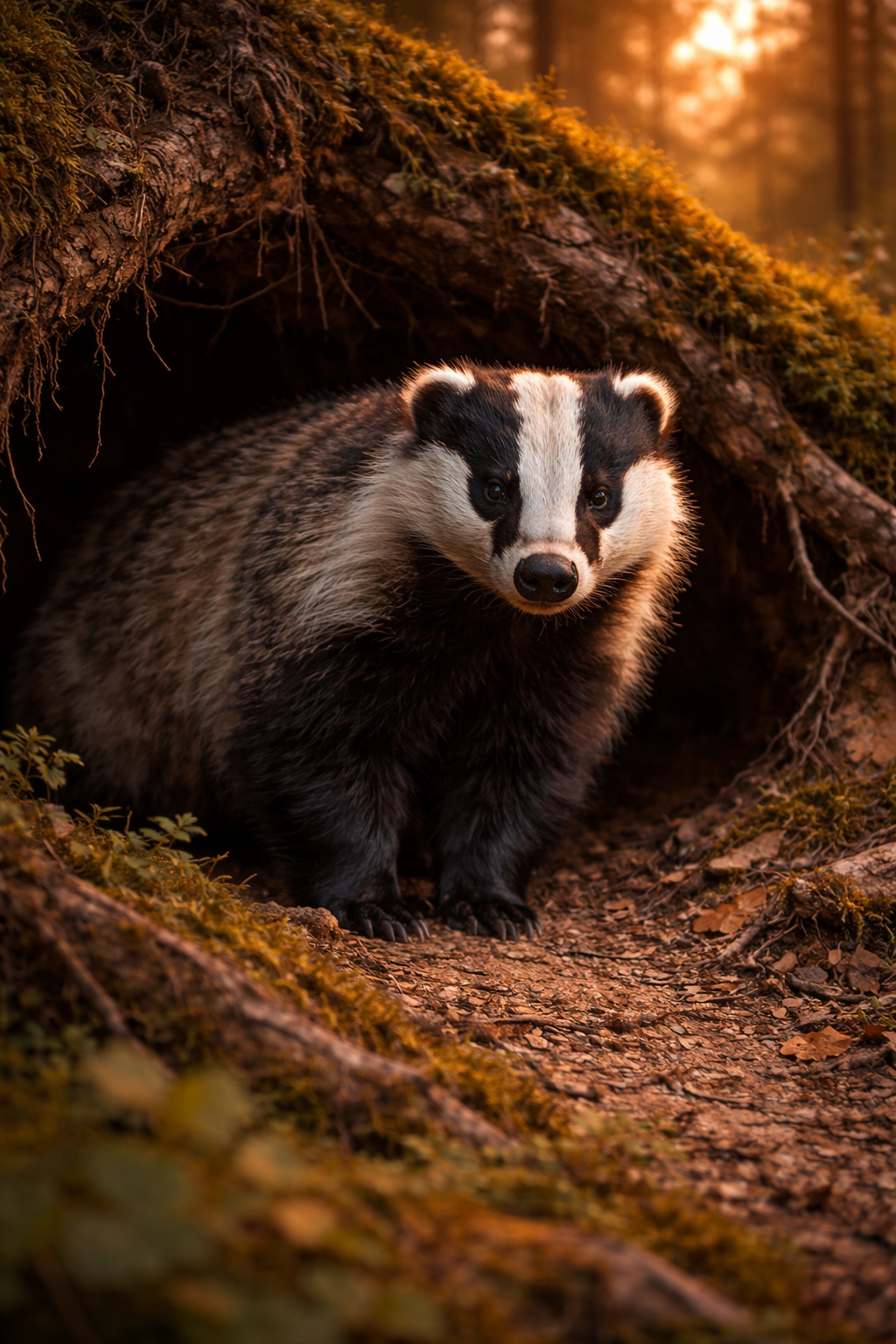
The Life Stages of a Badger
European badgers are born in February in underground chambers deep within the sett — lined with dry grass, bracken, and leaves collected by the whole clan. Cubs are born blind and hairless but develop quickly. They emerge above ground for the first time in April or May, often appearing at the sett entrance at dusk — one of British wildlife's most beloved sights. By autumn they are foraging independently, learning the intricate social dynamics of clan life.
Badger Age to Human Years Conversion Table
| Badger Age | European Badger | American Badger | Captive Badger | Life Stage |
|---|---|---|---|---|
| Birth | Newborn | Newborn | Newborn | Newborn cub |
| 2 months | ~5 yrs | ~4 yrs | ~3 yrs | First emergence above ground |
| 6 months | ~12 yrs | ~10 yrs | ~7 yrs | Juvenile; independent foraging |
| 1 year | ~18 yrs | ~16 yrs | ~11 yrs | Sub-adult |
| 2 years | ~28 yrs | ~24 yrs | ~18 yrs | Young adult |
| 4 years | ~44 yrs | ~38 yrs | ~30 yrs | Prime adult |
| 7 years | ~62 yrs | ~55 yrs | ~46 yrs | Mature adult |
| 10 years | ~76 yrs | ~72 yrs | ~60 yrs | Senior |
| 15 years | Elder | Elder | ~78 yrs | Elder |
| 19 years | Wild record | — | ~88 yrs | Record territory |
🦡 The UK badger population is estimated at around 485,000 individuals — the highest density of European badgers anywhere in their range, due to the UK's mild climate, abundant earthworms, and relatively low predator pressure. The Badger Trust monitors UK populations and advocates for badger welfare. Badgers are fully protected under the Protection of Badgers Act 1992 — it is illegal to kill, injure, or disturb badgers or interfere with their setts without a licence.
Things About Badgers That Will Actually Surprise You
🦡 The word "badger" as a verb — meaning to pester or harass persistently — derives directly from the practice of badger baiting, in which badgers were placed in barrels or artificial setts and dogs set upon them. The badger's tenacious, persistent defence gave rise to the figurative use. Badger baiting was banned in England in 1835 — one of the world's first animal welfare laws — but the verb persists in everyday language as an unsuspecting linguistic fossil of a now-illegal practice.
Badger Species of the World
There are 11 species commonly called badgers across three subfamilies of Mustelidae. Here are the most notable.
| Species | Range | Weight | Notable Trait | Wild Lifespan |
|---|---|---|---|---|
| European Badger | Europe & W. Asia | 7–17 kg | Largest UK land predator; century-old setts; clan social structure | 5–15 yrs |
| American Badger | N. American grasslands | 4–12 kg | Solitary; hunts with coyotes; fastest digger in N. America | 9–14 yrs |
| Honey Badger | Africa, Middle East, S. Asia | 7–16 kg | Fearless; partially immune to venom; thick loose skin resists bites | ~24 yrs |
| Hog Badger | SE Asia | 7–14 kg | Pig-like snout; nocturnal; roots for food like a pig | ~10 yrs |
| Ferret Badger | SE Asia | 1–3 kg | Smallest badger; more weasel-like; climbs trees | ~10 yrs |