📅 Updated 🌍 Down 43% in 21 years🦁 Fewer than 25,000 remain
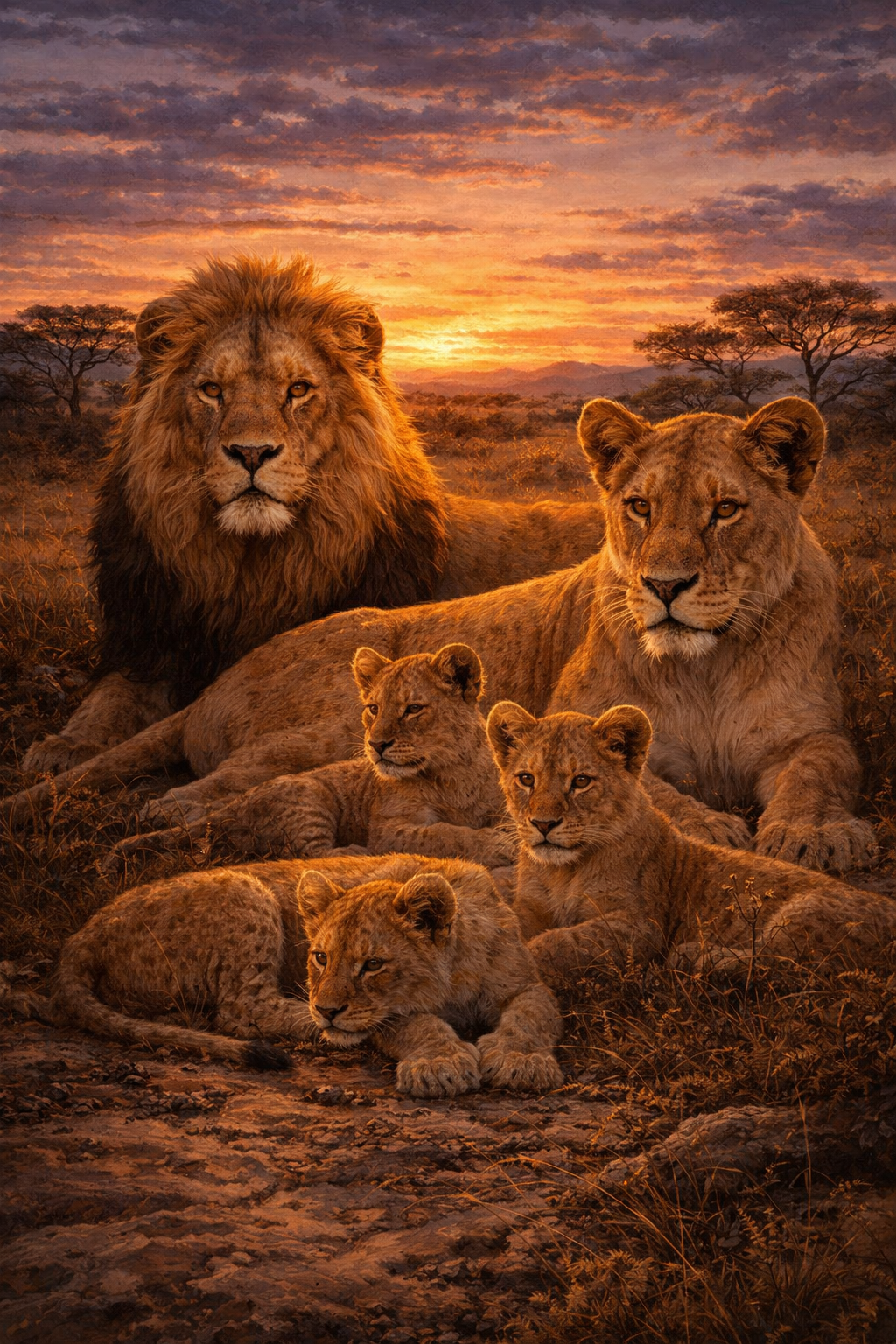
Lions have lost 43% of their population in 21 years. Fewer than 25,000 remain in Africa — down from an estimated 200,000 in the 1970s. A 10-year-old wild male is already elderly. Females do 90% of the hunting. And when new males take over a pride, the consequences for existing cubs are brutal and immediate.
Lion lives are defined by the pride — and by the brutal mathematics of pride takeover. Males who grow up in a pride are eventually expelled as sub-adults; they must form coalitions, fight for territory, and take over a pride of their own. Each successful takeover resets the reproductive clock of the pride — at devastating cost to existing cubs. The female's life is comparatively stable, built around the core of related lionesses who form the pride's permanent foundation.
0–3 mo
Cub (Newborn)
Born blind and helpless in litters of 2–4, hidden by the mother in dense cover. Eyes open at 3–11 days. Intensely vulnerable — cub mortality in the first year can exceed 80% in some populations. Mothers keep cubs hidden from the pride for the first 4–6 weeks.
3 mo–1 yr
Cub (Active)
Introduced to the pride. Begins accompanying adults. Play is essential — cubs develop hunting skills, social bonds, and coordination through mock attacks on each other and on the tails of tolerant adults. Still highly vulnerable to infanticide if new males take over the pride.
1–2 yrs
Juvenile
Weaned but still dependent on the pride. Females beginning to participate in hunts as learners. Males developing the first hints of mane — a fluffy crown that will grow over the next several years. Social hierarchy within the pride becoming clear to younger lions.
2–4 yrs
Sub-adult
Young males begin to be expelled from the natal pride — sometimes gently pushed out, sometimes violently ejected by resident males. They form nomadic coalitions with brothers and peers, wandering territories in search of opportunity. Young females stay in the pride. This is the most dangerous period for males — homeless, inexperienced, and competing for scarce resources.
4–8 yrs
Prime Adult
Prime lions — males with full manes, females at peak reproductive and hunting condition. A coalition of prime males that has successfully taken over a pride is a formidable social and physical force. Lionesses are producing cubs reliably. Pride tenure for males averages just 2–3 years before a new coalition challenges them.
8–12 yrs
Mature / Senior
A wild lion reaching this age has navigated the brutal arithmetic of pride life — territorial challenges, prey injuries, and disease — with remarkable success. Senior males who have lost pride tenure often become nomadic again; females may remain in the pride as grandmothers of the next generation of cubs.
12–20+ yrs
Elder
Elder lions are extraordinary survivors — wild males past 12 are genuinely rare. The oldest wild lion on record, a Serengeti lioness, reached 18 years. The oldest captive lion lived to 29. In captivity, without the pressures of territorial combat, prey injury, and food scarcity, lions express their full biological potential across two decades.
Age Chart
Lion Age to Human Years
Lion Age
Lioness ♀ (wild)
Male ♂ (wild)
Captive
Life Stage
3 months
~2 yrs
~2 yrs
~2 yrs
Newborn cub
1 year
~7 yrs
~8 yrs
~6 yrs
Active cub
2 years
~14 yrs
~16 yrs
~11 yrs
Juvenile / sub-adult
4 years
~26 yrs
~30 yrs
~20 yrs
Prime adult
6 years
~37 yrs
~44 yrs
~28 yrs
Prime adult (peak)
8 years
~47 yrs
~57 yrs
~36 yrs
Mature adult
10 years
~55 yrs
~68 yrs
~44 yrs
Senior (wild ♀) / Elder (wild ♂)
14 years
~68 yrs
Exceptional
~57 yrs
Elder (wild ♀)
20+ years
—
—
~76 yrs
Captive elder
🦁 Wild male lions age significantly faster than females in human-equivalent terms — the physiological demands of territorial combat, mane maintenance, and pride competition accelerate their biological decline. A 10-year-old wild male lion is the equivalent of a 68-year-old human; a 10-year-old lioness is more like 55. The oldest verified wild lion was an 18-year-old Serengeti lioness tracked by the Serengeti Lion Project. The oldest captive lion on record was Arjun, who died at 29 years at the Van Vihar National Park, India.
Pride Dynamics
The Pride — The Most Complex Social Structure of Any Cat
🦁 Lions are the only social cat species on Earth. Every other cat — tigers, leopards, cheetahs, jaguars — is solitary. The lion's pride system represents a unique evolutionary solution to the challenges of hunting large prey and defending territory on open savanna, and it comes with social complexity that rivals many primate species.
A typical pride consists of 2–18 related adult females (often mothers, daughters, and sisters who have lived together for years or decades), their cubs, and a coalition of 2–4 adult males who hold the pride against rivals. The females are the stable core — they do most of the hunting, raise the cubs communally, and remain in the territory for life. Males are the temporary layer — their tenure averages just 2–3 years before a stronger coalition displaces them.
When a new male coalition takes over a pride, they almost always kill existing young cubs — any cub under approximately 9 months old is killed. This brutal behaviour is adaptive: the new males eliminate offspring they did not sire, and the loss of cubs brings the females into oestrus again within days, allowing the new males to sire their own cubs during their limited tenure. This is sexually selected infanticide — one of the most studied examples in animal behaviour.
👑 The Coalition
Male lions are almost never successful alone. Coalitions of 2–4 males — usually brothers or age-mates who grew up together — hold territory and pride tenure far longer than solitary males. A coalition of 3+ males may hold a pride for 4–6 years; a single male rarely lasts more than 1. The most famous lion coalition studied was the Mapogo coalition of the Sabi Sand reserve in South Africa — six brothers who held the largest territory ever recorded for a lion coalition and were documented killing hundreds of lions over their tenure.
🏹 Who Actually Hunts
Lionesses do approximately 85–90% of all pride hunting. They are lighter, faster, and more agile than males, and they hunt cooperatively — coordinating pincer movements, ambushes, and chase-and-tackle sequences. Males will eat first despite hunting less, a social hierarchy enforced by size. Male lions do hunt — particularly solitary or nomadic males with no pride to feed them — but within a pride, their primary role is territorial defence rather than food provision. Research from the Panthera Lion Programme has confirmed this division of labour across multiple populations.
🍼 Communal Cub-Rearing
When multiple lionesses in a pride give birth close in time — which frequently happens as pride females synchronise oestrus — they raise their cubs communally, in a créche. All females nurse all cubs indiscriminately. Cubs suckle from any lactating female, not just their mother. This communal nursing spreads the energetic cost of lactation across multiple females and improves cub survival rates significantly — a pride with four lactating females produces more surviving adults than four solo mothers would. It is one of the most sophisticated cooperative breeding systems documented in any large carnivore.
Fascinating Facts
Things About Lions That Will Actually Surprise You
📉 200,000 to 25,000 — The Collapse
Africa's lion population has collapsed from an estimated 200,000 individuals in the 1970s to fewer than 25,000 today — a decline of approximately 87% in 50 years. The IUCN classifies the lion as Vulnerable, with populations declining across most of their range. The primary drivers are habitat loss and fragmentation (lions need enormous territories — a pride may use 100–400 km²), prey depletion through bushmeat hunting, conflict with livestock farmers leading to retaliatory killing, and trophy hunting. West and Central African lion populations are classified separately as Critically Endangered — fewer than 2,000 remain in those regions combined.
🌙 The Roar — 8 km of Territory
A lion's roar is one of the loudest sounds produced by any land animal — audible up to 8 kilometres away in calm conditions and reaching 114 decibels at close range (comparable to a jet engine at 100 metres). Lions roar to advertise their presence and territorial boundaries to rival coalitions, to maintain contact between separated pride members, and as a social bonding behaviour — pride members often roar in chorus, creating a unified territorial advertisement. The roar begins with a series of moaning sighs and builds to full-throated roars. Lions typically roar most at dusk, dawn, and after dark. Resident lions who hear an unfamiliar roar respond by collectively investigating — they can assess a stranger's coalition size by listening to individual voices.
🖤 The Mane — A Health Signboard
The male lion's mane is a biological honest signal — it cannot be faked. Mane darkness correlates directly with testosterone levels; fullness correlates with nutritional status and fighting success. Females in the Serengeti Lion Project consistently preferred darker-maned males as mates in controlled experiments. Mane development is also temperature-sensitive — lions in hotter climates grow thinner manes, which is why Tsavo lions (known for being maneless or thinly maned) occur in one of Kenya's hottest regions. The mane also provides genuine protection: lions target the neck and throat in fights, and a thick mane absorbs bite and claw damage that would otherwise be catastrophic.
💤 The Sleep — 20 Hours
Lions are among the most sedentary of all large mammals — adults sleep or rest for 16–20 hours per day. This is not laziness; it is metabolic efficiency. A large carnivore that hunts irregularly must conserve energy between kills, which can be spaced days apart. Lions in hotter regions sleep longest during midday heat and are most active at night, when temperatures drop and prey is less vigilant. Their eyes have a reflective layer behind the retina (tapetum lucidum) that dramatically enhances low-light vision — they see approximately 8× better than humans in darkness, making them highly effective nocturnal hunters.
🦷 Cooperative Hunting — Strategy, Not Instinct
Lion hunts involve coordinated roles that appear to be individually learned and strategically assigned, not simply instinctive. Research published in Science identified distinct hunting roles — "wings" (flanking animals), "centres" (driving prey toward the group), and "blockers" — with individual lionesses consistently taking the same role across multiple hunts. Older, more experienced lionesses are more effective hunters. Hunting success rates range from 17–19% for solitary attempts to over 30% for coordinated group hunts of large prey. Prey selection is sophisticated: lions favour young, old, injured, or isolated animals, reducing their own injury risk.
🧬 The Asiatic Lion — 500 Survivors
The Asiatic lion (Panthera leo leo) was once widespread from Greece to India — lions appear in ancient Mesopotamian art, Greek mythology, and Persian royal imagery. Today, the entire wild Asiatic lion population consists of approximately 500–700 individuals in a single forest: Gir National Park in Gujarat, India. This single-location concentration is itself a conservation risk — a single disease outbreak or major natural disaster could eliminate the entire population. India has been debating establishing a second Asiatic lion population at an alternative site for over two decades, a proposal that has faced political and local resistance. Asiatic lions differ subtly from African lions: they have less mane development, a belly fold, and a distinctive elbow tuft.
🦁 The Serengeti Lion Project, ongoing since 1966 and based at the Serengeti Research Institute, is one of the longest-running large carnivore studies in the world. It has tracked individual lions across generations for nearly 60 years, producing foundational research on pride dynamics, infanticide, population ecology, and the effects of disease (including the 1994 canine distemper outbreak that killed approximately 1,000 Serengeti lions — one-third of the population — in a single year). Almost everything reliably known about wild lion behaviour comes from this and a handful of comparable long-term studies.
Big Cat Comparison
Lions Among the Big Cats
The five big cats — lion, tiger, leopard, jaguar, and snow leopard — represent the genus Panthera, defined by the ability to roar (with the exception of the snow leopard, whose classification remains debated). Here's how they compare across the metrics that matter.
Species
Wild Lifespan
Wild Population
Social Structure
IUCN Status
Key Threat
African LionP. leo
10–14 yrs
~20,000–25,000
Pride (unique among cats)
Vulnerable
Habitat loss; retaliatory killing
Asiatic LionP. leo
10–14 yrs
~500–700
Pride; smaller than African
Endangered
Single-location risk; disease
TigerP. tigris
10–15 yrs
~4,500–5,000
Solitary
Endangered
Poaching; habitat loss
LeopardP. pardus
12–17 yrs
~250,000+
Solitary
Vulnerable
Habitat fragmentation
JaguarP. onca
12–15 yrs
~64,000–173,000
Solitary
Vulnerable
Amazon deforestation
Snow LeopardP. uncia
10–12 yrs
~4,000–6,500
Solitary
Vulnerable
Poaching; prey decline; climate
CheetahA. jubatus
8–12 yrs
~6,500–7,000
Solitary (♀); coalitions (♂)
Vulnerable
Genetic bottleneck; habitat loss
🦁 The cheetah's inclusion in this table reflects its ecological overlap with lions despite belonging to a different genus (Acinonyx). Cheetahs cannot roar — they chirp, purr, and yelp. They are also the only big cat that cannot retract its claws, which function more like running shoes than weapons. Lions frequently steal cheetah kills, and cheetah cubs suffer significant predation from lions — their ranges overlap throughout sub-Saharan Africa in constant, asymmetric competition.
When a new male coalition takes over a pride, they typically kill all cubs younger than approximately 9 months — cubs they could not have sired. This behaviour, called sexually selected infanticide, is adaptive from the males' perspective: the loss of cubs brings the females back into oestrus within 2–4 days, allowing the new males to sire their own cubs during their limited pride tenure (typically 2–3 years). Without infanticide, males would spend most of their tenure raising another male's offspring. This was first extensively documented and explained by evolutionary biologist Sarah Blaffer Hrdy and subsequently confirmed across multiple lion populations by the Serengeti Lion Project. Cubs between 9 months and 2 years are rarely killed — they can survive without suckling and are not a reproductive opportunity cost to the new males.
Lions are apex carnivores that prey primarily on medium to large ungulates — wildebeest, zebra, buffalo, and various antelope species across their African range. A single lion requires approximately 5–7 kg of meat per day on average, though they may consume up to 30–40 kg at a single kill and then fast for several days. Lions will also scavenge heavily — they are not above stealing kills from cheetahs, wild dogs, and even spotted hyenas (despite the common assumption that it's always hyenas stealing from lions). In West Africa and parts of the Kalahari, lions have been documented killing and eating other large predators including spotted hyenas and wild dogs. Livestock predation is a growing issue as wild prey declines — it is the primary driver of human-lion conflict and retaliatory killing across Africa.
A lion's roar can be heard up to 8 kilometres away in still conditions and reaches 114 decibels at close range. The roar serves as territorial advertisement — resident pride members who hear an unfamiliar roar will investigate collectively, using the number of voices they hear to assess the size of the rival coalition. Research has shown that prides respond more cautiously when playback recordings suggest a larger rival coalition than their own. Lions typically roar most at dusk, dawn, and during the night. Pride members roar in chorus — the synchronised roaring of an entire pride creates a unified territorial signal that is one of the most evocative sounds in African wildlife. The roar is produced by a specialised larynx unique to the genus Panthera.
Lions were once far more widespread — the species ranged from West Africa through the Middle East, across the Indian subcontinent, and historically into southern Europe (the Macedonian lion persisted into ancient Greek times and is depicted in classical art). The European and Middle Eastern populations were hunted to extinction between approximately 100 AD and 1000 AD. The Indian population was similarly reduced — from widespread across the subcontinent to a single surviving population in Gir Forest, Gujarat, by the early 20th century (reaching a low of approximately 20 animals around 1900). The Gir population has since recovered to approximately 500–700 animals, but remains precariously confined to a single location. The cave lion (Panthera leo spelaea), a distinct subspecies, inhabited Europe and northern Asia until approximately 14,000 years ago and was a significant competitor with early humans.
This is one of the most contested questions in African conservation, and the evidence is genuinely mixed. Proponents argue that regulated trophy hunting generates revenue for conservation areas and creates economic incentives for local communities and landowners to maintain lion habitat rather than converting it to agriculture — particularly on private and communal land outside national parks. Critics point to evidence that poorly regulated hunting removes dominant males from prides, triggering the infanticide cycle and destabilising populations — and that the economic benefits often do not reach local communities. The scientific consensus is that the conservation impact depends almost entirely on regulation quality, quota sustainability, and community benefit distribution. Blanket bans may reduce incentives for habitat maintenance; poorly regulated hunting causes demonstrable population harm. The debate reflects broader disagreements about conservation philosophy rather than a clear factual consensus. The IUCN does not advocate for a blanket ban but calls for rigorous management standards.