Popular Pets
🐶 Dog 🐱 Cat 🐰 Rabbit 🐹 Hamster 🐾 Guinea Pig 🦜 Parrot 🦡 Ferret 🐀 Rat 🐭 Chinchilla 🦔 Hedgehog 🐟 Goldfish 🦜 Macaw
Farm & Large Animals
🐴 Horse 🐄 Cow 🐄 Highland Cow 🐷 Pig 🐑 Sheep 🐐 Goat 🐴 Donkey 🦙 Alpaca 🐐 Mountain Goat 🐔 Chicken 🦆 Duck 🦃 Turkey
Wild Animals
🐘 Elephant 🦁 Lion 🐯 Tiger 🐆 Leopard 🐺 Wolf 🐻 Bear 🐻‍❄️ Polar Bear 🦍 Gorilla 🐒 Chimpanzee 🦧 Orangutan 🦘 Kangaroo 🐾 Capybara 🦒 Giraffe 🦊 Fox 🦅 Raptor 🦉 Owl 🐧 Penguin 🦩 Flamingo 🐾 Hyena 🐾 Meerkat 🦥 Sloth 🦡 Badger 🐾 Wolverine 🐾 Armadillo
Ocean & Aquarium
🦈 Shark 🐋 Orca 🐬 Dolphin 🐋 Whale 🐋 Blue Whale 🐳 Beluga Whale 🦄 Narwhal 🐋 Bowhead Whale 🐾 Manatee 🐟 Manta Ray 🐟 Freshwater Fish 🐠 Saltwater Fish 🐴 Seahorse 🐟 Koi
Exotic & Weird
🐍 Snake 🐍 Ball Python 🦎 Bearded Dragon 🦎 Iguana 🦎 Komodo Dragon 🦎 Chameleon 🦎 Leopard Gecko 🐢 Tortoise 🐢 Snapping Turtle 🐢 Sea Turtle 🐊 Crocodilian 🕷️ Tarantula 🦎 Axolotl 🐙 Octopus 🌊 Jellyfish 🦞 Lobster 🐚 Quahog 🔬 Tardigrade
Info
About FAQ Contact
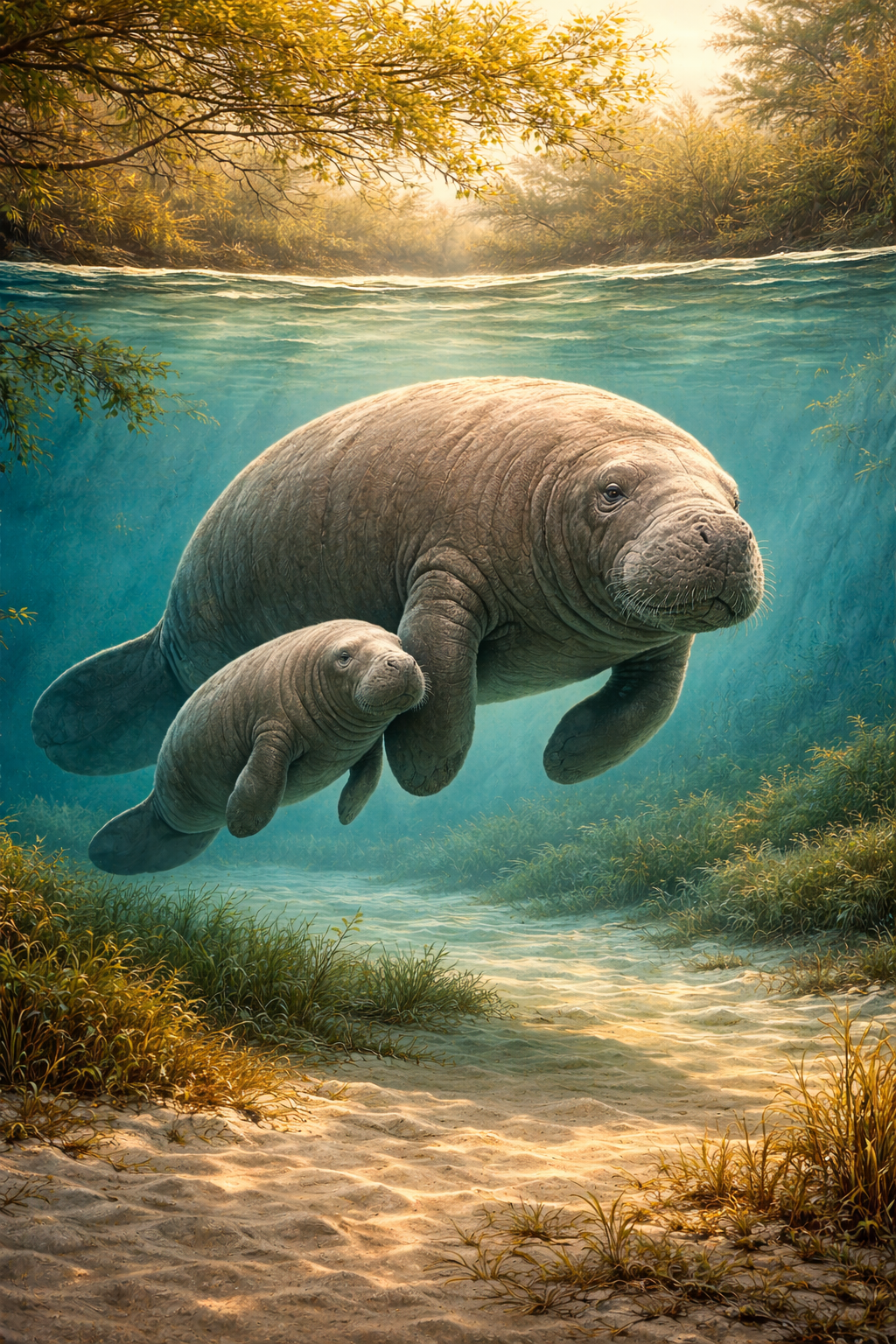
Manatee floating underwater, facing the viewer, flippers spread, light rays from above
🦭 Wild Animals

How Old Is a Manatee in Human Years?

📅 Updated 🔬 Marine biology research 🦭 3 species covered

Manatees are the gentle giants of shallow coastal waters — slow, unhurried, and surprisingly long-lived. They share a common ancestor with elephants, navigate by taste and touch, and can live nearly 70 years. Their closest living relative is not the whale, but the dugong.

Calculate Manatee Age →
🦭 Manatee Age in Human Years
in human years
Manatee age
Life stage
Human milestone
🦭 What this age means

Manatee Age to Human Years — Full Table

Manatee aging is based on research from the Save the Manatee Club and the Florida Fish and Wildlife Conservation Commission, which has maintained individual identification records of Florida manatees since the 1970s — one of the longest-running marine mammal monitoring programmes in the world.

Manatee AgeHuman EquivalentLife StageWhat's Happening
0–1 year0–4 yearsCalfNursing; stays within body-length of mother; learning migration routes
1–2 years4–8 yearsCalfWeaning begins; increasingly independent but still travelling with mother
2–5 years8–18 yearsJuvenileIndependent; learning warm-water refuges and seagrass feeding grounds
5–9 years18–28 yearsSub-adultApproaching sexual maturity; females may have first calf around age 5
10–19 years28–45 yearsPrime adultPeak reproductive years; experienced navigator of coastal waterways
20–34 years45–58 yearsMature adultEstablished home ranges; known individuals in long-term monitoring databases
35–49 years58–68 yearsSeniorSlowing; experienced animals with decades of habitat knowledge
50–69 years68–85 yearsElderExceptional longevity — Snooty reached 69; wild elders extremely rare

The Life Stages of a Manatee

Manatees have a slow reproductive rate — females typically give birth to a single calf every 2–5 years, with gestation lasting about 13 months. This means population recovery from boat strikes and other mortality events is inherently slow, making every individual manatee's survival significant.

0–2 yrs
Calf
Born at around 30 kg, nursing, and almost never more than a body-length from its mother. The mother teaches migration routes, warm-water refuges, and feeding grounds.
2–5 yrs
Juvenile
Weaned and increasingly independent. Learning the coastal geography that will define their life range. Highly vulnerable to boat strike injuries.
5–9 yrs
Sub-adult
Approaching reproductive maturity. Females may have their first calf as early as age 5. Males reach maturity slightly later, around age 9–10.
10–34 yrs
Prime & Mature Adult
Peak reproductive and physical condition. Many individuals in Florida's monitoring database are known by name and have been tracked for decades.
35–49 yrs
Senior
Experienced animals with established home ranges and deep knowledge of seasonal resources and warm-water refuges.
50+ yrs
Elder
Extraordinary longevity. Only documented reliably in captivity — wild individuals this age exist but are rarely confirmed. Snooty holds the record at 69.

Things About Manatees That Will Actually Surprise You

🐘 Closer to Elephants Than Whales
Despite living in water and resembling a blubbery dolphin, manatees are more closely related to elephants than to any marine mammal. Both belong to the superorder Afrotheria and diverged from a common ancestor roughly 60 million years ago. The evidence is in the details: manatees have toenails on their flippers, replace their teeth horizontally the same way elephants do, and have dense bones that function similarly to elephant ivory for ballast control.
🌡️ Apollo Beach: Hundreds in One Place
At TECO's Manatee Viewing Center at Apollo Beach, just south of Tampa, Florida, hundreds of manatees — both adults and calves — congregate every winter in the warm-water discharge from Tampa Electric's power plant. Entry is free, the viewing platform is elevated and close, and on peak winter days you can see more manatees in one location than almost anywhere else on Earth. It's one of Florida's most extraordinary and underrated wildlife spectacles. Visit the Manatee Viewing Center →
👄 Lips That Think
A manatee's upper lip is split into two independently moving halves, each covered in stiff sensory bristles called vibrissae — the same structures as whiskers on a cat, but far more numerous and densely packed. These bristles function almost like fingers: manatees use them to grasp, manipulate, and assess food, and to navigate murky water by touch. The lip bristles are so sensitive they can detect changes in water pressure from several metres away — essentially a hydrodynamic sensor.
🌿 The Ocean's Lawnmowers
An adult manatee eats 4–9% of their body weight in aquatic vegetation every day — up to 50 kg for a large individual. They graze on over 60 species of seagrass, algae, and freshwater plants. Because they consume so much vegetation across such wide ranges, manatees play a measurable role in seagrass ecosystem maintenance. There are only 3 species of manatee in the world: the West Indian (including the Florida subspecies), the Amazonian, and the West African — plus the closely related dugong, which is their nearest living relative.
🚤 Death by Propeller
The single greatest threat to Florida manatees is watercraft collision. Manatees spend most of their time at or just below the surface, move slowly, and their grey skin blends with shallow water sediment. Nearly every adult manatee in Florida carries propeller scars — researchers use these scar patterns as individual identification markers, the same way whale researchers use flukes. The Florida FWC's photo-ID database contains thousands of individually identified manatees, many tracked for 30+ years.
🔢 How Many Are Left
The Florida manatee population reached a record high of approximately 7,520 individuals in the 2022 aerial survey — a recovery milestone from fewer than 1,300 in the 1970s. However, 2021 saw the deadliest year on record with over 1,100 manatee deaths, largely from starvation due to seagrass loss caused by water pollution. Globally, all three manatee species are listed as Vulnerable by the IUCN, and the Amazonian manatee is listed as Vulnerable with declining population trend.

🦭 The Florida manatee is a subspecies of the West Indian manatee (Trichechus manatus latirostris). Its US federal protection status was controversially downlisted from Endangered to Threatened in 2017 — a decision that remains contested given ongoing mortality pressures. The Save the Manatee Club, co-founded by singer Jimmy Buffett and former Florida Governor Bob Graham in 1981, remains one of the most active manatee conservation organisations in the world.

How We Calculate Manatee Age

Manatee aging follows a moderately accelerated trajectory compared to humans. They mature faster in their early years — reaching reproductive age by 5–9 — then age at a rate broadly comparable to humans through adulthood. The conversion below is based on developmental milestones documented in long-term Florida FWC monitoring studies.

  • Years 0–2: approximately 4× human rate (rapid calf development)
  • Years 2–10: approximately 2.5× human rate (juvenile to young adult)
  • Years 10+: approximately 1.5× human rate (gradual adult aging)

The species selector notes the three manatee species. West Indian / Florida manatees are the best-studied. Amazonian manatees are smaller and live exclusively in freshwater; West African manatees are the least studied of the three. Snooty's verified age of 69 is used as the maximum for Florida manatees.

💡 Manatee age is determined in living animals primarily through long-term photo-ID tracking rather than biological markers. In deceased animals, age can be estimated by counting growth layer groups in the periotic bone of the inner ear — a technique similar to counting tree rings, accurate to within a few years.

Other Marine and Long-Lived Animals

Frequently Asked Questions

Manatee aging broadly parallels human development, though somewhat accelerated in early life. A 1-year-old manatee is roughly equivalent to a 4-year-old child — still nursing but increasingly mobile. By age 5, a manatee has reached young adulthood, comparable to a human in their late teens. A 30-year-old manatee is in their mid-50s in human terms. The oldest verified manatee, Snooty, lived to 69 — equivalent to a human in their mid-80s.
Wild manatees typically live 40–60 years with good fortune — avoiding boat strikes, cold stress events, and red tide. The oldest verified manatee was Snooty, a Florida manatee born in captivity in 1948 who lived at the South Florida Museum in Bradenton until his accidental death in 2017 at age 69. In the wild, lifespan is difficult to verify, but long-term photo-ID monitoring suggests some individuals live into their 50s. Captive manatees with consistent veterinary care tend to live longer.
Yes — surprisingly closely. Manatees and elephants both belong to the superorder Afrotheria and share a common ancestor from roughly 60 million years ago. Physical evidence of this relationship includes toenails on manatee flippers, horizontal tooth replacement identical to the elephant's conveyor-belt molar system, and bone density similar to elephant ivory that functions as ballast control in the water. The dugong — the manatee's closest living relative — shares all of these traits.
Florida offers the best manatee viewing in the world. TECO's Manatee Viewing Center at Apollo Beach near Tampa is free and draws hundreds of manatees in winter months, congregating around warm water discharged by Tampa Electric's power plant. Crystal River National Wildlife Refuge on Florida's Gulf Coast allows regulated swimming with manatees. Blue Spring State Park near Orange City is another major winter gathering point. Outside Florida, West African manatees can be spotted in rivers and coastal waters from Senegal to Angola, and Amazonian manatees in the Amazon and Orinoco river systems.
All three manatee species are classified as Vulnerable by the IUCN. The Florida manatee population has recovered significantly — from under 1,300 in the 1970s to over 7,500 today — but remains under pressure from boat strikes, habitat degradation, and seagrass loss. In 2021, over 1,100 Florida manatees died, largely from starvation caused by pollution-driven seagrass die-off in the Indian River Lagoon. The Amazonian manatee faces additional pressure from hunting and river development. Their slow reproductive rate — one calf every 2–5 years — makes population recovery inherently slow.