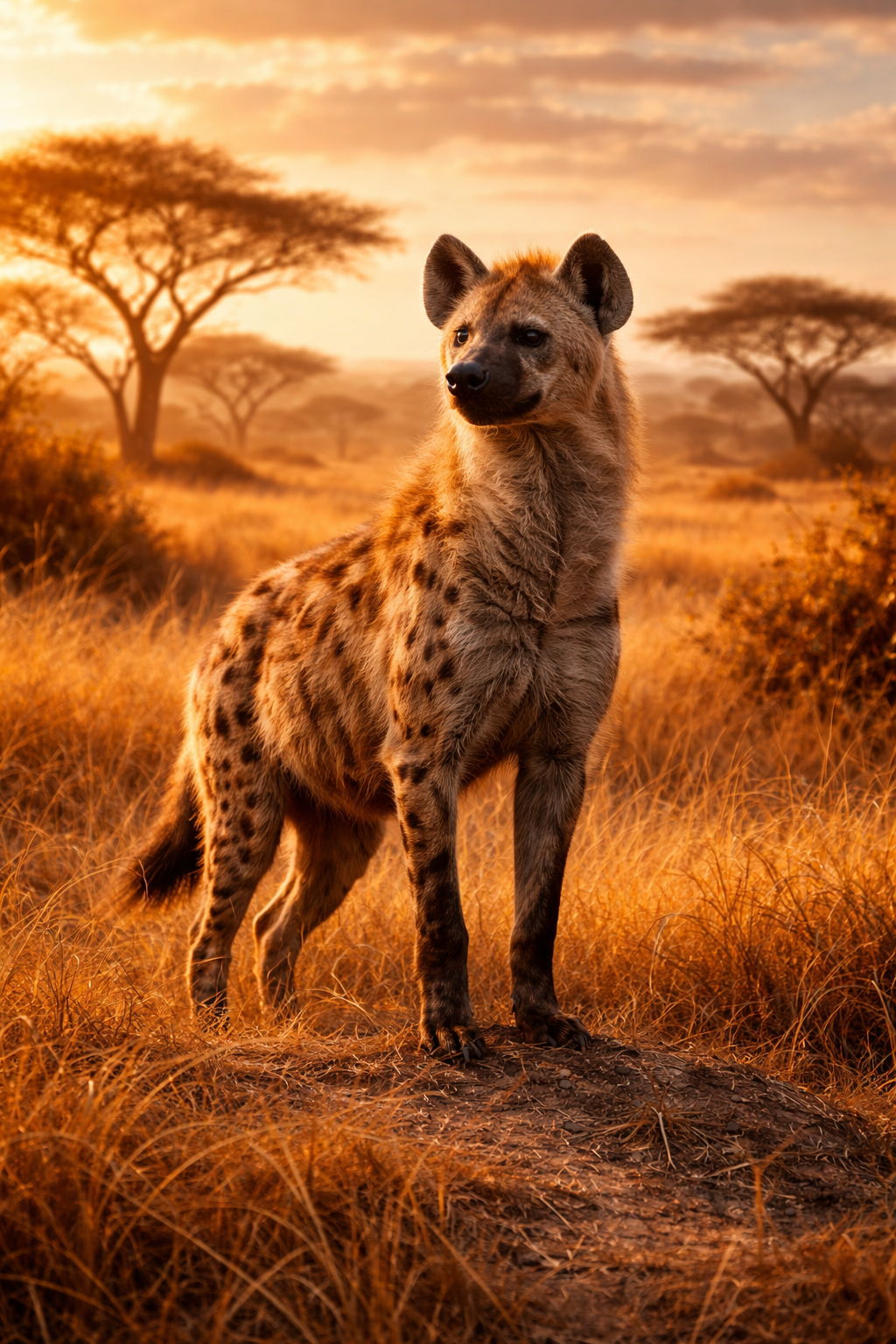
The Life Stages of a Hyena
Spotted hyena cubs are born with eyes open and teeth already erupted — one of the most precocial large carnivore births. Within minutes of birth, sibling aggression begins. Litters are typically two cubs, and the dominant cub — usually female in a matriarchal system — may kill or starve its sibling in the first days of life. Surviving this initial competition is the first of many social tests a hyena will face.
Hyena Age to Human Years Conversion Table
| Hyena Age | Spotted Hyena | Striped Hyena | Captive Hyena | Life Stage |
|---|---|---|---|---|
| Birth | Newborn | Newborn | Newborn | Newborn cub |
| 3 months | ~5 yrs | ~6 yrs | ~4 yrs | Growing cub |
| 1 year | ~12 yrs | ~14 yrs | ~10 yrs | Juvenile |
| 2 years | ~20 yrs | ~24 yrs | ~17 yrs | Young adult |
| 4 years | ~32 yrs | ~38 yrs | ~28 yrs | Prime adult |
| 8 years | ~48 yrs | ~57 yrs | ~43 yrs | Mature adult |
| 12 years | ~59 yrs | ~72 yrs | ~57 yrs | Senior |
| 18 years | ~74 yrs | Elder | ~72 yrs | Elder |
| 25 years | ~90 yrs | — | ~85 yrs | Record territory |
🦁 Spotted hyenas (Crocuta crocuta) are significantly larger and longer-lived than striped hyenas (Hyaena hyaena). The spotted hyena is Africa's most common large carnivore — with a total wild population estimated at 27,000–47,000 individuals according to the IUCN — yet it is frequently misunderstood and underappreciated. Striped hyenas range across North Africa, the Middle East, and South Asia, and are classified as Near Threatened.
Things About Hyenas That Will Actually Surprise You
🦁 Hyena droppings are bright white due to the calcium content of the bones they digest. No other large African carnivore produces white scat. This is ecologically significant — hyenas return calcium and phosphorus to the soil through their droppings, making them important nutrient recyclers in African ecosystems. A clan of hyenas can completely process a large ungulate carcass — bones included — leaving virtually nothing behind. In this role, they are arguably more ecologically important than lions, which leave substantial carcass remains.
The Four Hyena Species Compared
There are four living hyena species, occupying very different ecological niches. The spotted hyena is the largest and most social; the aardwolf is the smallest and is entirely insectivorous — it eats termites, not large prey.
| Species | Range | Social Structure | Primary Diet | Wild Lifespan | IUCN Status |
|---|---|---|---|---|---|
| Spotted Hyena | Sub-Saharan Africa | Clan up to 80 | Large ungulates (hunted) | 20–25 yrs | Least Concern |
| Striped Hyena | N. Africa, Middle East, S. Asia | Solitary/pairs | Omnivore; carrion, fruit | 15–20 yrs | Near Threatened |
| Brown Hyena | Southern Africa | Small clans (~6) | Carrion, small prey, fruit | 15–20 yrs | Near Threatened |
| Aardwolf | E. & S. Africa | Monogamous pairs | Termites (up to 300,000/night) | ~15 yrs | Least Concern |