Popular Pets
🐶 Dog 🐱 Cat 🐰 Rabbit 🐹 Hamster 🐾 Guinea Pig 🦜 Parrot 🦡 Ferret 🐀 Rat 🐭 Chinchilla 🦔 Hedgehog 🐟 Goldfish 🦜 Macaw
Farm & Large Animals
🐴 Horse 🐄 Cow 🐄 Highland Cow 🐷 Pig 🐑 Sheep 🐐 Goat 🐴 Donkey 🦙 Alpaca 🐐 Mountain Goat 🐔 Chicken 🦆 Duck 🦃 Turkey
Wild Animals
🐘 Elephant 🦁 Lion 🐯 Tiger 🐆 Leopard 🐺 Wolf 🐻 Bear 🐻‍❄️ Polar Bear 🦍 Gorilla 🐒 Chimpanzee 🦧 Orangutan 🦘 Kangaroo 🐾 Capybara 🦒 Giraffe 🦊 Fox 🦅 Raptor 🦉 Owl 🐧 Penguin 🦩 Flamingo 🐾 Hyena 🐾 Meerkat 🦥 Sloth 🦡 Badger 🐾 Wolverine 🐾 Armadillo
Ocean & Aquarium
🦈 Shark 🐋 Orca 🐬 Dolphin 🐋 Whale 🐋 Blue Whale 🐳 Beluga Whale 🦄 Narwhal 🐋 Bowhead Whale 🐾 Manatee 🐟 Manta Ray 🐟 Freshwater Fish 🐠 Saltwater Fish 🐴 Seahorse 🐟 Koi
Exotic & Weird
🐍 Snake 🐍 Ball Python 🦎 Bearded Dragon 🦎 Iguana 🦎 Komodo Dragon 🦎 Chameleon 🦎 Leopard Gecko 🐢 Tortoise 🐢 Snapping Turtle 🐢 Sea Turtle 🐊 Crocodilian 🕷️ Tarantula 🦎 Axolotl 🐙 Octopus 🌊 Jellyfish 🦞 Lobster 🐚 Quahog 🔬 Tardigrade
Info
About FAQ Contact
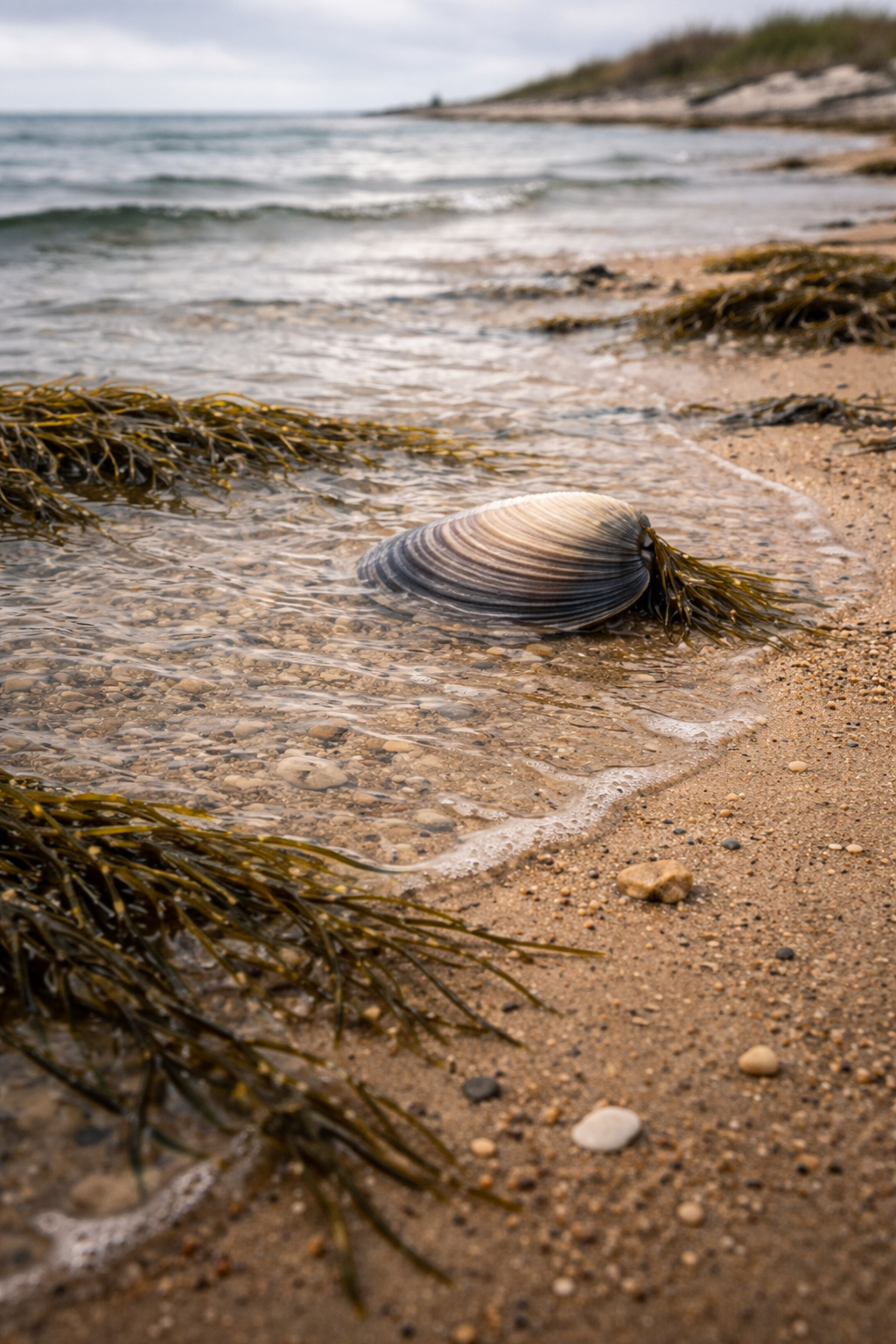
Quahog clam on a New England shoreline with seaweed and gentle waves
🦪 Long-Lived Legends

The Clam That Lived 507 Years

📅 Updated 🔬 Born 1499 AD 🦪 Killed during age measurement

Ming the ocean quahog clam was born the year Vasco da Gama returned from India. It survived on the floor of the North Atlantic for over five centuries, filtering seawater in near-freezing darkness. Scientists collected it in 2006, confirmed its age by counting 507 growth rings in its shell — and accidentally killed it in the process.

Calculate Clam Age →
🦪 Ocean Quahog Clam Age in Human Years
in human years
Clam age
Life stage
Born in era
🦪 What this age means

507 Years on the Ocean Floor — A Timeline

1499
Ming is born, settling onto the seabed off Iceland as a tiny larva. Vasco da Gama has just returned to Portugal from his first voyage to India. Leonardo da Vinci is 47. The Ming Dynasty of China is at its height.
1564
Ming is 65 years old. Shakespeare is born. Ming is still small by adult standards — ocean quahogs grow slowly in cold water.
1687
Ming is 188 years old. Isaac Newton publishes Principia Mathematica. Ming has now lived longer than any human in recorded history.
1776
Ming is 277 years old. The United States declares independence. Ming continues filtering seawater in the dark, cold North Atlantic, utterly indifferent.
1914
Ming is 415 years old. World War I begins. The shell that has recorded 415 winters is buried in sediment on the Icelandic seabed.
2006
Ming is 507 years old. Researchers from Bangor University dredge Ming from 80 metres of water off Iceland. It is frozen alive on the research vessel. Scientists later open the shell to count its rings. They count 507. In the process, Ming dies.

🦪 The initial age estimate announced by researchers was 405 years — Ming was already extraordinary news. A more careful re-count of the rings in 2013 revised the figure to 507 years. The discrepancy arose because the first count missed some very fine rings near the umbo (the oldest part of the shell near the hinge). The corrected age makes Ming the oldest non-colonial animal with a confirmed age on record — surpassing the previous record of 374 years held by another Arctica islandica specimen from the same study. Ming's shell is now preserved at Bangor University.

The Life Stages of an Ocean Quahog

The ocean quahog's life is one of almost imperceptible slowness. Where most animals measure developmental milestones in weeks or months, the quahog measures them in decades. A clam that has barely reached adulthood may already be 20 years old — older than many of the humans who will eat it.

0–1 yr
Veliger Larva
Free-swimming larval stage lasting 2–4 weeks. Carried by ocean currents. Settles on the seabed and begins forming its shell. Mortality is extraordinarily high — only a tiny fraction survive.
1–5 yrs
Juvenile
Tiny shell, buried in sediment. Filter-feeding on phytoplankton. Growing slowly — shell growth rings are already forming, one per year, the future record of its age.
5–25 yrs
Sub-adult
Approaching commercial harvest size. Many quahogs consumed as "littlenecks" or "cherrystones" at this age — before reaching even a quarter of their potential lifespan.
25–100 yrs
Adult
Fully mature. Reproductively active — releasing millions of eggs or sperm into the water column each season. The shell rings are now a detailed archive of every winter the clam has survived.
100–300 yrs
Elder
A genuinely ancient animal. Metabolic rate continues to slow. Cellular repair mechanisms that would have failed in most animals decades ago continue functioning. The ocean floor around it has changed many times.
300–507 yrs
Extraordinary Elder
Ming territory. Born before European contact with the Americas. Survived the Little Ice Age, the Industrial Revolution, and two World Wars on the floor of the North Atlantic — until 2006.

Quahogs, Clams & the World's Longest-Lived Animals

The ocean quahog (Arctica islandica) holds the verified record for the longest-lived non-colonial animal. But it belongs to a broader family of extraordinarily long-lived bivalves — and is part of a wider story about which animals age the slowest.

SpeciesMax Verified AgeHabitatNotes
Ocean Quahog (Arctica islandica)507 years (Ming)North Atlantic seafloorOldest verified non-colonial animal ever recorded
Hard Clam / Quahog (Mercenaria mercenaria)~40 yearsAtlantic US coast, estuariesThe clam eaten as chowder; far shorter-lived than ocean quahog
Geoduck (Panopea generosa)~168 yearsPacific NorthwestWorld's largest burrowing clam; up to 1.5kg; prized in Asian cuisine
Horse Mussel (Modiolus modiolus)~50+ yearsNorth AtlanticLong-lived relative; forms reef-like structures on the seabed
Greenland Shark (Somniosus microcephalus)~400+ yearsArctic/North Atlantic deepLongest-lived vertebrate; reaches sexual maturity at ~150 years
Bowhead Whale (Balaena mysticetus)~211 yearsArctic oceanLongest-lived mammal; has unique DNA repair mechanisms

More Things About Quahogs That Will Surprise You

🍜 Eaten Long Before It's Old
The vast majority of quahogs consumed by humans are harvested at 3–5 years old — sold as "littlenecks" (smallest), "topnecks", or "cherrystones" (medium). A "chowder clam" is typically 5–7 years old. The ocean quahog that could live 500 years is usually eaten before it's a decade old. The US harvests approximately 100 million pounds of hard clams annually — almost none of which approach their biological potential.
🧬 The Secret to Not Aging
Research published in Aging Cell found that ocean quahog tissues show significantly lower levels of protein carbonylation (oxidative damage to proteins) than shorter-lived bivalves — even at advanced ages. Their cells appear to maintain protein quality control mechanisms that most animals lose over time. They also show unusually high resistance to oxidative stress and have antioxidant enzyme activity that remains elevated for centuries. Scientists studying biological aging consider the quahog one of the most important model organisms for understanding why some animals age so slowly.

🦪 There are approximately 15,000 known species of bivalve worldwide — clams, oysters, mussels, scallops, and cockles. The ocean quahog is found across the North Atlantic from Iceland to the eastern United States, typically in water 25–500 metres deep. It is fished commercially across its range, with Iceland and the US being the largest producers. The species is currently assessed as not threatened by the IUCN, though deep-sea trawling and ocean warming pose long-term risks to populations.

Things About Ocean Quahog Clams That Will Actually Surprise You

🧊 Cold Is the Key
Ocean quahog clams live their extraordinary long lives in cold North Atlantic and Arctic waters, typically at depths of 25–500 metres where temperatures hover around 0–8°C. Cold temperature directly slows metabolism — biochemical reactions that cause cellular damage occur more slowly at low temperatures. The extreme longevity of Arctica islandica is directly linked to its cold habitat. Clams of the same species in warmer southern waters live noticeably shorter lives. Cold water is, in a very real sense, the clam's fountain of youth.
🛡️ Exceptional Cellular Defences
Research comparing Arctica islandica to shorter-lived clam species has found that ocean quahogs have superior antioxidant defences and protein stability compared to species that age and die much faster. Their cells are exceptionally resistant to oxidative stress — the cellular damage caused by reactive oxygen species that is a primary driver of ageing in most animals. Their proteins resist unfolding and aggregation (a key feature of cellular ageing) far more effectively than those of shorter-lived relatives. These molecular defences appear to be the biochemical basis of their longevity.
📊 Climate Archive
The annual growth rings in Arctica islandica shells are not just age records — they are detailed climate archives. Ring width reflects water temperature and food availability in each year. A shell that lived for 200+ years contains a year-by-year record of ocean conditions going back centuries. Scientists have used collections of overlapping shell records (similar to how tree-ring researchers build multi-century records) to reconstruct North Atlantic sea surface temperature records going back 1,000+ years — far beyond the period covered by instrumental measurements.
🍽️ How a Clam Eats
Ocean quahogs are filter feeders, drawing water across their gills using cilia (tiny hair-like projections) and trapping phytoplankton and organic particles. A single clam can filter several litres of water per hour. They open their shells slightly to allow water flow and can close them tightly in response to disturbance — the strong adductor muscles that close the shell are among the most powerful muscles relative to body size of any animal. Their lifestyle is almost entirely passive: buried in sediment, filtering the ocean, depositing one ring per year, for centuries.

Other Extraordinary Animals

Frequently Asked Questions

The nickname Ming was given informally by the media and researchers because the clam was born in 1499 — during the Ming dynasty of China (1368–1644). The name caught on and became widely used. Its formal scientific identification is simply a specimen of Arctica islandica. The clam itself was originally estimated at 405 years old when first reported in 2007; the corrected count of 507 years was established in 2013 after a more careful analysis of the fine rings near the hinge, where the oldest growth is recorded.
Yes — though "accident" requires some context. The clam was dredged from the seabed and frozen alive on the research vessel as part of standard sample collection procedure, before anyone knew its extraordinary age. The shell was then opened and sectioned to count the growth rings — a process that is necessarily fatal. At the time of initial collection, there was no way to know that this particular individual was anything exceptional without examining it. Once the rings were counted and its age recognised, the animal was already dead. The story is sometimes told as a straightforward blunder, but it was really the consequence of the age-determination method itself requiring the shell to be opened. Researchers have since developed non-destructive sampling techniques using high-resolution imaging that can count rings without opening the shell.
It depends on definitions. Ming at 507 years is the oldest verified age for a non-colonial animal with a hard confirmed record. However, colonial organisms (where individual animals form persistent colonies) can be far older — some deep-sea coral colonies are estimated at 4,000+ years, and Posidonia oceanica seagrass meadows in the Mediterranean may be 100,000+ years old, though these represent clonal expansion rather than a single individual organism. The immortal jellyfish (Turritopsis dohrnii) has no fixed lifespan at all, and can theoretically live indefinitely through biological age reversal — but has no "confirmed age" in the same sense. Among individual animals with verified ages, Ming is the record holder.