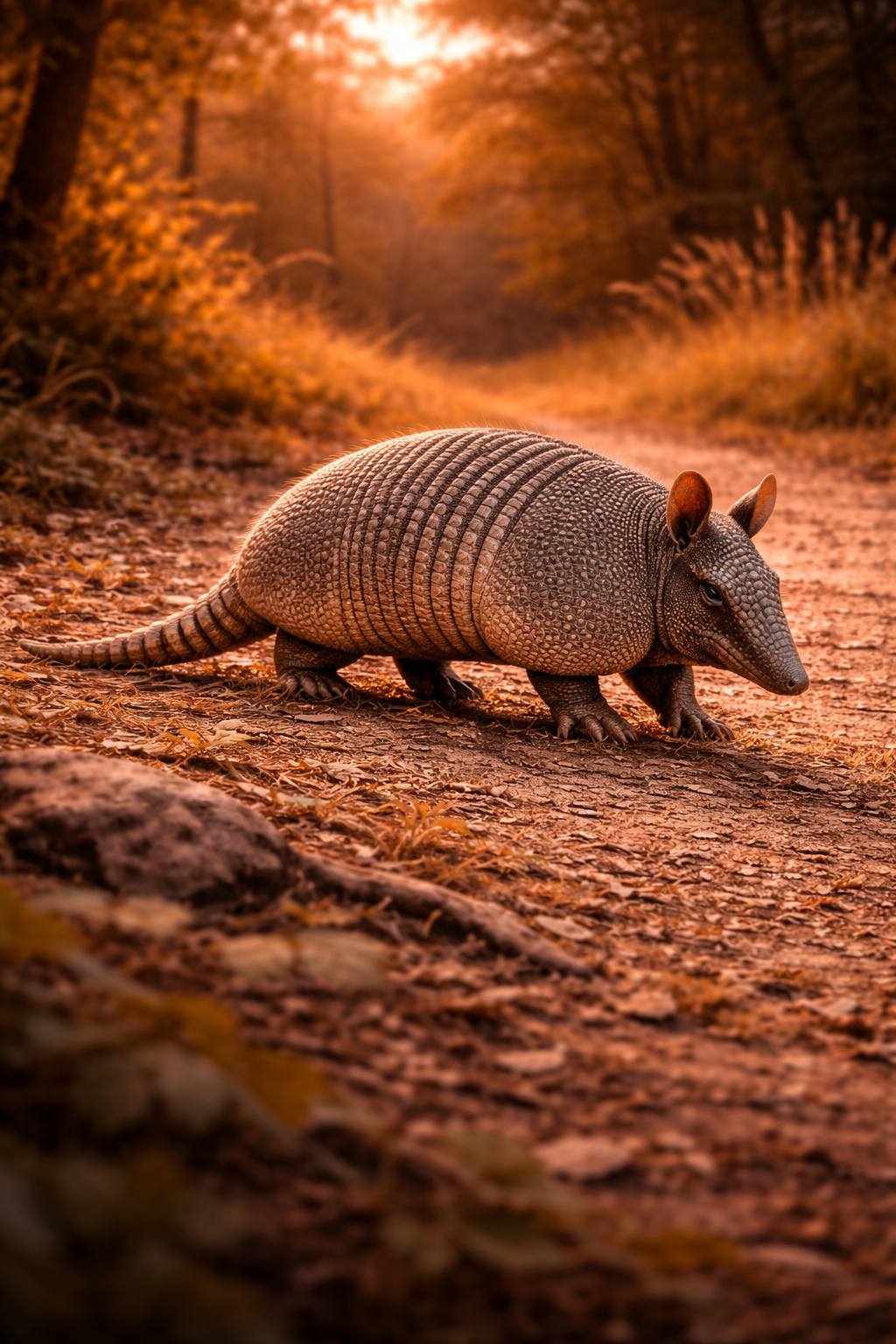
The Life Stages of an Armadillo
The nine-banded armadillo's reproductive biology is unlike any other mammal's. A single fertilised egg implants and then splits into four identical embryos — every birth produces four genetically identical offspring. This consistent quadruplet birth makes armadillos invaluable in biomedical research, where uniform genetic material across siblings eliminates experimental variables that would confound studies in other animals.
Armadillo Age to Human Years Conversion Table
| Armadillo Age | Nine-Banded | Giant Armadillo | Captive Armadillo | Life Stage |
|---|---|---|---|---|
| Birth | Newborn | Newborn | Newborn | Newborn pup |
| 3 months | ~6 yrs | ~5 yrs | ~4 yrs | Juvenile; independent foraging |
| 1 year | ~14 yrs | ~12 yrs | ~8 yrs | Sub-adult |
| 2 years | ~24 yrs | ~21 yrs | ~14 yrs | Young adult; first breeding |
| 4 years | ~40 yrs | ~36 yrs | ~24 yrs | Prime adult |
| 7 years | ~59 yrs | ~54 yrs | ~38 yrs | Mature adult |
| 10 years | ~74 yrs | ~70 yrs | ~50 yrs | Senior |
| 15 years | Elder | Elder | ~68 yrs | Elder |
| 23 years | — | — | ~90 yrs | Captive record territory |
🛡️ The nine-banded armadillo (Dasypus novemcinctus) has been expanding its range northward through the United States since the 19th century, moving from Texas into states as far north as Nebraska and Illinois. This range expansion is driven by warming temperatures and the absence of natural predators in human-modified landscapes. The IUCN lists it as Least Concern with a stable and growing population.
Things About Armadillos That Will Actually Surprise You
🛡️ The word "armadillo" comes from the Spanish for "little armoured one" — given by Spanish conquistadors who had never seen anything like them when they arrived in the Americas. There are 21 living species of armadillo, ranging from the pink fairy armadillo (Chlamyphorus truncatus) — the smallest at just 85g and 13cm long — to the giant armadillo (Priodontes maximus), which can reach 60kg and 1.5 metres in length and possesses the largest claws of any living mammal relative to body size.
Armadillo Species — A Family Portrait
There are 21 living armadillo species, all found in the Americas. They range from tiny to surprisingly large, and vary dramatically in their defensive strategies, diets, and habitats.
| Species | Range | Size | Notable Trait | Conservation |
|---|---|---|---|---|
| Nine-Banded | S. USA to Argentina | 3–6 kg | Always identical quadruplets; carries leprosy; expanding US range | Least Concern |
| Giant Armadillo | S. America | 18–60 kg | Largest claws of any mammal; digs burrows used by 25+ other species | Vulnerable |
| Three-Banded | S. America | 1–1.6 kg | Only armadillo that can fully roll into a ball | Near Threatened |
| Pink Fairy | Argentina (desert) | 80–100 g | Smallest armadillo; lives mostly underground; size of a hamster | Data Deficient |
| Giant Armadillo | Tropical S. America | Up to 60 kg | Keystone burrower — burrows used by jaguars, anteaters, foxes | Vulnerable |