📅 Updated 🔬 Negligible senescence🦞 Record: 20kg, ~100+ years
Lobsters don't appear to get weaker, less fertile, or more likely to die as they get older. A 50-year-old lobster is as vigorous as a 10-year-old. They continue growing for their entire lives. There is no known upper age limit. The largest ever caught weighed 20 kilograms. What kills lobsters is not ageing — it's the cost of keeping up with their own growth.
Note: lobster age cannot be determined directly from living animals — there is no hard structure to count rings on. Age is estimated from size and growth data. The conversion below is based on American lobster growth rates.
—
in human years
—
—
Lobster age
—
Life stage
—
Est. size
🦞 What this age means
—
🔬 Negligible Senescence — What It Actually Means
In most animals, mortality risk increases with age and reproductive output decreases with age — these are the two defining features of biological ageing (senescence). In lobsters, neither pattern is clearly observed. Older lobsters do not show declining immune function, reduced fertility, or increased likelihood of dying in any given year compared to younger adults of the same size. In fact, larger (older) female lobsters produce dramatically more eggs — a 20-year-old female produces roughly 10,000 eggs per brood; a 100-year-old female may produce 100,000 or more. This is the opposite of the reproductive decline seen in most ageing animals. The molecular basis involves continuous telomerase activity — the enzyme that maintains the protective caps on chromosomes that shorten with each cell division in most animals. In lobsters, telomerase remains active in adult tissues, preventing the telomere shortening that is a key molecular driver of cellular ageing.
Age & Size Table
Lobster Age, Size & Human Equivalent
Lobster Age
Est. Weight
Human Equivalent
Notes
1 year
~10g
~7 yrs
Settled to seabed; tiny
5 years
~200g
~18 yrs
Sub-legal size; still growing fast
7 years
~450g (1 lb)
~22 yrs
Legal harvest size in most regions
15 years
~1.5 kg
~38 yrs
Prime adult; breeding regularly
25 years
~2.5 kg
~50 yrs
Large adult; increasingly rare
50 years
~4–6 kg
~62 yrs
Genuinely old; producing thousands of eggs
100 years
~10–15 kg
~75 yrs
Extraordinary; possibly the largest in region
~140 years
~20 kg
Record
Estimated age of the largest ever caught
🦞 The largest American lobster ever recorded was caught off Nova Scotia, Canada in 1977 — it weighed 20.1 kg (44.4 lbs) with a body length of 64 cm. Based on growth rate data, it was estimated to be over 100 years old. It is now in the Guinness World Records. Most lobsters caught commercially are 5–7 years old and weigh around 450g–1kg. A lobster that reaches legal harvest size represents only a tiny fraction of its potential lifespan.
Life Stages
The Life Stages of a Lobster
Lobster development is one of the most unusual in the animal kingdom — they moult (shed their entire exoskeleton) throughout their lives, growing larger with each moult. Unlike most animals, lobsters show no measurable decline in reproductive capacity, metabolic rate, or strength with age — a trait called negligible senescence that has made them one of the most intensely studied animals in aging research.
0–2 wks
Larval Stages I–III
Hatches from eggs as a tiny, free-swimming larva. Drifts near the surface. Moults through three larval stages in the first 2 weeks. Extraordinarily vulnerable — most never survive to settle on the seafloor.
2 wks–1 yr
Post-larval / Juvenile
Settles to the seafloor at Stage IV. Seeks shelter under rocks and in crevices. Moults frequently — several times per year. Growing from millimetres to a few centimetres. Cannibalism is a significant mortality risk.
1–5 yrs
Sub-adult
Still moulting 1–2 times per year. Developing the asymmetric claws — one crusher, one cutter. Establishing territory on the seafloor. Approaching legal harvest size in most jurisdictions.
5–10 yrs
Young Adult
Reaching sexual maturity around 5–7 years. Moulting frequency decreasing to once per year or less. The moult is still a dangerous period — soft-shelled lobsters are highly vulnerable to predation.
10–50 yrs
Prime Adult
Fully established. Continuing to grow with each moult — a 50-year-old American lobster can weigh over 9 kg. No measurable decline in reproductive output or physical condition. Telomerase activity remains high throughout.
50–100+ yrs
Elder
Estimated ages of 70–100+ years have been reported. The moult eventually becomes the primary cause of death — the energy cost of shedding an increasingly large shell becomes too great, and the lobster dies during or after moulting.
Species & The Immortality Question
100+ Species — and One That May Not Age
There are approximately 75 recognised species of "true" lobster (family Nephropidae) worldwide, plus dozens of spiny lobsters, slipper lobsters, and squat lobsters. The American and European lobsters are the most commercially important and best-studied. What makes all of them biologically extraordinary is a single enzyme: telomerase.
Regional markets; considered delicacy in parts of Asia
Negligible Senescence — What It Actually Means
Lobsters produce telomerase — an enzyme that repairs the telomeres (protective caps) at the ends of chromosomes — in virtually all their tissues, throughout their entire lives. In humans and most other animals, telomerase production declines with age, telomeres shorten, and cells lose the ability to divide properly. This is a key mechanism of aging. Lobsters appear to maintain telomere length indefinitely.
This does not make them immortal — they can still die from disease, predation, or the increasingly costly moult. But it does mean that a 70-year-old lobster shows no measurable decline in fertility, strength, or metabolic rate compared to a 10-year-old lobster. In the biological sense, they do not get old. They just get larger — until the moult kills them.
🦞 The global lobster catch is approximately 200,000–250,000 tonnes per year. The US and Canadian American lobster fishery alone generates over $1 billion annually — making it one of the most valuable single-species fisheries in the world. Maine's lobster harvest regularly exceeds 100 million pounds per year. The industry employs approximately 5,000 licensed lobstermen in Maine alone, plus thousands more in processing and related industries.
Additional Facts Worth Knowing
👃 Tasting With Their Feet
Lobsters have chemoreceptors on their legs and feet — they literally taste the seafloor as they walk across it. Their antennules (smaller pair of antennae) detect waterborne chemicals with extraordinary sensitivity, capable of tracking scent plumes across significant distances in total darkness. They navigate primarily by smell and touch — their eyesight is poor, detecting only light and shadow rather than distinct images.
🎨 Colour Variations
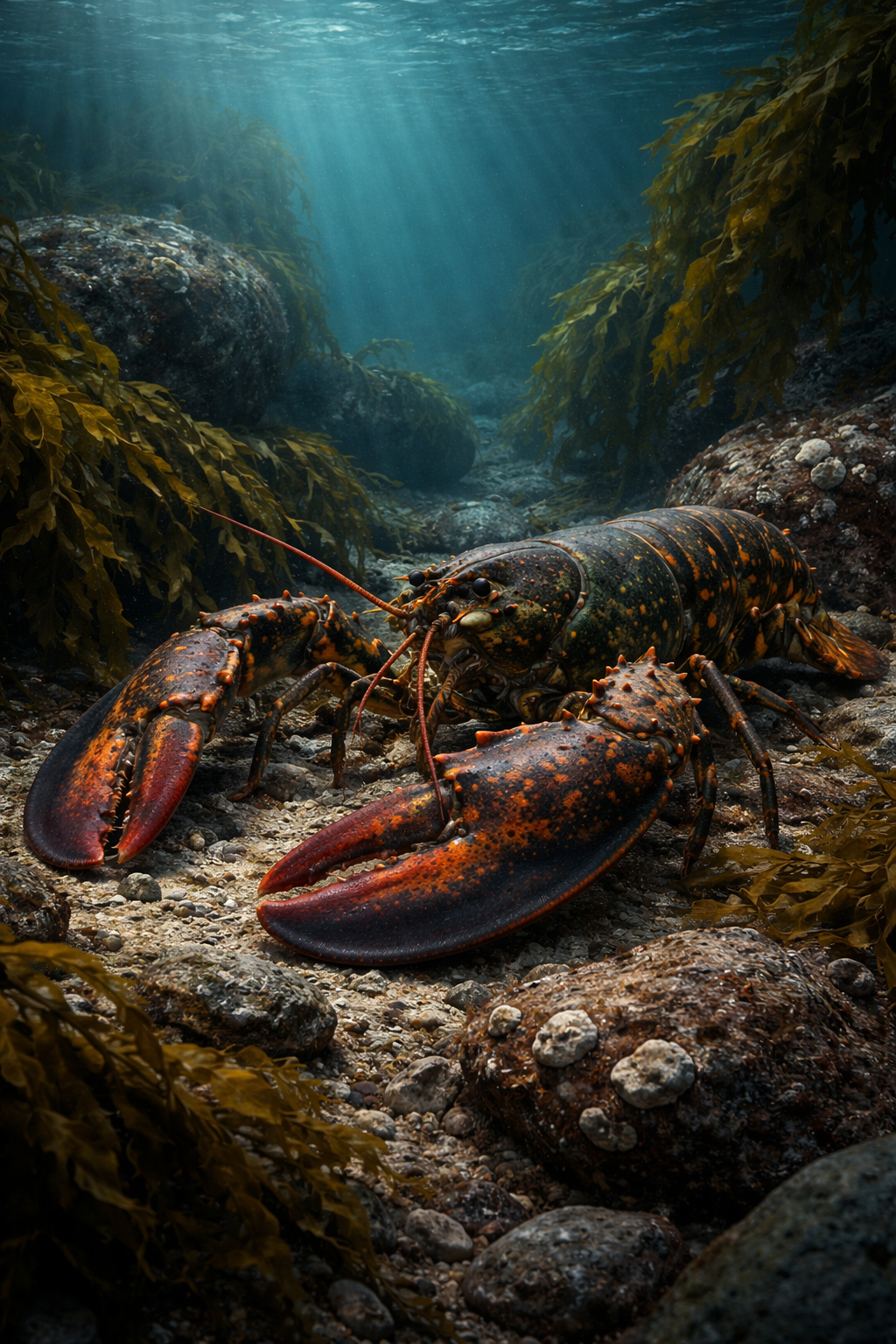
American lobsters are normally dark greenish-brown — the colour comes from a protein called crustacyanin binding to a red pigment called astaxanthin. Heat from cooking denatures the protein, releasing the red pigment and turning the lobster bright red. Genetic mutations produce rare colour variants: blue lobsters occur in roughly 1 in 2 million (documented by the Maine Lobstermen's Association), yellow in 1 in 30 million, and the rarest — albino (white) — in approximately 1 in 100 million. Calico (orange and black) and split-coloured (half one colour, half another) lobsters also occur.
Fascinating Facts
Things About Lobsters That Will Actually Surprise You
⚰️ What Actually Kills Lobsters
If lobsters don't age, what kills them? The answer is moulting exhaustion. Lobsters must continue to moult (shed their entire exoskeleton) to grow throughout their lives. As they get larger, each moult requires more energy and is more physically demanding. A very large, old lobster may eventually lack the energy to complete a moult successfully and die in the process. They are also killed by shell disease (a bacterial infection that pits and erodes the shell, increasingly common in warmer coastal waters), predation, and fishing. In heavily fished regions, almost no lobster reaches old age — they are caught long before their biology becomes a limiting factor.
🔵 Blue Blood, Three Hearts
Like other crustaceans, lobsters have blue blood (haemolymph containing haemocyanin — copper-based rather than iron-based oxygen carrier) and three hearts: one main heart and two accessory pumping organs. Their nervous system is decentralised — rather than one large brain, they have a series of ganglia (nerve clusters) distributed along the body. This is why a lobster can continue moving after its head is removed — the tail ganglion can still generate movement signals independently. The decentralised nervous system also raises significant questions about how lobsters perceive pain.
🎭 Two Different Claws
American lobsters (Homarus americanus) and European lobsters (Homarus gammarus) have two functionally different claws. The larger crusher claw has blunt, rounded teeth and is used to crack open shells — mussels, snails, and other hard prey. The smaller cutter claw has sharp, serrated edges and is used to tear flesh and seize fast-moving prey. Which claw is on which side varies between individuals and is not genetically fixed — it is determined by which claw is used more during development. Most lobsters are not left- or right-clawed at birth; they become so through use.
🌡️ Climate Change & Shell Disease
Epizootic Shell Disease — a bacterial infection causing progressive erosion of the lobster's shell — has increased dramatically in Gulf of Maine lobster populations since the early 2000s, correlating with warming water temperatures. Warmer water appears to weaken the lobster's immune defences and promote bacterial growth. While lobster catches have actually increased in recent decades as warming has benefited juvenile survival, shell disease is a growing concern for long-term population health. It also directly reduces the commercial value of affected individuals. The Gulf of Maine is warming faster than almost any other ocean region on Earth.
This is genuinely contested. The traditional view was that lobsters, as invertebrates with a decentralised nervous system, lack the neural architecture for pain consciousness. This position has been challenged by a growing body of research. A 2021 review commissioned by the UK government found "strong evidence" that decapod crustaceans (including lobsters and crabs) are capable of experiencing pain and distress, leading to the UK Animal Welfare (Sentience) Act 2022 including decapod crustaceans as sentient beings — a first. The scientific debate is not fully resolved. Most animal welfare scientists now believe that killing lobsters by immediately severing the brain and main nerve cord (with a sharp knife), rather than boiling alive, is the more humane practice.
Unlike fish (scales), clams (shell rings), or trees (wood rings), lobsters have no permanent hard structure that accumulates annual growth records — they moult their shells entirely. Age must be estimated indirectly from size and growth rate data. Growth rates vary significantly with water temperature and food availability, making size-based age estimates imprecise. A method using lipofuscin accumulation (a cellular pigment that builds up with age in nerve tissue) has been developed and offers more reliable age estimates from brain tissue samples, but this requires killing the animal. For large old lobsters, age estimates carry significant uncertainty.
Live lobsters are typically dark blue-green or mottled brown-green — their natural camouflage against rocky seabed. The colour comes from a pigment called astaxanthin, which in living lobsters is bound to proteins called crustacyanins that shift the pigment's colour toward blue-green. When heat denatures (unfolds) the crustacyanin proteins during cooking, the astaxanthin is released and reverts to its natural red-orange colour. The same pigment that makes wild salmon flesh orange and flamingo feathers pink — astaxanthin — is responsible for the red colouration of cooked lobster, crab, and shrimp.