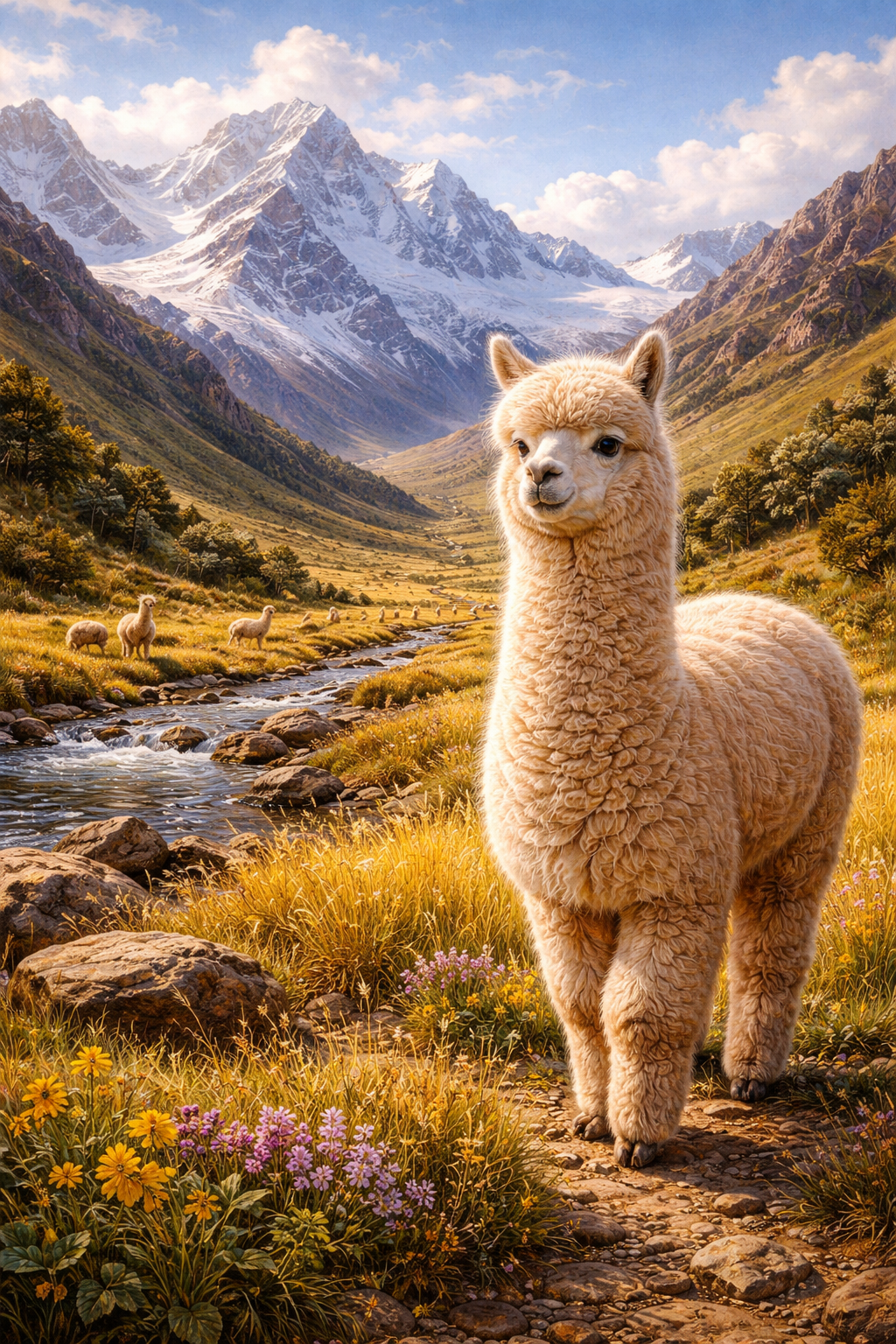
One Family — Four Animals
South America has four camelid species: two wild (vicuña and guanaco) and two domesticated (alpaca from vicuña, llama from guanaco). All four are related to Old World camels but diverged from that lineage around 11 million years ago. None of them have humps.
Alpaca Age to Human Years
| Age | Human Equivalent | Life Stage |
|---|---|---|
| 6 months | ~6 yrs | Cria — weaned, growing fast |
| 1 year | ~10 yrs | Juvenile — sub-adult |
| 2 years | ~16 yrs | Young adult — approaching maturity |
| 3 years | ~20 yrs | Adult — first shearing in full production |
| 7 years | ~36 yrs | Prime — peak fibre quality years |
| 12 years | ~52 yrs | Mature — fibre beginning to coarsen |
| 18 years | ~66 yrs | Senior — retirement from breeding |
| 25+ years | ~78 yrs | Elder — exceptional longevity |
Things About South American Camelids That Will Actually Surprise You
🦙 The vicuña was hunted nearly to extinction in the 20th century — by 1960 the population had fallen to approximately 6,000 individuals, down from an estimated 2–3 million at the time of European contact. Legal protection from the 1970s onwards, particularly through the Vicuña Convention signed by Peru, Bolivia, Chile, Argentina, and Ecuador, allowed populations to recover to approximately 350,000–400,000 today. It is one of South America's more successful conservation recoveries. The traditional Andean chaku — a community ceremony in which hundreds of people form a human chain to herd vicuñas, shear them, and release them — has been revived in several regions as a legal and sustainable harvest method, with proceeds supporting local communities.