Popular Pets
🐶 Dog 🐱 Cat 🐰 Rabbit 🐹 Hamster 🐾 Guinea Pig 🦜 Parrot 🦡 Ferret 🐀 Rat 🐭 Chinchilla 🦔 Hedgehog 🐟 Goldfish 🦜 Macaw
Farm & Large Animals
🐴 Horse 🐄 Cow 🐄 Highland Cow 🐷 Pig 🐑 Sheep 🐐 Goat 🐴 Donkey 🦙 Alpaca 🐐 Mountain Goat 🐔 Chicken 🦆 Duck 🦃 Turkey
Wild Animals
🐘 Elephant 🦁 Lion 🐯 Tiger 🐆 Leopard 🐺 Wolf 🐻 Bear 🐻‍❄️ Polar Bear 🦍 Gorilla 🐒 Chimpanzee 🦧 Orangutan 🦘 Kangaroo 🐾 Capybara 🦒 Giraffe 🦊 Fox 🦅 Raptor 🦉 Owl 🐧 Penguin 🦩 Flamingo 🐾 Hyena 🐾 Meerkat 🦥 Sloth 🦡 Badger 🐾 Wolverine 🐾 Armadillo
Ocean & Aquarium
🦈 Shark 🐋 Orca 🐬 Dolphin 🐋 Whale 🐋 Blue Whale 🐳 Beluga Whale 🦄 Narwhal 🐋 Bowhead Whale 🐾 Manatee 🐟 Manta Ray 🐟 Freshwater Fish 🐠 Saltwater Fish 🐴 Seahorse 🐟 Koi
Exotic & Weird
🐍 Snake 🐍 Ball Python 🦎 Bearded Dragon 🦎 Iguana 🦎 Komodo Dragon 🦎 Chameleon 🦎 Leopard Gecko 🐢 Tortoise 🐢 Snapping Turtle 🐢 Sea Turtle 🐊 Crocodilian 🕷️ Tarantula 🦎 Axolotl 🐙 Octopus 🌊 Jellyfish 🦞 Lobster 🐚 Quahog 🔬 Tardigrade
Info
About FAQ Contact
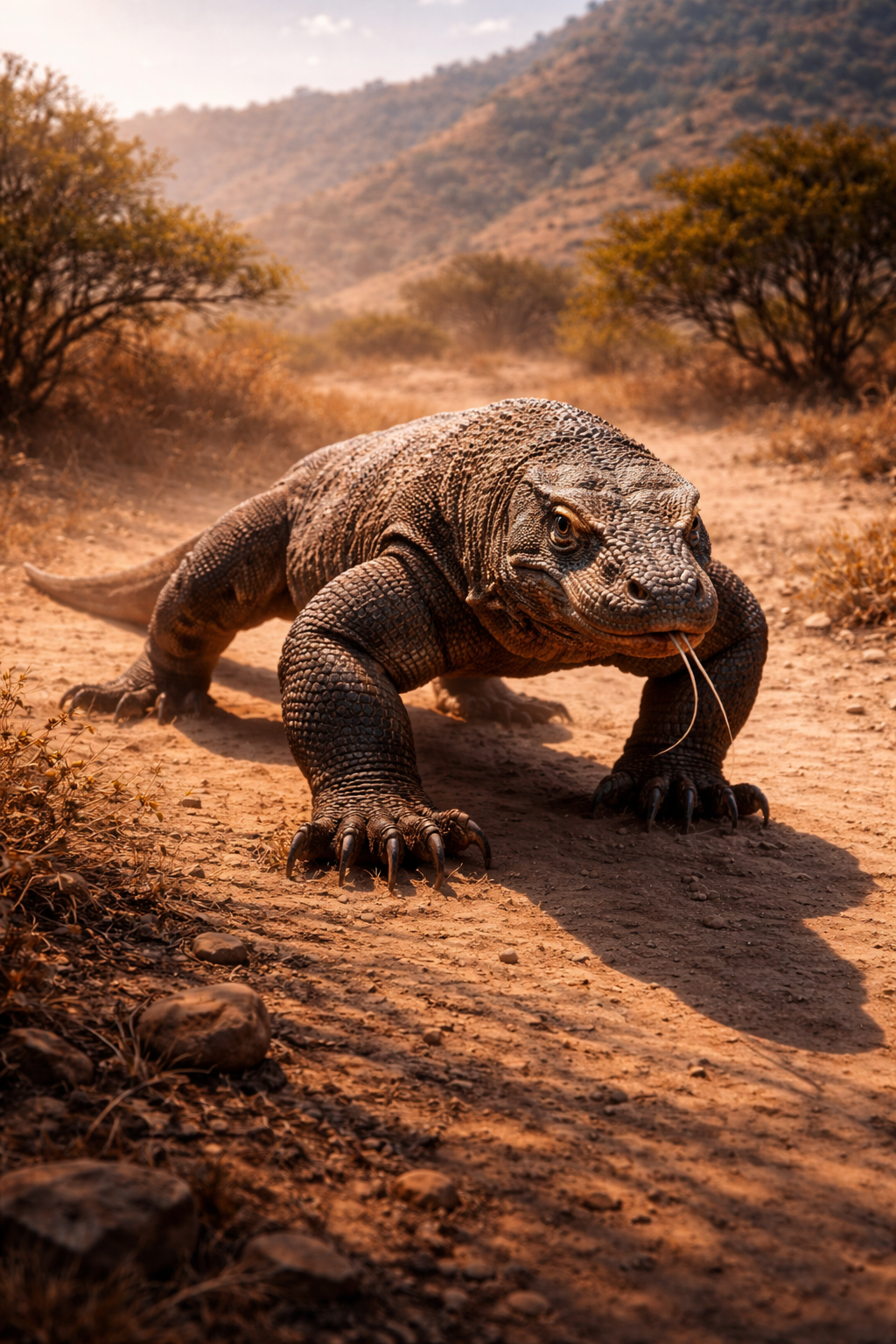
Photorealistic painting of a Komodo dragon stalking across dry Indonesian scrubland with forked tongue extended
🦎 Wild Animals

How Old Is a Komodo Dragon in Human Years?

📅 Updated March 2026 🏝️ Komodo National Park, Indonesia 🦎 Lifespan: 30+ years

Komodo dragons have iron-coated serrated teeth that replace every 40 days. They wear chainmail armour under their scales. They can reproduce without males. They smell blood from 6 miles away. They can eat 80% of their body weight in a single meal. The largest living lizard on Earth — and one of the most scientifically astonishing animals alive.

Calculate Komodo Age →
🦎 Komodo Dragon Age in Human Years
in human years
Komodo age
Life stage
Sex
🦎 What this age means

The Life Stages of a Komodo Dragon

Komodo dragons begin life in the treetops and end it as the apex predator of their island ecosystem — a trajectory that takes roughly a decade of careful concealment, rapid growth, and acquired hunting skill. Their life history is shaped entirely by the unusual conditions of island life: extreme heat, limited prey, and a social structure defined by size.

0–1 year
Hatchling (Tree-Dweller)
Hatched from leathery eggs after 7–8 months of incubation, hatchlings emerge at around 40cm long and immediately climb trees — their primary survival strategy. Adult Komodo dragons are cannibalistic: smaller individuals are prey. The treetops are the only safe zone. Young Komodos spend their first years in the canopy, hunting insects, small lizards, geckos, and birds' eggs. They roll in faeces to mask their scent from adults patrolling below — a remarkable early survival adaptation documented by researchers.
1–4 years
Juvenile
Still primarily arboreal but growing rapidly. The juvenile's diet expands to include larger prey — small mammals, eggs, birds. The forked tongue is becoming increasingly effective as the Jacobson's organ develops — tasting the air for scent particles that reveal the direction and distance of potential prey or danger. Growing quickly on a diet richer in protein than an adult's, juveniles gain mass rapidly during this stage. The descend from the trees happens gradually as the dragon grows too heavy for branches and too large to be targeted by adults.
4–8 years
Sub-Adult
Now fully terrestrial and growing toward adult size. The sub-adult Komodo is developing the ambush hunting strategy that will define its adult life: patience, concealment, explosive short-distance acceleration. It is targeting progressively larger prey — graduating from small mammals to deer fawns and smaller monitor lizards. The iron-coated serrated teeth are fully functional, replacing every 40 days to maintain razor sharpness. The chain-mail-like armour of osteoderms beneath the skin is becoming more pronounced — a living suit of protection.
8–15 years
Young Adult
Sexually mature and approaching full size. Male Komodo dragons compete for females through combat — rearing onto their hind legs and grappling with their forearms in bouts that can last hours, with the loser retreating before serious injury. Females can reproduce sexually or, uniquely, by parthenogenesis — producing viable eggs without male fertilisation, all of which develop into males. A young adult Komodo is a formidable ambush predator, capable of taking adult deer and occasionally water buffalo.
15–30 years
Prime Adult
The apex predator of Komodo Island. A prime adult male may reach 3 metres and 90kg — the largest individual in an ecosystem over which it exercises unchallenged dominance. A single adult Komodo can consume 80% of its body weight in one meal, then not eat again for weeks. Its slow metabolism is extraordinarily efficient — it can survive on as few as 12 large meals per year. When not hunting, a prime adult spends most of its time thermoregulating in the sun — its remarkable physiology operating at a pace that belies its explosive hunting capability.
30–40+ years
Elder
The oldest known wild Komodo dragons have been documented at 30+ years through long-term field tracking; captive individuals have reached 40+ years. An elder Komodo dragon carries the accumulated territorial knowledge of its home range — every deer trail, every water source, every strategic vantage point. Its size alone commands deference from younger, smaller individuals. As the population is confined to a small set of islands with fewer than 3,500 individuals worldwide, every elder represents a significant fraction of a critically endangered species.

Komodo Dragon Age to Human Years Conversion

Komodo AgeHuman EquivalentLife StageTypical SizeKey Milestone
HatchlingNewborn–InfantHatchling~40cm, ~100gHatches; immediately climbs trees; rolls in faeces for camouflage
1 year~5 yrsJuvenile~50–70cmArboreal; hunting insects and small reptiles
3 years~13 yrsJuvenile~100cmGrowing; beginning to descend from trees
6 years~22 yrsSub-Adult~150cmFully terrestrial; hunting small mammals
10 years~32 yrsYoung Adult~200–240cmSexual maturity; capable of parthenogenesis (♀)
15 years~43 yrsPrime Adult~250–300cmFull size; apex predator; dominant territorial male
25 years~62 yrsSeniorMax sizeContinued territorial dominance
35+ years~78 yrsElderMax sizeExceptional longevity in wild or captivity

🦎 Komodo dragon age in the wild is estimated primarily from size and long-term mark-recapture data. Unlike turtles or fish, they do not have growth rings that can be counted. Long-term studies in Komodo National Park, building on the pioneering fieldwork of Walter Auffenberg in 1969, have tracked tagged individuals across multiple decades — providing the foundation for current understanding of wild Komodo lifespans. IUCN Red List — Komodo dragon.

Komodo Dragons — What Science Has Recently Discovered

Komodo dragons continue to generate landmark scientific research — revealing that these seemingly ancient predators are more biologically sophisticated than anyone expected.

📰 July 2024 — Major Research
Their Teeth Are Coated in Iron — And It May Explain How T. rex Ate

A study published in Nature Ecology & Evolution by researchers from King's College London made a startling discovery: the serrated edges and tips of Komodo dragon teeth are coated in iron — visible as a distinctive orange tinge along the cutting surfaces. This iron coating, applied like "icing on a cake" over the thin layer of enamel, maintains the razor sharpness of the teeth and protects the serrations from wear.

Komodo dragons replace each tooth every 40 days and maintain up to 5 replacement teeth per position simultaneously. Despite this rapid turnover, the iron coating keeps each tooth sharp at all times — essential for an animal that tears through deer, water buffalo, and bone. Without the iron, the thin enamel on the cutting edges would wear away rapidly, dulling teeth that the animal depends on entirely for killing and feeding.

The finding opened a significant new line of inquiry: carnivorous dinosaurs like Tyrannosaurus rex had almost identically shaped serrated teeth. If Komodo dragons — the closest living anatomical analogue to large theropod dinosaurs — rely on iron to keep their teeth functional, did T. rex do the same? Researchers cannot yet confirm this, as fossilisation obscures iron content in ancient teeth. But the Komodo dragon's teeth have become a primary research tool for understanding how the great meat-eaters of the Mesozoic actually bit, tore, and fed.

📰 Ongoing — The Venom Debate
Venomous or Not? Science Still Isn't Completely Sure

For decades, the accepted explanation for why Komodo dragon prey dies so reliably was bacterial sepsis — the idea that the dragons' saliva harboured a lethal cocktail of bacteria from the rotting meat they fed on, causing fatal infection in bitten prey over several days. This was taught as fact in wildlife programmes worldwide.

In 2009, research using MRI imaging revealed complex venom glands in the lower jaw, producing anticoagulant compounds that cause profuse bleeding and blood-pressure-lowering compounds that induce shock. This replaced the bacteria theory. But subsequent research complicated the picture further — other scientists questioned whether the venom glands deliver enough compound to have significant effect compared to the physical damage of the bite itself.

A 2025 histochemical study confirmed the presence of multiple toxin types in Komodo venom glands, but the functional debate continues: is the bite lethal primarily from blood loss and shock caused by the bite's physical damage, from anticoagulant compounds in the saliva, or from the venom gland compounds? The most current scientific consensus is that the bite is devastating from multiple compounding factors — deep lacerations from iron-coated serrated teeth, anticoagulant saliva, and possibly venom compounds — making the question of which factor dominates somewhat academic from the prey's perspective.

What is definitively settled: no wild Komodo dragon has been documented waiting days for bacterial sepsis to kill prey. They kill quickly — within 30 minutes in most documented hunts — using a combination of the bite's immediate damage and whatever physiological effects follow.

📰 Research — Medical Breakthrough
Komodo Dragon Blood Contains a Powerful Antibiotic Peptide

In a remarkable medical discovery, researchers isolated a powerful antibacterial peptide called VK25 from Komodo dragon blood plasma. Based on analysis of this peptide, scientists synthesised a derivative called DRGN-1 and tested it against multidrug-resistant (MDR) pathogens — some of the most difficult-to-treat bacterial infections in modern medicine.

The results were striking: DRGN-1 was effective against drug-resistant bacterial strains and even some fungi. It also significantly promoted wound healing in both uninfected and infected wounds — an effect that makes it doubly valuable as a potential medical compound. For a species that regularly survives bites from other Komodo dragons whose saliva contains anticoagulants and toxins, a blood-based antibacterial system would be a logical evolutionary development.

The research has not yet produced a clinical product, but it adds Komodo dragons to the growing list of animals — including horseshoe crabs, cone snails, and Gila monsters — whose unusual biology has yielded compounds with significant medical potential. The irony is compelling: the animal popularly imagined as a walking biological hazard may contribute to fighting antibiotic-resistant infection.

📰 Ongoing — Conservation
Fewer Than 3,500 Left — Climate Change Threatens Their Island Home

Komodo dragons are listed as Endangered on the IUCN Red List, with the entire world population of fewer than 3,500 individuals confined to Komodo National Park — a UNESCO World Heritage Site comprising the islands of Komodo, Rinca, Gili Motang, and parts of Flores in Indonesia. Their historical range once extended across Indonesia and Australia; today it is a tiny fraction of that.

The most significant long-term threat is climate change and rising sea levels, which are projected to inundate significant portions of the low-lying island habitat within this century. Deer poaching — removing the Komodo dragon's primary prey — is an active and ongoing threat, with poachers sometimes taking 20–30 animals per night on the west coast of Komodo Island. Illegal wildlife trade in the dragons themselves also persists.

Global Conservation committed to a new 3-year Global Park Defense program in 2024 in partnership with the Komodo Survival Program, including renovation of ranger stations, deployment of marine radar systems to detect illegal vessels at night, and a rapid sea patrol vessel for west coast interdiction. In 2024, four individuals involved in a Komodo dragon smuggling operation received prison sentences following expert testimony from conservation programme staff — a rare prosecution success in a notoriously difficult enforcement environment.

Things About Komodo Dragons That Will Actually Surprise You

⚔️ Chainmail Armour Under the Skin
Beneath the scales of a Komodo dragon lies a layer of tiny bone plates called osteoderms — the same structures found in crocodilians — that form a flexible chainmail-like armour across the body. Research published in Journal of the Mechanical Behavior of Biomedical Materials found that each osteoderm has a unique sensor-bone structure that may also function as a sensory system, detecting pressure from bites and physical contact. The armour protects Komodo dragons from each other — because they regularly fight and bite — and from the struggling prey they hold down. Adult males in particular have heavily developed osteoderms that provide significant bite resistance during combat.
👃 Smelling Blood from 6 Miles Away
Komodo dragons locate prey using a forked tongue that delivers scent particles to the Jacobson's organ — a chemical detection system capable of detecting blood and decomposing carrion from up to 9.5 kilometres (6 miles). The forked tongue works as a stereo olfactory system: the two tips sample air from slightly different positions, allowing the dragon to determine the direction of a scent source and navigate toward it with precision. This system is essentially the same as that of snakes, with whom Komodo dragons share a deep evolutionary relationship within the order Squamata. At a carcass, multiple Komodo dragons may detect the meal and converge from across the island — with the largest individual taking precedence.
🥚 Immaculate Conception — Parthenogenesis
Female Komodo dragons can reproduce by parthenogenesis — producing viable offspring from unfertilised eggs, with no male involvement. The resulting offspring are all male (because of the ZW sex-determination system — parthenogenetic eggs contain only Z chromosomes, developing into ZZ males). This ability, first confirmed in captivity at Chester Zoo and London Zoo in 2006, may have evolved as an adaptation to island isolation — a female Komodo dragon that reaches an uninhabited island alone can establish a population by producing male offspring, then mate with them. The system is extraordinary: a single female can theoretically found an entire new population. It has since been documented in several zoo settings and is believed to occur occasionally in the wild.
🍖 Can Eat 80% of Body Weight in One Meal
Komodo dragons have a highly flexible lower jaw and expandable stomach that allows them to consume enormous meals relative to body weight. A large individual can eat 80% of its body weight in a single feeding — equivalent to a 90kg human eating 72kg of food in one sitting. They consume prey almost entirely — bones, hide, hooves, and intestinal contents — leaving almost nothing behind. Indigestible material including hair, horns, and teeth is compacted into a mass called a gastric pellet and regurgitated. After a large meal, a Komodo dragon may not eat again for weeks or even months, surviving on the energy stored in the meal and its slow metabolic rate.
🏃 Faster Than You Think
Komodo dragons appear slow and ponderous — which they are for most of their day. But during a hunt or threat response, they can accelerate to 19 km/h (12 mph) in short bursts — fast enough to outrun most humans over a short distance. Their hunting strategy depends on concealment rather than pursuit: they wait motionless for prey to approach within striking range, then launch an explosive short-distance attack. Their tail is also a formidable weapon — a powerful sideways strike from a large Komodo can knock a human off their feet. Attacks on humans are extremely rare but documented: the few that have occurred in Komodo National Park have typically involved tourists ignoring safety protocols or rangers caught off guard.
🩸 Blood That Fights Superbugs
Komodo dragons regularly survive bites from each other — delivered with serrated iron-coated teeth into an oral environment containing anticoagulant saliva. Their ability to survive these wounds led researchers to investigate their blood, which yielded a discovery with potential medical significance: the antibacterial peptide VK25, isolated from blood plasma, was used to synthesise a derivative called DRGN-1 that has shown effectiveness against multidrug-resistant bacterial pathogens in laboratory testing. The compound also promoted wound healing. While not yet a clinical product, Komodo dragon blood represents one of several animal-derived compounds currently being investigated as potential weapons against antibiotic-resistant infection — one of the most pressing challenges in modern medicine.

🦎 The Komodo dragon evolved in Australia approximately 3.8 million years ago and spread into Indonesia as sea levels dropped during ice ages, eventually becoming isolated on the Indonesian islands as sea levels rose again. Their giant size — up to 3 metres and 90kg — is thought to be partly an adaptation to hunting the giant pygmy elephants (Stegodon) that once inhabited these islands. Those elephants are extinct, and Komodo dragons now mainly prey on deer and wild pigs introduced by humans. Their evolutionary history spans millions of years across a range that once stretched from Australia to India; today the entire species exists only on a handful of small Indonesian islands.

Komodo Dragon vs Other Large Lizards

SpeciesMax LengthMax WeightRangeStatusNotable Trait
Komodo Dragon~3m~90kg (wild); 166kg recorded captiveKomodo NP, IndonesiaEndangeredIron teeth; parthenogenesis; chainmail armour
Asian Water Monitor~2.5m~25kgSouth & Southeast AsiaLeast ConcernHighly adaptable; swims well; urban environments
Nile Monitor~2.4m~20kgSub-Saharan AfricaLeast ConcernExcellent swimmer; invasive in Florida
Crocodile Monitor~2.4m (tail accounts for most length)~14kgNew GuineaLeast ConcernLongest monitor by length; arboreal
Green Iguana~1.5m~8kgCentral/South AmericaLeast ConcernHerbivore; popular exotic pet; invasive in Florida

Other Reptiles & Wild Animals on PawClocks

Frequently Asked Questions

The answer is genuinely debated. MRI imaging has revealed glands in the lower jaw producing anticoagulant and blood-pressure-lowering compounds. A 2025 histochemical study confirmed multiple toxin types in these glands. However, subsequent research has questioned whether these compounds reach prey in sufficient quantities to have significant effect compared to the physical damage of the bite itself. The current scientific consensus is that the bite is lethal from multiple compounding factors — deep lacerations from iron-coated serrated teeth, anticoagulant saliva causing profuse bleeding, and possibly venom compounds. What is settled: Komodo dragons kill prey quickly (within 30 minutes) through the bite's immediate effects, not through slow-acting bacterial sepsis as was once believed.
Yes — female Komodo dragons can reproduce by parthenogenesis, producing viable offspring from unfertilised eggs without any male involvement. The offspring are all male (due to ZW sex-determination — parthenogenetic eggs contain only Z chromosomes, developing into ZZ males). This ability was first confirmed in captivity and is believed to occur occasionally in the wild. It may have evolved as an adaptation to island isolation — a lone female can theoretically found a new population by producing male offspring, then mating with them.
Komodo dragons are cannibalistic — larger individuals will eat smaller ones. Hatchlings and juveniles spend their first years in the canopy, where adult Komodos cannot follow. They even roll in faeces to make themselves smell unappealing and mask their scent from adults patrolling below. As they grow larger — typically after 3–4 years — they are too heavy for branches and too large to be targeted by adults, so they descend to the ground permanently.
Adult Komodo dragons are apex predators that eat almost any meat — deer, wild pigs, water buffalo, smaller Komodo dragons, carrion, eggs, and occasionally humans. They are ambush predators that wait motionless for prey to approach, then launch short explosive attacks targeting the throat or underside. They consume prey almost entirely — bones, hide, and hooves — compacting indigestible material into gastric pellets that are later regurgitated. Juveniles eat insects, small lizards, eggs, and small mammals. Adults can eat 80% of their body weight in a single meal and then not eat again for weeks.
Yes — Komodo dragons are listed as Endangered on the IUCN Red List with fewer than 3,500 individuals remaining, all confined to Komodo National Park in Indonesia. Their historical range once extended across Indonesia and Australia. Threats include deer poaching (removing their primary prey), illegal wildlife trade, habitat disturbance, and most significantly, rising sea levels from climate change threatening to inundate significant portions of their low-lying island habitat within this century.
Komodo dragons can reach 19 km/h (12 mph) in short bursts — fast enough to outrun most humans over a short distance. However, their hunting strategy relies on concealment and ambush rather than pursuit. They wait motionless for prey to approach within striking distance, then launch an explosive short-distance attack. Their tail is also a formidable weapon — a powerful sideways strike from a large Komodo can knock a person off their feet.
A 2024 study in Nature Ecology & Evolution found that the serrated edges and tips of Komodo dragon teeth are coated in iron — visible as a distinctive orange tinge. This iron coating maintains razor sharpness despite the teeth having only a thin layer of enamel. Each tooth is replaced every 40 days, with up to 5 replacement teeth per position maintained simultaneously. The curved, serrated shape is almost identical to the teeth of large carnivorous dinosaurs like T. rex — making Komodo dragons a key research model for understanding how ancient predators hunted and ate.