📅 Updated 🔬 Species lifespan data🐬 Signature whistles as names
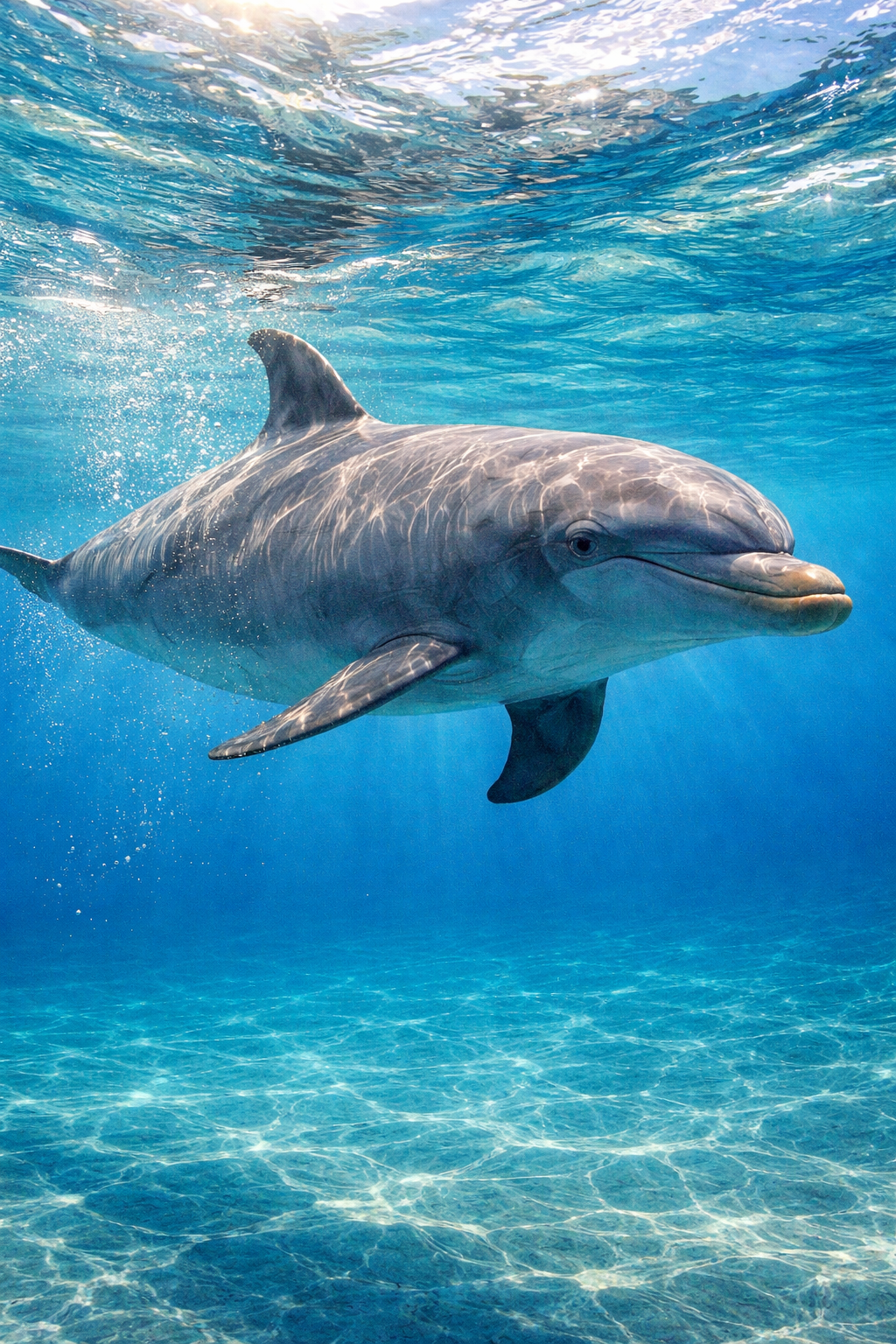
Dolphins use signature whistles as individual names — each dolphin has a unique call that others use to address them directly. They sleep with one eye open, grieve their dead, and can live 40–60 years. The orca is technically a dolphin.
Taxonomically, all dolphins belong to the family Delphinidae — which also includes orcas, the largest member. Lifespans vary dramatically by species, with female orcas at one extreme and spinner dolphins at the other.
🐬 Bottlenose Dolphin
40–50 years (females to 60+)
The most studied and recognised dolphin. Individual females have been tracked for decades by researchers. Oldest recorded individual: Nicklo, at least 67 years old at her last sighting in Sarasota Bay, Florida.
🐋 Orca (Killer Whale)
Males ~30 yrs · Females up to 90 yrs
Technically the largest dolphin. Female orcas live dramatically longer than males and go through menopause — one of only 5 species to do so. A female orca known as Granny (J2) was estimated to be 105 when she disappeared in 2016.
🌀 Spinner Dolphin
~20 years avg
Named for their acrobatic spinning leaps. Smaller and shorter-lived than bottlenose dolphins. Found across tropical oceans globally. A 15-year-old spinner dolphin is already senior.
⚡ Common Dolphin
~25 years avg
One of the most abundant dolphin species globally. Forms enormous "superpods" of thousands. Faster-living and shorter-lived than bottlenose dolphins. Highly social and vocal.
🌊 Risso's Dolphin
~35 years avg
Distinguished by their heavily scarred bodies — scars from squid beaks and other dolphins accumulate over a lifetime, turning older individuals almost entirely white. The most battle-scarred dolphins on the planet.
Age Chart
Bottlenose Dolphin Age in Human Years
Using proportional lifespan mapping with a bottlenose dolphin average lifespan of 45 years. The longest-lived females stretch this, but the table reflects the majority of individuals.
Dolphin Age
Human Equivalent
Life Stage
What's Happening
1 year
~2 yrs
Calf
Still nursing, inseparable from mother
3 years
~6 yrs
Calf
Learning to hunt, developing social bonds
6 years
~12 yrs
Juvenile
Increasingly independent, approaching sexual maturity
10 years
~22 yrs
Young adult
Sexually mature, establishing social rank
15 years
~33 yrs
Prime adult
Peak of social and cognitive ability
20 years
~44 yrs
Prime/Mature
Experienced, socially central in their pod
25 years
~55 yrs
Mature
Middle to late adult — a social elder in their pod
30 years
~64 yrs
Senior
Senior — decades of accumulated knowledge
40 years
~78 yrs
Elder
Exceptional — a long-lived female may still be thriving
50+ years
~90+ yrs
Elder
Extraordinary — record territory for bottlenose
Fascinating Facts
Things About Dolphins That Will Actually Surprise You
📛 Signature Whistles — Names
Every bottlenose dolphin develops a unique signature whistle within the first year of life — a sound that functions as a personal name. Other dolphins copy and use that whistle to address the individual directly. Research published in PNAS confirmed dolphins respond to their own signature whistle but not others'. This is the only non-human example of naming behaviour confirmed in wild animals.
🧰 Tool Use & Culture
Bottlenose dolphins in Shark Bay, Australia use marine sponges as foraging tools — wearing them on their rostrums to probe the seabed for fish. This behaviour is taught by mothers to daughters and passed culturally across generations, not genetics. It represents one of the clearest examples of non-primate tool use and cultural transmission in the animal kingdom.
🧠 Self-Awareness
Dolphins pass the mirror self-recognition test — one of the most rigorous tests for self-awareness. They inspect their own reflections, examine markings placed on their bodies, and show behaviours that indicate they understand the reflection is themselves. This capacity is shared with humans, great apes, elephants, and a small number of other species.
💤 Sleep with One Eye Open
Dolphins practice unihemispheric slow-wave sleep — sleeping with one brain hemisphere at a time while the other remains alert. This allows them to continue swimming, surfacing to breathe, and watching for predators while asleep. They literally sleep with one eye open. The two hemispheres alternate, giving each a rest period.
👵 The Grandmother Effect
Female orcas go through menopause — one of only 5 species to do so (alongside humans, short-finned pilot whales, beluga whales, and narwhals). Post-reproductive orca females, like human grandmothers, dramatically improve their group's survival — leading their pods to food during lean times using decades of accumulated knowledge. Their grandchildren are 4.5x more likely to die in the year after grandma dies.
🌍 Population & Threats
Most common dolphin species are not globally endangered, but several face serious threats. The Māui dolphin (New Zealand) has fewer than 50 individuals remaining — Critically Endangered. The baiji (Yangtze River dolphin) was declared functionally extinct in 2006. Major threats to dolphin populations include bycatch in fishing nets, ocean pollution, boat strikes, and climate change disrupting prey availability.
🐬 The Sarasota Dolphin Research Program in Florida has been continuously monitoring a bottlenose dolphin population since 1970 — the longest running study of any wild dolphin population in the world. It has documented the full lives of hundreds of individual dolphins across multiple generations, producing some of the most detailed data on dolphin lifespan, social structure, and behaviour ever assembled.
In the News
Dolphins in the Headlines
From AI models attempting to decode dolphin language to alarming new data on their shrinking lifespans, dolphins have been generating significant scientific news in 2025 and 2026.
Google AI Blog · April 2025
Google's DolphinGemma AI Is Learning to Understand Dolphin Communication
Google announced DolphinGemma — a foundational AI model trained on decades of underwater dolphin vocalization data collected by the Wild Dolphin Project — that can learn the structure of dolphin sounds and generate novel dolphin-like sequences. The model is being integrated with underwater hardware worn by researchers to enable real-time analysis of dolphin calls in the field. Scientists say it represents the most serious attempt yet at decoding the patterns within dolphin communication, potentially opening the door to genuine interspecies exchange.
Atlantic Dolphins Are Dying Much Younger — Scientists Sound the Alarm
A University of Colorado Boulder study found that common dolphins in the North Atlantic are living significantly shorter lives than they did in the 1990s — with female longevity dropping by an average of seven years. Researchers analyzed 759 stranded dolphins along the Bay of Biscay and linked the decline to bycatch deaths and environmental pressures. The findings expose flaws in traditional population monitoring methods and call for adaptive conservation measures including smarter fishing restrictions.
Mediterranean Dolphin Discovery "Not Expected at All" — New Ecotypes Found
A University of Exeter study upended a long-held understanding of Mediterranean bottlenose dolphins, revealing they are divided not by an east-west geographic split as previously believed, but by coastal and offshore ecotypes that share territory but rarely interact — passing each other like ships in the night. Lead researcher Daniel Moore called the finding completely unexpected, saying modern genomic techniques revealed a population structure that older methods had entirely missed, with significant implications for conservation boundaries.
Scientists age dolphins primarily through growth layer groups (GLGs) in their teeth — similar to tree rings, each year of life deposits a visible layer in the dentine. This method requires a tooth sample, which is usually only possible from deceased animals. For living individuals in long-term studies like the Sarasota program, ages are known because researchers have watched these dolphins since birth, building multi-generational records going back decades.
Yes — this is one of the most remarkable facts in animal cognition research. Every bottlenose dolphin develops a unique signature whistle in their first year that functions as a personal identifier. Other dolphins copy and use this whistle to call the individual specifically. In 2013, research published in PNAS confirmed that dolphins respond selectively to their own signature whistle, and in 2023, further studies confirmed that dolphins use copied signatures to address specific individuals — directly analogous to calling someone by name. No other non-human animal has been shown to do this in the wild.
Male orcas live on average to around 30 years; females to 50–80, sometimes beyond 90. The leading hypothesis is the "grandmother hypothesis" — post-reproductive females provide such crucial navigational and foraging knowledge to their pods that natural selection favoured extended female lifespan. Male orcas generally don't stay with their birth pod in the same deeply integrated way, reducing the survival benefit of their longevity. Females who stop reproducing but keep living contribute more to their grandchildren's survival than if they'd kept breeding.
Wild dolphins are generally not dangerous to humans and unprovoked serious attacks are extremely rare. However, dolphins are large, powerful wild animals that can cause injury — they should not be approached, fed, or touched in the wild. Dolphins that become habituated to human feeding can become aggressive and have injured people. Captive dolphins have occasionally injured trainers, usually due to frustration or stress. The "friendly dolphin" image, while largely accurate, can lead people to underestimate them.
Echolocation is a biological sonar system — dolphins produce focused clicks through a fatty organ in their forehead called the melon, which shapes the sound into a beam. When the clicks hit an object, the echoes return and are detected through the lower jaw, which transmits vibrations to the inner ear. This allows dolphins to "see" in murky water with extraordinary detail — they can detect a golf ball-sized object at 70 metres and distinguish between objects of very similar density. Dolphins use echolocation to hunt, navigate, and communicate.