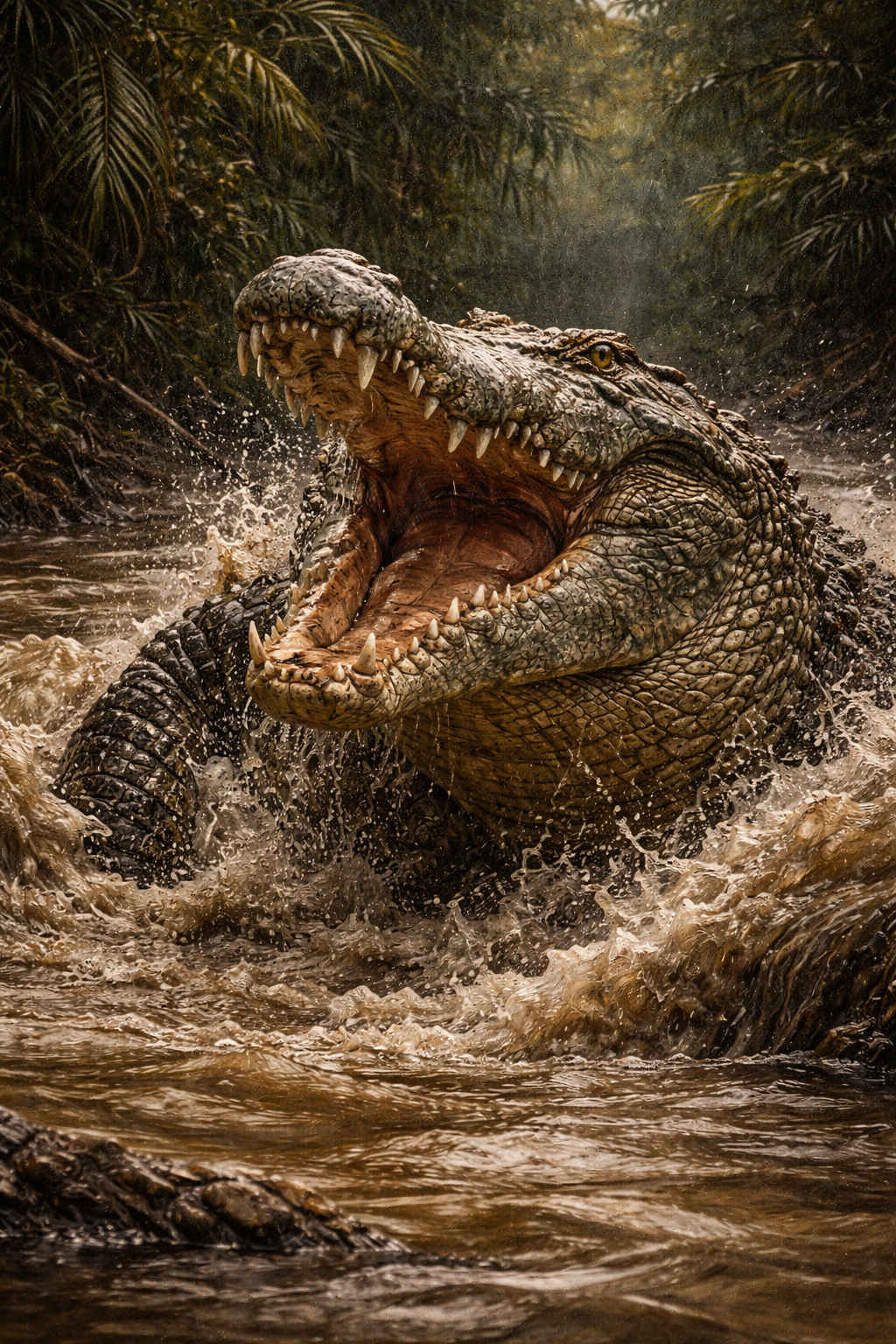
Five Crocodilian Species
Saltwater Crocodile Age to Human Years
| Age | Human Equivalent | Approx Size | Life Stage |
|---|---|---|---|
| 1 year | ~4 yrs | ~60 cm | Hatchling — most vulnerable period |
| 5 years | ~12 yrs | ~1.2 m | Juvenile — still at risk from predators |
| 10 years | ~22 yrs | ~2 m | Sub-adult — beginning to establish territory |
| 20 years | ~38 yrs | ~3.5–4 m | Prime adult — dominant breeding animal |
| 30 years | ~50 yrs | ~4.5–5 m | Mature — large, experienced, territorial |
| 50 years | ~64 yrs | ~5.5–6 m | Elder — among the largest in region |
| 70 years | ~75 yrs | ~6–7 m | Exceptional — still growing |
| 100+ years | ~85+ yrs | ~7 m+ | Living legend — possible but unconfirmed |
🐊 The largest living crocodilian on record is Cassius, a saltwater crocodile at Marineland Melanesia in Queensland, Australia, measuring 5.48 metres and estimated to be over 110 years old (born approximately 1903–1910). He was captured in the wild in 1987 and is still alive as of 2026. A wild saltwater crocodile called Gomek, captured in New Guinea and later displayed at St Augustine Alligator Farm in Florida, measured 5.5 metres and was estimated at 70–80 years old when he died in 1997. Crocodilian age estimation from living animals relies primarily on growth rate modelling — there is no non-destructive ageing method equivalent to scale rings in fish.
Things About Crocodilians That Will Actually Surprise You
🐊 The American alligator is one of conservation's genuine success stories. By the 1950s–60s, unregulated hunting for hides had reduced the US population to critically low levels and the species was listed as endangered in 1967. Following legal protection under the Endangered Species Act, populations recovered dramatically — today there are an estimated 5 million American alligators in the wild across the southeastern United States. It was removed from the endangered species list in 1987. The recovery is considered one of the most successful wildlife conservation programmes in US history.