Popular Pets
🐶 Dog 🐱 Cat 🐰 Rabbit 🐹 Hamster 🐾 Guinea Pig 🦜 Parrot 🦡 Ferret 🐀 Rat 🐭 Chinchilla 🦔 Hedgehog 🐟 Goldfish 🦜 Macaw
Farm & Large Animals
🐴 Horse 🐄 Cow 🐄 Highland Cow 🐷 Pig 🐑 Sheep 🐐 Goat 🐴 Donkey 🦙 Alpaca 🐐 Mountain Goat 🐔 Chicken 🦆 Duck 🦃 Turkey
Wild Animals
🐘 Elephant 🦁 Lion 🐯 Tiger 🐆 Leopard 🐺 Wolf 🐻 Bear 🐻‍❄️ Polar Bear 🦍 Gorilla 🐒 Chimpanzee 🦧 Orangutan 🦘 Kangaroo 🐾 Capybara 🦒 Giraffe 🦊 Fox 🦅 Raptor 🦉 Owl 🐧 Penguin 🦩 Flamingo 🐾 Hyena 🐾 Meerkat 🦥 Sloth 🦡 Badger 🐾 Wolverine 🐾 Armadillo
Ocean & Aquarium
🦈 Shark 🐋 Orca 🐬 Dolphin 🐋 Whale 🐋 Blue Whale 🐳 Beluga Whale 🦄 Narwhal 🐋 Bowhead Whale 🐾 Manatee 🐟 Manta Ray 🐟 Freshwater Fish 🐠 Saltwater Fish 🐴 Seahorse 🐟 Koi
Exotic & Weird
🐍 Snake 🐍 Ball Python 🦎 Bearded Dragon 🦎 Iguana 🦎 Komodo Dragon 🦎 Chameleon 🦎 Leopard Gecko 🐢 Tortoise 🐢 Snapping Turtle 🐢 Sea Turtle 🐊 Crocodilian 🕷️ Tarantula 🦎 Axolotl 🐙 Octopus 🌊 Jellyfish 🦞 Lobster 🐚 Quahog 🔬 Tardigrade
Info
About FAQ Contact
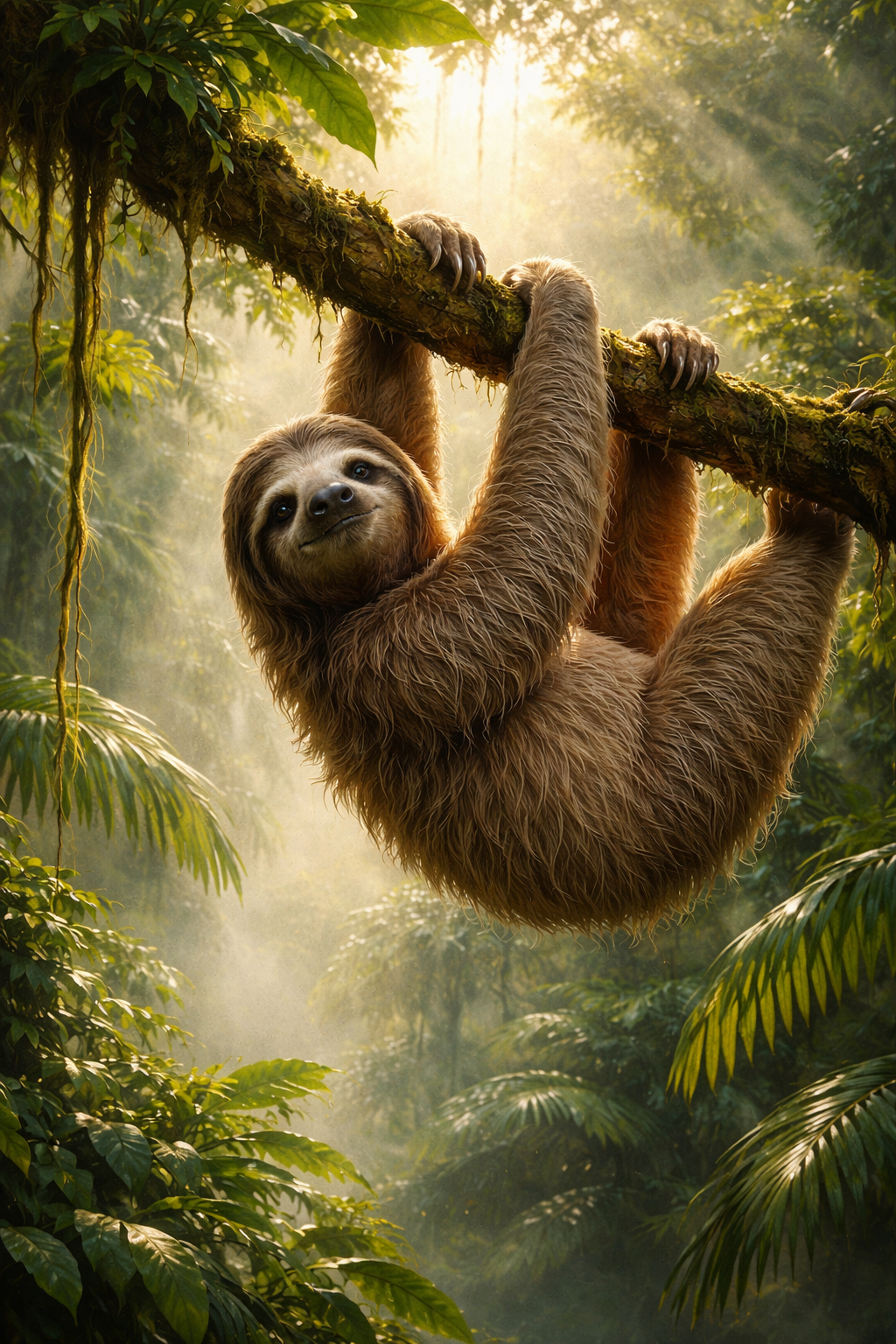
Photorealistic painting of a three-toed sloth hanging from a rainforest branch
🦥 Wild Animals

How Old Is a Sloth in Human Years?

📅 Updated March 2026 🌿 Central & South America 🦥 Lifespan: 20–40+ years

Sloths move at 0.03 mph — the slowest mammals on Earth. They sleep up to 20 hours a day, take a month to digest a single meal, and descend from their tree just once a week to use the bathroom. Algae grows in their fur. They are, by every measure, a masterpiece of doing less. And it has worked for 64 million years.

Calculate Sloth Age →
🦥 Sloth Age in Human Years
in human years
Sloth age
Life stage
Species
🦥 What this age means

The Life Stages of a Sloth

Sloths develop slowly — matching their whole approach to life. A sloth pup clings to its mother for the first six to twelve months, riding on her belly and learning which leaves are safe to eat by watching her. Independence is a gradual process, not an event. Sexual maturity arrives late, and sloths are not particularly prolific breeders — typically producing just one pup per year, or less. Their long lives are a counterbalance to low reproductive rates.

0–6 mo
Pup (Newborn)
Born with a full coat and open eyes — sloths are precocial, born relatively developed. The pup clings to its mother's belly immediately, navigating by smell and sound. It begins sampling leaves within weeks, learning which species are edible by mimicking its mother. The bond is intense — orphaned sloths that lose their mothers before 6 months rarely survive without specialist rehabilitation.
6–12 mo
Juvenile
The pup begins making short independent forays, still returning to its mother's territory. It is learning the canopy geography — which branches lead where, which trees carry which leaves in which seasons. This spatial memory will serve it for decades. The mother tolerates increasing independence, and the pup begins to develop its own home range within the mother's territory.
1–3 yrs
Sub-Adult
Fully independent but not yet sexually mature. The sub-adult establishes its own home range — typically 2–5 hectares — in the forest canopy, overlapping with neighbours' territories without significant conflict. It has identified its preferred tree species and established daily routines. The digestive microbiome is fully developed, enabling efficient processing of tough, toxic leaves that other animals cannot eat.
3–10 yrs
Adult (Prime)
Sexually mature and reproductively active. Female sloths give birth to one pup approximately every 12–18 months. Males maintain overlapping home ranges with females and compete for mating access through scent marking and, occasionally, direct combat with claws. A prime adult sloth has deep knowledge of its canopy territory — ideal resting spots, reliable food trees, escape routes, and seasonal food patterns.
10–20 yrs
Mature Adult
A well-established territory holder. Reproductive success is maintained; females continue producing pups annually or near-annually. The sloth's slow metabolism means physical ageing is gradual — a 15-year-old sloth in the wild shows few outward signs of age. Home range is thoroughly mapped and efficiently exploited. Algae coverage in fur is at its most developed — camouflage at its most effective.
20–50 yrs
Senior / Elder
Wild sloths rarely reach this age; most are taken by predators or habitat loss well before 20. Those that do are extraordinary survivors with deep canopy knowledge. In captivity, sloths routinely reach 30–40 years with documented cases exceeding 50. The oldest known captive sloth lived to 43 years. An elder captive sloth is a slow, deliberate, profoundly relaxed presence — the living embodiment of a creature that has perfected the art of sustainable living.

Sloth Age to Human Years Conversion Table

Sloth AgeTwo-Toed ♀/♂Three-Toed ♀/♂Captive SlothLife Stage
BirthNewbornNewbornNewbornPup
6 months~4 yrs~5 yrs~3 yrsJuvenile
1 year~8 yrs~10 yrs~6 yrsSub-adult
3 years~21 yrs~25 yrs~16 yrsYoung adult
5 years~30 yrs~37 yrs~22 yrsPrime adult
10 years~52 yrs~63 yrs~38 yrsMature adult
15 years~68 yrsElder~53 yrsSenior
20 years~80 yrs~65 yrsElder
40 years~88 yrsRecord-territory (captive)

🦥 Wild sloth ages are estimates — sloths are notoriously difficult to track and age-related decline is subtle due to their slow metabolism. Captive lifespans are significantly longer and better documented. The two-toed sloth (Choloepus hoffmanni and C. didactylus) generally outlives the three-toed sloth (Bradypus spp.) both in the wild and in captivity. The key longevity factors in captivity are diet quality, environmental enrichment, and avoidance of stress — captive sloths are highly susceptible to stress-related illness.

Things About Sloths That Will Actually Surprise You

🌿 The Slowest Mammal — By Design
Sloths hold the title of the world's slowest mammal, moving at a top speed of around 0.03 mph (0.05 km/h) through the trees. In the water, they are significantly faster. But the slowness is not a failure — it is a masterpiece of energy budgeting. Sloths have a metabolic rate 40–74% lower than expected for a mammal of their size, according to research published in Physiological Zoology. Their leaf diet is so low in calories that moving faster would simply be unsustainable. By barely moving, they require barely any food — and what little they eat, they process for weeks.
🌱 The Algae Ecosystem
Sloth fur is not just fur — it is a living ecosystem. The outer layer of each hair shaft has microscopic transverse cracks that trap moisture and allow algae (Trichophilus welckeri) to grow. This algae tints the sloth green, providing canopy camouflage. A 2014 study in PLOS ONE found that sloths actively consume the algae from their fur, gaining supplementary nutrients from it. The fur also harbours moths, beetles, cockroaches, and fungi — the sloth is, in effect, a slowly moving habitat.
🚽 The Weekly Descent — Most Dangerous Moment
Sloths descend to the ground approximately once per week to defecate — and this is the most dangerous thing they do. On the ground, sloths are essentially helpless against predators; they move at a fraction of their already-slow tree speed. An estimated half of all sloth predation events occur during or after this weekly toilet trip. Why they do it at all, rather than simply defecating from the canopy, is still debated — leading theories involve scent-based mating communication and fertilising their primary food trees.
💪 Hanging Without Effort
Sloths hang upside down for most of their lives — sleeping, eating, mating, and even giving birth in this position. Unlike humans and most other mammals, sloth organs are attached to the ribcage by fibrous adhesions, preventing them from pressing against the diaphragm and impairing breathing when inverted. Their curved claws lock passively around branches — they require zero muscular effort to maintain their grip. A sloth can hang dead — confirmed by researchers who have found deceased sloths still gripping branches after death. Their entire body plan is optimised for a life spent upside down.
🏊 Surprisingly Strong Swimmers
In the flooded forests of the Amazon, sloths regularly swim between trees and across rivers. They are surprisingly capable swimmers — using their long arms in a breaststroke motion and moving at up to 0.17 mph (0.27 km/h) in water, roughly three times their land speed. Their naturally buoyant stomach contents (fermented leaves, slow-moving gases) help them float. Swimming is not an emergency skill for sloths — it is a routine part of navigating their flooded forest habitat, particularly during the Amazonian wet season when water levels rise dramatically.
🧬 64 Million Years of Slowness
Sloths are the survivors of a once-diverse group of mammals called Xenarthra (which also includes armadillos and anteaters). Their ancestors included Megatherium — a ground sloth the size of an elephant that roamed South America until approximately 10,000 years ago and may have been hunted to extinction by early humans. Modern sloths have refined the hanging, slow-metabolism strategy over 64 million years. They have survived ice ages, mass extinctions, and the arrival of humans — a strategy that has, so far, proved more durable than speed. Genetic research shows modern tree sloths are the distilled product of millions of years of evolutionary pressure toward stillness.

🦥 Sloths have extra cervical vertebrae — three-toed sloths have 9 neck vertebrae (most mammals have 7), giving them the ability to rotate their heads up to 270 degrees. This allows them to scan for predators without moving their body — a crucial adaptation for an animal that relies on stillness as camouflage. Two-toed sloths have 6 cervical vertebrae. The variation in vertebrae count between closely related species is extremely unusual in mammals and reflects the independent evolutionary paths of the two sloth families.

Two-Toed vs Three-Toed Sloths — Key Differences

Despite their similar appearance and lifestyle, two-toed and three-toed sloths are more distantly related than many people realise. They represent two separate evolutionary experiments that independently arrived at similar slow-living solutions.

FeatureTwo-Toed SlothThree-Toed Sloth
FamilyMegalonychidaeBradypodidae
Species2 species (Hoffmann's, Linnaeus's)4 species (incl. Pygmy)
Neck vertebrae6 (same as most mammals)9 (can rotate 270°)
Facial featuresFlat face, no visible tail"Smiling" face, short tail
Activity patternMostly nocturnalMore diurnal
DietLeaves, fruit, flowers, small animalsLeaves almost exclusively
Wild lifespan~25 years~20 years
Captive lifespan40–50 years30–40 years
Conservation statusLeast Concern (both species)Varies; Pygmy is Critically Endangered

Other Wild Animals on PawClocks

Frequently Asked Questions

Sloth slowness is a highly evolved energy conservation strategy, not a limitation. Sloths have the lowest metabolic rate of any non-hibernating mammal — about 40–74% lower than expected for their body size. Their diet of leaves is low in nutrition and difficult to digest; a sloth's stomach can take up to a month to fully process a meal. Moving slowly means they burn very little energy, require very little food, and are nearly invisible to predators who use movement to detect prey. Slowness is not a weakness — it is a masterpiece of evolutionary engineering that has kept sloths alive for 64 million years.
Yes — and it is not accidental. Sloth fur has microscopic grooves that collect rainwater, and a specific species of algae (Trichophilus welckeri) grows in these grooves. The algae turns the sloth's fur greenish, providing camouflage in the forest canopy. Research published in 2014 found that sloths actively lick their own fur to consume the algae, suggesting it provides nutritional supplementation. The fur also hosts moths, beetles, cockroaches, and fungi — forming a miniature ecosystem. Sloth fur is, biologically, one of the most complex and inhabited surfaces of any mammal.
Only about once a week — and they climb all the way down from the tree canopy to do it on the ground, which is the most dangerous thing they do. This weekly toilet trip accounts for the majority of sloth predation events — they are slow, exposed, and vulnerable on the ground. Why they do this rather than simply defecating from the canopy is still debated. One leading theory is that the toilet trip enables sloths to deposit their scent for mating signals. Another is that depositing waste at the base of their tree fertilises it. The metabolic reason sloths only go once a week is that digestion is extremely slow — their gut flora takes weeks to break down leaf material.
Surprisingly well — sloths are capable swimmers and can move through water significantly faster than they move on land or through trees. They use their long arms to perform a recognisable breaststroke and can cross rivers efficiently. Their stomach contents, which are often very full due to slow digestion, provide natural buoyancy. In the flooded forests of the Amazon basin, swimming is a regular part of sloth life rather than an emergency skill.
They are related, but more distantly than most people assume. Two-toed sloths (family Megalonychidae) and three-toed sloths (family Bradypodidae) represent a remarkable case of convergent evolution — they independently evolved very similar slow, hanging lifestyles from different ancestors. Their last common ancestor lived tens of millions of years ago. They are, effectively, two separate evolutionary experiments that arrived at the same solution.
Most sloth species are currently classified as Least Concern by the IUCN, but the Pygmy three-toed sloth (Bradypus pygmaeus), found only on a tiny island off Panama, is Critically Endangered with a wild population estimated at fewer than 100 individuals. All sloth species face pressure from deforestation in Central and South America — sloths are highly dependent on contiguous forest canopy and are poorly equipped to cross open ground between forest fragments. Electrocution on uninsulated power lines is also a significant cause of sloth mortality in fragmented habitats.
Their claws do the work entirely passively. Sloth claws are long, curved, and hook around branches in a grip that requires no muscular effort to maintain — the weight of the sloth's body simply deepens the grip. This is why sloths can sleep for 15–20 hours without falling, and why deceased sloths are sometimes found still hanging. Their organs are also anchored to the ribcage to prevent them pressing on the diaphragm when inverted, which would otherwise impair breathing. The upside-down lifestyle is so thoroughly engineered into the sloth's anatomy that hanging is their default state, not an effort.