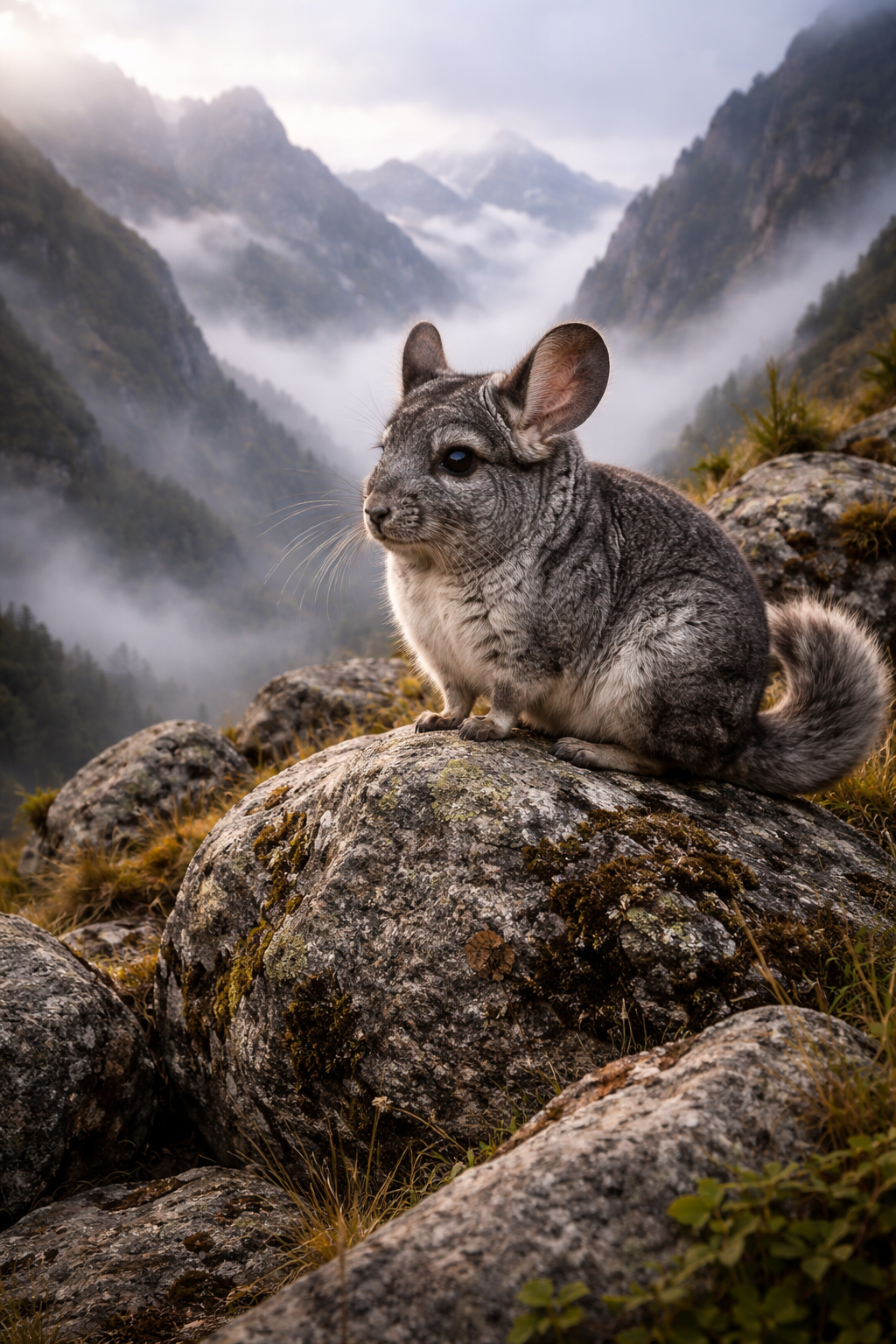
📅 Updated 🔬 15–20 yr lifespan🐭 Densest fur of any land animal
Chinchillas have the densest fur of any land mammal — up to 80 hairs per follicle. They can live 20 years. The world record is 29. They are sold as starter pets for children, which is one of the great mismatches in the pet trade. A chinchilla purchased today may still be alive when a newborn in the same household is in college.
Based on an average captive lifespan of 15 years for a well-cared-for chinchilla. Note how quickly the early years pass — a 1-year-old chinchilla is already approaching their mid-teens in human terms.
Chinchilla Age
Human Equivalent
Life Stage
What's Happening
3 months
~4 yrs
Kit
Weaned; socialising rapidly; still very small
6 months
~7 yrs
Juvenile
Approaching sexual maturity; growing fast
1 year
~13 yrs
Young adult
Nearly full size; personality fully emerging
2 years
~19 yrs
Adult
Fully grown; prime condition; strong bonds
5 years
~33 yrs
Prime adult
Mid-life; peak health with good husbandry
8 years
~48 yrs
Mature
Mature; monitoring dental health important
12 years
~67 yrs
Senior
Senior; reduced activity, careful monitoring
16 years
~82 yrs
Elder
Elder; exceptional longevity
29 years
~120+ yrs
World record
Radar — Guinness World Record
🐭 The Guinness World Record for the oldest chinchilla was Radar, owned by Christina Anthony of California, USA, who lived to 29 years and 229 days, dying in February 2014. Most chinchillas live 10–15 years in captivity; those reaching 20+ are genuinely exceptional. Wild chinchillas in the Andes mountains live considerably shorter lives — approximately 8–10 years — due to predation and environmental pressures.
Colour Mutations
Chinchilla Colour Mutations — From Wild Grey to Violet
Wild chinchillas are agouti grey — a salt-and-pepper pattern formed by banded hair fibres. Selective breeding since Chapman's original 11 animals has produced over 30 recognised colour mutations. Some mutations carry health risks; others are purely cosmetic. Below are the most common and notable.
Colour
Description
Rarity
Health Notes
Eye Colour
Standard Grey
Wild-type agouti; bluish-grey with white belly
Common
Healthiest — closest to wild genetics
Black
Beige (Heterozygous)
Warm beige coat; result of one beige gene
Common
Healthy; single gene
Pink/Red
White Wilson
White to pale grey; variable markings
Common
Generally healthy; avoid homozygous pairing
Black or Pink
Black Velvet
Deep black saddle with white belly
Moderate
Carrier of velvet gene — do not pair velvet × velvet (lethal)
Black
Violet
Blue-violet tint; requires two violet genes
Rarer
Healthy homozygous; must breed carefully to maintain
Black
Sapphire
Blue-grey; similar to violet but distinct gene
Rarer
Healthy; homozygous viable
Black
Homo Beige (Pink White)
Two beige genes; very pale, almost white
Uncommon
Associated with reduced lifespan and vision issues
Pink/Red
Ebony
Uniform dark grey to black all over
Uncommon
Homozygous ebony can cause fur and skin darkening issues
Black
🐭 The velvet gene is one of the most important to understand in chinchilla breeding. A single velvet gene produces the beautiful Black Velvet, Brown Velvet, or TOV (Touch of Velvet) patterns. But two velvet genes are lethal — homozygous velvet kits do not survive. Responsible breeders never pair two velvet-carrying animals. (See the AVMA chinchilla health guidance for welfare considerations in breeding.) Always ask a breeder about the genetic background of any coloured chinchilla before purchase.
Life Stages
The Life Stages of a Chinchilla
Chinchillas are among the longest-lived of all small rodents — reaching 15–20 years in captivity, with exceptional individuals living past 25. Their developmental arc is slow and precocial: chinchilla pups are born fully furred, eyes open, and capable of running within hours. They are built for altitude, cold, and extraordinary longevity.
0–2 wks
Newborn Kit
Born fully furred with eyes open — one of the most precocial small rodents. Weighs around 35–60g. Can walk within hours of birth. Already nursing but nibbling solid food within days. Litters typically 1–3 kits.
2 wks–2 mo
Kit
Growing rapidly. Dense fur fully established. Developing individual social bonds that define colony relationships. Dust baths — essential for coat maintenance, absorbing oils and moisture — begin at this stage.
2–8 mo
Juvenile
Weaned around 6–8 weeks. Still developing socially. Sexual maturity around 8 months for females, slightly later for males. Full adult coat density now fully expressed — up to 80 hairs per follicle, the densest fur of any land mammal.
8 mo–3 yrs
Young Adult
First breeding. Chinchillas form strong pair bonds. Gestation is unusually long for a small rodent — 111 days — producing the highly precocial young. Peak reproductive years with reliable, healthy litters.
3–10 yrs
Prime Adult
Fully established. In the Andes, wild chinchillas at this stage have survived the extreme temperature swings of high-altitude life. In captivity, prime chinchillas are at their most socially engaged and physically robust.
10–18 yrs
Senior
Slower and quieter but deeply bonded to familiar keepers. Dental monitoring becomes essential — malocclusion risk increases with age. Regular weigh-ins catch health changes early. A chinchilla reaching this stage has had exceptional genetics and outstanding care.
18–29+ yrs
Elder
Extraordinary longevity by any small-rodent standard. The world record holder, Radar, lived to 29 years and 229 days. Elder chinchillas deserve every comfort: familiar routines, minimal stress, easy food access. Each year past 18 is remarkable.
Fascinating Facts
Things About Chinchillas That Will Actually Surprise You
🪶 The Densest Fur on Earth
Chinchillas have 60–80 hair fibres growing from each follicle, compared to 1–4 in humans and 15–20 in the next densest land mammal (the sea otter). Each individual fibre is approximately 6 micrometres in diameter — so fine it is almost invisible individually. The fur is so tightly packed that it is virtually impenetrable to fleas and lice, which cannot physically move through the fibres — chinchillas are one of the few mammals almost entirely immune to external parasites. Water cannot reach the skin either, which is why bathing causes fungal infection rather than cleaning. In the wild, chinchillas roll in natural volcanic ash deposits in the Andes; captive chinchillas need pumice-based dust offered 2–3 times per week. A single coat garment requires the pelts of 80–100 chinchillas — the direct driver of their near-extinction.
🌡️ Heat Is Lethal — By Design
Chinchillas evolved at 3,000–5,000 metres elevation in the Chilean and Peruvian Andes — environments where temperatures rarely exceed 15°C even in summer. Their fur, perfectly suited to these conditions, becomes a deadly liability in warmth. Heat stroke begins above 25°C (77°F) and can be fatal within 2–3 hours without intervention. Above 28°C, death can occur faster. Symptoms include lying on their side, laboured breathing, and red ears (blood vessels dilating to shed heat). The recommended range is 16–22°C (60–72°F) year-round. This makes chinchillas fundamentally incompatible with warm climates, non-air-conditioned homes, or direct sunlight — critical information that is routinely omitted in pet store sales. A chinchilla left in a warm car or near a sunny window can die within an hour.
🦷 Teeth That Never Stop Growing
Chinchillas are elodont — all their teeth (both incisors and all molars) grow continuously throughout their lives. This is unusual even among rodents, many of which have only ever-growing incisors. In the wild, a diet of tough Andean grasses, bark, and shrubs wears the teeth at the correct rate. In captivity, unlimited Timothy or orchard grass hay is essential to replicate this wear — not pellets, not treats. Dental malocclusion — where teeth grow misaligned and begin pressing into cheeks, tongue, or adjacent teeth — is one of the leading causes of death in captive chinchillas. The cheek teeth are impossible to examine without sedation and special equipment, so problems often go undetected until the chinchilla stops eating. Once severe malocclusion develops, it is usually irreversible. Regular weigh-ins (weekly) are the best early warning system — weight loss precedes visible symptoms by weeks.
🥚 111-Day Gestation — Extraordinary for a Rodent
Most small rodents have gestation periods of 18–30 days — hamsters gestate in just 16. Chinchillas gestate for 111 days — nearly four months — one of the longest gestations of any rodent relative to body size. This extended pregnancy produces highly precocial young: chinchilla kits are born fully furred, eyes open, teeth present, and capable of walking within hours. Compare this to rats or mice, born hairless and blind after 3 weeks. The trade-off is reproductive rate — chinchillas typically have 1–3 kits per litter and 1–2 litters per year, compared to a rat's 8–12 pups every 3 weeks. This slow reproduction is part of why wild population recovery from hunting was so difficult, and why the species remains Critically Endangered in the wild today.
💨 Fur Slip — A Predator Escape Mechanism
When grabbed by a predator — or mishandled by a human — chinchillas can voluntarily release a patch of fur from the seized area in an instant. This reflex, called fur slip, leaves the predator holding a clump of fur while the chinchilla escapes. The bare patch regrows over 6–8 weeks. It is an evolutionary adaptation to the Andean predator community — birds of prey, foxes, and snakes that grab rather than bite. In captivity, fur slip is a clear signal that handling was too forceful or the animal was frightened. Chinchillas should always be scooped from below, never grabbed around the torso. Repeated fur slip events are a welfare red flag indicating chronic stress. Some chinchillas will fur slip even from gentle handling if they are not sufficiently tame — patience in building trust is essential.
🌙 Crepuscular Rhythms — Wired for Twilight
Chinchillas are crepuscular — biologically programmed to be most active at dawn and dusk. In the Andes, this timing minimises overlap with both daytime aerial predators (condors, hawks) and fully nocturnal hunters, concentrating activity in the transitional light windows when predator visibility is lowest. In captivity, this rhythm is largely maintained regardless of the keeper's schedule. This means chinchillas are typically quiet and inactive during school and working hours — a fundamental mismatch with young children expecting an always-on interactive pet. Their activity peaks are early morning (5–8am) and early evening (6–10pm). They also have exceptional hearing — their large ears can rotate independently to locate sounds, and loud or sudden noises cause significant stress. Quiet, predictable environments suit them far better than busy family rooms.
The Founding Story
Eleven Animals. Every Chinchilla Alive Today.
🐭 In 1923, a US mining engineer named Mathias F. Chapman obtained special permission from the Chilean government to capture wild long-tailed chinchillas in the Atacama highlands. What he brought back — just 11 animals — would become the genetic foundation of every captive chinchilla on Earth.
By the time Chapman made his request, wild chinchillas had already been commercially hunted for over three centuries. The Spanish colonial trade in chinchilla pelts began in the 1500s — the Chincha people of the Andes had long used chinchilla fur for clothing and blankets, and the conquistadors rapidly recognised its extraordinary quality. By the late 1800s, commercial fur hunting had intensified to industrial scale: millions of pelts were exported annually. Chile, Argentina, Bolivia, and Peru each banned chinchilla hunting in turn — Chile in 1929 — but by then the damage was done. Wild populations had effectively collapsed.
Chapman spent three years in the Chilean highlands slowly acclimatising his 11 captured animals to lower elevations — moving them gradually downhill to prevent the physiological shock that had killed previous attempts to relocate high-altitude animals. He kept meticulous records and worked with local miners who helped him locate the increasingly rare wild animals. In 1927, he shipped all 11 survivors to California, where he established the first chinchilla breeding colony outside South America.
🧬 The Genetic Bottleneck
All captive chinchillas today — every pet, every fur farm animal, every zoo specimen — descend from Chapman's 11 individuals. This is one of the most extreme founder effect bottlenecks of any domestic species. The narrow genetic base means certain heritable conditions are more common than they would be in a wild population. It also means the entire global captive chinchilla gene pool has less genetic diversity than a small wild colony would naturally have.
📉 Wild Status Today
The long-tailed chinchilla (Chinchilla lanigera) is listed as Critically Endangered by the IUCN. Wild populations survive only in fragmented colonies in the Atacama Desert region of Chile, at elevations of 3,000–5,000m. Estimates suggest fewer than 10,000 wild individuals remain, possibly far fewer. Threats today include illegal hunting (chinchilla fur remains valuable), predation by introduced species, habitat degradation from mining, and climate change affecting Andean vegetation. The short-tailed chinchilla (Chinchilla chinchilla) is in even worse shape — it may be functionally extinct in the wild.
🧥 The Fur Trade Legacy
A single full-length chinchilla fur coat requires the pelts of 80–100 animals. At peak trade in the early 20th century, an estimated 500,000 pelts per year were exported from South America (documented in IUCN historical records). Chinchilla fur remains among the most expensive in the world — a high-quality coat can cost $10,000–$100,000. Fur farming (using captive descendants of Chapman's 11) continues primarily in Poland, the USA, and parts of South America. The fur trade is the direct reason the species came within a few individuals of extinction — and why every pet chinchilla carries the genetic legacy of just 11 wild animals.
⚠️ The Starter Pet Mismatch
Chinchillas are frequently and incorrectly marketed as easy starter pets for children. The reality: they live 15–20 years, require temperatures below 25°C at all times, need large multi-level enclosures (a single chinchilla needs a minimum 100×60×120cm cage), must have unlimited Timothy hay, regular dust baths (2–3 times per week), cannot be wet, bond slowly and on their own terms, are most active when children are asleep, and can inflict painful bites when frightened. They are intelligent, curious, and rewarding animals — for patient adults who have researched their needs. Chinchilla rescues are consistently overwhelmed with animals surrendered by families who received inadequate information at the point of sale.
A 5-year-old chinchilla is roughly equivalent to a 33-year-old human — a fully established prime adult with, if well cared for, a decade or more of life still ahead. In chinchilla terms, this is the comfortable middle period: personality fully established, bonds with their keeper strong, health typically stable. It's a good time to ensure the husbandry is optimal — particularly unlimited Timothy hay access for dental health — to support the years ahead.
Chinchillas need dust baths because their fur is so dense that water cannot penetrate to the skin — bathing with water would trap moisture at the base of the fur, leading to fungal infection, skin irritation, and fur matting. Dust baths should be offered 2–3 times per week for approximately 10–15 minutes. Use specific chinchilla dust (volcanic pumice or a similar fine, dry abrasive — not sand). The dust should be placed in a container large enough for the chinchilla to roll in (many keepers use a ceramic bowl, glass pot, or purpose-made enclosed bath house to reduce dust scatter). Over-bathing strips natural oils from the fur, so more than 3 times per week is generally unnecessary.
Chinchillas are social animals that live in colonies in the wild and generally do better with a companion. Pairs and small groups of same-sex animals (or neutered pairs) tend to be more active, less stressed, and longer-lived than solitary animals. However, introductions must be done very carefully — chinchillas can be territorial and introductions done too quickly can result in serious injuries. Some chinchillas, particularly those who have been solitary for many years, may not accept a companion. A single chinchilla with a highly engaged, interactive keeper can live a good life — but ideally, pairs are better.
Yes — this is one of the most striking population bottlenecks in pet animal history. Mathias Chapman, a US mining engineer working in Chile, captured 11 wild long-tailed chinchillas in 1923 after obtaining special permission from the Chilean government (the species is now listed on CITES Appendix I) (the species was already protected). He spent three years slowly moving them to lower altitudes to acclimatise them before shipping them to California in 1927. His breeding programme formed the foundation of the entire global captive chinchilla population. All pet chinchillas alive today, and all chinchilla fur farm animals, descend from these 11 individuals. This extremely narrow genetic base has implications for health — some heritable conditions are more common than they would be in a genetically diverse population.
Veterinary and rescue organisation data consistently point to two equal answers: inadequate diet and inadequate temperature control. On diet: many owners feed too many treats (fruit, seeds, commercial treat mixes) and not enough hay. Hay should make up 80–90% of a chinchilla's diet — not pellets, not treats. Insufficient hay causes dental malocclusion, which is often irreversible and fatal. On temperature: many owners are unaware that temperatures above 25°C are dangerous and above 28°C can be lethal within hours. A chinchilla kept in a room that reaches summer temperatures without air conditioning is at serious risk. A secondary common mistake is using a wheel that is too small — chinchillas need a large solid-surface wheel (at least 30cm diameter) to prevent spinal curvature.