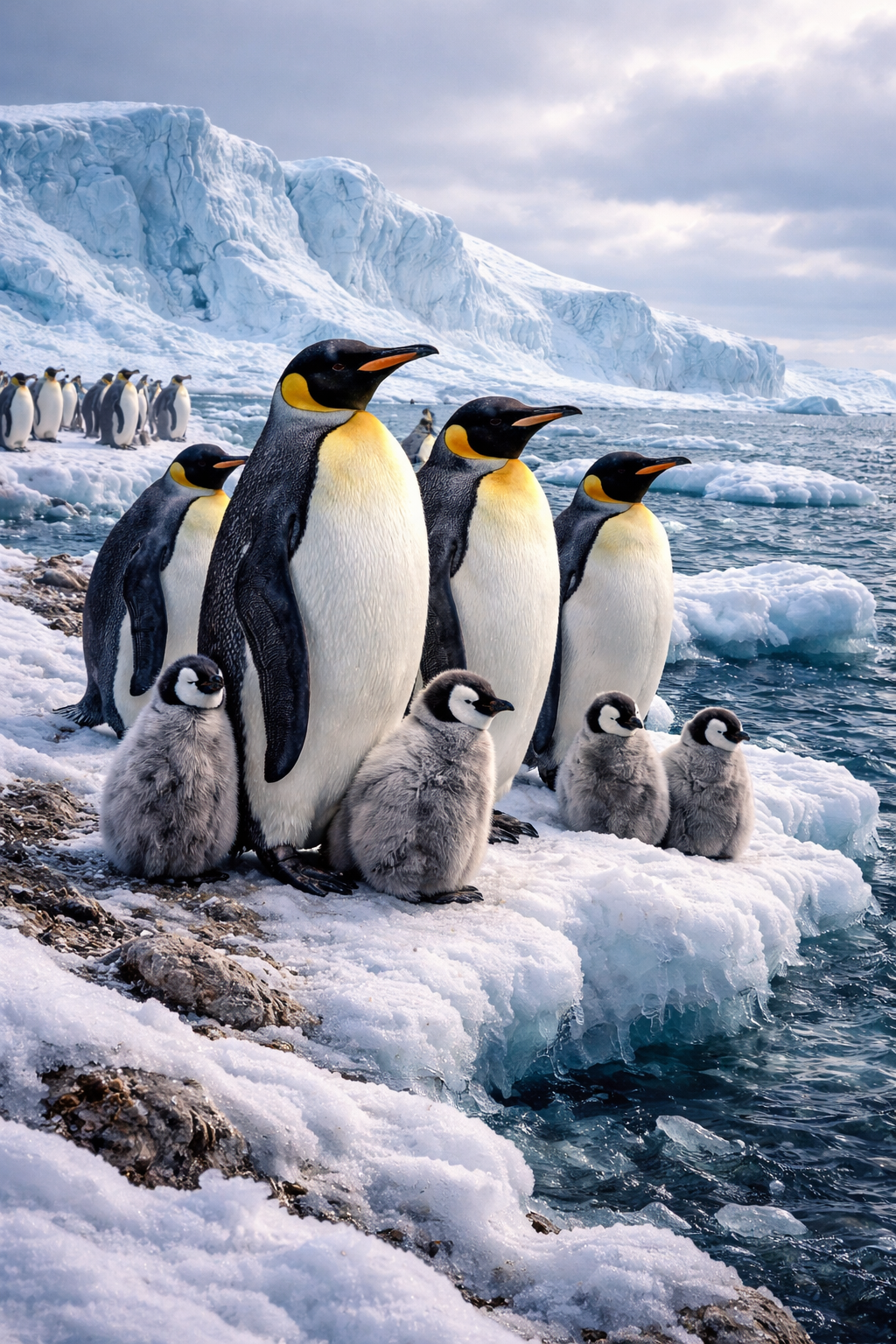
The Major Penguin Species
All 18 penguin species live in the Southern Hemisphere — a common misconception is that penguins are uniquely Antarctic, but most species never see Antarctic conditions. They range from the Galápagos Islands on the equator to the sub-Antarctic islands of South Georgia and Kerguelen, to the coasts of South Africa, New Zealand, Argentina, and Chile. Only 4 species breed on the Antarctic continent itself.
The Life Stages of an Emperor Penguin
The emperor penguin's life stages are the most extreme of any bird — beginning in the Antarctic winter's perpetual dark and spanning decades of ocean migration, deep diving, colonial breeding, and the relentless search for krill and fish in one of the most productive but rapidly changing ocean systems on Earth.
Penguin Age to Human Years — Species Comparison
| Penguin Age | Emperor | King | Adélie | African | Little Blue | Life Stage |
|---|---|---|---|---|---|---|
| Hatchling | Newborn | Newborn | Newborn | Newborn | Newborn | Egg/Chick |
| 1 year | ~6 yrs | ~5 yrs | ~8 yrs | ~9 yrs | ~16 yrs | Juvenile — at sea |
| 3 years | ~15 yrs | ~13 yrs | ~22 yrs | ~27 yrs | ~37 yrs | Sub-adult/Young adult |
| 6 years | ~27 yrs | ~24 yrs | ~43 yrs | ~51 yrs | ~68 yrs | Prime adult — breeding |
| 12 years | ~48 yrs | ~46 yrs | ~75 yrs | ~78 yrs | Elder | Mature adult |
| 20 years | ~70 yrs | ~66 yrs | Elder | ~88 yrs | — | Senior (emperor/king) |
| 30+ years | ~85 yrs | ~82 yrs | — | Elder | — | Elder emperor/king |
🐧 The dramatic lifespan variation among penguins — little blues averaging 6 years while emperors and kings regularly exceed 20 — reflects the fundamental ecological differences between species. The smallest penguins face higher predation pressure, have higher metabolic costs relative to body size, and breed in more accessible coastal environments where human disturbance is more significant. Emperor and king penguins invest enormous energy per breeding attempt (4-month male fasts; 10–13 month chick-rearing periods) and compensate with long lifespans and multiple breeding seasons. All 18 penguin species are K-selected — producing few offspring per year and investing heavily in each one.
The Emperor Penguin's Vanishing World
🧊 The Ice Is Disappearing — And the Penguins Have Nowhere Else to Go
Emperor penguins are among the animals most directly and immediately threatened by climate change — not because of direct warming effects, but because their entire life cycle is built around Antarctic fast ice. They need stable sea ice attached to the Antarctic coastline for approximately 10 months per year: to breed on, to moult on, and to access the ocean food supply from. When that ice breaks up too early — before chicks have grown their waterproof feathers — the entire breeding season's output is lost. Every chick falls into water it cannot survive in. The breeding colony produces nothing.
The 2022 and 2023 Antarctic sea-ice seasons were among the lowest on record — unprecedented in the satellite observation era and, based on ice cores, possibly in the last thousand years. In 2023, Antarctic sea ice extent fell so far below historical norms that scientists described the anomaly as "mind-blowing." That record was the winter breeding season for emperor penguins. For multiple colonies, the ice platform they needed simply wasn't there when chicks needed it.
Emperor penguins cannot significantly adapt to this. They cannot shorten the time chicks need to grow. They cannot move to different habitats. They cannot breed somewhere warmer and survive. Their biology was shaped over hundreds of thousands of years for exactly this environment — which is now changing faster than any previous climate shift the species has experienced.
Penguin Conservation — The Latest Research
A landmark study published in Biological Conservation by researchers at the Woods Hole Oceanographic Institution (WHOI) found that emperor penguins meet the criteria for uplisting from Near Threatened to Vulnerable or Endangered on the IUCN Red List — a significant and urgent change that would trigger enhanced international protection measures.
The study used a Multi-Model Large Ensemble framework — the first to integrate natural variability in physical and biological processes across a wide range of Earth system and ecological models — to produce the most comprehensive and uncertainty-aware assessment of emperor penguin extinction risk yet conducted. "This is the first study to integrate natural variability in physical and biological processes," said lead author Dr. Stéphanie Jenouvrier of WHOI. The findings have direct implications for the IUCN Red List reassessment of emperor penguins and for arguments to establish Marine Protected Areas in the Ross Sea and Weddell Sea — vital refugia for emperor penguins that have so far not been established despite years of international negotiation.
Prof Phil Trathan of the British Antarctic Survey noted: "Emperor penguins are vital indicators of ecosystem health in the Antarctic. Harnessing robust models that increase our understanding about uncertainty and risk are vital if we are to better conserve and protect this and other species."
Research published in Proceedings of the Royal Society B in March 2026, tracking emperor penguin populations across the seven Ross Sea colonies over 20 years of satellite imagery, documented a dramatic acceleration in decline. After a period of slight increase from 2005 to 2019–2020, the population entered steep decline from 2020 to 2024, resulting in a loss of approximately 23,000 birds in five years — approximately 32% of the regional population.
The research linked the decline directly to sea ice concentration anomalies — years with lower-than-normal sea ice extent showed significantly reduced penguin colony attendance. The 2022 and 2023 record low sea-ice years were clearly visible in the data as dramatic drops. The authors identified a 90% probability that the Ross Sea metapopulation had lower springtime attendance across the study period compared to the 2005 baseline, with the mean change estimated at -23%.
The findings are particularly alarming because the Ross Sea has historically been considered one of the last relatively pristine large marine ecosystems — a potential climate refuge for emperor penguins as other areas decline. The new data suggests even the Ross Sea is no longer reliably stable.
Australian Antarctic Division research using European Space Agency Sentinel-2 satellite imagery to monitor 27 East Antarctic emperor penguin colonies over 2018–2023 found that 13 of those colonies are at risk of reduced or complete breeding failure due to habitat loss, and that 9 of those 13 experienced reduced or complete breeding failure at least once during the study period.
The critical vulnerability: emperor penguins need fast ice (sea ice attached to the Antarctic coastline) at a precise distance from the open ocean. Too far, and the adults cannot reach open water to feed during the breeding season. Too close, and the ice breaks up before chicks are old enough to survive at sea. If the ice disintegrates before early December — when chicks still have their downy plumage — all chicks perish. Climate change is making this goldilocks window narrower and less reliable.
Senior researcher Dr Barbara Wienecke emphasised a biological constraint that cannot be negotiated around: "They cannot shorten the time chicks need to grow and develop. Emperor penguins can cope with disruptive events, provided they do not occur frequently." The frequency is increasing.
While emperor penguin headlines dominate polar conservation news, the African penguin faces an even more immediate extinction crisis. The global population has declined by over 70% in three decades, from approximately 1.5 million birds in the 1950s to fewer than 10,000 breeding pairs today — a collapse driven by a combination of historical egg and guano harvesting, oil spills, overfishing of anchovy and sardine prey, and climate-driven shifts in fish distribution that have pulled prey stocks away from breeding colonies.
The fish distribution shift is particularly intractable: as ocean temperatures warm, the sardine and anchovy populations that African penguins depend on have shifted eastward along the South African coast, moving away from the penguins' established breeding colonies. Adult penguins cannot travel far enough to access the prey, and breeding colonies that have been occupied for generations are now experiencing persistent food shortages. Penguins International's #NotOnOurWatch campaign is working to raise awareness and funding for emergency conservation measures, but without resolution of the food distribution problem, the species faces functional extinction within decades.
Things About Penguins That Will Actually Surprise You
🐧 Penguins evolved from flying birds approximately 60–65 million years ago — shortly after the end-Cretaceous extinction that killed the non-avian dinosaurs. Fossil evidence suggests the penguin body plan was established early: fossil penguins from 37 million years ago were already flightless marine birds, and some extinct species were considerably larger than any living penguin — Palaeeudyptes klekowskii, estimated from bones found in Antarctica, may have reached 2 metres tall and 115kg — larger than an adult emperor penguin by a significant margin. The penguin order (Sphenisciformes) is thought to have originated in the southern hemisphere near what is now New Zealand, spreading from there along cold-water currents to Antarctica, South America, South Africa, and eventually the Galápagos.