Popular Pets
🐢 Dog 🐱 Cat 🦜 Parrot
Farm & Large Animals
🐴 Horse πŸ” Chicken πŸ¦† Duck πŸ¦ƒ Turkey
Ocean & Aquarium
πŸ‹ Bowhead Whale 🐟 Koi
Info
AboutFAQContact
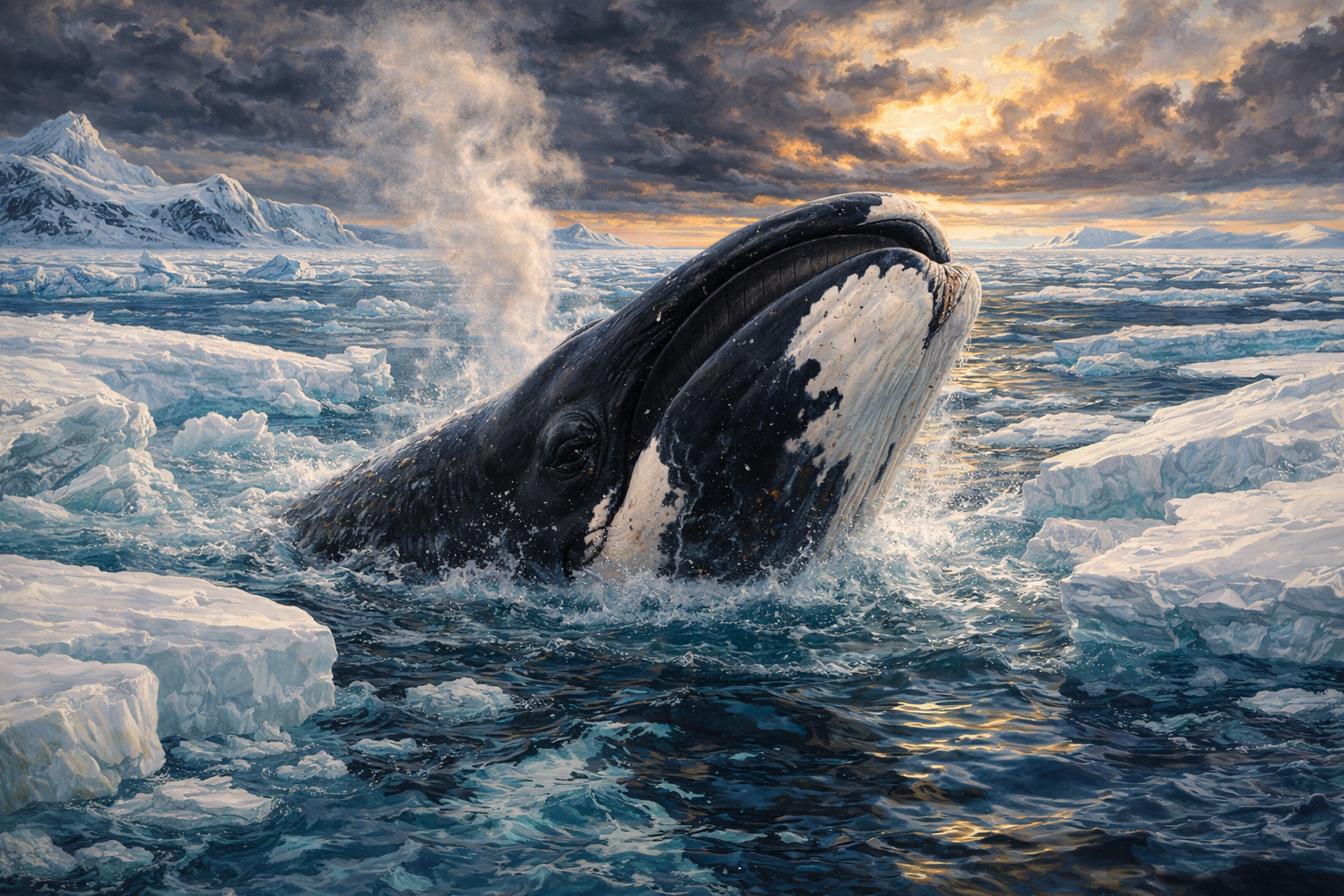
Photorealistic painting of a bowhead whale surfacing through arctic ice with dramatic stormy sky
πŸ‹ Ocean & Aquarium

How Old Is Your Bowhead Whale in Human Years?

πŸ“… Updated April 2026πŸ‹ Lives: 200+ yearsRecord: 211+ years verified

A bowhead whale surfacing through Arctic sea ice today may have been alive during the American Civil War. With a maximum verified age exceeding 211 years, the bowhead whale is the longest-lived mammal on Earth. A 2025 study published in Nature identified the protein responsible β€” CIRBP β€” present in bowhead cells at 100 times higher levels than in humans. This discovery could one day help extend human lifespan.

Calculate Bowhead Whale Age β†’
πŸ‹ Bowhead Whale Age in Human Years
β€”
in human years
β€”
β€”
Bowhead Whale age
β€”
Life stage
~150 yrs
Avg lifespan
πŸ‹ What this age means
β€”

Things About Bowhead Whales That Will Actually Surprise You

🧬 200+ Years β€” The Longest-Lived Mammal
The bowhead whale holds the verified record for the longest-lived mammal. Age is estimated using aspartic acid racemisation in eye lens proteins β€” a chemical process that occurs at a known rate, allowing age to be calculated from preserved tissue. The oldest confirmed individual was estimated at 211 years. Traditional Inuit knowledge of bowhead longevity long preceded scientific verification β€” IΓ±upiaq whalers described bowheads as animals that "live two human lifetimes," a description borne out by science. Some individuals have been found with 19th-century stone and metal harpoon tips embedded in their blubber β€” physical evidence of surviving over a century of intensive Arctic whaling.
πŸ”¬ The Protein That Explains 200-Year Lifespans
A landmark study published in Nature in October 2025 identified a specific protein β€” CIRBP (Cold-Inducible RNA-Binding Protein) β€” present in bowhead whale cells at 100 times higher levels than in humans. CIRBP plays a critical role in repairing double-strand breaks in DNA β€” the type of genetic damage that accumulates with age and drives cancer and cellular senescence. Bowhead whale cells show enhanced DNA repair capacity and lower mutation rates than cells of other mammals. Researchers at the University of Rochester are now investigating whether this pathway can be upregulated in humans β€” opening a potential route to extending human healthspan.
πŸ‹ Built for the Arctic
The bowhead whale is uniquely adapted to life in Arctic and sub-Arctic waters. Its blubber layer reaches up to 50cm thick β€” the thickest of any whale β€” providing both insulation and energy reserves through Arctic winters when food is scarce. Bowheads can break through sea ice up to 60cm thick using their massive, reinforced skull β€” an adaptation that allows them to breathe in areas inaccessible to other whales. They are filter feeders, consuming tiny zooplankton through baleen plates, and a single bowhead can eat over 1.8 tonnes of food per day during summer feeding season.
🎡 Bowhead Whales Sing β€” and Their Songs Change Over Time
Bowhead whales produce extraordinarily complex, melodic songs β€” the most varied of any baleen whale. Unlike humpback whales, whose males all sing the same song in a given season, bowhead whales sing dozens of different songs simultaneously, with individuals improvising and varying their vocalisations. Researchers have recorded over 60 distinct song types from a single population in a single winter. The songs appear to serve a reproductive function, but their extraordinary complexity and variability remain incompletely understood. Bowhead song can be heard over distances of hundreds of kilometres through Arctic waters.

Bowhead Whales β€” The Latest Science and Research

πŸ“° October 2025 β€” Longevity Research
Nature Study Identifies the Protein Behind Bowhead Whale's 200-Year Lifespan β€” May Help Humans Live Longer

A landmark study published in Nature in October 2025 by researchers at the University of Rochester and collaborators identified CIRBP (Cold-Inducible RNA-Binding Protein) as a key mechanism underlying the bowhead whale's extraordinary longevity. The protein, expressed at levels up to 100 times higher in bowhead whale cells than in human cells, plays a critical role in repairing double-strand breaks in DNA β€” the type of genetic damage that accumulates with age and drives cancer, cellular senescence, and age-related disease.

The researchers found that bowhead whale cells have enhanced DNA repair capacity and lower mutation rates than cells of any other mammal studied. Counterintuitively, bowhead cells also require fewer oncogenic mutations to become cancerous than human cells β€” yet bowheads do not develop cancer at elevated rates, suggesting their superior DNA repair prevents the initial mutations from accumulating. The study's senior author Vera Gorbunova stated: "This research shows it is possible to live longer than the typical human lifespan. By studying the only warm-blooded mammal that outlives humans, our work provides information about the mechanisms that allow such extended lifespans." Research is now underway to develop strategies to upregulate the CIRBP pathway in human cells.

πŸ“° Conservation
Bowhead Whales and the Paradox of Peto β€” Giant, Long-Lived, and Cancer-Resistant

Bowhead whales present a profound challenge to basic cancer biology known as Peto's Paradox: the observation that cancer rates do not scale with body size or lifespan as simple mathematics would predict. A bowhead whale has trillions more cells than a human and lives 2-3 times longer β€” statistically, it should develop cancer at dramatically higher rates. Yet bowheads appear remarkably cancer-resistant, with age-related disease appearing far later and less frequently than in humans.

The resolution to this paradox, as the 2025 Nature study revealed, lies in enhanced DNA repair mechanisms β€” the CIRBP protein actively prevents the accumulation of oncogenic mutations rather than eliminating cells that have already mutated. This "conservative" cellular strategy, which repairs damaged cells rather than destroying them, may be a more efficient approach to longevity than the tumour-suppression strategies used by other large long-lived species like elephants. Understanding how different species solved the same evolutionary problem of maintaining cellular integrity over long lifespans is now a major frontier in longevity research.

Frequently Asked Questions

Bowhead whales are the longest-lived mammal on Earth. The oldest verified individual was estimated at 211 years using aspartic acid racemisation in eye lens tissue. Scientific evidence suggests maximum lifespans may exceed 200 years, and traditional Inuit knowledge has long described bowheads as animals that live "two human lifetimes." Some individuals have been found with 19th-century harpoon tips still embedded in their blubber, providing physical confirmation of multi-century survival.
A 2025 Nature study identified a key mechanism: the protein CIRBP (Cold-Inducible RNA-Binding Protein) is expressed at levels up to 100 times higher in bowhead whale cells than in human cells, dramatically enhancing their ability to repair DNA double-strand breaks. This superior DNA repair capacity prevents the accumulation of oncogenic mutations and maintains cellular integrity over centuries. Cold-water living may also contribute β€” slower metabolism reduces cellular oxidative stress, and CIRBP is specifically activated by cold temperatures.
Bowhead whales are among the largest animals on Earth. Adults typically reach 14-18 metres in length and weigh 75,000-100,000 kg (75-100 tonnes), with large females being significantly larger than males. They are the second-largest animal on Earth after the blue whale. Their blubber layer reaches up to 50cm thick β€” the thickest of any whale β€” providing essential insulation in Arctic waters that remain near freezing year-round.

More Animals on PawClocks