Popular Pets
🐶 Dog 🐱 Cat 🐰 Rabbit 🐹 Hamster 🐾 Guinea Pig 🦜 Parrot 🦡 Ferret 🐀 Rat 🐭 Chinchilla 🦔 Hedgehog 🐟 Goldfish 🦜 Macaw
Farm & Large Animals
🐴 Horse 🐄 Cow 🐄 Highland Cow 🐷 Pig 🐑 Sheep 🐐 Goat 🐴 Donkey 🦙 Alpaca 🐐 Mountain Goat 🐔 Chicken 🦆 Duck 🦃 Turkey
Wild Animals
🐘 Elephant 🦁 Lion 🐯 Tiger 🐆 Leopard 🐺 Wolf 🐻 Bear 🐻‍❄️ Polar Bear 🦍 Gorilla 🐒 Chimpanzee 🦧 Orangutan 🦘 Kangaroo 🐾 Capybara 🦒 Giraffe 🦊 Fox 🦅 Raptor 🦉 Owl 🐧 Penguin 🦩 Flamingo 🐾 Hyena 🐾 Meerkat 🦥 Sloth 🦡 Badger 🐾 Wolverine 🐾 Armadillo
Ocean & Aquarium
🦈 Shark 🐋 Orca 🐬 Dolphin 🐋 Whale 🐋 Blue Whale 🐳 Beluga Whale 🦄 Narwhal 🐋 Bowhead Whale 🐾 Manatee 🐟 Manta Ray 🐟 Freshwater Fish 🐠 Saltwater Fish 🐴 Seahorse 🐟 Koi
Exotic & Weird
🐍 Snake 🐍 Ball Python 🦎 Bearded Dragon 🦎 Iguana 🦎 Komodo Dragon 🦎 Chameleon 🦎 Leopard Gecko 🐢 Tortoise 🐢 Snapping Turtle 🐢 Sea Turtle 🐊 Crocodilian 🕷️ Tarantula 🦎 Axolotl 🐙 Octopus 🌊 Jellyfish 🦞 Lobster 🐚 Quahog 🔬 Tardigrade
Info
About FAQ Contact
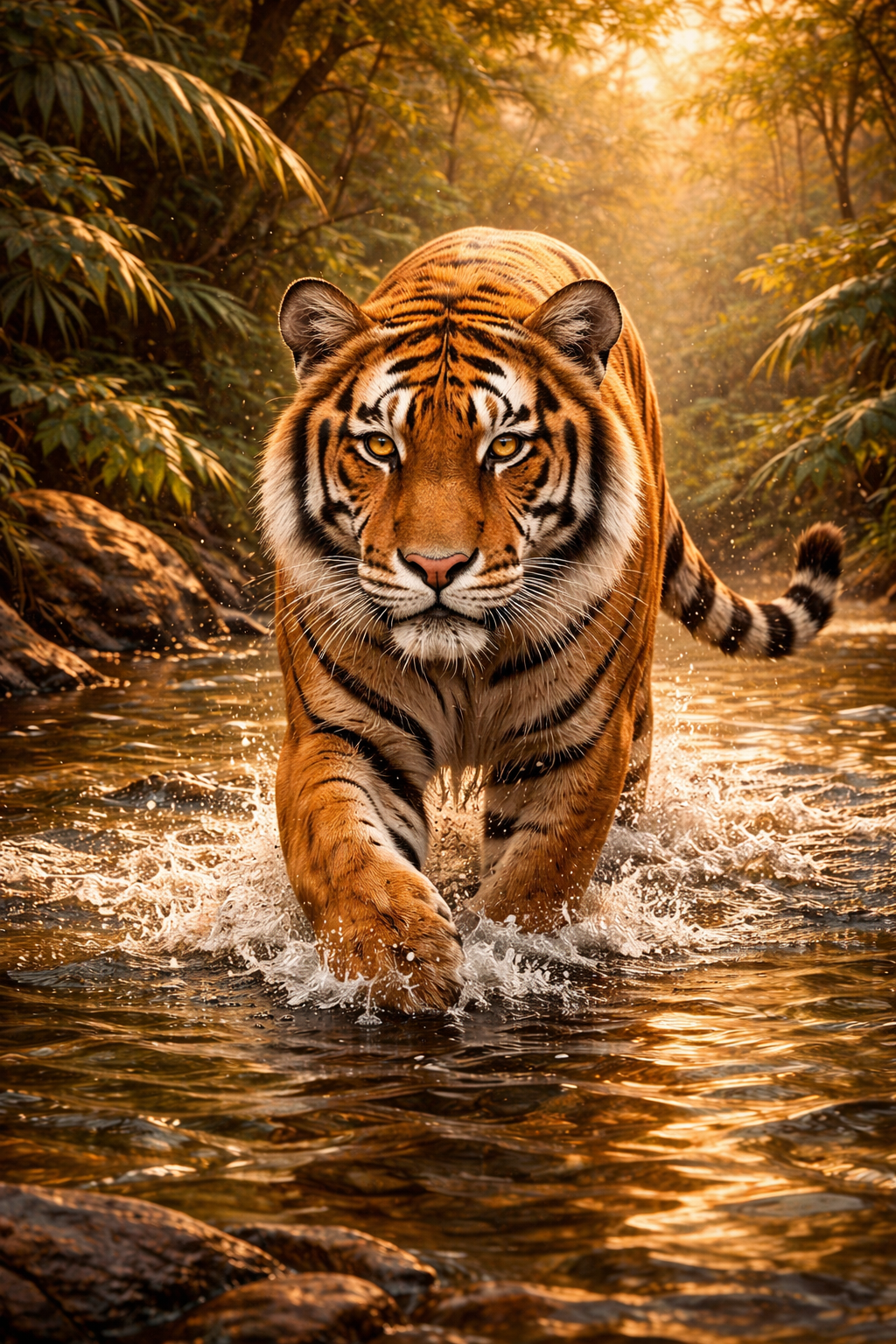
Bengal tiger charging through a jungle river, eyes fixed forward, water splashing
🐯 Wild Animals

How Old Is a Tiger in Human Years?

📅 Updated 🔬 Wild & captive data 🐯 6 subspecies covered

There are fewer than 4,000 wild tigers left on Earth — down from 100,000 a century ago. Three subspecies went extinct in the 20th century. A wild tiger's entire lifespan is shorter than many people's careers. Every individual matters enormously.

Calculate Tiger Age →
🐯 Tiger Age in Human Years
in human years
Tiger age
Life stage
Setting
🐯 What this age means

Six Living Subspecies — Three Already Gone

The tiger was once one species distributed across most of Asia. Three subspecies went extinct in the 20th century. Six survive today, all endangered or critically endangered.

🐯 Bengal Tiger
~2,500–3,000 wild
The most numerous subspecies. Found in India, Bangladesh, Nepal, and Bhutan. India's Project Tiger, launched in 1973, helped stabilise populations after near-collapse.
❄️ Amur (Siberian) Tiger
~500–600 wild
The largest living cat on Earth. Found in the Russian Far East and small parts of China. Adapted to extreme cold with a thick fur coat and extra fat layer. Critically endangered.
🌴 Sumatran Tiger
~400–600 wild
The smallest living tiger subspecies, found only on the Indonesian island of Sumatra. Critically Endangered — deforestation for palm oil is the primary driver of habitat loss.
🐾 Indochinese Tiger
~150–350 wild
Found in Cambodia, Laos, Myanmar, Thailand, and Vietnam. Severely fragmented population. Poaching for traditional medicine markets is the dominant threat.
🌿 Malayan Tiger
~80–120 wild
Critically Endangered. Found only in the southern Malay Peninsula. Recognised as a distinct subspecies only in 2004. Rapid population decline due to deforestation and poaching.
🏔️ South China Tiger
Possibly extinct in wild
Functionally extinct in the wild — no confirmed wild sightings since the 1980s. Around 100 survive in captivity in China. Considered the most critically endangered tiger subspecies.
💀 Bali Tiger
Extinct — 1940s
The smallest tiger subspecies, native to the Indonesian island of Bali. The last confirmed individual was killed in 1937. Hunted to extinction in a matter of decades.
💀 Caspian Tiger
Extinct — 1970s
Once ranged from Turkey to China across Central Asia. Habitat destruction and prey depletion drove extinction. Genetically closely related to the Amur tiger — potentially restorable.
💀 Javan Tiger
Extinct — 1970s–80s
Native to the Indonesian island of Java. As human population grew and forests were cleared, the tiger's prey base collapsed. The last confirmed sighting was 1976.

Tiger Age to Human Years — Full Table

Tiger AgeWild TigerCaptive TigerLife Stage
6 months~5 yrs~3 yrsCub
1 year~9 yrs~5 yrsCub
2 years~18 yrs~9 yrsSub-adult
3 years~27 yrs~14 yrsYoung adult
5 years~40 yrs~22 yrsPrime adult
7 years~53 yrs~31 yrsMature
9 years~65 yrs~40 yrsSenior (wild)
12 years~78 yrs~54 yrsElder (wild)
16 yearsRecord territory~71 yrsSenior (captive)
22 years~96 yrsElder (captive)

The Life Stages of a Tiger

Tigers are solitary from a young age and mature relatively quickly for a large cat. A wild tiger's life is defined by the challenge of establishing and defending a territory large enough to sustain them — a task that begins in earnest before age 3 and becomes increasingly difficult as habitat shrinks.

0–6 mo
Cub
Born blind in litters of 2–4. Fully dependent on mother. Eyes open at 2 weeks. Begin eating meat at 8 weeks. Mortality is very high — up to 50% die in their first year.
6–18 mo
Juvenile
Learning to hunt by observation. Still dependent on mother. Beginning to develop adult stripe patterns and hunting instincts.
18 mo–3 yr
Sub-adult
Accompanying mother on hunts. Developing independence. Males begin dispersing from natal territory around age 2–3, often travelling hundreds of kilometres.
3–7 yrs
Young Adult
Establishing territory. First reproduction typically around age 3–4 for females, slightly later for males. Most dangerous period — competition for territory is intense.
7–12 yrs
Prime Adult
Peak physical condition. Established territory. Experienced hunters. Dominant individuals in their range. In the wild, this is the most productive phase.
12–16+ yrs
Senior
Slowing physically. Territories become harder to defend. Tooth wear can make hunting large prey difficult — increasing the risk of targeting livestock or, rarely, humans.

Things About Tigers That Will Actually Surprise You

📉 The 97% Decline
At the start of the 20th century, an estimated 100,000 tigers roamed across Asia. By 2010 that number had fallen to approximately 3,200 — a decline of around 97% in 100 years. Three subspecies went extinct entirely. The IUCN lists all tiger subspecies as Endangered or Critically Endangered.
🏊 Swimmers
Tigers are exceptional swimmers — unlike most cats, they actively seek out water and are known to swim across rivers several kilometres wide. They cool off in streams and lakes during hot weather, and have been documented swimming up to 29 km in a single journey. Bengal tigers in the Sundarbans mangrove forest have become partly adapted to a semi-aquatic lifestyle.
🔬 No Two Stripes Alike
A tiger's stripe pattern is as unique as a human fingerprint — no two tigers have the same pattern. Wildlife researchers use stripe identification to track and count individuals in the wild without capture. The stripes extend through the fur to the skin itself — a shaved tiger would still show its stripe pattern on the skin.
🌙 Solitary Hunters
Tigers are strictly solitary — each adult maintains an exclusive territory ranging from 20 km² for females to over 100 km² for males. They communicate via scent marks, scratch posts, and roars, but rarely interact except to mate. A female raises her cubs entirely alone for 2–3 years, teaching them everything they need to survive before releasing them to find their own territories.
💀 White Tigers — Not a Subspecies
White tigers are not a separate subspecies — they are Bengal tigers with a recessive gene causing reduced pigmentation. Almost all white tigers in captivity descend from a single wild-caught individual named Mohan, captured in 1951. Captive white tigers are produced by severe inbreeding (often father-daughter or sibling pairings), causing serious health problems. No white tiger has been reliably sighted in the wild since 1958.
🌿 Striped for Grassland
The tiger's vertical stripes provide disruptive camouflage in tall grass and dappled forest light — breaking up the body's outline rather than matching a background colour. The pattern is most effective at the low light levels typical of dawn and dusk hunting, when prey animals' colour vision is at its weakest. Despite appearing vivid in photographs, tigers are remarkably difficult to spot in their natural habitat.

🐯 The Global Tiger Recovery Program, launched in 2010 at the St Petersburg Tiger Summit, set a goal of doubling wild tiger numbers by 2022 (TX2). By 2023, the global estimate had risen to approximately 3,726–5,578 — a genuine, hard-won recovery from the 2010 low. India, Nepal, and Bhutan drove most of the growth. But the Malayan, Sumatran, South China, and Indochinese subspecies continue to decline. The recovery is real but fragile.

Tigers and Humans — A Dangerous History

⚠️ Tigers are the most dangerous big cat to humans historically. The Champawat Tiger — a Bengal tigress in Nepal and northern India — killed an estimated 436 people between 1900 and 1907, the highest confirmed human death toll attributed to any single wild animal in recorded history. She was eventually shot by hunter Jim Corbett in 1907.

Tiger attacks on humans are relatively rare given how few wild tigers remain — but they are not trivial. The WWF and Indian wildlife authorities estimate that 50–100 people are killed by tigers in India annually, primarily in the Sundarbans delta region of West Bengal where the mangrove habitat forces unusually close contact between tigers and the local fishing and honey-gathering communities.

Why the Sundarbans Are Different

The Sundarbans — a vast mangrove delta shared between India and Bangladesh — holds one of the world's largest tiger populations (estimated 100–120 individuals on the Indian side alone). The geography forces a level of human-tiger overlap found nowhere else: fishermen and honey collectors enter the forest regularly, boats are small and low, and tigers have learned to ambush from the water's edge. Local communities wear masks on the back of their heads — tigers typically attack from behind — as a documented deterrent that reduced attacks in controlled studies.

When Tigers Attack

The vast majority of tiger attacks involve specific circumstances:

  • Old or injured tigers that can no longer take down large prey — dental wear, injury, or porcupine quill infections can make a tiger shift to easier targets
  • Surprise encounters at close range — tigers that have been startled or cornered
  • Habitat overlap in the Sundarbans and other heavily populated areas where tiger territory and human activity overlap
  • Tigresses with cubs — a mother perceiving a threat to her offspring is among the most dangerous scenarios
  • Captive or zoo incidents — the majority of fatal tiger attacks in Western countries involve captive animals

Notable Man-Eaters of History

TigerRegionPeriodAttributed DeathsNotes
Champawat TigerNepal / Uttarakhand, India1900–1907436Highest confirmed toll of any wild animal in history. Shot by Jim Corbett.
Tiger of SegurTamil Nadu, India1950s~40Operating near the Nilgiri Hills; responsible for numerous cattle and human kills.
Thak TigressKumaon, India19384 confirmedAlso shot by Jim Corbett; his account in The Man-Eating Leopard of Rudraprayag documents the hunt.
Sundarbans Tigers (ongoing)West Bengal / BangladeshOngoing50–100/yr (India)Multiple individuals; the only persistent man-eating tiger population in the modern world.

📖 Jim Corbett (1875–1955) was a British-Indian hunter and conservationist who hunted some of India's most notorious man-eating tigers and leopards — including the Champawat Tiger and the Rudraprayag Leopard. His books, including Man-Eaters of Kumaon (1944), are considered classics of natural history writing. Remarkably, Corbett later became one of India's first and most passionate conservation advocates — Corbett National Park, India's oldest national park and a key tiger reserve, is named after him.

Other Wild Animals

Frequently Asked Questions

A 10-year-old wild tiger is approximately 72 human years old — a genuine elder by the standards of wild tiger life. Most wild tigers don't make it to 10. A 10-year-old captive tiger, by contrast, is around 45 in human terms — middle-aged, with a decade or more potentially ahead.
Tigers have been subject to more intense and sustained hunting pressure, largely because tiger parts — bones, skins, organs — have been valued in traditional Chinese medicine for centuries, creating a persistent illegal trade. Tigers also have smaller, more fragmented remaining populations across more countries, making coordinated protection harder. Lions face similar threats but still have some large, contiguous populations in Africa. Tiger subspecies are more geographically isolated and numerically smaller, making each one far more vulnerable to extinction.
Project Tiger was launched by the Indian government in 1973 in response to a dramatic population collapse. It established tiger reserves, banned hunting, and invested in habitat protection. By most measures, it has been one of conservation's genuine success stories — India's tiger population grew from approximately 1,800 in the 1970s to over 3,000 by 2023. India now hosts roughly 75% of the world's remaining wild tigers. The programme has been replicated and expanded across the tiger's range in subsequent decades.
Yes — there are estimated to be 5,000–7,000 tigers in captivity in the United States alone, largely in private ownership and poorly regulated facilities. This exceeds the entire wild global tiger population. Most captive tigers in private hands have no conservation value — they are often inbred, not suitable for release, and their trade can actually fuel demand for tiger products that drives wild poaching. The US captive tiger crisis gained public attention through the Netflix documentary Tiger King in 2020.
Territory size varies considerably by subspecies and habitat quality. Female Bengal tigers maintain territories of roughly 20–60 km². Males patrol much larger areas — often 60–100 km² or more — that may overlap with several female territories. Amur tigers in Russia have been tracked covering over 1,000 km². Territory size generally reflects prey density: in prey-rich habitats territories are smaller; in degraded habitats tigers must range further to find enough food.