Popular Pets
🐶 Dog 🐱 Cat 🐰 Rabbit 🐹 Hamster 🐾 Guinea Pig 🦜 Parrot 🦡 Ferret 🐀 Rat 🐭 Chinchilla 🦔 Hedgehog 🐟 Goldfish 🦜 Macaw
Farm & Large Animals
🐴 Horse 🐄 Cow 🐄 Highland Cow 🐷 Pig 🐑 Sheep 🐐 Goat 🐴 Donkey 🦙 Alpaca 🐐 Mountain Goat 🐔 Chicken 🦆 Duck 🦃 Turkey
Wild Animals
🐘 Elephant 🦁 Lion 🐯 Tiger 🐆 Leopard 🐺 Wolf 🐻 Bear 🐻‍❄️ Polar Bear 🦍 Gorilla 🐒 Chimpanzee 🦧 Orangutan 🦘 Kangaroo 🐾 Capybara 🦒 Giraffe 🦊 Fox 🦅 Raptor 🦉 Owl 🐧 Penguin 🦩 Flamingo 🐾 Hyena 🐾 Meerkat 🦥 Sloth 🦡 Badger 🐾 Wolverine 🐾 Armadillo
Ocean & Aquarium
🦈 Shark 🐋 Orca 🐬 Dolphin 🐋 Whale 🐋 Blue Whale 🐳 Beluga Whale 🦄 Narwhal 🐋 Bowhead Whale 🐾 Manatee 🐟 Manta Ray 🐟 Freshwater Fish 🐠 Saltwater Fish 🐴 Seahorse 🐟 Koi
Exotic & Weird
🐍 Snake 🐍 Ball Python 🦎 Bearded Dragon 🦎 Iguana 🦎 Komodo Dragon 🦎 Chameleon 🦎 Leopard Gecko 🐢 Tortoise 🐢 Snapping Turtle 🐢 Sea Turtle 🐊 Crocodilian 🕷️ Tarantula 🦎 Axolotl 🐙 Octopus 🌊 Jellyfish 🦞 Lobster 🐚 Quahog 🔬 Tardigrade
Info
About FAQ Contact
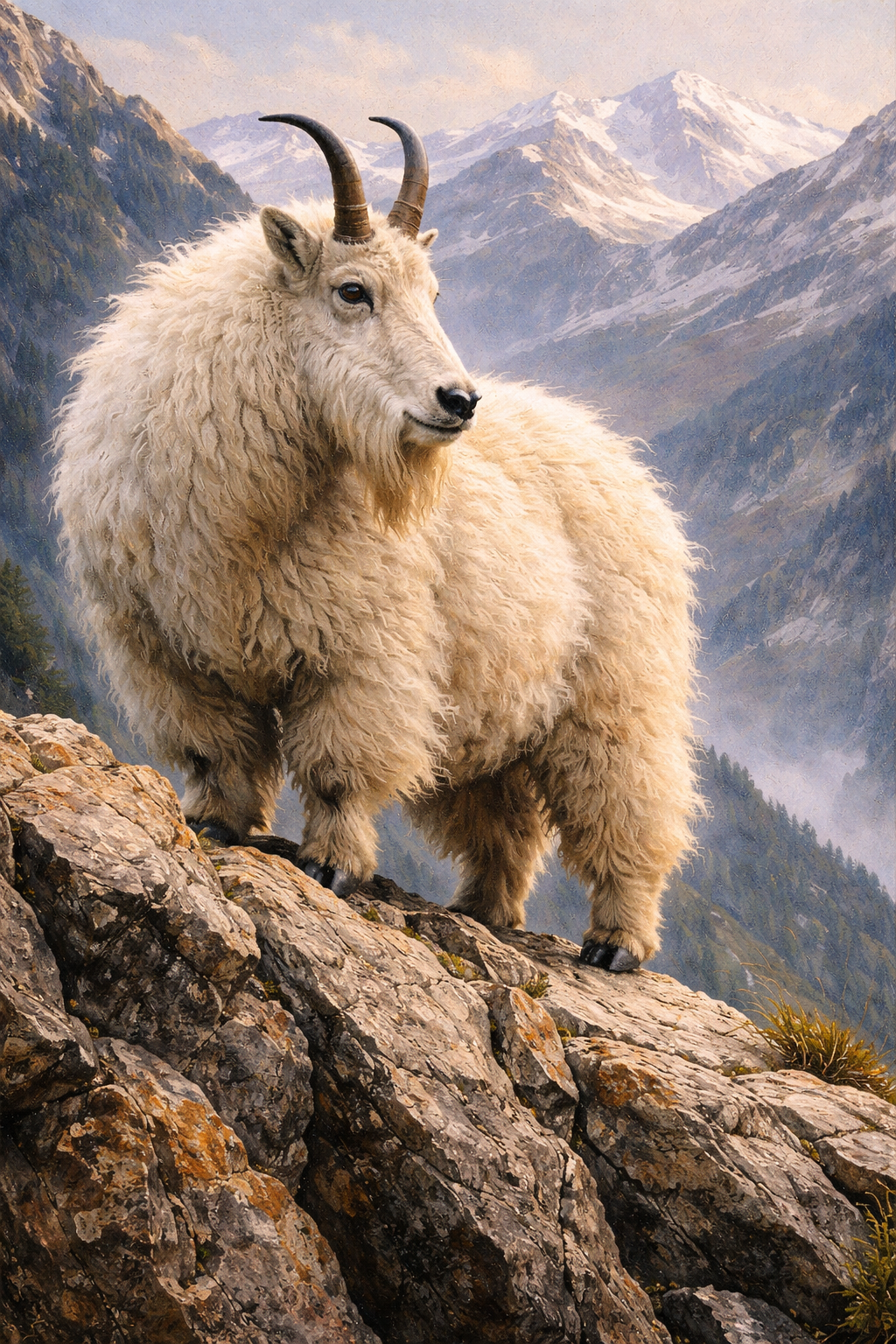
Photorealistic painting of a mountain goat on a Rocky Mountain cliff face
🐐 Wild Animals

How Old Is a Mountain Goat in Human Years?

📅 Updated 🏔️ Lives above 3,000 metres 🐐 Not actually a goat

Mountain goats navigate near-vertical rock faces at over 3,000 metres with a calm precision that defies physics. Their hooves are engineered like climbing shoes — hard outer edge for grip, soft inner pad for friction. They are not true goats. They age rings in their horns like trees. And their fights, though rare, are surprisingly lethal.

Calculate Mountain Goat Age →
🐐 Mountain Goat Age in Human Years
in human years
Goat age
Life stage
Sex
🐐 What this age means

The Life Stages of a Mountain Goat

Mountain goats live compressed, intense lives shaped entirely by altitude and terrain. Their developmental milestones are rapid in youth — kids are mobile within hours of birth at elevations where any immobility is fatal — and their lifespan is constrained not by internal ageing so much as by the cumulative toll of one of Earth's harshest environments. Females consistently outlive males, whose lives are shortened by combat, physiological stress, and risk-taking during rut.

0–1 mo
Kid
Born on cliff ledges or steep terrain where predators cannot easily follow. Standing within 30 minutes of birth. Climbing within hours. Their hooves are fully functional from day one — they must be. Mortality is highest in the first weeks: falls, weather, and golden eagle predation are the primary risks.
1 mo–1 yr
Juvenile
Growing rapidly. Nursing until approximately 3–4 months, then transitioning to foraging. Learning the cliff geography of their home range from their mother — mountain goat terrain knowledge is largely learned, not instinctive. Young kids play-fight extensively, developing the balance and coordination they will need for life on vertical terrain.
1–3 yrs
Sub-adult
Approaching sexual maturity — females typically first breed at 2.5 years, males at 2–3 years though dominant males prevent younger males from breeding. Horns growing toward adult length. Beginning to establish range and social position. The thick double coat — wool underlayer and longer guard hair outer layer — now fully developed.
3–7 yrs
Prime Adult
Full adult size and horn development. Nannies in prime reproductive condition — producing one kid per year in most cases. Billies competing seriously for breeding access. The annual horn rings clearly visible, providing an accurate age record. At this stage the mountain goat is at the height of its physical capabilities.
7–12 yrs
Mature
An experienced mountain goat with deep knowledge of their terrain, escape routes, mineral lick locations, and seasonal migration routes. Nannies continue breeding reliably into this range. Billies face increasing competition from younger males and accumulate injuries from years of combat. The horn rings now form a detailed age record.
12–18 yrs
Senior / Elder
Senior mountain goats are rare in the wild — the combination of harsh winters, accumulated injuries, and competition limits most individuals to 12–15 years. The oldest verified wild mountain goat reached 18 years. Elder nannies often retain social dominance over younger females despite reduced physical condition, relying on experience and established territory knowledge.

Mountain Goat Age to Human Years

Mountain Goat AgeNanny (♀)Billy (♂)Life StageHorn Rings
Birth~Newborn~NewbornKid0 — rings form annually from year 1
6 months~4 yrs~4 yrsJuvenile0 — first ring still forming
1 year~8 yrs~8 yrsYearling1 ring
3 years~20 yrs~19 yrsSub-adult / Young adult3 rings
5 years~30 yrs~29 yrsPrime adult5 rings
8 years~44 yrs~42 yrsMature8 rings
12 years~59 yrs~57 yrsSenior12 rings
15 years~68 yrsElder ♂Elder (nanny) / Exceptional (billy)15 rings
18 years~76 yrsWild record holder18 rings

🐐 Mountain goat age can be determined precisely by counting annual growth rings on the horns — a technique called horn annuli aging. Each winter, when nutrition is scarce, horn growth slows and leaves a visible constriction ring. Counting these rings from the base gives an exact age — one of the few large mammals whose age can be determined with certainty in the field. Both sexes retain their horns for life (unlike deer antlers, which are shed annually), making the entire life record visible in a single horn.

The Mountain Goat's Hoof — Nature's Climbing Shoe

🐐 No other large mammal can navigate the terrain that mountain goats treat as everyday commuting. Their hooves are not simply tough — they are a multi-component system that solves multiple engineering problems simultaneously, and they have no meaningful parallel in any other ungulate.

The outer edge of each hoof is made of hard keratin — sharp and stiff, designed to bite into rock edges like a climbing crampon. But the inner surface of each hoof is a soft, rubbery pad that creates friction and suction against smooth rock faces, functioning like a sticky climbing shoe sole. This combination — hard perimeter grip + soft inner traction — allows mountain goats to hold on surfaces that would be impassable for any other large animal.

Each foot has two large hooves that spread independently, widening the base of support on uneven terrain. Behind these sit two smaller dewclaws that splay outward to grip on loose scree and prevent backward sliding on steep descents. The entire foot is designed to maximise contact area with minimal body weight commitment at any single point.

📐 What They Can Climb
Mountain goats can ascend slopes of 60 degrees — steeper than most skiing black runs. They traverse ledges as narrow as 5 centimetres (roughly two fingers wide). They can jump 3.5 metres horizontally between cliff faces. They navigate terrain at elevations up to 4,000+ metres in the Rocky Mountains and Coast Ranges, where oxygen levels are significantly reduced and footing is permanently icy or loose.
⚖️ Low Centre of Gravity
Mountain goats are built low and heavy relative to their leg length — their low centre of gravity reduces tipping force on steep terrain. Their powerful shoulder and neck muscles provide stability when pushing off from ledges. Their calm temperament on exposure — they show no apparent fear of heights — is not bravado but a genuine lack of vertigo response, likely an evolved suppression of the startle reflex that would be fatal in their environment.
🧊 Winter Navigation
Mountain goats are year-round residents at altitude — unlike bighorn sheep, they do not descend significantly in winter. They navigate iced rock faces using the same hooves, relying on the hard outer edge to chip into ice and the dewclaws to arrest slides. Their thick double coat — a dense wool underlayer and longer oily guard hairs — provides insulation rated for temperatures well below −40°C. They are adapted to conditions that would kill most ungulates within hours.

Things About Mountain Goats That Will Actually Surprise You

🐐 Not Actually a Goat
Despite the name, Oreamnos americanus is not a true goat (genus Capra). Mountain goats are the sole member of the genus Oreamnos — a distinct North American lineage within the subfamily Caprinae. Their closest living relatives are the chamois of Europe and the Caucasus (Rupicapra spp.) and the Asian gorals and serows, not domestic goats. They diverged from Old World relatives when their ancestors crossed the Bering land bridge from Asia approximately 100,000 years ago, adapting to North American alpine terrain in isolation. The name "mountain goat" reflects superficial resemblance, not evolutionary relationship. A more accurate common name would be "Rocky Mountain chamois."
🪝 Horn Rings — Reading Age Like Tree Rings
Both male and female mountain goats grow permanent, unbranched horns made of keratin over a bone core — unlike deer, which shed antlers annually. Each autumn-winter cycle, when nutrition drops, horn growth slows and leaves a visible constriction ring. Counting these rings from the base gives the animal's exact age. The rings are permanent and cumulative — an 18-year-old goat has 18 readable rings. This makes mountain goats one of the few large mammals that can be aged precisely in the field without killing them, using binoculars and good light.
⚔️ Horn Combat — Surprisingly Lethal
Mountain goats rarely fight — their sharp, thin horns make combat genuinely dangerous, and both sexes bear weapons they can use effectively. When conflicts do occur, mountain goats target the rump and flanks rather than engaging in the head-to-head clashing of bighorn sheep. A single horn stab to the flank can puncture a lung or rupture an intestine. Research published in Scientific Reports found that adult male mountain goats show significantly higher rates of puncture wounds than females — consistent with horn combat being a real source of mortality. The avoidance behaviour seen in mountain goats — elaborate appeasement postures, threat displays, deliberate yielding on ledges — is an adaptation to the lethality of their weapons.
🧂 Salt Lick Obsession
Mountain goats have an intense, often reckless craving for salt and minerals — they will descend thousands of metres from their cliff habitats to reach mineral licks, crossing terrain and road systems that they would otherwise avoid entirely. This is a physiological response to the mineral-poor diet available on high alpine vegetation. They lick road surfaces treated with de-icing salt, gnaw on wooden structures soaked in human sweat (which contains sodium), and will stand on road edges in dangerous proximity to vehicles to access salt deposits. Olympic National Park has documented multiple human fatalities from mountain goats at mineral licks — not from aggression but from the goats simply walking toward salt sources on narrow trails where people were present.
🌿 Nanny Dominance — Females Rule
Mountain goat society is female-dominated for most of the year. Nannies occupy the best cliff terrain, determine group movements, and aggressively defend feeding and resting areas even against much larger billies. Billy males are largely solitary outside of the November–December rut, living in bachelor groups or alone in lower-quality terrain yielded to them by dominant nannies. This sex segregation is unusual among ungulates and reflects the nannies' need for the most secure cliff terrain to raise kids safely. Female mountain goats are consistently more aggressive day-to-day than males outside of rut — the opposite of the pattern seen in most large ungulates.
📍 Non-Native in Some Parks — An Ecological Issue
Mountain goats are native to the Rocky Mountains and Coast Ranges of North America, but they were introduced to several mountain ranges where they did not historically occur — including Olympic National Park (Washington) and parts of the Sierra Nevada. In Olympic, transplanted in the 1920s, they reached a population of ~1,100 by 2018 and caused significant damage to fragile alpine vegetation and soils through trampling and grazing. A major relocation and culling programme by the National Park Service in 2018–2021 removed over 400 animals, with many successfully relocated to their native Cascades range. The project is one of the largest wildlife management operations in national park history.

🐐 The IUCN lists the mountain goat as Least Concern, with an estimated North American population of 82,000–100,000 individuals across their range in Alaska, British Columbia, Alberta, the Yukon, and the western contiguous United States. However, some local populations — particularly in isolated southern mountain ranges at the edges of their range — are declining due to climate change, which reduces the extent of suitable high-alpine habitat and increases parasite pressure as temperatures rise.

Mountain Goat vs Other Alpine Ungulates

Mountain goats share high-altitude North American terrain with bighorn sheep and share evolutionary heritage with Old World counterparts like chamois and ibex. Here's how they compare across the metrics that matter most at elevation.

SpeciesRangeWild LifespanMax ElevationHorn TypeIUCN Status
Mountain Goat Oreamnos americanusRocky Mtns, Coast Range, Alaska12–18 yrs4,000+ mPermanent, sharp, thin — both sexesLeast Concern
Bighorn Sheep Ovis canadensisW. North America10–14 yrs3,500+ mMassive curling horns (rams); shorter (ewes)Least Concern
Dall Sheep Ovis dalliAlaska, NW Canada12–16 yrs3,000+ mLarge curling (rams); shorter (ewes)Least Concern
Alpine Chamois Rupicapra rupicapraEuropean Alps, Carpathians14–22 yrs3,000+ mHooked at tip — both sexesLeast Concern
Alpine Ibex Capra ibexEuropean Alps10–20 yrs3,300+ mLong, sweeping ridged (males much larger)Least Concern
Himalayan Tahr Hemitragus jemlahicusHimalayas10–15 yrs5,000+ mCurved, ridged — both sexesNear Threatened
Snow Leopard prey (multiple)Central Asia, HimalayasVaries5,000+ mVaries by speciesVaries

🐐 The Alpine chamois is the mountain goat's closest Old World relative — both evolved from shared Caprinae ancestors that spread across the Bering land bridge during Pleistocene glaciations. Chamois live significantly longer (up to 22 years recorded in the wild) and have a similar female-dominated social structure. Both species rely on permanent hooves with hard outer edges and soft inner pads for cliff navigation — a convergent solution that evolved independently but from the same anatomical starting point.

Other Wild Animals

Frequently Asked Questions

Mountain goats are native to the rocky alpine zones of western North America — from southeastern Alaska and the Yukon south through British Columbia, Alberta, and into the Rocky Mountains and Cascade ranges of Washington, Oregon, Idaho, Montana, and Wyoming, with isolated populations further south. They are year-round residents at elevation, typically living above the treeline at 1,500–4,000+ metres. They prefer cliff terrain with steep, broken rock faces that provide escape routes from predators and breeding exclusivity. The National Park Service manages populations in several national parks including Glacier, North Cascades, and Olympic (where they are non-native).
Mountain goats are browsers and grazers of alpine vegetation — they eat whatever is available at altitude, which is not much. Their diet includes grasses, sedges, forbs, mosses, lichens, woody shrubs, and ferns. They will eat bark and twigs in winter when herbaceous plants are buried under snow. Their digestive system is highly efficient at extracting nutrition from low-quality, coarse alpine vegetation. The mineral deficiencies in this diet drive their famous craving for salt, which they seek at mineral licks and on human infrastructure. They are most active at dawn and dusk, spending midday resting in secure cliff locations.
Adult mountain goats have few effective predators precisely because their cliff habitat is inaccessible to most carnivores. Mountain lions are the primary predator of adults, capable of navigating rocky terrain well enough to ambush goats at lower elevations or on cliff edges. Wolves occasionally take goats on gentler terrain. Grizzly bears pursue goats opportunistically. Golden eagles are the primary threat to kids — they can knock young goats off ledges with aerial strikes or simply carry small kids away. The evolutionary pressure from these predators helps explain why nannies select the most inaccessible cliff terrain for kidding and early rearing.
Mountain goats were introduced to Olympic National Park in the 1920s when they were not historically present there. Without natural predators and in a novel ecosystem that had not co-evolved with them, the population grew to approximately 1,100 animals by 2018. Their grazing, trampling, and wallowing caused significant damage to fragile alpine vegetation and soils — in a park with many endemic plant species. They also congregated near human infrastructure to access sweat and urine for sodium, creating safety hazards. In 2019, the National Park Service conducted a major operation to relocate goats to the North Cascades (their native range) and remove others. Over 400 goats were moved or removed, in the largest wildlife operation in the park's history.
Mountain goats and bighorn sheep are the two most iconic large mammals of the North American alpine zone, but they are quite distinct. Mountain goats are white, stocky, and have thin straight horns in both sexes — they prefer the steepest, most vertical cliff terrain and are year-round high-altitude residents. Bighorn sheep are brown, more lightly built, and the males have the iconic massive curling horns that they use in dramatic head-clashing combat. Bighorn sheep use less vertical terrain, descend more in winter, and have a more typical male-dominant social structure. The two species can overlap in habitat but generally partition terrain — mountain goats take the most inaccessible vertical areas; bighorn use the broken but less sheer cliff faces and subalpine zones.