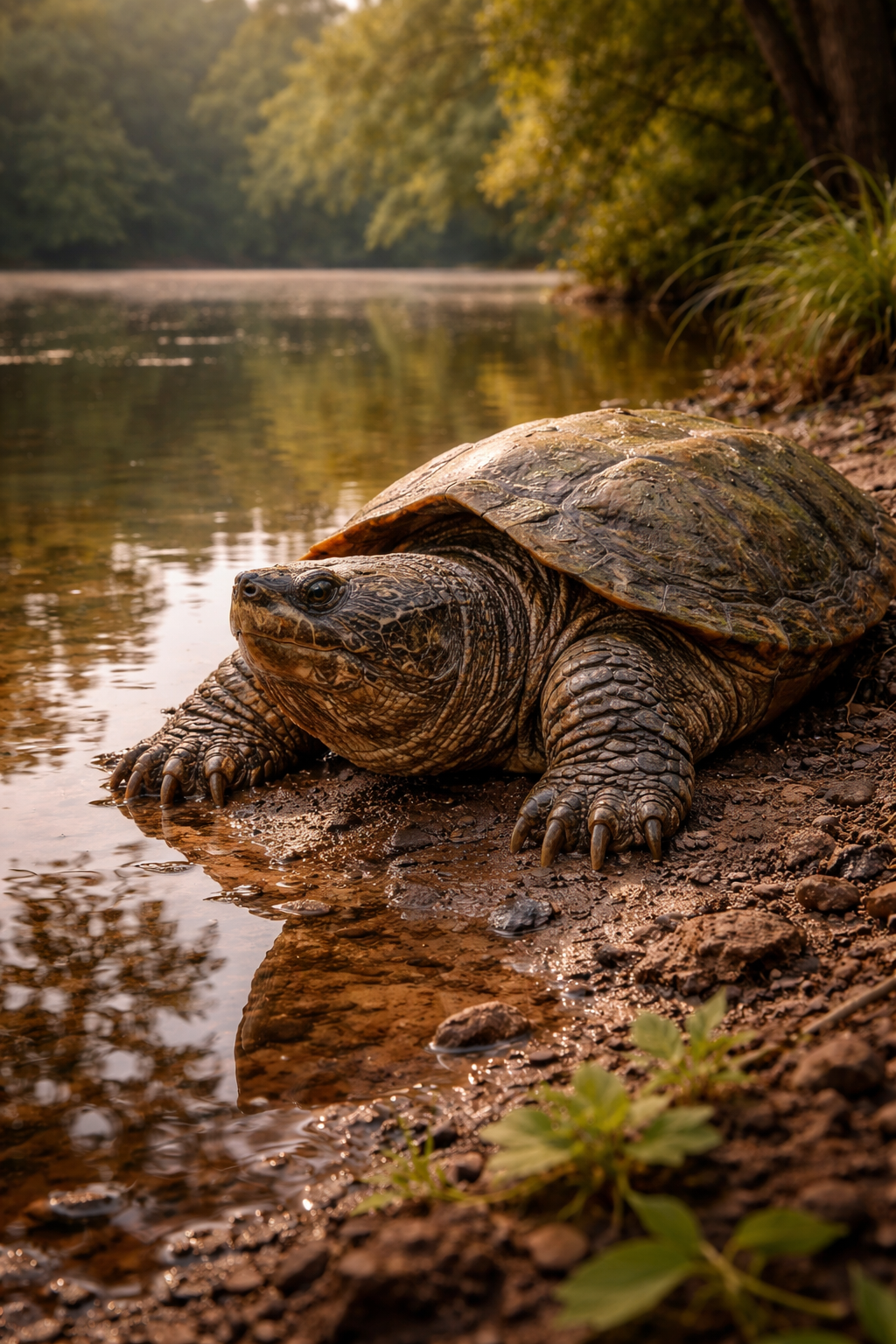
The Life Stages of a Snapping Turtle
Snapping turtles have one of the most challenging early life survival rates of any vertebrate — researchers estimate that 99.4% of snapping turtle hatchlings die before reaching sexual maturity. Eggs are raided by raccoons, skunks, foxes, and crows. Hatchlings are taken by herons, bass, pike, mink, and every other predator in the ecosystem. The few that survive this gauntlet become near-invulnerable adults — heavily armoured, pugnacious, and extraordinarily long-lived.
Snapping Turtle Age to Human Years Conversion
| Turtle Age | Common Snapper | Alligator Snapper | Life Stage | Key Milestone |
|---|---|---|---|---|
| Hatchling | Newborn | Newborn | Hatchling | Quarter-sized; 99.4% won't reach adulthood |
| 2 years | ~8 yrs | ~5 yrs | Juvenile | Growing in shallows; avoiding predators |
| 5 years | ~16 yrs | ~9 yrs | Juvenile/Sub-adult | Most predation risk behind them |
| 12 years | ~30 yrs | ~19 yrs | Young Adult | Sexual maturity in females (common snapper) |
| 20 years | ~44 yrs | ~30 yrs | Prime Adult | Peak size and territorial establishment |
| 40 years | ~70 yrs | ~53 yrs | Senior | Decades of waterway knowledge |
| 60 years | ~86 yrs | ~72 yrs | Elder | Exceptional longevity |
| 100+ years | Elder ♦ | ~88 yrs | Documented maximum (common) | Living fossil |
| 150 years | — | ~90 yrs | Estimated maximum (alligator) | Pre-WWII birth year |
🐢 Snapping turtle age in the wild is estimated by counting growth rings in bone cross-sections (skeletochronology) — similar to tree rings — or by long-term mark-recapture programmes tracking known individuals. Because snapping turtles grow very slowly after reaching adulthood, and adult mortality rates are low under natural conditions, populations are extremely sensitive to elevated adult mortality. Removing even a small number of breeding adults each year — through commercial harvest, road kills, or fishing bycatch — can push a local population into decline that takes decades to reverse.
Snapping Turtles — New Protections and a Remarkable Comeback Story
After decades of commercial over-harvesting and habitat loss, the alligator snapping turtle has finally received the federal protection conservation scientists have been advocating for — and reintroduction programmes are beginning to reverse a century of regional extinctions.
In a landmark conservation ruling, the US Fish & Wildlife Service officially listed the Suwannee alligator snapping turtle (Macrochelys suwanniensis) as Threatened under the Endangered Species Act on June 26, 2024. The broader alligator snapping turtle (Macrochelys temminckii) listing was expected to follow in late 2024 or early 2025, completing federal protection for one of North America's most iconic freshwater reptiles.
The listing followed more than a decade of advocacy, legal action by the Center for Biological Diversity, and court-ordered deadlines that forced the federal government to act. The alligator snapping turtle's decline was dramatic — the species suffered catastrophic commercial harvest in the 1960s and 1970s to feed the turtle soup industry, then continued to decline from bycatch in trotlines, hoop nets, and other unattended fishing gear, compounded by dam construction that blocked river access and degraded habitat. By 1991, the species had vanished entirely from Kansas; by the 1990s it had disappeared from several other states at the edges of its historic range.
The ESA listing prohibits direct take and requires federal agencies to consult on activities that may harm alligator snappers or their critical habitat — including dam operations, river channelisation, and commercial fishing activities in occupied waterways.
In one of the more striking freshwater conservation stories of recent years, Kansas began reintroducing alligator snapping turtles to the Neosho River in late 2024 — the first time the species has been present in Kansas waters since 1991, when the last known individual was captured in Onion Creek, a tributary of the Verdigris River.
The reintroduction programme, a partnership between Kansas Department of Wildlife and Parks and Missouri State University researchers, used juvenile turtles aged 6–8 years that were raised at the Tishomingo National Fish Hatchery in Oklahoma. Each turtle was tagged with tracking devices to allow researchers to monitor movement patterns, survival rates, and growth. A second release in 2025 continued the programme.
The reintroduction builds on years of prior work in Oklahoma, where approximately 1,200 juvenile alligator snapping turtles have been released into the Caney, Neosho, and Verdigris Rivers — but river dams prevented natural spread into Kansas, requiring human-assisted reintroduction. The alligator snapping turtle has now been reintroduced in Illinois, Tennessee, Louisiana, Oklahoma, and Kansas — a multi-state effort to reverse the regional extinctions caused by overharvesting and habitat degradation.
Understanding alligator snapping turtle populations is extraordinarily difficult — they are deeply aquatic, prefer undisclosed remote waterways, and rarely surface except to breathe. A U.S. Fish & Wildlife Service biologist and his research team spent the spring and summer of 2024 trapping and releasing hundreds of alligator snapping turtles across Mississippi in intensive population surveys — the kind of baseline data that conservation decisions depend on.
The research featured some creative innovations. One graduate student developed a method using game cameras pointed at the water, photographing every 60 seconds over five days and counting how many times individual turtles surfaced to breathe — then using that data to model population size. The results matched mark-recapture estimates closely, opening a new non-invasive survey methodology.
The team also brought metal detectors and portable X-ray machines into the field to assess a poorly understood threat: fishing hook ingestion. Alligator snapping turtles drawn to baited trotlines sometimes swallow hooks, and when discovered, fishers typically cut the line rather than risk their fingers in a turtle's jaws — leaving hooks inside the animal. X-ray surveys will reveal how widespread hook ingestion is, which hook types are most problematic, and potentially inform fishing gear regulations to protect the species.
One of the less-publicised threats to snapping turtle populations is the international live animal trade, driven primarily by demand in China and Southeast Asia where live turtles command high prices in food, traditional medicine, and pet markets. A single adult common snapping turtle was reportedly selling for an average of $662 in Hong Kong markets as recently as 2016. In 2005, an estimated 275,896 live snapping turtles were exported from the United States alone.
The trade drives "turtle mining" — intensive commercial trapping of adult turtles from wild populations. Because snapping turtles take 11–16 years to reach sexual maturity and have naturally low adult mortality rates, removing breeding adults from a population has effects that compound over decades. Michigan banned commercial turtle and amphibian trapping in 2008 following a compelling case made by DNR biologists; other states have varying regulations.
The ESA listing of the alligator snapping turtle in 2024 provides federal-level protection against commercial take — but the common snapping turtle remains unprotected federally, and its populations in states with permissive harvest regulations continue to face pressure from commercial trappers supplying the international live animal market.
Things About Snapping Turtles That Will Actually Surprise You
🐢 If you find a snapping turtle crossing a road, you can help it safely if you do so correctly. Slide a car floor mat, shovel, or piece of flat cardboard under the turtle and drag it to the side of the road it was heading toward — never the side it came from, as it will attempt to cross again. Do not pick it up by the tail — this can injure the spine and tail vertebrae. A large snapper can be lifted with both hands gripping the back of the shell, well away from the head — but keep in mind the neck can extend surprisingly far backward. Never relocate a snapping turtle to a different waterway; they have strong site fidelity and will attempt to return, crossing roads repeatedly until they succeed or are killed.
Common vs Alligator Snapping Turtle
| Feature | Common Snapping Turtle | Alligator Snapping Turtle |
|---|---|---|
| Scientific name | Chelydra serpentina | Macrochelys temminckii |
| Size | Up to 45+ lbs (20kg+) | Up to 200+ lbs (90kg+) |
| Shell | Relatively smooth; smaller serrations | Three prominent ridges; heavily serrated |
| Eye placement | Top of head | Sides of head (lateral) |
| Jaw | Powerful; blunt beak | Strongly hooked beak; scissor-like |
| Tongue lure | None | Yes — worm-like appendage used to lure fish |
| Hunting style | Active hunter and scavenger | Ambush specialist; mostly sit-and-wait |
| Lifespan | 40–100+ years | Possibly 150+ years |
| Range | Across North America | Southeastern US river systems only |
| Federal status | Not listed federally | Threatened (ESA, 2024) |