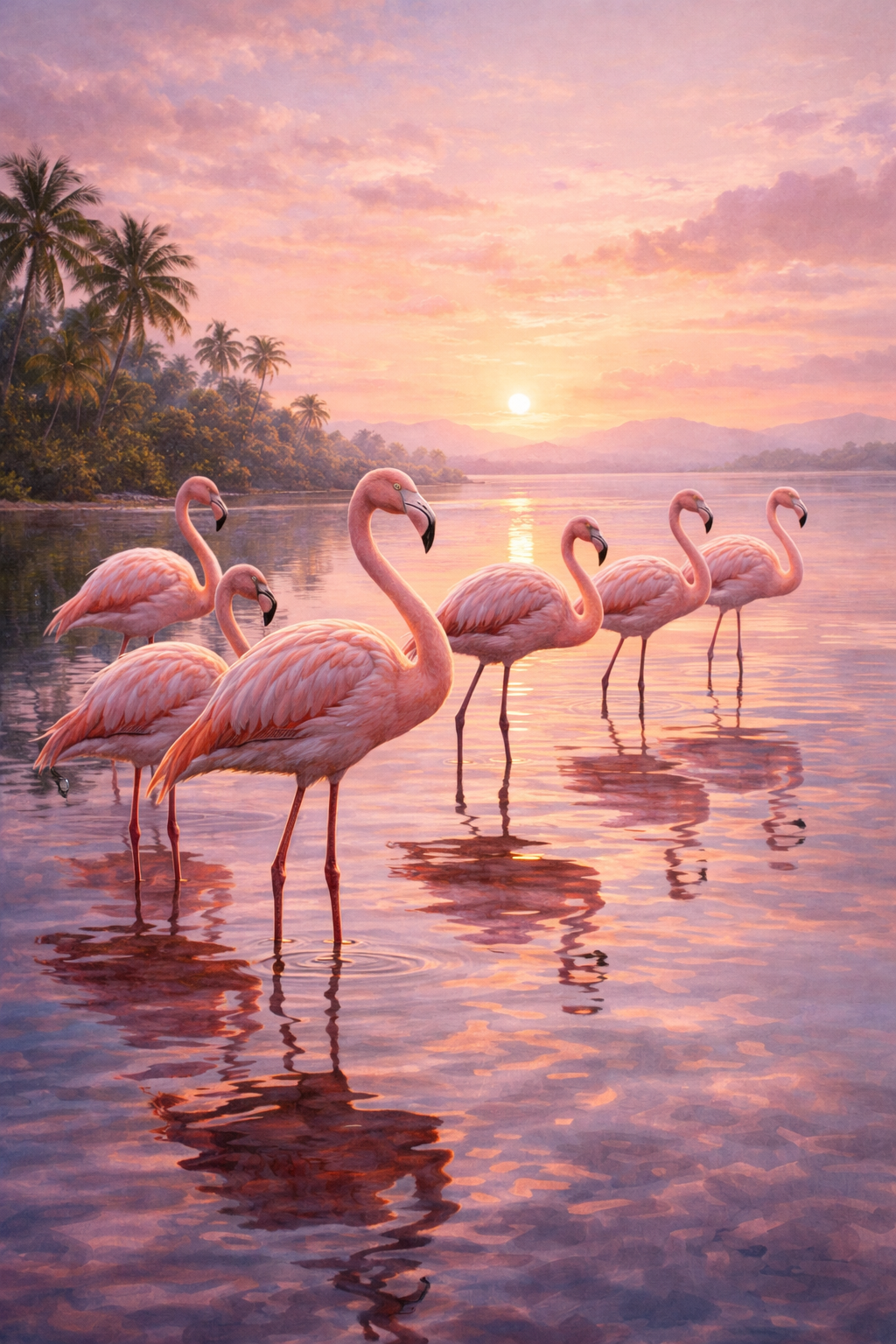
All Six Flamingo Species
There are six flamingo species worldwide — distributed across Africa, southern Europe, the Middle East, South Asia, and the Americas. All share the same fundamental biology: filter-feeding, carotenoid-dependent pink colouration, and highly colonial breeding. But they vary significantly in size, habitat, range, and conservation status.
The Life Stages of a Greater Flamingo
Greater flamingos develop slowly for a large bird — they don't reach their full pink coloration until around age 3, and don't breed successfully until age 6 or later. But once established in a colony, they can remain productive members of that colony for decades.
Flamingo Age to Human Years Conversion
| Flamingo Age | Greater Flamingo | American Flamingo | Lesser Flamingo | Life Stage | Key Milestone |
|---|---|---|---|---|---|
| Hatchling | Newborn | Newborn | Newborn | White chick on mud nest | Born white; fed red crop milk |
| 1 year | ~4 yrs | ~4 yrs | ~8 yrs | Immature | Still grey; learning to filter-feed |
| 3 years | ~10 yrs | ~10 yrs | ~22 yrs | Sub-adult | Pink developing; first courtship displays |
| 6 years | ~19 yrs | ~19 yrs | ~37 yrs | Young Adult | First breeding attempt |
| 15 years | ~40 yrs | ~40 yrs | ~63 yrs | Prime Adult | Deeply pink; experienced breeder |
| 30 years | ~62 yrs | ~62 yrs | Elder | Senior | Multiple decades of colony experience |
| 50 years | ~78 yrs | ~76 yrs | — | Elder | Exceptional longevity |
| 83+ years | ~90 yrs ♦ | — | — | Record (captive) | Adelaide Zoo's "Greater" |
🦩 Flamingo age in the wild is typically estimated through leg band records — birds are banded as chicks and then resighted over decades. The greater flamingo at Adelaide Zoo known informally as "Greater" reached at least 83 years before dying in 2014, having arrived at the zoo in 1933 as an already-adult bird. Wild greater flamingos in the Camargue (southern France) have been tracked for over 60 years through banding programmes, with the oldest known wild individuals estimated at 50+ years.
Flamingos — The Latest Stories
In August 2023, Hurricane Idalia swept through the Caribbean and made landfall in Florida — and it brought unexpected passengers. A flock of American flamingos was blown north from their Caribbean range and scattered across Florida, appearing in locations from the Gulf Coast to central Florida where flamingos hadn't been seen in over a century. Most flamingo storm arrivals in Florida last a few weeks before the birds disperse. These didn't leave.
A coordinated survey conducted by the Caribbean Flamingo Conservation Group in February 2024 found 101 wild American flamingos across Florida — the largest wild flamingo presence in the state since the early 1900s. The largest group, over 50 birds, was concentrated in Florida Bay within Everglades National Park. Audubon Florida's state research director Jerry Lorenz described 101 as likely "the floor of this new population, and there could be more that were not counted."
The birds' persistence reflects a genuine ecological fact: American flamingos were historically native to Florida, breeding in large numbers in South Florida wetlands until the Victorian plume trade drove them to local extinction. An ounce of flamingo feathers was literally worth more than an ounce of gold at the peak of the trade. UCF research published in late 2025 concluded that while the long-term outlook for flamingo recovery in Florida is promising, natural recovery without active human intervention is unlikely — the existing population is too small and too dependent on fortuitous weather events for self-sustaining growth. Proposals to formally support flamingo reintroduction have gained traction in the Florida legislature, and there is ongoing discussion about making the American flamingo Florida's official state bird.
A study published in Current Biology by researchers from King's College London and international partners used two decades of satellite earth-observation data to assess all key flamingo feeding lakes in Ethiopia, Kenya, and Tanzania — home to more than three-quarters of the global lesser flamingo population. The findings were alarming.
Rising water levels — driven partly by increased rainfall linked to climate change — are diluting the alkaline chemistry of the soda lakes that lesser flamingos depend on. Lesser flamingos feed almost exclusively on Spirulina, a blue-green algae that thrives only in highly concentrated alkaline water. As lakes freshen and swell, algae productivity collapses and the flamingos lose their primary food source. Birds are being pushed out of historic feeding grounds toward alternative lakes — but only 3 of the 6 newly suitable lakes have any conservation protection.
The research called for coordinated cross-border conservation action, improved monitoring, and more sustainable land management surrounding key flamingo lakes. The East African lesser flamingo colonies — including the famous "pink carpet" spectacles at Lake Nakuru that have made these birds icons of African wildlife photography — face an uncertain future as the hydrology of their lake systems is restructured by climate change.
The Victorian and Edwardian fashion industry's appetite for feathers in hat decoration drove one of the most catastrophic episodes of bird persecution in North American history. At the peak of the plume trade in the late 1800s, the feathers of wading birds — egrets, herons, roseate spoonbills, and flamingos — were literally more valuable by weight than gold. Commercial plume hunters swept through the wetlands of South Florida, decimating breeding colonies.
American flamingos, which had bred in large numbers in the Everglades and Florida Bay for millennia, were essentially extinct as a Florida breeding species by the early 1900s. The passage of the Migratory Bird Treaty Act in 1918 provided legal protection — but by then the damage was done. The flamingo didn't return to Florida in meaningful numbers for over a century, and then only by the accidental intervention of a major hurricane.
The plume trade story is also the founding story of Audubon — the organisation was formed specifically to combat the slaughter, and Audubon wardens were posted at Florida colonies to protect nesting birds. The first Audubon warden killed in the line of duty, Guy Bradley, was shot by a plume hunter near Flamingo, Florida, in 1905. His death galvanised public outrage that helped end the commercial plume trade. The flamingo, the bird that bears the name of the town where Bradley was murdered, is only now beginning to return.
Three flamingo species inhabit the high-altitude salt lakes of the Andes — the Chilean, Andean, and Puna flamingos — at elevations of up to 4,500 metres. The Andean flamingo is listed as Vulnerable by the IUCN; the Puna and Chilean as Near Threatened. All three declined severely during the 20th century from a combination of egg harvesting, habitat disturbance from mining operations, and hunting.
Conservation of these species requires coordinated action across Argentina, Bolivia, Chile, and Peru — four countries with different regulations, enforcement capacities, and economic pressures. The Grupo Conservación Flamencos Altoandinos (GCFA), coordinated by the American Museum of Natural History, leads research, monitoring, and capacity building across the range. Regular simultaneous censuses track population trends across the entire region.
The primary threat to the Andean and Puna flamingos is now lithium mining — the salt flats (salares) of the Atacama and surrounding regions contain some of the world's largest lithium deposits, and demand has surged with the electric vehicle revolution. The brine extraction processes used in lithium mining alter the hydrology of salt flat ecosystems, potentially disrupting the specific lake chemistry that high-altitude flamingos depend on for breeding and feeding. Balancing conservation with the mineral resources considered essential for green energy transition is one of the more complex environmental dilemmas of the current era.
Things About Flamingos That Will Actually Surprise You
🦩 The word "flamingo" comes from the Spanish and Portuguese word flamengo — "flame-coloured" — though some etymologists suggest a connection to the Spanish region of Flanders (Flamenco) via the flamboyant associations of both. The collective noun for a group of flamingos in flight is a flamboyance — one of the more fitting collective nouns in ornithology. On the ground or in water they may also be called a colony, stand, or flurry. The word "flamboyance" perfectly captures the visual experience of encountering a large flock: an overwhelming, almost artificial-seeming explosion of pink against a wetland landscape.