🐻❄️ Polar Bear Age in Human Years
—
in human years
—
—
Bear age
—
Life stage
—
Population
🐻❄️ What this age means
—
Age Chart
Polar Bear Age to Human Years
| Age | Human Equivalent | Life Stage |
|---|---|---|
| Birth | Newborn | Cub — born in snow den, eyes closed, ~700g |
| 6 months | ~5 yrs | First emergence from den with mother |
| 2 years | ~14 yrs | Weaned — newly independent |
| 5 years | ~22 yrs | Young adult — sexually mature |
| 10 years | ~38 yrs | Prime adult — peak hunting condition |
| 18 years | ~56 yrs | Mature — still breeding |
| 25 years | ~68 yrs | Senior — exceptional wild longevity |
| 42 years | Record | Debby — oldest verified polar bear |
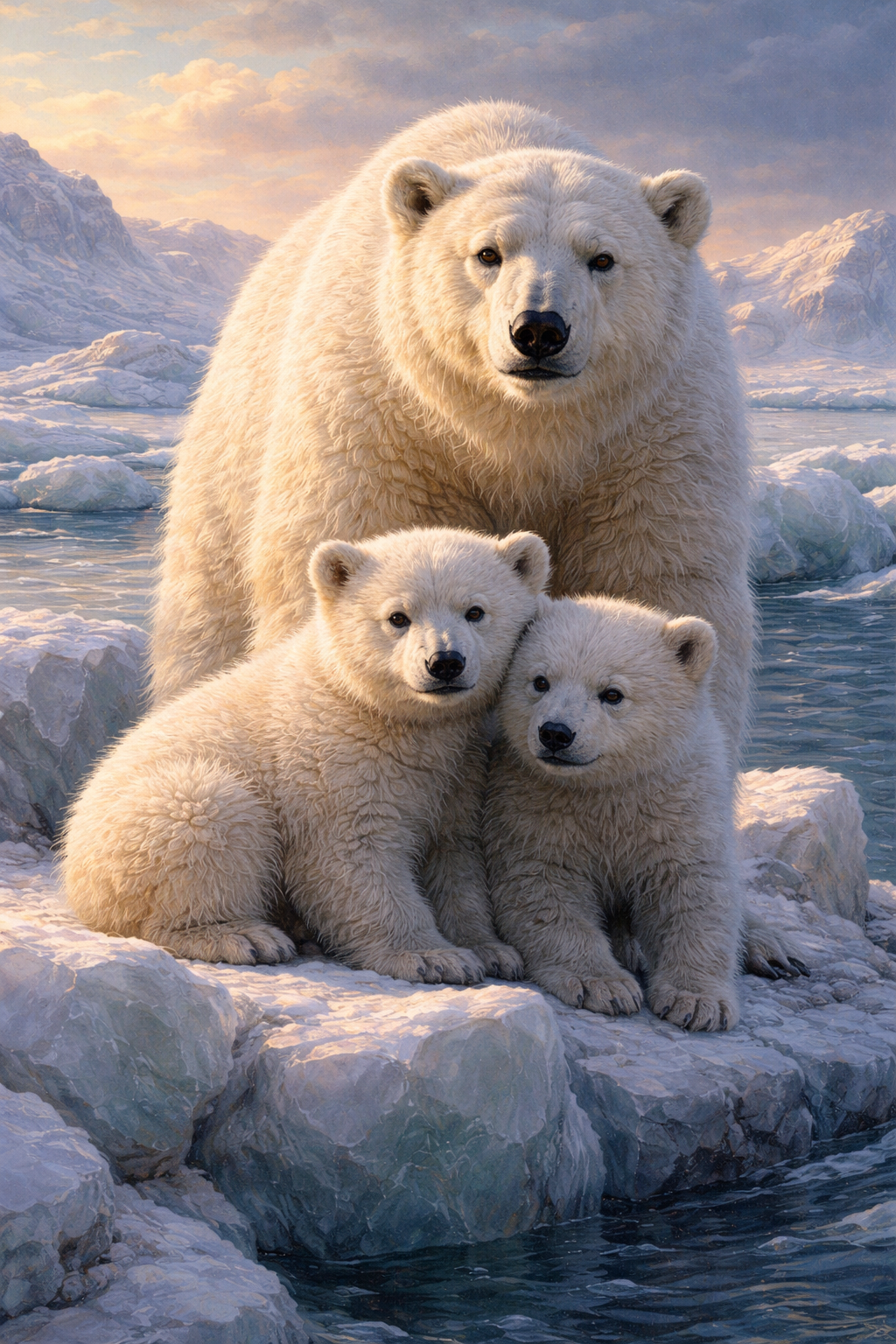
🐻❄️ Polar bear cubs are born in midwinter inside a snow den dug by the mother — typically in November or December after a 6–8 month gestation including delayed implantation. Cubs weigh just 600–700g at birth — extraordinarily small for an animal whose mother weighs 150–250kg. They are born blind and helpless and spend their first 2–3 months nursing inside the den before emerging in spring. The mother does not eat during the entire denning period — she survives entirely on fat reserves accumulated during the previous hunting season. Twin cubs are the most common litter size.
Fascinating Facts
Things About Polar Bears That Will Actually Surprise You
🌊 Marathon Swimmers
Polar bears are classified as marine mammals — the only bear species with this designation — because of their dependence on the sea. They swim using their large partially-webbed front paws in a dog-paddle stroke and have been tracked on open-water swims of over 100km. One female was recorded swimming 687km continuously over 9 days in the Beaufort Sea, losing 22% of her body weight and her cub during the crossing. As sea ice retreats further from shore, these long-distance swims are becoming more common and more dangerous — particularly for cubs, who lack the fat reserves for sustained cold-water swimming.
🍖 8 Months Without Eating
Polar bears are hypercarnivores — their diet consists almost entirely of ringed seals and bearded seals, hunted at breathing holes in the sea ice. During the ice-free summer months when hunting is impossible, they fast — living entirely on fat reserves for up to 8 months. Their metabolism shifts into a fasting state that prevents muscle breakdown and maintains kidney function without urinating, a physiological feat that has been studied for insights into human kidney disease and muscle-wasting conditions. A well-fed polar bear can be 50% body fat before the fasting season begins.
🧊 Not Actually White
Polar bear fur is not white — individual hairs are transparent and hollow. The white appearance comes from light scattering off the translucent structure of the fur, similar to how snow appears white despite being made of clear ice crystals. The skin beneath is black — which absorbs solar radiation efficiently. A popular claim that polar bear hairs act as fibre-optic tubes channelling UV light to the dark skin has been thoroughly debunked — the hairs are not optically transparent to UV and do not conduct light in that way. The hollow structure provides exceptional insulation rather than light conduction.
🌍 Climate's Indicator Species
The polar bear has become the defining symbol of climate change because its fate is directly and measurably linked to sea ice extent. Arctic sea ice is declining at approximately 13% per decade — the ice-free season is lengthening, forcing longer fasting periods. Female bears in poorer condition at the start of denning season produce smaller cubs with lower survival rates. The Hudson Bay population — one of the most studied — has declined by approximately 30% since the 1980s. The IUCN projects two-thirds of polar bears could be lost by 2050 if current warming continues. There are currently estimated to be 20,000–31,000 polar bears across 19 subpopulations globally.
👃 Smell Over 30km
Polar bears have an extraordinary sense of smell — they can detect a seal's breathing hole under 1 metre of snow and are estimated to smell prey from distances of up to 30km and through ice up to 1 metre thick. This olfactory ability is their primary hunting tool — sea ice hunting is mostly about finding the right breathing hole and waiting with extraordinary patience, sometimes for hours, for a seal to surface. Their hearing and vision are comparable to humans, but their nose is their dominant sense. They can also detect a dead whale carcass from 20km downwind.
🧬 Related to Brown Bears
Polar bears (Ursus maritimus) diverged from brown bears (Ursus arctos) approximately 400,000–500,000 years ago — relatively recently in evolutionary terms. The two species can interbreed and produce fertile offspring called pizzly bears or grolar bears. As climate change pushes polar bears south and brown bears north, these hybrid encounters are increasing — raising complex conservation questions about hybridisation. Polar bears are so recently diverged from brown bears that their genome shows signatures of rapid adaptation to Arctic conditions — changes in genes related to fat metabolism, cardiovascular function, and coat colour happened very quickly in evolutionary time.
More Wild Animals
Other Animals to Explore
FAQ
Frequently Asked Questions
Polar bears are the world's largest land predators. Adult males typically weigh 350–700kg and stand 1.2–1.6 metres at the shoulder, with a body length of 2.4–3 metres. The largest verified wild polar bear weighed 1,002kg. Females are roughly half the size of males — typically 150–250kg — one of the most pronounced sexual size dimorphisms of any mammal. This size difference is related to reproductive strategy: larger males compete more effectively for mates, while smaller females can survive extended fasting during denning more efficiently. A male polar bear is roughly the size of a large horse by weight.
Only pregnant females den and enter a sleep state resembling hibernation — adult males and non-pregnant females remain active year-round, even through Arctic winter. The denning female's body temperature drops only slightly (unlike true hibernators whose temperature falls dramatically), and she gives birth and nurses cubs during this period. Her metabolic rate decreases but she can rouse relatively quickly if disturbed. Males and non-pregnant females continue hunting on sea ice throughout winter, which is actually their most productive hunting season as ice extent is at maximum and seals are accessible. The popular image of polar bears sleeping through winter applies only to denning females.
Ringed seals are the primary prey, accounting for the vast majority of their diet. Bearded seals, harp seals, and hooded seals are also taken. When available, polar bears will scavenge whale carcasses — gatherings of dozens of bears at a bowhead whale carcass have been documented. As summer fasting periods lengthen due to climate change, polar bears are increasingly resorting to land-based foods: bird eggs, vegetation, berries, and human refuse around Arctic settlements. These foods provide far fewer calories than seal fat — a polar bear cannot maintain body condition on terrestrial foods alone. The shift toward land-based foraging is a symptom of deteriorating habitat rather than a viable long-term dietary strategy.