📅 Updated 🔬 Wildlife biology research🐘 African & Asian species
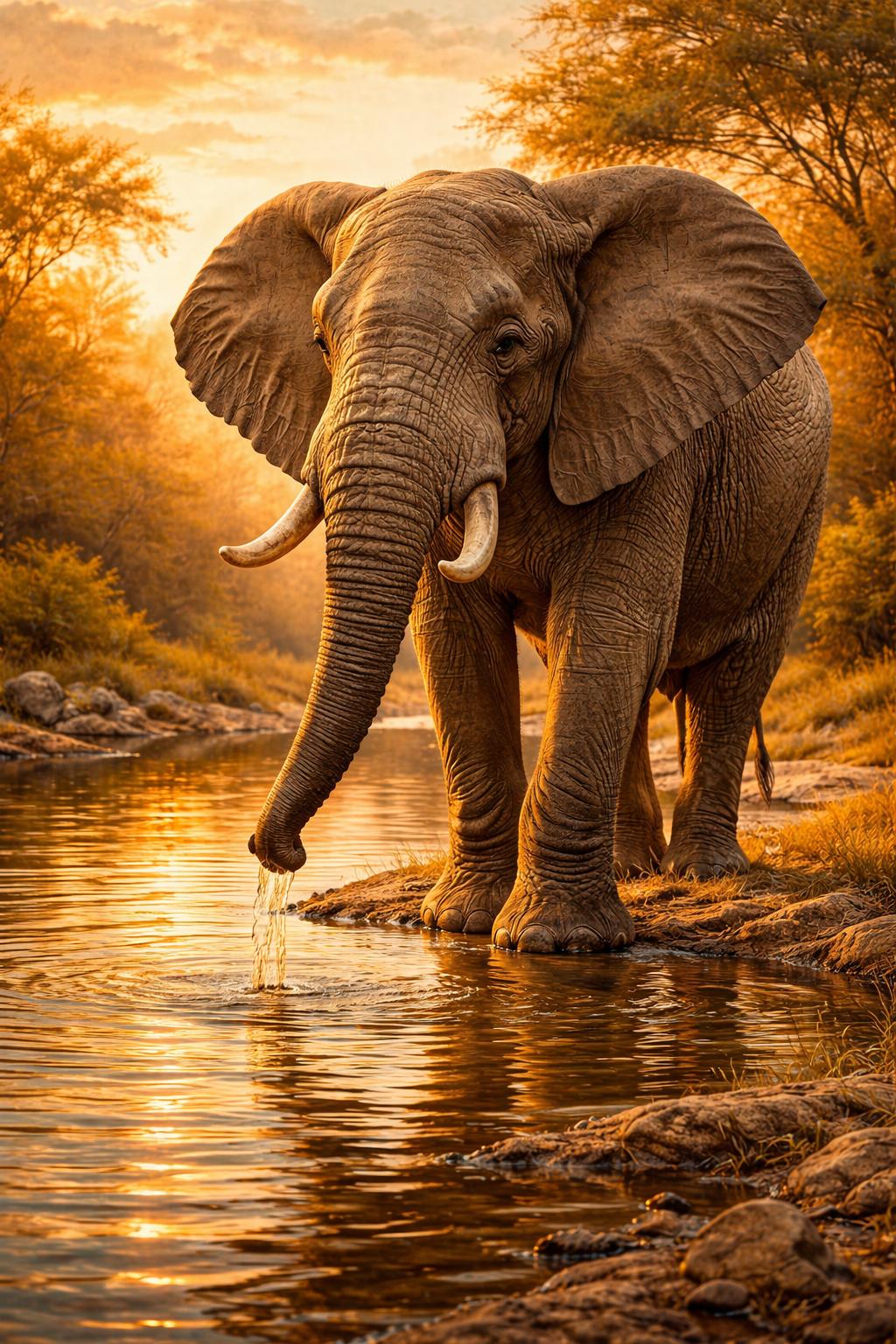
Of all the animals on Earth, elephants age most like us. They have long childhoods, complex social bonds, identifiable elders, and they mourn their dead. An elephant at 40 is, in almost every meaningful sense, a middle-aged human.
Elephant aging closely parallels human development. Research from the Amboseli Elephant Research Project — the longest-running elephant study in the world (since 1972) — provides the biological basis for these equivalencies.
Elephant Age
Human Equivalent
Life Stage
What's Happening
0–1 year
0–2 years
Infant
Highly dependent; learning to control trunk (100,000+ muscles)
Still under matriarch protection; males beginning to explore range
10–14 years
~15–22 years
Sub-adult
Females approach first estrus; males begin to leave natal herd
15–24 years
~23–35 years
Young adult
First calves for females; males learning dominance hierarchy
25–39 years
~36–50 years
Adult
Peak reproductive years; bulls entering prime musth cycles
40–49 years
~51–62 years
Mature adult
Matriarchs at their most knowledgeable; bulls at social peak
50–59 years
~63–74 years
Senior
Fifth molar set in use; beginning to slow; still socially vital
60–70 years
~75–85 years
Elder
Sixth and final molar set; survival depends on soft vegetation near water
70+ years
85+ years
Exceptional elder
Record territory — Lin Wang (Asian) lived to 86
Life Stages
The Life Stages of an Elephant
Elephants have one of the most human-like developmental arcs of any animal — a long, protected childhood, a defined adolescence, peak reproductive years, and a recognized elder phase where accumulated wisdom becomes a survival resource for the whole herd.
0–4 yrs
Infant & Calf
Fully dependent. Learning trunk coordination, herd dynamics, and which plants to eat by watching elders.
5–14 yrs
Juvenile
Playful and curious. Females stay with natal herd; males begin testing independence.
15–24 yrs
Young Adult
Females have first calves around age 12–14. Males leave the herd and join bachelor groups.
25–39 yrs
Prime Adult
Peak physical and reproductive condition. Bulls in regular musth; cows raising calves.
40–55 yrs
Mature / Matriarch
The most socially important phase. Matriarchs hold the knowledge that keeps herds alive in drought.
56+ yrs
Elder
Final molar set in use. Survival linked closely to access to soft foods and water sources.
Fascinating Facts
Things About Elephants That Will Actually Surprise You
🦷 Death by Dentition
Elephants don't die of old age in the conventional sense — they die when their teeth run out. They cycle through six sets of molars across a lifetime. When the sixth set wears down, they can no longer chew food, and they starve. This is why old elephants migrate toward swamps and riverbanks, where soft vegetation grows — they're adapting their entire diet to their dental reality.
🧠 The Matriarch Effect
Research published in Animal Behaviour found that herds led by older matriarchs outsurvive herds with younger leaders during droughts and predator encounters. A 58-year-old matriarch has encountered more lions, found more waterholes, and navigated more droughts than any younger elephant. When poaching removes matriarchs, entire herds lose decades of accumulated environmental knowledge overnight.
💀 Bone Recognition
Elephants show measurable behavioural responses to the bones and skulls of other elephants — including strangers. Studies at Save the Elephants document herds returning to the site of a deceased elephant repeatedly over years, touching the bones with their trunks and feet. They show no similar response to the bones of other large animals. This is not metaphor — it's documented, observed behaviour.
📡 Seismic Communication
Elephants communicate across distances of up to 10 kilometres using infrasound — frequencies below what humans can hear — transmitted both through air and through the ground. They detect these seismic signals through their feet and the sensitive skin of their trunk tips. This allows herds to coordinate movements and warn each other of danger across distances equivalent to crossing a city.
🪞 Mirror Self-Recognition
Elephants are one of only a handful of animals — alongside great apes, dolphins, and magpies — that pass the mirror self-recognition test. When researchers painted a mark on an elephant's forehead and placed them before a mirror, the elephant used the mirror to investigate the mark on their own face. This is considered a marker of self-awareness and is extremely rare in the animal kingdom.
🌳 Ecosystem Engineers
African elephants are considered a keystone species — their feeding behaviour physically reshapes entire landscapes. They knock down trees, creating open grassland used by dozens of other species. Their dung, deposited across vast ranges, contains undigested seeds that germinate at distances of up to 65 kilometres from the parent plant. The IUCN lists African forest elephants as Critically Endangered — losing them would transform entire biomes.
🐘 According to the IUCN Red List, African savanna elephants are classified as Endangered and African forest elephants as Critically Endangered. The global African elephant population has declined from an estimated 10 million in the early 20th century to approximately 415,000 today — a 96% reduction driven primarily by ivory poaching and habitat loss.
Methodology
How We Calculate Elephant Age
Unlike dogs or cats, elephant aging is remarkably close to human aging — the developmental milestones are broadly parallel. Our calculator uses a near-linear conversion based on wildlife biology research, with slight adjustments for the extended juvenile period and the compressed elder phase (elephants don't have the luxury of a very long old age once their final teeth wear down).
Years 0–10: roughly 1:1.5 ratio (elephants develop slightly faster in early life)
Years 10–40: close to 1:1 (the most parallel phase to human adulthood)
Years 40–70: approximately 1:1.2 (senior years arrive a little earlier in elephants)
The species selector adjusts maximum lifespan expectations — African savanna elephants average 60–70 years in the wild; Asian elephants average 48–60 years; African forest elephants are less well studied but broadly similar to savanna elephants.
💡 The Amboseli Elephant Research Project in Kenya has been tracking individually named elephants since 1972 — making it one of the most comprehensive wildlife aging databases on the planet. Much of what we know about elephant lifespan and development comes from this single, extraordinary long-term study.
In the News
Elephants in the Headlines
From vaccine development to carbon storage research and conflict mitigation, elephants have been generating significant conservation news in 2025 and 2026.
International Elephant Foundation · February 2026
IEF Announces 20+ Conservation Projects for 2026 Across Africa and Asia
The International Elephant Foundation launched its 2026 conservation portfolio spanning projects from Kenya and Zambia to Sri Lanka and the Democratic Republic of Congo. Key initiatives include human-elephant conflict mitigation in the KAZA Transfrontier Conservation Area, next-generation K9 elephant guardian programs in Zimbabwe, and the development of a vaccine for the deadly Elephant Endotheliotropic Herpesvirus. The portfolio reflects growing recognition that protecting elephants requires addressing both poaching and the livelihoods of communities living alongside them.
Forest Elephants Are Carbon Storage Champions — and They're Disappearing
Research highlighted by WWF and modelled in PNAS shows that African forest elephants play a critical and irreplaceable role in maintaining the carbon storage capacity of Central African rainforests. By selectively browsing vegetation and dispersing seeds over tens of kilometres, elephants shape tree communities toward high-wood-density species. Modelling suggests that losing forest elephants could reduce Central African rainforest carbon biomass by 6–9% — a staggering ecological and climate consequence given that forest elephants now occupy only about 25% of their historic range.
Mountain Gorillas Up, But African Wildlife Down 76% in 50 Years — A Complex Picture
WWF's Living Planet Report delivered a starkly divided picture: mountain gorilla populations have grown at 3% per year since 2010, a rare conservation success driven by intensive protection and veterinary care. But overall African wildlife populations have declined by 76% in the past half-century. For elephants specifically, forest elephants are categorised as Largely Depleted by the Global Species Status assessment, while savanna elephant strongholds in southern Africa show relative stability — a critical distinction that is reshaping conservation strategy across the continent.
Elephant aging is remarkably parallel to humans. A 10-year-old elephant is roughly equivalent to a human child of similar age — still dependent, still learning. At 20, elephants have reached young adulthood, comparable to a human in their mid-20s. A 40-year-old elephant is in mature middle age, and a 60-year-old elephant is an extraordinary elder. The main difference is at the very end: once an elephant's final set of molars wears down, their lifespan becomes sharply limited.
African savanna elephants typically live 60–70 years in the wild. Asian elephants average 48–60 years. The oldest verified elephant on record was Lin Wang, an Asian elephant who served in the Chinese Expeditionary Force in World War II and later lived at Taipei Zoo, dying in 2003 at an estimated age of 86 years. Wild elephant lifespan is ultimately governed by dentition — they only have six sets of molars across their lifetime.
The saying has genuine biological basis. Elephants have the largest brain of any land animal and a highly developed hippocampus — the brain region most associated with spatial memory and long-term recall. Matriarchs have been observed leading herds to waterholes they hadn't visited in over 30 years. They also recognise individual humans and elephants after separations of two decades or more, and show measurable distress responses when encountering the bones of deceased herd members.
Musth is a periodic hormonal state in bull elephants characterised by a massive surge in testosterone — up to 60 times normal levels. Bulls in musth secrete a dark fluid from the temporal glands on the sides of their heads and dribble urine almost continuously. They become highly aggressive and dominant, and are avoided by other bulls, including much larger ones. Young bulls in their 20s experience musth for a few weeks per year; older bulls in their 40s and 50s can remain in musth for several months at a time.
African savanna elephants (Loxodonta africana) are the largest land animals on Earth, standing up to 4 metres tall and weighing up to 6,000 kg. African forest elephants (Loxodonta cyclotis) are a separate, smaller species living in Central African rainforests. Asian elephants (Elephas maximus) are smaller, with distinctly different ear shapes (smaller, shaped like the Indian subcontinent), smoother skin, and a single-fingered trunk tip compared to the African species' two-fingered tip. All three are endangered.