🦧 Orangutan Age in Human Years
—
in human years
—
—
Age
—
Life stage
—
Species
🦧 What this age means
—
The Three Species
Three Orangutan Species
🦧 Bornean Orangutan
Pongo pygmaeus
Wild lifespan30–40 yrs
Population~104,700
StatusCritically Endangered
Decline>50% in 60 years
🦧 Sumatran Orangutan
Pongo abelii
Wild lifespan35–45 yrs
Population~13,846
StatusCritically Endangered
HabitatN. Sumatra only
🦧 Tapanuli Orangutan
Pongo tapanuliensis
Wild lifespan~35 yrs estimated
Population<800 individuals
StatusCritically Endangered
Described2017 — newest great ape
🦧 The Tapanuli orangutan was only formally described as a distinct species in November 2017 — making it the first new great ape species identified in nearly 90 years, and the most recently described great ape in history. It lives in a single fragmented forest area of just 1,000 km² in the Batang Toru ecosystem of North Sumatra. With fewer than 800 individuals, it is the most endangered great ape on Earth. A hydroelectric dam project approved in the same region threatens to fragment its already tiny habitat further.
Age Chart
Orangutan Age to Human Years
| Age | Human Equivalent | Life Stage |
|---|---|---|
| 1 year | ~5 yrs | Infant — nursing, clinging to mother |
| 3 years | ~10 yrs | Young juvenile — beginning to explore |
| 6 years | ~16 yrs | Juvenile — still learning from mother |
| 8 years | ~20 yrs | Sub-adult — newly independent |
| 12 years | ~30 yrs | Young adult — sexually mature |
| 20 years | ~46 yrs | Prime adult — peak condition |
| 35 years | ~64 yrs | Senior — still active in wild |
| 62 years | Record | Puan — Perth Zoo record |
Fascinating Facts
Things About Orangutans That Will Actually Surprise You
👶 The Longest Childhood
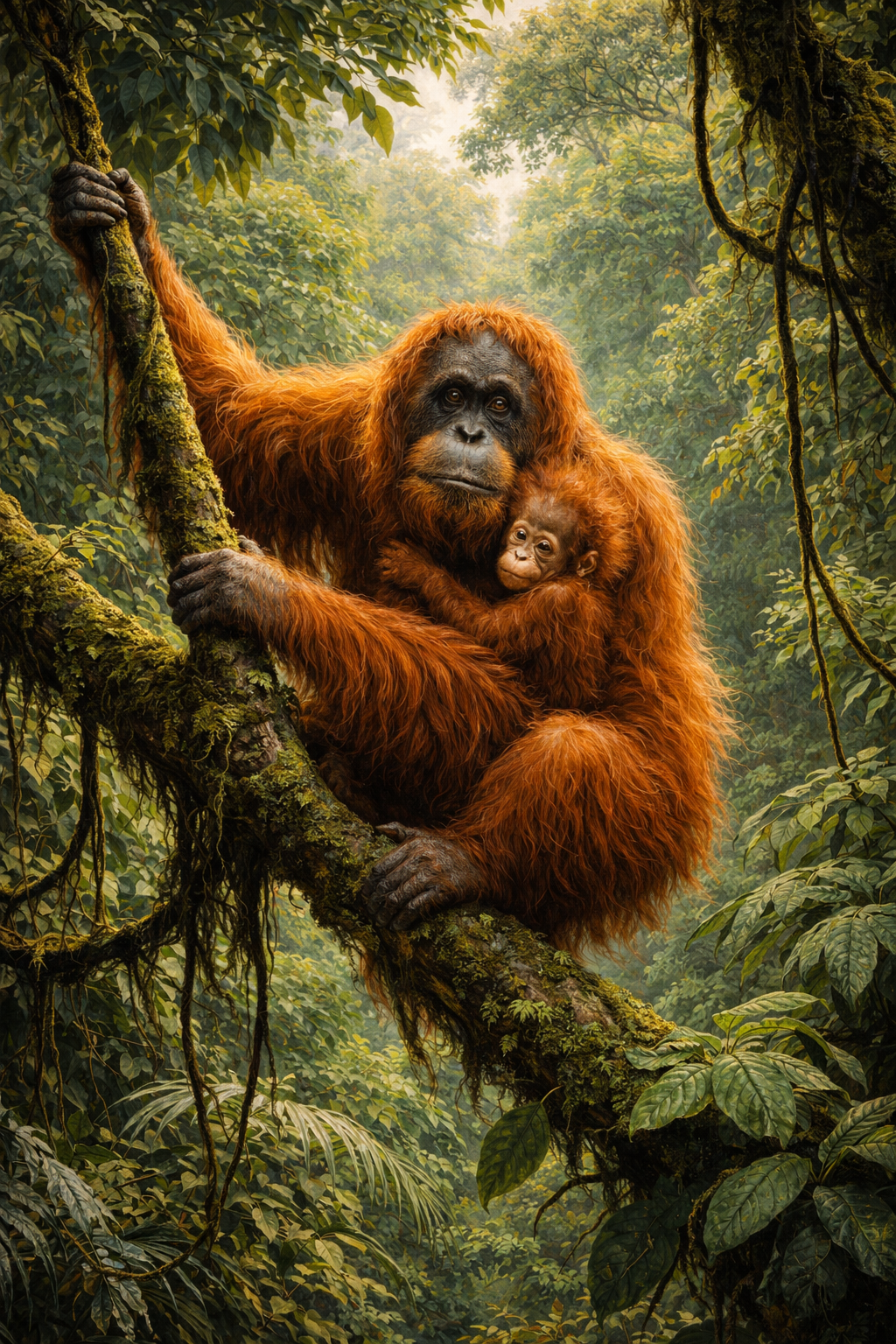
Orangutans have the longest childhood of any non-human animal — infants stay with their mothers for 7–8 years, and the mother-offspring bond often persists for several years beyond independence. During this time the young orangutan learns everything: which of the hundreds of forest plant species are edible and when, how to build sleeping nests (they construct a new nest every single night), how to navigate the forest canopy, and which routes to use in different seasons. This learning is so complex and extensive that it cannot be compressed into a shorter period. Female orangutans give birth only once every 7–9 years — the longest interbirth interval of any mammal — which means a female produces only 4–5 offspring in her entire lifetime.
🔧 Tool Use and Planning
Wild orangutans are sophisticated tool users. They use sticks to extract honey and insects from tree cavities, use leaves as gloves when handling spiny fruit, use large leaves as umbrellas during rain, and have been documented using plant stems as tools to probe for seeds in hard-shelled fruit. What makes this particularly significant is that orangutans have been observed planning for future tool use — carrying tools to a site before arriving, anticipating a need rather than responding to an immediate one. This capacity for future planning was long considered uniquely human. Captive orangutans have demonstrated they can deceive researchers, plan escape routes, and learn from watching others perform tasks.
🌿 The Palm Oil Crisis
The primary threat to all orangutan species is deforestation for palm oil plantations. Indonesia and Malaysia produce approximately 85% of the world's palm oil — used in roughly half of all supermarket products, from biscuits to shampoo. Vast areas of Borneo and Sumatra's lowland rainforest, the orangutan's primary habitat, have been cleared and converted to monoculture plantations. Between 1999 and 2015, Borneo lost approximately 100,000 Bornean orangutans — roughly half the population at the start of that period. Certified sustainable palm oil exists but remains a small fraction of total production. Consumer pressure and purchasing decisions in import markets directly affect the rate of habitat destruction.
🧬 Our Closest Asian Relative
Orangutans share approximately 96.9% of their DNA with humans — making them our closest relatives outside of Africa (chimpanzees and gorillas are closer at ~98.7% and ~98.3% respectively, but are African apes). The name "orangutan" comes from the Malay words orang (person) and utan (forest) — "person of the forest". Unlike chimpanzees and gorillas, orangutans are largely solitary — adult males maintain large home ranges and rarely interact with other adults except during mating. Flanged adult males, with their distinctive large cheek pads (flanges), emit a "long call" — a loud vocalization that can carry over a kilometre through dense forest.
😴 Nest Builders
Every night without exception, orangutans construct a new sleeping nest in the forest canopy — selecting a sturdy foundation branch, bending and weaving smaller branches into a platform, adding a leafy mattress layer, and sometimes constructing a roof for rain protection. The process takes 5–10 minutes and produces a structurally sophisticated sleeping platform strong enough to support an adult orangutan's weight. Over a lifetime, an orangutan may build 30,000 or more individual nests. Nest building is a learned skill — juveniles practice from an early age, initially building poor-quality nests that improve with experience. The locations of nests can be used by researchers to track population distribution and density.
📣 The Long Call
Flanged adult male orangutans — those with fully developed cheek pads and throat pouches — produce one of the most distinctive vocalisations in the animal kingdom: the long call. Beginning with a series of bubbling sounds, building to a roaring crescendo, and ending with long sighing exhalations, a long call can last up to 4 minutes and travel over 1 kilometre through dense rainforest. Long calls advertise the male's presence to females and warn rival males away. Unflanged males — those that have not yet developed cheek pads — can remain in this state for years or even decades, only developing flanges when a dominant flanged male leaves the area. It is one of the most unusual developmental strategies in primates.
More Wild Animals
Other Great Apes & Primates
FAQ
Frequently Asked Questions
Orangutans cannot speak — they lack the vocal anatomy for human speech — but captive individuals have learned substantial sign language vocabularies. The most famous example is Chantek, a Sumatran orangutan raised at the University of Tennessee who learned over 150 signs, used them in novel combinations, and demonstrated understanding of abstract concepts. Chantek also showed evidence of symbolic thinking — using the sign for "eye-drink" to mean contact lens solution, for example. Orangutans have also learned to use lexigram boards and tablet-based communication systems. The cognitive capacity for symbolic communication appears to be present; the limitation is entirely physical — the vocal anatomy, not the brain.
The large fatty cheek pads (flanges) of adult male orangutans are a secondary sexual characteristic that develops under the influence of testosterone — but only in males that have achieved social dominance. In a remarkable developmental strategy unique among primates, male orangutans exist in two distinct adult male forms: flanged males with full cheek pads and throat pouches, and unflanged males that resemble large females. Unflanged males can remain in this state for years or decades while a dominant flanged male is present in the area — essentially suppressing their own sexual development to avoid confrontation. When the dominant male dies or moves away, an unflanged male can develop flanges within months. Both male types are sexually mature and capable of reproduction, but flanged males are strongly preferred by females and produce the long call that unflanged males cannot.
The most direct consumer action is checking for certified sustainable palm oil (CSPO) in products and supporting companies that have committed to sustainable sourcing. Organisations like the Roundtable on Sustainable Palm Oil (RSPO) certify supply chains, though the certification's rigour is debated. Avoiding palm oil entirely is not the solution — switching to alternative vegetable oils would require significantly more land overall. The Orangutan Foundation International, Borneo Orangutan Survival Foundation, and Sumatran Orangutan Society all run rehabilitation and habitat protection programmes. Deforestation and the illegal pet trade (confiscated infant orangutans require years of rehabilitation) remain the primary issues requiring both consumer and policy responses.