📅 Updated 🏴 Scotland's oldest breed🐄 Documented since 6th century
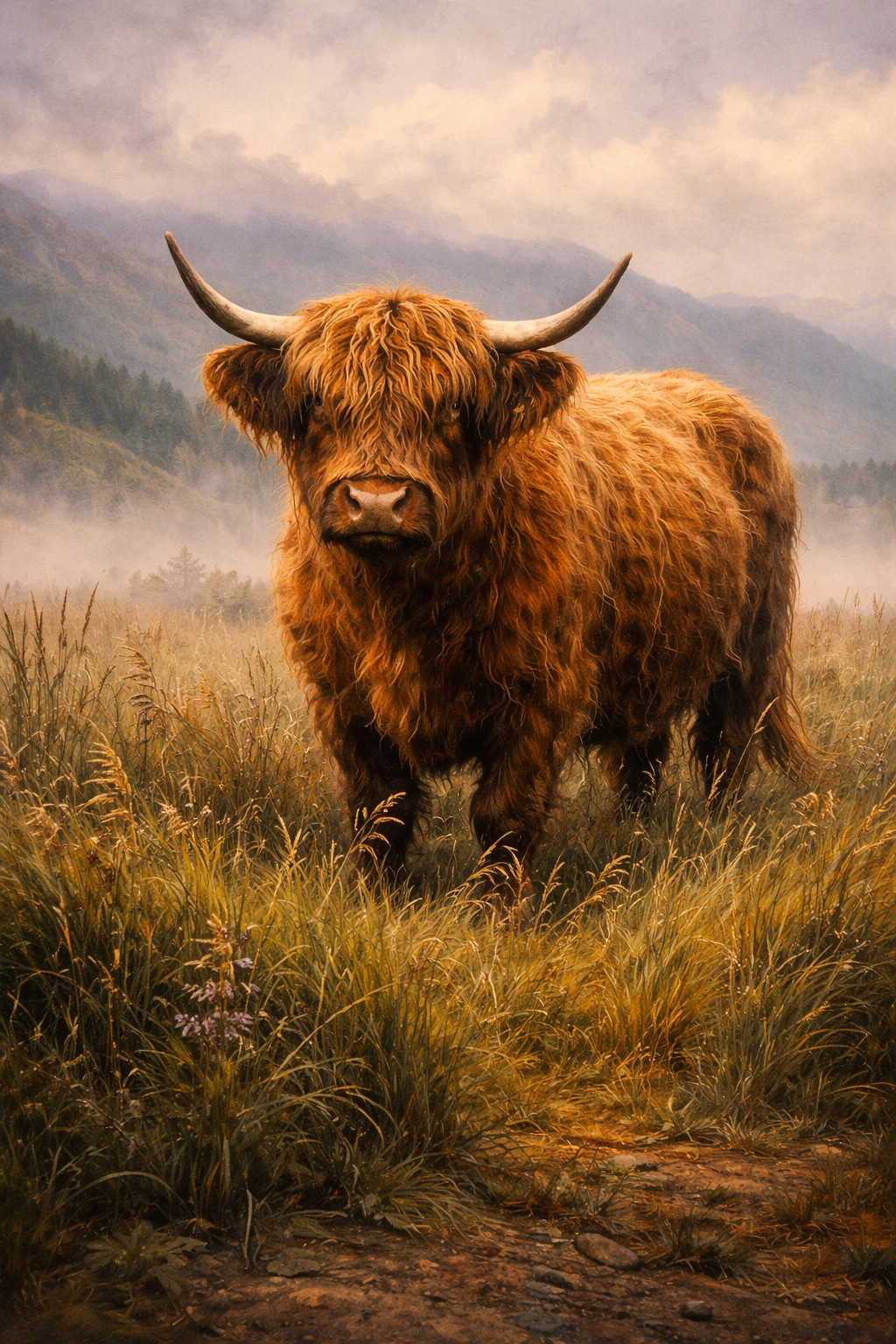
Highland cattle have been roaming Scottish hills for over 1,500 years — the oldest cattle breed in the world with a recorded herdbook. They survive conditions that would kill most breeds, grow a double coat so thick they don't need shelter, and live 15–20 years with ease. The dossan — that famous curtain of hair — is not a style choice. It's survival engineering.
Highland cattle mature more slowly than most commercial breeds — a reflection of their adaptation to environments where rushing to reproductive maturity would be a liability. Their developmental arc is steady, patient, and long. A Highland cow at 5 years is still building toward her prime; at 12 she may still be producing calves reliably. Their constitution is built for endurance, not speed.
0–6 mo
Calf
Born with a full coat and extraordinary vigour — Highland calves are up and nursing within an hour, even in winter conditions that would threaten other breeds. Their double coat is already functional from birth. Mothers are fiercely protective.
6 mo–1 yr
Weaned Calf
Weaned at 6–8 months. Beginning to develop the characteristic long dossan and adult coat texture. Still close to the herd and learning foraging behaviour. The horns, present from birth as small buds, are now clearly visible.
1–2 yrs
Stirk / Yearling
A stirk — the traditional term for a Highland yearling. Growing rapidly, developing the muscular frame and coat that defines the breed. Socially integrating into the fold (the traditional term for a Highland herd). Horns developing their characteristic outward and upward sweep.
2–3 yrs
Young Adult
Approaching sexual maturity — heifers (young females) typically calve for the first time at 2–3 years. Bulls reach breeding maturity around 2 years. Still growing in frame and coat. The breed's characteristic docile temperament is now fully apparent.
3–8 yrs
Prime Adult
A Highland cow in her prime — fully grown, reproductively reliable, and at peak physical condition. Producing a calf annually in well-managed herds. The coat is at its most impressive: layered, oily, and extraordinarily weather-resistant. Highland cattle at this stage require minimal intervention.
8–15 yrs
Mature
A mature Highland — still reproductively active in most females, still commanding presence in bulls. Their accumulated knowledge of their territory, their established place in the social hierarchy of the fold, and their hardiness all continue to serve them. Highland cows regularly produce calves past 12 years.
15–25+ yrs
Elder
Elder Highlands are genuinely exceptional animals. Where most commercial cattle breeds are culled long before this point, a well-kept Highland may still be grazing Scottish hills at 20 or beyond. Some individuals reach 25+ years. Their longevity relative to their commercial counterparts is one of the most striking aspects of the breed.
Age Chart
Highland Cow Age to Human Years
Highland Age
Human Equivalent
Life Stage
What's Happening
3 months
~3 yrs
Calf
Fully coated; learning foraging from mother
1 year
~8 yrs
Stirk
Weaned; horns growing; developing adult coat
2 years
~14 yrs
Young adult
Approaching sexual maturity; heifers may calve
3 years
~20 yrs
Young adult
First or second calf; full coat achieved
5 years
~30 yrs
Prime adult
Peak reproductive condition; most impressive coat
8 years
~42 yrs
Mature
Experienced cow; reliable annual calving
12 years
~57 yrs
Mature/senior
Still reproductively active; deep herd knowledge
16 years
~68 yrs
Elder
Senior; reduced productivity but still thriving
20+ years
~78 yrs
Elder
Exceptional longevity for any cattle breed
🐄 Highland cattle reach full frame size at 3–4 years — significantly later than most commercial beef breeds, which are slaughtered at 18–24 months before full maturity. This slow growth rate produces well-marbled, flavourful beef, but makes Highland cattle economically marginal as commercial beef producers compared to faster-maturing breeds. Their value lies in land management, conservation grazing, and hardy constitution in environments unsuitable for other breeds.
Breed History
Scotland's Oldest Breed — 1,500 Years in the Hills
🐄 The Highland Cattle Society maintains the world's oldest cattle herdbook, established in 1884. But the breed itself predates the herdbook by over a millennium — Highland cattle are documented in Scottish records from the 6th century AD, making them the oldest registered cattle breed in the world.
Highland cattle developed over centuries of natural and human selection in some of Britain's harshest terrain: the Scottish Highlands and the Western Isles, where rainfall can exceed 3,000mm per year, winds routinely exceed gale force, and winter grazing may consist of rough moorland grasses, heather, and sedge that would be nutritionally inadequate for most livestock.
The breed was traditionally divided into two distinct types: the Kyloe, a smaller, darker animal from the Hebridean islands, adapted to coastal conditions and sea spray; and the larger, more varied mainland Highland. The Highland Cattle Society's herdbook unified the two types in 1884, creating the single registered breed known today. All registered Highland cattle worldwide trace their lineage through this herdbook.
Queen Victoria's enthusiasm for the breed — she kept a fold at Balmoral Castle from the 1850s onward — significantly raised their profile and drove their spread beyond Scotland. The royal fold at Balmoral remains active today, and Highland cattle have since been exported to over 60 countries, thriving from Scandinavia to Australia to Canada.
📜 The Herdbook
The Highland Cattle Society herdbook, established in 1884, is the oldest cattle breed registry in the world. Every registered Highland cattle animal has a traceable pedigree recorded in it. The society sets breed standards, manages the registry, and promotes the breed internationally. Registration requires both parents to be registered Highlands — the breed has remained free of crossbreeding within the registered population.
👑 Queen Victoria's Fold
Queen Victoria established a Highland cattle fold at Balmoral Castle in the 1850s, making the breed fashionable among landowners across Britain and beyond. The royal fold continues today — Balmoral maintains a registered Highland herd, and the breed's association with the Scottish Highlands and royal patronage has made it one of the most photographed and recognisable livestock breeds in the world. The animals photographed by tourists on Highland roads are almost certainly the result of this Victorian-era popularisation.
🌍 Global Spread
From their Scottish origins, Highland cattle have been exported to over 60 countries. They thrive in Norway, Sweden, and Finland (where their cold tolerance is particularly valued), in Canada and the northern United States, in Australia and New Zealand, and even at altitude in Central Europe. Their adaptability to cold, wet, and rough grazing conditions makes them uniquely valuable on marginal agricultural land where commercial breeds cannot sustain themselves.
Fascinating Facts
Things About Highland Cattle That Will Actually Surprise You
🧥 The Double Coat — Engineering, Not Aesthetics
The Highland's coat is a two-layer system unlike any other cattle breed. The outer layer — the long, coarse, oily dossan — can grow to 30cm or more and is naturally water-resistant, shedding rain before it reaches the skin. The inner layer is a dense, fine undercoat that provides insulation equivalent to several centimetres of wool. Together they allow Highlands to survive winters in the open without shelter at temperatures other breeds cannot tolerate without housing. The coat is shed in spring and regrown each autumn — Highland cattle in summer look remarkably slimmer than their winter appearance suggests. Their only cattle breed in the world with this specific double-layer structure.
👁️ The Dossan — Eye Protection, Not Blindness
The long forelock covering the Highland's face — also called the dossan — is widely assumed to impair vision. It does not. Highlands have excellent peripheral vision around the hair, and the forelock protects the eyes from face flies, UV radiation from snow glare, and wind-driven rain and debris. Research on Highland vision confirms they can see normally through and around the forelock. Attempts to clip the forelock as a welfare intervention are therefore misguided — it serves a genuine protective function. The Highland Cattle Society advises against routine forelock trimming.
🍃 Conservation Grazing — The Ecological Role
Highland cattle are increasingly used as conservation grazing animals across Europe. Their ability to thrive on rough, poor-quality vegetation — including heather, rushes, bracken, and coarse moorland grasses — makes them ideal for managing habitats that would be damaged by more intensive grazing. They browse selectively, their hoofprints create micro-habitats for invertebrates, and their dung supports diverse dung beetle communities. Rewilding Britain and similar organisations use Highland cattle as a low-impact substitute for extinct large herbivores in habitat restoration projects. They require no supplementary feeding on appropriate land, no housing, and minimal veterinary intervention — making them the most cost-effective large grazer for conservation purposes.
🐄 Fold, Not Herd — Highland Terminology
A group of Highland cattle is called a fold, not a herd — from the Scots Gaelic failt, meaning shelter or enclosure. This reflects the traditional practice of folding (enclosing) cattle in stone-walled enclosures during the worst Highland winters. The terminology persists in breed documentation, showing exhibitions, and formal Highland cattle culture. A fold can range from a handful of animals on a croft to several hundred on a large Highland estate. The Highland Cattle Society registers each fold separately, with fold records tracing animals through their productive lives.
🥩 Beef — Lean, Marbled & Slow-Grown
Highland beef has a distinctive flavour profile compared to commercial breeds: richer, more complex, and well-marbled despite being lower in saturated fat than most commercial beef. This is a consequence of slow growth on diverse rough grazing — the varied diet produces intramuscular fat (marbling) that contributes to flavour, while the slow development timeline means animals are not pushed with high-energy concentrate feeds. Highland beef commands premium prices in specialist butchers and farm shops. The breed is not commercially viable for large-scale supermarket beef production due to its slow growth rate — its market is premium and niche.
🌡️ Cold Tolerance — Built for the Worst
Highland cattle can survive temperatures well below freezing without shelter, supplementary feeding, or significant welfare compromise — a claim no other common cattle breed can match. AHDB research on Highland hardiness confirms their metabolic efficiency on poor-quality forage is significantly higher than commercial breeds. They maintain body condition on vegetation with a dry matter digestibility as low as 55%, compared to the 65%+ required by most commercial dairy and beef breeds. In practice this means they can be kept on land completely unsuitable for other livestock — rough hill ground, boggy fields, and coastal margins — at very low cost per head.
🐄 Highland cattle produce milk with a high butterfat content of 4–7% — significantly richer than commercial dairy breeds (Holstein-Friesian average: ~4%). While they produce far less volume than dairy breeds, Highland milk was traditionally used to make butter and crowdie (a Scottish fresh cheese) on crofts. Some small-scale artisan producers still milk Highland cattle for specialty dairy products, though it is labour-intensive. The high butterfat content means their calves grow well even when milk yield is modest.
Breed Comparison
Highland Cattle vs Other Breeds
Comparing Highland cattle to other common breeds reveals what makes them extraordinary — and where the trade-offs lie. No breed is better or worse in absolute terms; each is optimised for different conditions and purposes.
Breed
Origin
Lifespan
Temperament
Cold Hardiness
Primary Use
Highland
Scotland
15–25 yrs
Docile, curious
Exceptional — no shelter needed
Conservation, premium beef, crofting
Hereford
England
12–18 yrs
Docile
Good
Commercial beef; widely adapted
Aberdeen Angus
Scotland
12–20 yrs
Calm; can be reactive
Good
Premium commercial beef; marbling
Holstein-Friesian
Netherlands
5–8 yrs (production)
Calm
Moderate; needs housing
High-volume commercial dairy
Limousin
France
12–16 yrs
Can be flighty
Moderate
Lean commercial beef; fast-growing
Dexter
Ireland
15–20 yrs
Docile; hardy
Good
Small farms; dual-purpose beef/dairy
Longhorn
England
15–20 yrs
Docile; good mothers
Good
Conservation, traditional beef
🐄 The Holstein-Friesian lifespan column reflects commercial production reality, not biological potential. Dairy cows of this breed are capable of living 15–20 years, but the physiological demands of high-volume milk production cause them to become economically unviable after 3–5 lactations (5–8 years) and they are typically culled. This is not a characteristic of the breed's biology — it is a characteristic of the industrial system. Highland cattle, kept at lower production intensity, express their full biological longevity.
Highland cattle have a well-deserved reputation for docility — they are consistently ranked among the calmest large cattle breeds by farmers and veterinarians. However, they are still large animals (cows typically 400–500kg, bulls 700–900kg) with long horns, and all cattle can be dangerous when startled, protecting calves, or in pain. Their horns extend further than most polled breeds, requiring more lateral space when moving through gateways. Cows with young calves are always more reactive and should be treated with greater caution. The UK Health and Safety Executive advises the same precautions around Highland cattle as any other breed.
Highland cattle prices vary significantly by age, sex, registration status, and pedigree. A registered heifer (young female) typically costs £800–£2,500 in the UK market; a good breeding bull can reach £5,000–£15,000+ at Highland Cattle Society shows and sales. Unregistered stock is cheaper but cannot be shown or used for registered breeding. Premium pedigree animals with show records can command considerably higher prices. Running costs are relatively low compared to other breeds: Highlands need no housing, minimal supplementary feeding in most environments, and have low veterinary costs due to their hardiness. The main cost is initial purchase and fencing.
In their natural Highland environment, Highland cattle graze year-round on rough vegetation: moorland grasses, heather, rushes, sedge, bracken, and scrubby woody plants. They are significantly more efficient at digesting poor-quality forage than commercial breeds — able to maintain body condition on grazing that would cause commercial breeds to lose weight. In lowland or improved pasture conditions, they do not require the same supplementation as higher-output breeds. Most Highland keepers provide hay or haylage in severe weather when grazing is snow-covered, and mineral blocks are recommended. What they do not need — and what most other cattle breeds require — is concentrate feed, silage, or housed feeding periods.
Yes — Highland cattle are increasingly kept as companion animals and smallholding animals rather than purely for beef or crofting. Their docile temperament, attractive appearance, and manageable size (compared to commercial breeds) make them appealing to hobby farmers and smallholders. A minimum of two animals is strongly recommended — cattle are herd animals and a single animal experiences significant stress. They need adequate space (at least 0.5–1 acre per animal, preferably more), proper fencing, a source of fresh water, and access to rough grazing or hay. Keeping a single "pet cow" is possible but requires companion animals for welfare reasons.
A fold is the correct collective noun for a group of Highland cattle — from the Scots Gaelic tradition of folding (enclosing) cattle in stone enclosures for protection. The term is used in breed documentation, show schedules, and Highland cattle culture. The Highland Cattle Society registers individual folds (essentially owner-identified groups or herds), and fold records trace animals through their registration history. Saying you have a "herd" of Highland cattle is not incorrect, but "fold" is the traditional and preferred term within the breed community.