Popular Pets
🐶 Dog 🐱 Cat 🐰 Rabbit 🐹 Hamster 🐾 Guinea Pig 🦜 Parrot 🦡 Ferret 🐀 Rat 🐭 Chinchilla 🦔 Hedgehog 🐟 Goldfish 🦜 Macaw
Farm & Large Animals
🐴 Horse 🐄 Cow 🐄 Highland Cow 🐷 Pig 🐑 Sheep 🐐 Goat 🐴 Donkey 🦙 Alpaca 🐐 Mountain Goat 🐔 Chicken 🦆 Duck 🦃 Turkey
Wild Animals
🐘 Elephant 🦁 Lion 🐯 Tiger 🐆 Leopard 🐺 Wolf 🐻 Bear 🐻‍❄️ Polar Bear 🦍 Gorilla 🐒 Chimpanzee 🦧 Orangutan 🦘 Kangaroo 🐾 Capybara 🦒 Giraffe 🦊 Fox 🦅 Raptor 🦉 Owl 🐧 Penguin 🦩 Flamingo 🐾 Hyena 🐾 Meerkat 🦥 Sloth 🦡 Badger 🐾 Wolverine 🐾 Armadillo
Ocean & Aquarium
🦈 Shark 🐋 Orca 🐬 Dolphin 🐋 Whale 🐋 Blue Whale 🐳 Beluga Whale 🦄 Narwhal 🐋 Bowhead Whale 🐾 Manatee 🐟 Manta Ray 🐟 Freshwater Fish 🐠 Saltwater Fish 🐴 Seahorse 🐟 Koi
Exotic & Weird
🐍 Snake 🐍 Ball Python 🦎 Bearded Dragon 🦎 Iguana 🦎 Komodo Dragon 🦎 Chameleon 🦎 Leopard Gecko 🐢 Tortoise 🐢 Snapping Turtle 🐢 Sea Turtle 🐊 Crocodilian 🕷️ Tarantula 🦎 Axolotl 🐙 Octopus 🌊 Jellyfish 🦞 Lobster 🐚 Quahog 🔬 Tardigrade
Info
About FAQ Contact
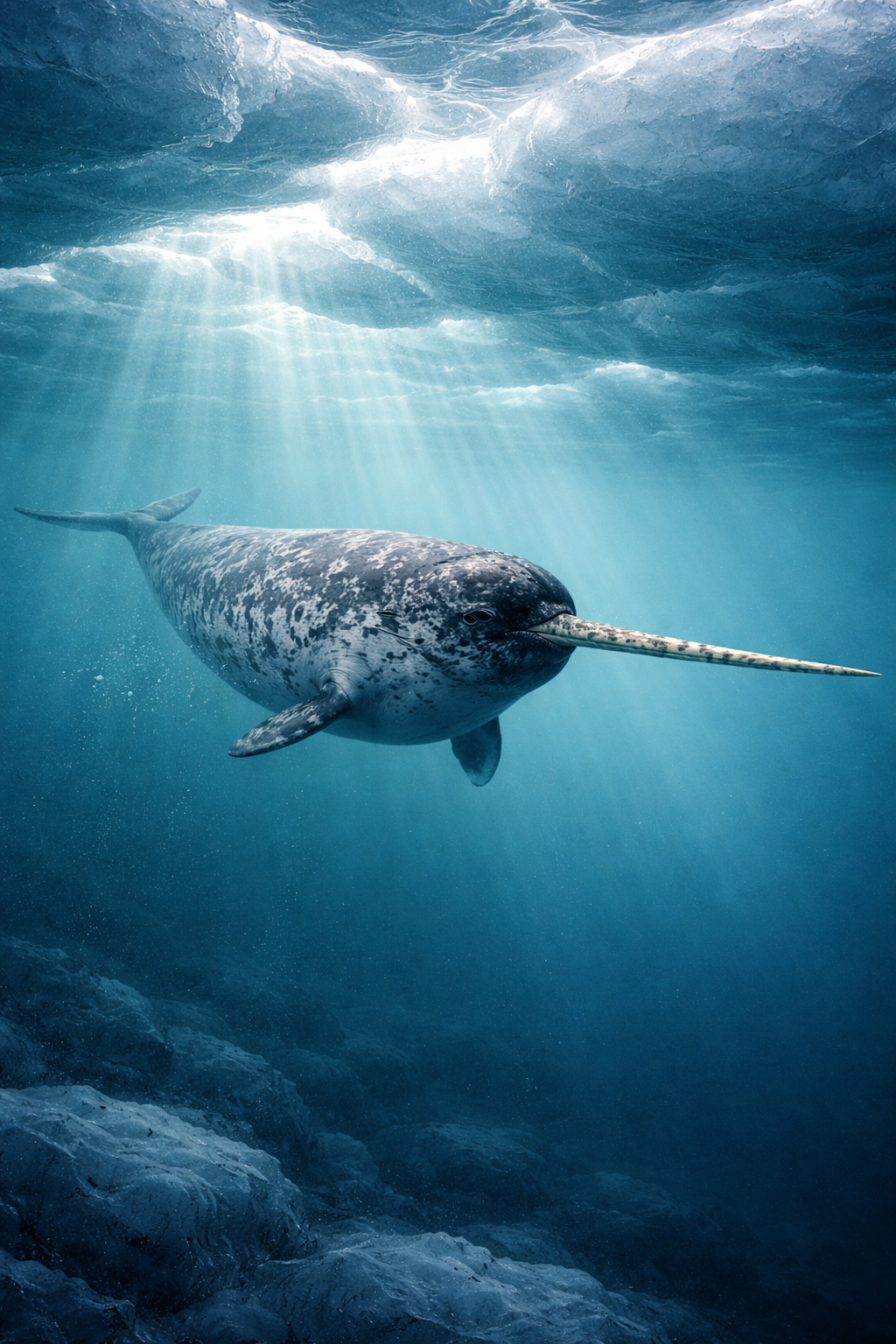
Photorealistic painting of a narwhal gliding beneath Arctic sea ice with its spiral tusk extended
🦄 Wild Animals

How Old Is a Narwhal in Human Years?

📅 Updated March 2026 🧊 High Arctic — Canada & Greenland 🦄 Lifespan: 50–100 years

The narwhal's tusk is a tooth with 10 million nerve endings — one of the most sensitive biological instruments on Earth. It dives to 1,800 metres. It cannot survive in captivity. It sold its tusk to medieval Europeans as a unicorn horn worth its weight in gold. And for centuries, scientists couldn't agree on what the tusk is even for. They still aren't entirely sure.

Calculate Narwhal Age →
🦄 Narwhal Age in Human Years
in human years
Narwhal age
Life stage
Sex
🦄 What this age means

The Life Stages of a Narwhal

Narwhals are among the most secretive and least studied of large cetaceans — they cannot survive in captivity, they spend much of their lives under dense Arctic ice, and their remote habitat makes long-term field research extraordinarily difficult. Much of what we know about narwhal life stages comes from the subsistence harvest by Inuit communities, who have observed narwhals for thousands of years, combined with satellite tagging, acoustic monitoring, and drone survey data collected over the last two decades.

0–2 years
Calf
Born in summer in shallow coastal waters, calves are approximately 1.5 metres long at birth with a mottled gray-brown colouration. They nurse for up to 20 months on rich milk while accompanying the mother through the first migration under sea ice. Calves stay in close contact with the mother, learning migration routes, feeding behaviours, and the social dynamics of narwhal pods. Male calves are born without tusks; the left canine tooth that will become the tusk begins growing shortly after birth.
2–8 years
Juvenile
Weaned but still learning. The juvenile narwhal is mastering the deep-diving techniques that define adult feeding — narwhals make some of the deepest dives of any cetacean, regularly reaching 800 metres and occasionally 1,500–1,800 metres in search of halibut and cod at depth. The juvenile is learning to navigate under sea ice, locating breathing holes and cracks, and developing the echolocation proficiency needed to hunt in near-total darkness at depth. In males, the tusk is beginning to elongate.
8–15 years
Sub-Adult
Approaching sexual maturity. In males, the tusk is now distinctively long — a spiral tooth that continues growing throughout life. Sub-adult males increasingly interact with other males in the tusk-crossing and parallel-swimming behaviours called "tusking" that appear to establish social hierarchy. Females approach sexual maturity around age 7 and may be beginning their first pregnancies. The sub-adult's colouration is shifting from juvenile mottled gray-brown toward the spotted black-and-white pattern of an adult.
15–40 years
Prime Adult
Fully mature and reproductively active. Females give birth approximately every 3 years after a 14-month gestation. Prime adult narwhals make the most extreme dives of their lives — plunging repeatedly to 800+ metres during winter feeding seasons under pack ice, spending up to 25 minutes submerged per dive. The male's tusk has reached impressive length. Social behaviour peaks: pods of several hundred to over a thousand narwhals aggregate in summer estuaries, engaging in complex social interactions researchers are only beginning to document with drone technology.
40–70 years
Mature Adult
An experienced Arctic navigator. Mature narwhals carry decades of knowledge about migration routes, reliable feeding areas under specific ice conditions, and the locations of breathing hole systems in pack ice. The spotted black-and-white adult colouration has deepened. In males, the tusk carries the accumulated growth of four to six decades — a spiralling record of years lived under Arctic ice. The narwhal's acute sensitivity to sound makes noise pollution from increased Arctic shipping a growing concern for mature individuals.
70–100 years
Elder
Among the longer-lived cetaceans — some individuals have been estimated at 90–100 years through growth layer analysis of teeth. An elder narwhal has navigated the Arctic for the better part of a century — witnessing and adapting to more ice change than any previous generation of its species has experienced. Elder narwhals' accumulated knowledge of ice conditions, feeding grounds, and migration timing accumulated over decades may be increasingly valuable — and increasingly rare — as the Arctic transforms around them.

Narwhal Age to Human Years Conversion Table

Narwhal AgeFemaleMaleLife StageTusk Status (♂)
BirthNewbornNewbornCalfNo tusk; left canine budding
2 years~6 yrs~6 yrsJuvenileTusk beginning to grow
5 years~13 yrs~14 yrsJuvenileTusk distinctly visible
10 years~23 yrs~26 yrsSub-adult/Young adultTusk ~1 metre; social tusking begins
20 years~38 yrs~43 yrsPrime adultTusk ~2 metres; peak length approaching
35 years~54 yrs~62 yrsMature adultTusk up to 3 metres; deeply spiralled
50 years~68 yrs~76 yrsSeniorFull-length tusk with decades of growth
75 years~82 yrsElder ♂ElderExceptional longevity
100 years~90 yrsEstimated maximum

🦄 Narwhal age is estimated from growth layer groups in the cementum of teeth — alternating light and dark layers deposited annually, similar to tree rings. This method has produced estimated ages of over 100 years for some individuals, making narwhals among the potentially longest-lived of all cetaceans after bowhead whales. However, wild narwhal age data remains limited because access to specimens requires collaboration with Inuit communities conducting subsistence harvests, and obtaining sufficient samples for population-level age analysis is logistically difficult.

Narwhals — Good News, Curious Behaviour, and New Discoveries

Recent years have brought a mix of encouraging conservation news and fascinating new research on one of the world's most mysterious and least-studied large mammals.

📰 June 2024 — Conservation Milestone
Population Quadruples — Narwhals Removed from Canada's At-Risk List

In a significant conservation win, Canada's Committee on the Status of Endangered Wildlife (COSEWIC) officially reclassified narwhals as "Not at Risk" in June 2024 — removing them from the special concern category they had previously occupied.

The reason: the Nunavut narwhal population has grown dramatically, from approximately 40,000 individuals in early population surveys to around 160,000 — a roughly fourfold increase. This makes the narwhal one of the more striking conservation success stories in Arctic marine mammal management.

The recovery reflects the effectiveness of co-managed Indigenous and scientific stewardship. "Narwhal are recognized as a cultural cornerstone by Inuit," said Jason Akearok of the Nunavut Wildlife Management Board. "In alignment with their cultural relevance, the Nunavut Wildlife Management Board commits to a thorough examination of scientific insights and Inuit Qaujimajatuqangit [knowledge]."

Scientists were careful to note that narwhals remain highly vulnerable to climate change despite the population rebound — their dependence on specific sea ice conditions makes them one of the cetacean species most exposed to Arctic warming. The report noted that boat traffic compels narwhals to move away, though this has not yet been shown to affect mortality rates.

📰 November 2025 — New Research
Narwhals Keep Punching Underwater Research Equipment — Hundreds of Times

In one of the more unexpectedly delightful research findings of 2025, scientists studying narwhals in Inglefield Bredning Fjord in northwest Greenland discovered that their passive acoustic monitoring devices were being repeatedly approached, scanned, and physically struck by narwhals — up to 10–11 times per day, with an estimated 484–613 total hits over two months of narwhal presence in the area.

The study, published in Communications Biology by researchers from Hokkaido University, found that narwhals dove to depths of 190–400 metres to visit the underwater equipment. The devices recorded echolocation clicks as the narwhals approached, followed by foraging-style "buzz" sounds, and then a physical strike. In some cases, a prolonged rubbing sound followed — which researchers speculated might be the narwhal using the equipment to scratch itself during moulting.

The researchers concluded narwhals were either playing with the equipment out of curiosity, confusing it with prey (the devices sat at depths where halibut and cod are found), or possibly using it as a scratching post. Inughuit hunters consulted during the study were not surprised: "They are familiar with narwhal entanglement in unattended gear. They also believe that narwhals like to play and are told so by their parents, and joked that narwhals might scratch their backs, like cats." The finding has implications for passive acoustic monitoring — previously assumed to be non-invasive.

📰 February 2025 — New Behavioural Science
Drones Capture 17 Never-Before-Seen Narwhal Behaviours

Using drones to observe narwhals in their natural Arctic habitat, researchers documented 17 distinct narwhal behaviours that had never previously been recorded or described in the scientific literature. The study, published in February 2025, represents one of the most significant expansions of narwhal behavioural science in recent decades.

The drone observations captured behaviours including complex social interactions between pods, previously undocumented feeding postures, and social play sequences. Narwhals proved to be highly gregarious and behaviourally complex — with a richer repertoire of social behaviours than their reputation as solitary, mysterious Arctic creatures might suggest.

The drone methodology is transformative for narwhal research because it allows observation without the disturbance that boat-based research inevitably causes — narwhals are highly sensitive to noise and regularly flee from approaching vessels. As drone technology improves, researchers expect to document significantly more of the narwhal's still-largely-unknown behavioural biology.

📰 Ongoing — The Climate Vulnerability
The Most Ice-Dependent Whale — and the Ice Is Disappearing

Despite the good news on population numbers, narwhals remain what researchers call the cetacean species most vulnerable to climate change. Their dependence on specific sea ice conditions is more extreme than any other whale — they rely on dense pack ice both for protection from orcas (which cannot navigate under it) and for the deep-water under-ice feeding on halibut and Greenland halibut that provides their winter nutrition.

As Arctic sea ice retreats, narwhals face two compounding threats: their orca-free refuge is shrinking as orcas expand into newly ice-free waters, and their winter feeding grounds are disrupted as ice conditions change. Genomic research published in 2024–2025 documented changes in narwhal aggregation behaviour directly linked to rising sea surface temperatures — whales shifting their distribution in ways that may expose them to increased predation and noise disturbance from the rapidly expanding Arctic shipping industry.

Things About Narwhals That Will Actually Surprise You

🦷 10 Million Nerve Endings in a Tooth
The narwhal tusk — which is the upper left canine tooth, growing in a left-handed helical spiral — contains approximately 10 million nerve endings connected to the outside world through millions of microscopic pores in the tusk's surface. Research published in Frontiers in Mechanical Engineering found that the tusk allows narwhals to detect fine gradients of salinity, temperature, and pressure in the surrounding water — making it one of the most sensitive biological instruments known. This sensory function likely helps narwhals detect prey-associated water column features under Arctic ice, where visibility is near-zero and other senses are paramount.
🏰 The Unicorn Horn Deception
For centuries, narwhal tusks were sold to Europeans as the horns of unicorns — alicorns — believed to have magical properties including the ability to neutralise poison and cure disease. Medieval European traders obtained the tusks from Inuit and Norse hunters and sold them for many times their weight in gold. European royalty, including Queen Elizabeth I, paid fortunes for them. The throne of Denmark, the Rosenborg throne, is made partially from narwhal tusks and remains on display in Copenhagen today. It was not until the 17th century that scientists confirmed the source. The deception lasted so long partly because narwhals were so remote that few Europeans had ever seen one.
🌊 Deepest Diving Cetacean — By Far
Narwhals routinely make some of the deepest and most extreme dives of any cetacean. Satellite tagging has recorded dives to 1,800 metres — deeper than most submarines operate — with dive durations of up to 25 minutes. They make these extreme dives repeatedly during winter, spending up to 6 hours per day at depths greater than 800 metres to feed on Greenland halibut and other deep-water fish beneath pack ice. Their physiology — including specialised blood oxygen storage and the ability to slow heart rate dramatically during dives — allows them to withstand pressures that would kill most other air-breathing animals. Research in Science documented this extreme diving behaviour comprehensively.
🚫 Cannot Survive in Captivity
Narwhals are one of the very few large marine mammals that have never successfully been kept in captivity. Every attempt to hold narwhals in aquaria has resulted in death within days to months. Their extreme physiological requirements — specific water temperature, deep-diving behaviour, acoustically quiet environments, specific prey — cannot be replicated in artificial settings. Their extreme sensitivity to stress compounds the problem: the capture process itself often proves fatal. This makes narwhals almost entirely dependent on wild observation for scientific study, which is why drone technology and satellite tagging have been such significant advances for narwhal research.
🎯 Tusk Used to Stun Fish
While the sensory function of the tusk is the leading scientific hypothesis for its primary purpose, camera trap footage has captured narwhals using their tusks to stun fish before eating them — striking Arctic cod with quick lateral tusk movements, leaving the fish momentarily immobilised. This was the first documented evidence of the tusk being used as a hunting tool. It suggests the tusk may be multi-functional — primarily a sensory organ for detecting environmental gradients and prey-associated cues, but also occasionally used as a physical hunting tool when opportunity presents. The footage also showed that males with longer tusks appeared to have greater success in the stunning technique, potentially linking tusk length to feeding success as well as mate attraction.
🧬 Narwhal-Beluga Hybrids Are Real
Narwhals and belugas are the only two members of the family Monodontidae — and they can interbreed. A skull found in West Greenland in 1990 was confirmed in 2019 through genomic analysis to be that of a first-generation male offspring of a female narwhal and a male beluga — the first confirmed narwhal-beluga hybrid. Nicknamed "narluga," the animal had unusual teeth (neither narwhal tusks nor beluga teeth, but a hybrid morphology), a rounded head more like a narwhal's, and an intermediate body size. Isotope analysis of the teeth suggested the narluga occupied a different ecological niche than either parent species — evidence that even first-generation hybrids can develop novel behaviours and dietary preferences.

🦄 The name narwhal comes from the Old Norse náhvalr — meaning "corpse whale" — a reference to the animal's mottled gray-white colouration, which early Norse observers thought resembled the skin of a drowned sailor. The narwhal's scientific name, Monodon monoceros, means "one-tooth, one-horn" in Greek — a reference to the single tusk. Approximately 1 in 500 male narwhals grows two tusks, when the normally vestigial right canine also erupts and spirals. A double-tusked narwhal skull was analysed as part of the 2025 narwhal-mooring research in Greenland, providing dietary data alongside the behavioural observations.

Narwhal vs Beluga — The Monodontidae Family

Narwhals and belugas are the only two living members of the family Monodontidae — more closely related to each other than to any other cetacean.

FeatureNarwhalBeluga
Scientific nameMonodon monocerosDelphinapterus leucas
Size4–6m (excl. tusk), ~1,600kg3–5.5m, ~1,500kg
ColourMottled gray-black-white (adult)Pure white (adult); born gray
TuskMales: up to 3m spiral toothNone
Head shapeRounded melon; no beakLarge, shapeable melon; no beak
NeckFused cervical vertebraeUnfused — can turn head
Max dive depth~1,800 metres~700 metres
Captivity survivalNever successfulSurvives well in captivity
Population~160,000~150,000–200,000
Hybrid possible?Yes — confirmed narluga documented (2019)

Other Arctic & Ocean Animals on PawClocks

Frequently Asked Questions

The narwhal tusk is not a horn — it is a tooth. Specifically, it is the upper left canine tooth of the male narwhal, which grows in a left-handed helical spiral and can reach up to 3 metres in length. Most males have one tusk; approximately 1 in 500 males grow two tusks. Females rarely grow tusks. The tusk is packed with approximately 10 million nerve endings connected to the outside world through microscopic pores — making it an extraordinarily sensitive sensory organ capable of detecting temperature, pressure, and chemical changes in surrounding water.
The leading hypothesis is that it is primarily a sensory organ — its 10 million nerve endings allow detection of fine gradients of salinity, temperature, and pressure, potentially helping locate prey under Arctic ice. Males with longer tusks appear to be preferred by females, suggesting a sexual selection component. Camera trap footage has also captured males using their tusks to stun fish with quick lateral strikes before eating them, suggesting a secondary hunting function. The tusk may therefore be multi-functional — and scientists still debate the relative importance of each function.
The global narwhal population is currently estimated at around 160,000 individuals — up from approximately 40,000 in early surveys — and was officially removed from Canada's at-risk species list in June 2024, reclassified as "Not at Risk." However, narwhals are considered one of the cetacean species most vulnerable to climate change due to their extreme dependence on Arctic sea ice. As ice retreats, narwhals lose their protection from orca predation and face increased shipping noise and disturbance.
No — narwhals cannot survive in captivity. Every attempt to keep narwhals in aquaria has resulted in death within days to months. Their extreme physiological requirements — specific water temperature, deep-diving behaviour, acoustically quiet environments, specific prey — cannot be replicated in artificial settings. They are one of the very few large marine mammals that have never successfully been kept in a zoo or aquarium.
Medieval European traders sold narwhal tusks as "unicorn horns" — alicorns — which were believed to have magical properties including the ability to detect and neutralise poison. Narwhal tusks were among the most valuable commodities in medieval Europe, worth many times their weight in gold. The throne of Denmark is made partially from narwhal tusks. It was not until the 17th century that European scientists confirmed the "unicorn horn" trade was actually narwhal teeth — a deception that lasted centuries.
Narwhals make some of the deepest dives of any cetacean — satellite tagging has recorded dives to 1,800 metres, deeper than most submarines operate. They make these extreme dives repeatedly during winter, spending up to 6 hours per day at depths greater than 800 metres to feed on Greenland halibut and other deep-water fish beneath pack ice. Dive durations can reach 25 minutes. Their physiology — including specialised blood oxygen storage and dramatic heart rate reduction — allows them to withstand pressures that would kill most other air-breathing animals.
Yes — a skull found in West Greenland was confirmed by genomic analysis in 2019 to be a first-generation offspring of a female narwhal and a male beluga. Nicknamed "narluga," it had unusual hybrid teeth, a rounded head more like a narwhal's, and an intermediate body size. Isotope analysis suggested the narluga occupied a different ecological niche than either parent — evidence that even first-generation hybrids can develop novel behaviours and dietary preferences.