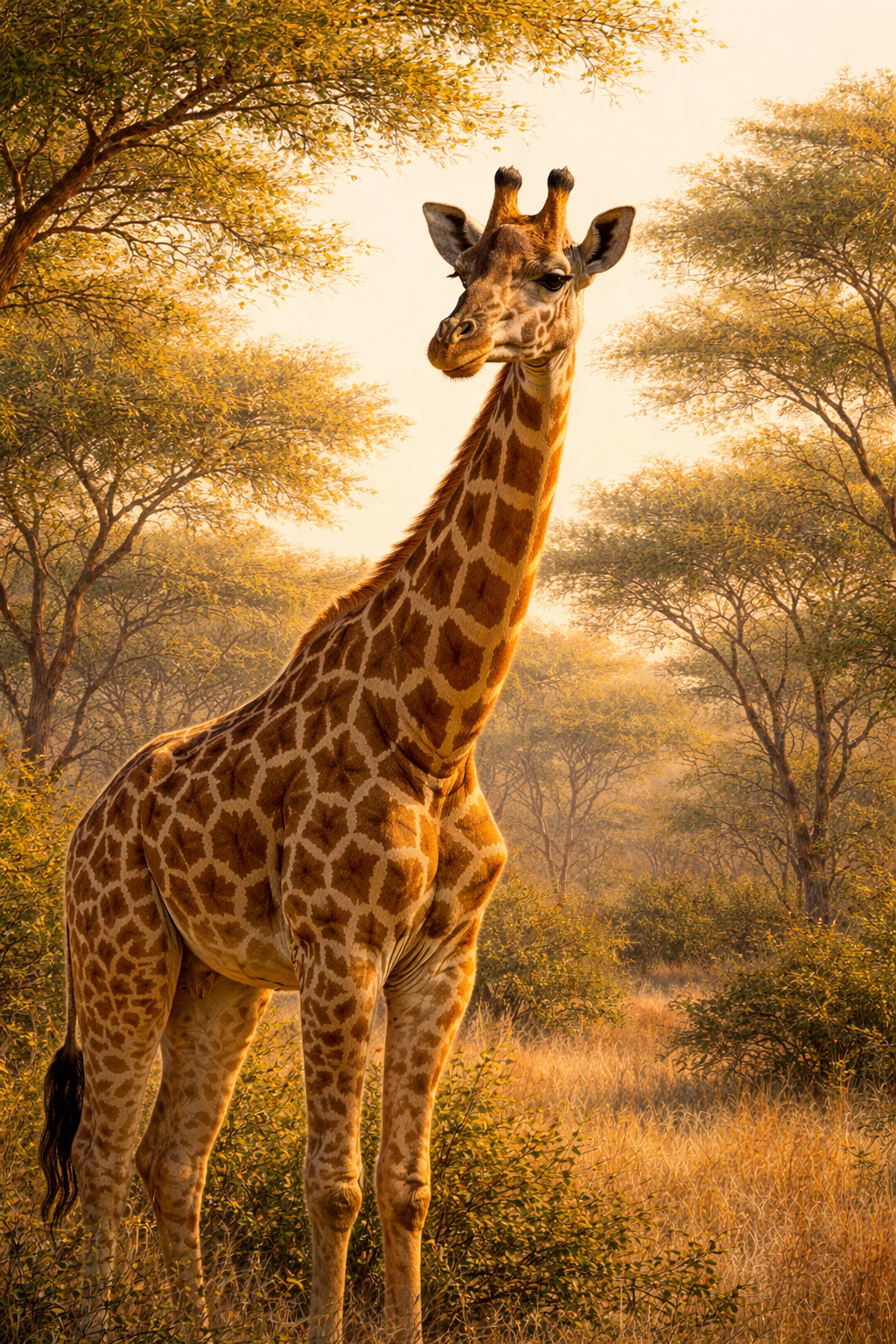
📅 Updated 🔬 Wildlife biology research🦒 World's tallest land animal
A giraffe calf drops two metres to the ground at birth and is walking within an hour. By age 5 they are a fully independent adult. These are animals that compress a human lifetime into 25 years — living fast, standing tall, and sleeping almost never.
Giraffes mature faster than humans but have significantly shorter lifespans. The equivalencies below are based on developmental milestones documented by the Giraffe Conservation Foundation and long-term field studies in East and Southern Africa.
Giraffe Age
Human Equivalent
Life Stage
What's Happening
0–6 months
0–3 years
Newborn/infant
Born at 1.8m tall; walking within hours; 50% mortality risk in first year
6–12 months
3–6 years
Calf
Beginning to browse independently; still close to mother
1–3 years
6–14 years
Juvenile
Crèche groups with other young giraffes; rapid height growth
3–5 years
15–24 years
Sub-adult
Females approaching first oestrus; males beginning necking bouts
5–10 years
25–38 years
Young adult
Females reproductively active; males still growing in neck and ossicone mass
10–15 years
39–54 years
Prime adult
Peak reproductive years; dominant bulls at their most competitive
15–20 years
55–68 years
Mature adult
Slowing reproduction; experienced animals with established home ranges
20–25 years
69–80 years
Senior
Exceptional wild longevity; captive individuals may reach this stage more reliably
25–31 years
81–90+ years
Elder
Record territory — captivity only; the oldest known giraffe reached ~31 years
Life Stages
The Life Stages of a Giraffe
Giraffes compress their developmental timeline significantly compared to humans — a giraffe is effectively a functional adult by age 5, and an elder by age 20. Their social structure is fluid and non-territorial, with individuals drifting in and out of loose groups called towers.
0–1 yr
Calf
Born at nearly 2 metres tall. First year is the most dangerous — lion, hyena, and leopard predation is highest.
1–3 yrs
Juvenile
Rapid growth phase. Juveniles often form crèche groups while mothers forage, a rare form of cooperative care in giraffes.
3–5 yrs
Sub-adult
Females approach first oestrus. Males begin practicing necking bouts — the fighting behaviour that determines breeding access.
5–14 yrs
Prime Adult
Peak physical condition. Dominant males achieve most matings. Females at highest reproductive output.
15–20 yrs
Mature Adult
Experienced animals with well-established knowledge of home range resources and seasonal patterns.
20+ yrs
Senior / Elder
Rare in the wild. In captivity, giraffes can reach their late 20s with good veterinary care.
Fascinating Facts
Things About Giraffes That Will Actually Surprise You
💤 The World's Most Sleep-Deprived Animal
Giraffes sleep an average of just 30 minutes to 2 hours per day — less than any other mammal studied. They rarely lie down because rising from the ground takes precious seconds that a lion can exploit. Most sleep is taken standing, in micro-naps of a few minutes. When giraffes do lie down, they curl their enormous neck back along their spine in one of the most extraordinary resting postures in the natural world.
🥊 Necking Isn't Gentle
Male giraffes fight by swinging their necks and striking rivals with their ossicone-studded heads — a behaviour called necking. These impacts can knock a rival unconscious, and occasionally kill. The force generated by a large bull's neck swing has been measured at the equivalent of a sledgehammer blow. This is why male necks are significantly longer, heavier, and more muscular than females': the neck is as much a weapon as a feeding tool.
❤️ An Engineering Marvel
A giraffe's heart weighs approximately 11 kg and generates twice the blood pressure of most mammals — necessary to pump blood two metres up the neck to the brain. But bending down to drink creates the opposite problem: a rush of blood to the head that would kill most animals. Giraffes have evolved a unique network of pressure-regulating vessels at the base of the brain, called the rete mirabile, that acts as a biological pressure dampener.
👅 The Prehensile Tongue
A giraffe's tongue is 45–50 cm long and deep blue-black in colour — the dark pigmentation is thought to protect it from UV radiation during the long hours spent foraging in direct sunlight. The tongue is prehensile, capable of wrapping around acacia thorns to strip leaves. A giraffe spends up to 16 hours a day eating, consuming roughly 34 kg of leaves and twigs — mostly from acacia trees that would be inaccessible to any other browser.
🐣 Born Into Danger
Giraffe calves are born after a 15-month gestation and drop nearly 2 metres to the ground — the jolt of landing is thought to help stimulate breathing. Within 30 minutes they are attempting to stand; within a few hours they are walking. Despite this remarkable start, up to 50% of calves die in their first year — primarily to lions, leopards, and hyenas. A mother giraffe defending her calf has been observed kicking a lion hard enough to break its jaw.
🔇 The Silent Animal That Isn't
Giraffes were long believed to be essentially mute. Research published in BMC Research Notes in 2015 revealed that giraffes hum to each other at night — a low-frequency sound around 92 Hz, produced over hours of darkness. The function is not yet fully understood, but the discovery upended decades of assumption that one of the largest animals on Earth had nothing to say.
🦒 The IUCN Red List classifies the giraffe (Giraffa camelopardalis) as Vulnerable, with the overall population having declined by approximately 30% over the past three decades. Four of the nine subspecies are now classified as Endangered or Critically Endangered. The Giraffe Conservation Foundation estimates fewer than 117,000 giraffes remain in the wild — fewer than the number of elephants.
Methodology
How We Calculate Giraffe Age
Giraffe aging is accelerated relative to humans — they mature faster, reproduce earlier, and have a compressed lifespan of 20–25 years in the wild. Our calculator maps key developmental milestones (first walking, sexual maturity, peak reproduction, senior phase) onto equivalent human life stages.
Years 0–3: rapid development phase, roughly 5× human rate
Years 3–10: approaching 3× human rate through young adulthood
Years 10–25: approximately 2.5× human rate through maturity and senior years
The sex selector adjusts slightly for the fact that female giraffes typically outlive males — males face higher mortality from fighting injuries and increased lion predation during competitive periods.
💡 Giraffe taxonomy was revised significantly in 2016 when genetic research suggested there may be four distinct giraffe species rather than one — a finding that dramatically changes their conservation status. The debate is ongoing among taxonomists, but it highlights how much is still being discovered about even the world's most recognisable animals. Learn more at the Giraffe Conservation Foundation.
Giraffes age roughly 3–5 times faster than humans depending on life stage. A 1-year-old giraffe is equivalent to approximately a 6-year-old child. A 5-year-old giraffe is comparable to a human in their mid-20s. At 15, a giraffe is in late middle age. Most wild giraffes don't reach 25 years, making that milestone the equivalent of reaching one's late 70s or 80s in human terms.
Wild giraffes typically live 20–25 years, with females generally outliving males. In captivity, where they're protected from predators and have reliable food, giraffes can reach 28–31 years. The oldest recorded giraffe in captivity lived to approximately 31 years. In the wild, major causes of death include lion predation (especially for calves and old animals), dehydration during drought, and fighting injuries in males.
Giraffes sleep less than almost any other mammal — averaging just 30 minutes to 2 hours per day, usually in short micro-naps of a few minutes taken while standing. They rarely lie down because rising from the ground takes several seconds, leaving them vulnerable to predators. When giraffes do lie down (usually for deeper REM sleep), they curve their long neck back along their body in one of the most visually striking resting postures in the animal kingdom.
The traditional explanation — reaching high leaves — is only partially correct. Research increasingly supports sexual selection as an equally important driver: male giraffes use their necks as weapons in necking battles, and males with longer, heavier necks win more fights and sire more offspring. Studies have found that the tallest males — not the best foragers — have the most reproductive success. The neck likely evolved under pressure from both foraging advantage and combat effectiveness, reinforcing each other over millions of years.
The overall giraffe species is classified as Vulnerable by the IUCN, but the situation is more severe for some populations. Four of the nine recognised subspecies are Endangered or Critically Endangered. The total wild population has declined by roughly 30% in 30 years, from around 155,000 to fewer than 117,000. This decline is driven by habitat loss, illegal hunting, and human-wildlife conflict. Alarmingly, giraffe conservation receives a fraction of the funding and attention directed at elephants, despite comparable population pressures.