Popular Pets
🐶 Dog 🐱 Cat 🐰 Rabbit 🐹 Hamster 🐾 Guinea Pig 🦜 Parrot 🦡 Ferret 🐀 Rat 🐭 Chinchilla 🦔 Hedgehog 🐟 Goldfish 🦜 Macaw
Farm & Large Animals
🐴 Horse 🐄 Cow 🐄 Highland Cow 🐷 Pig 🐑 Sheep 🐐 Goat 🐴 Donkey 🦙 Alpaca 🐐 Mountain Goat 🐔 Chicken 🦆 Duck 🦃 Turkey
Wild Animals
🐘 Elephant 🦁 Lion 🐯 Tiger 🐆 Leopard 🐺 Wolf 🐻 Bear 🐻‍❄️ Polar Bear 🦍 Gorilla 🐒 Chimpanzee 🦧 Orangutan 🦘 Kangaroo 🐾 Capybara 🦒 Giraffe 🦊 Fox 🦅 Raptor 🦉 Owl 🐧 Penguin 🦩 Flamingo 🐾 Hyena 🐾 Meerkat 🦥 Sloth 🦡 Badger 🐾 Wolverine 🐾 Armadillo
Ocean & Aquarium
🦈 Shark 🐋 Orca 🐬 Dolphin 🐋 Whale 🐋 Blue Whale 🐳 Beluga Whale 🦄 Narwhal 🐋 Bowhead Whale 🐾 Manatee 🐟 Manta Ray 🐟 Freshwater Fish 🐠 Saltwater Fish 🐴 Seahorse 🐟 Koi
Exotic & Weird
🐍 Snake 🐍 Ball Python 🦎 Bearded Dragon 🦎 Iguana 🦎 Komodo Dragon 🦎 Chameleon 🦎 Leopard Gecko 🐢 Tortoise 🐢 Snapping Turtle 🐢 Sea Turtle 🐊 Crocodilian 🕷️ Tarantula 🦎 Axolotl 🐙 Octopus 🌊 Jellyfish 🦞 Lobster 🐚 Quahog 🔬 Tardigrade
Info
About FAQ Contact
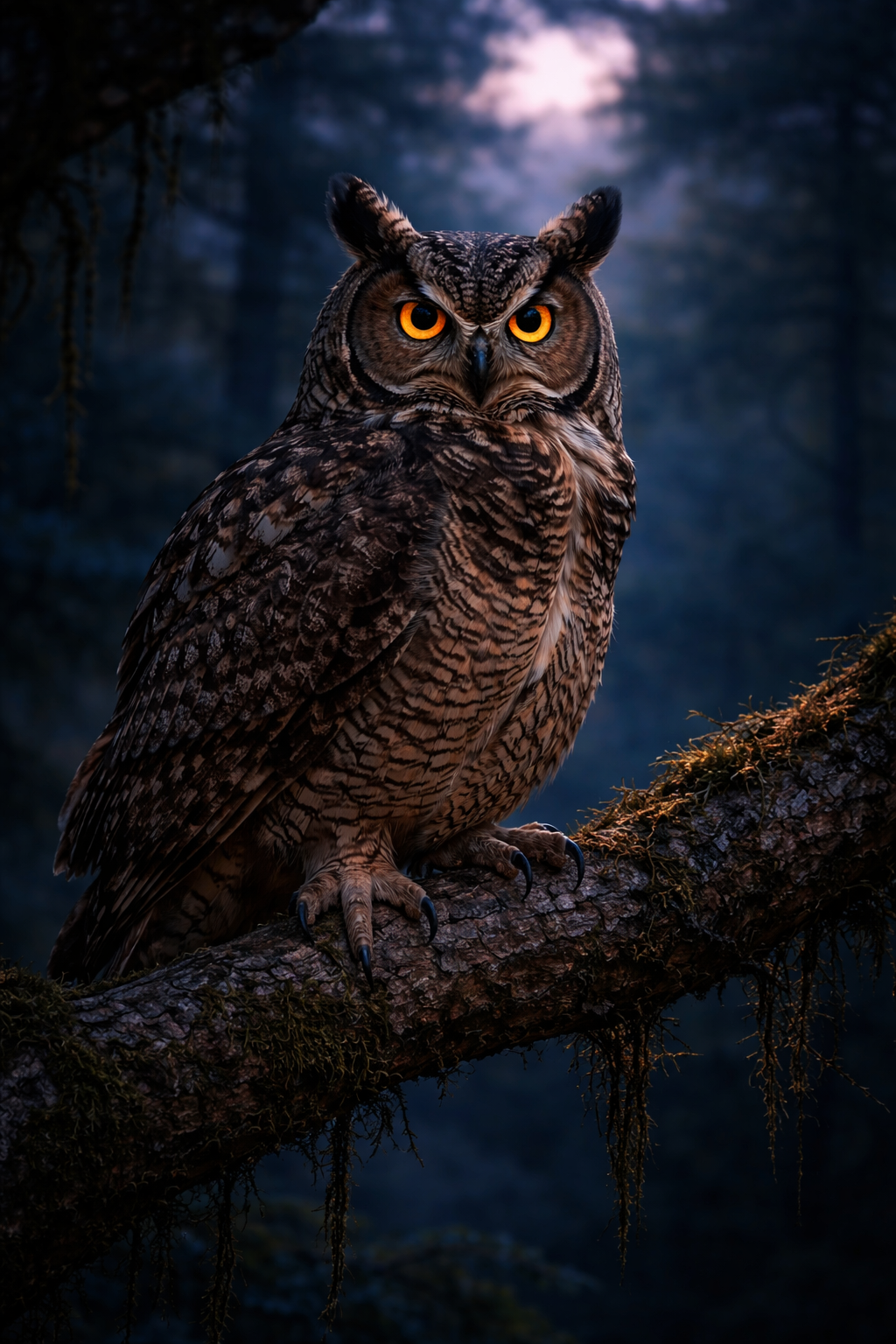
Photorealistic painting of a great horned owl with glowing orange eyes perched on a mossy branch in a misty midnight forest
🦉 Wild Animals

How Old Is an Owl in Human Years?

📅 Updated March 2026 🌍 Every continent except Antarctica 🦉 250+ species — 5 to 68 years

Owls can't move their eyes — they're fixed in the skull. So they evolved the ability to rotate their heads 270°. Their ears are asymmetrically placed so they can hear in three dimensions. Their feathers are engineered for near-silent flight. The great grey owl can hear a mouse moving under two feet of packed snow. 250 species. One extraordinary order of birds.

Calculate Owl Age →
🦉 Owl Age in Human Years
in human years
Owl age
Life stage
Species
🦉 What this age means

The Major Owl Species — A Field Guide

With over 250 species worldwide, owls inhabit every terrestrial habitat from Arctic tundra to tropical rainforest, equatorial desert to temperate woodland. They range in size from the 31-gram elf owl to the Blakiston's fish owl at 4.5kg. Their lifespans, hunting strategies, habitats, and conservation status vary as dramatically as their sizes. Here are the most significant species covered by our calculator.
Great Horned Owl portrait
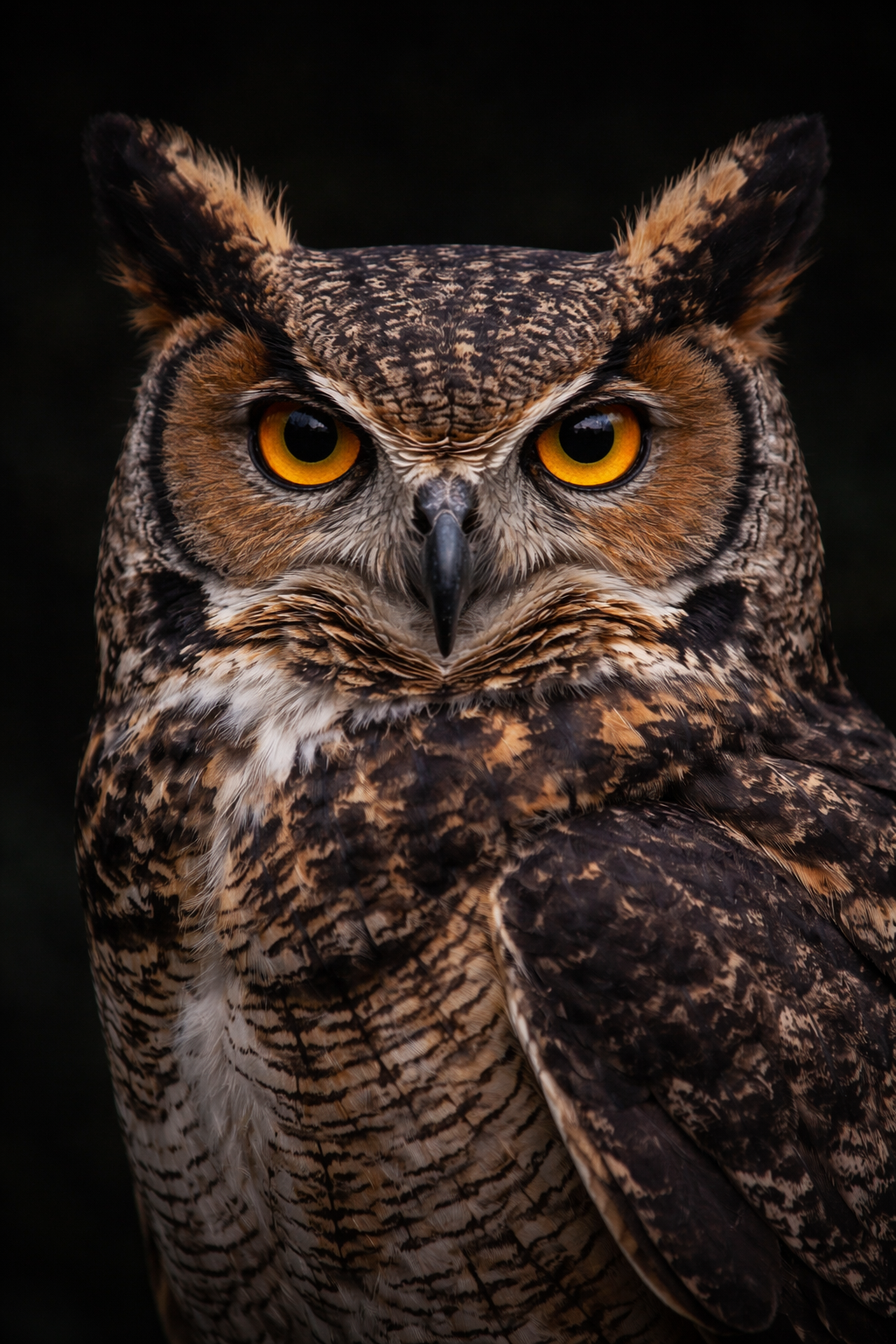
Great Horned Owl
Bubo virginianus
Wild avg: 13 yrs Max recorded: 29 yrs Wingspan: 91–152cm Weight: 0.9–2.5kg
The apex avian predator of North America — the "tiger of the sky." Great horned owls will kill prey much larger than themselves, including ospreys, other raptors, herons, domestic cats, rabbits, skunks, and even porcupines. They have the most powerful talons relative to body size of any North American bird, with a grip force exceeding 300 PSI. They are the earliest nesting bird in North America — females sit on eggs in mid-winter, sometimes with snow accumulating on their backs. They have almost no natural predators as adults. The "horns" are tufts of feathers with no functional role in hearing.
Barn Owl portrait
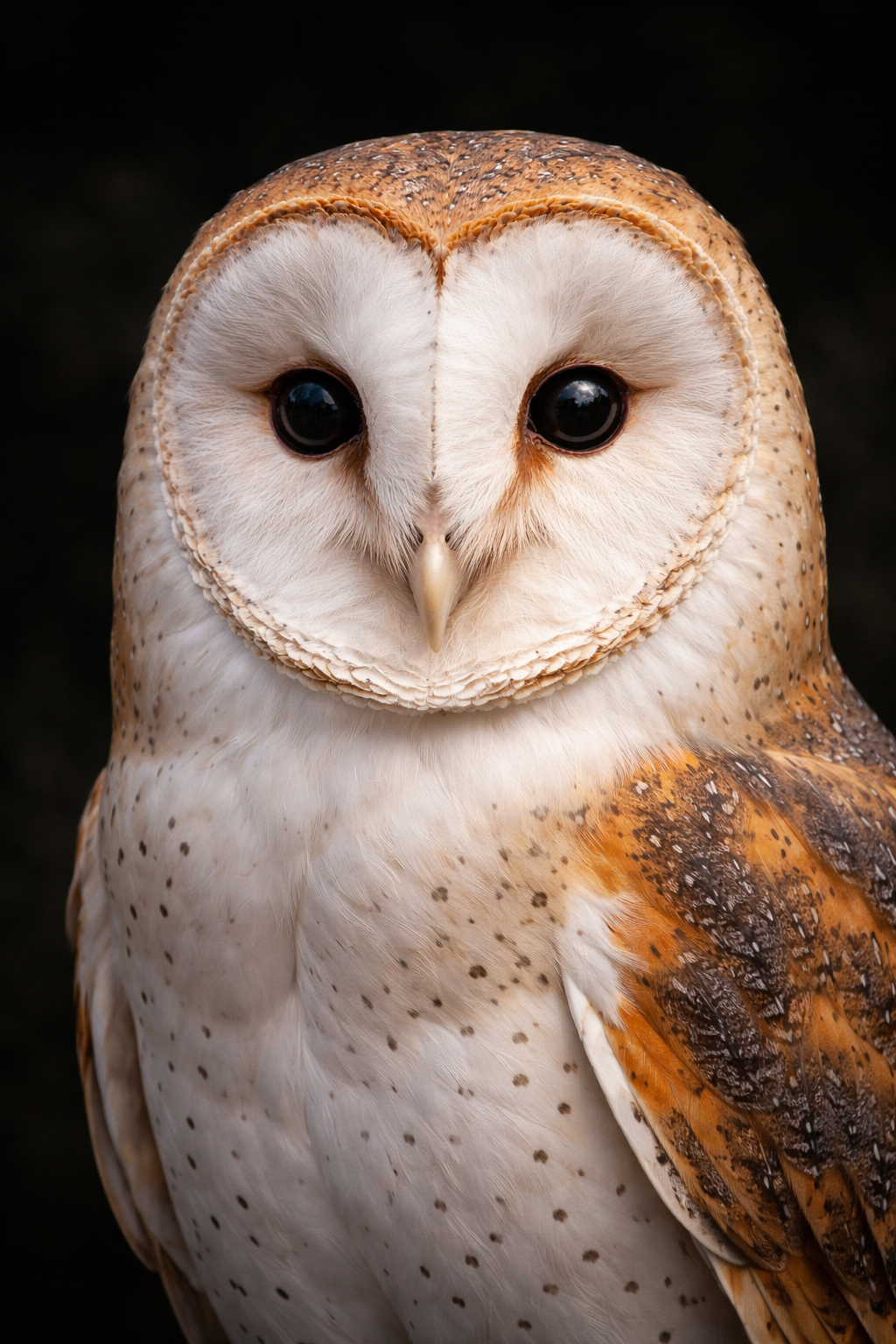
Barn Owl
Tyto alba
Wild avg: 4 yrs Max recorded: 15 yrs Wingspan: 80–95cm Weight: 224–710g
The most widely distributed land bird on Earth — found on every continent except Antarctica — and one of the most acoustically sophisticated predators alive. The barn owl's heart-shaped facial disc is a parabolic sound reflector of extraordinary precision; combined with asymmetrical ears, it can pinpoint prey in complete darkness by sound alone. It hunts by flying low and slow over open ground, detecting the rustling of small rodents entirely acoustically. Despite global abundance, barn owl populations have crashed across much of Europe and North America due to rodenticide poisoning and the loss of old barns, hedgerows, and rough grassland habitat.
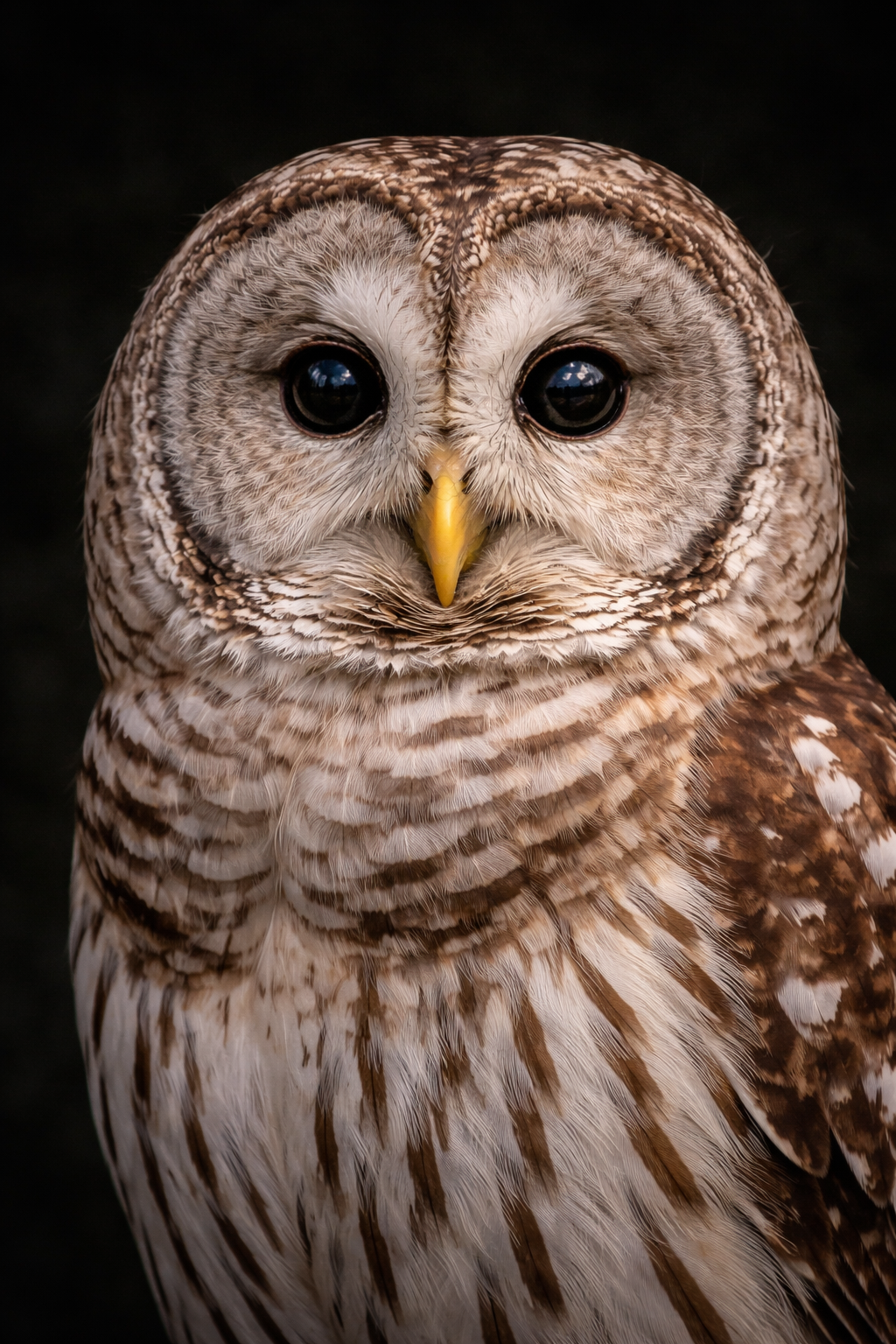
Barred Owl portrait
Barred Owl
Strix varia
Wild avg: 10 yrs Max recorded: 24 yrs Wingspan: 96–125cm Weight: 470–1,050g
A generalist predator that has become the centre of one of North America's most contentious conservation debates. Native to eastern North America, the barred owl expanded westward through the 20th century — facilitated by fire suppression, bison eradication, and climate change opening forest corridors across the Great Plains. On the West Coast, it has become an invasive species threatening the spotted owl, eating 29 at-risk species, and disrupting entire Pacific Northwest forest ecosystems. Recognisable by its resonant "Who cooks for you? Who cooks for you-all?" call, heard in suburban forests across much of North America.
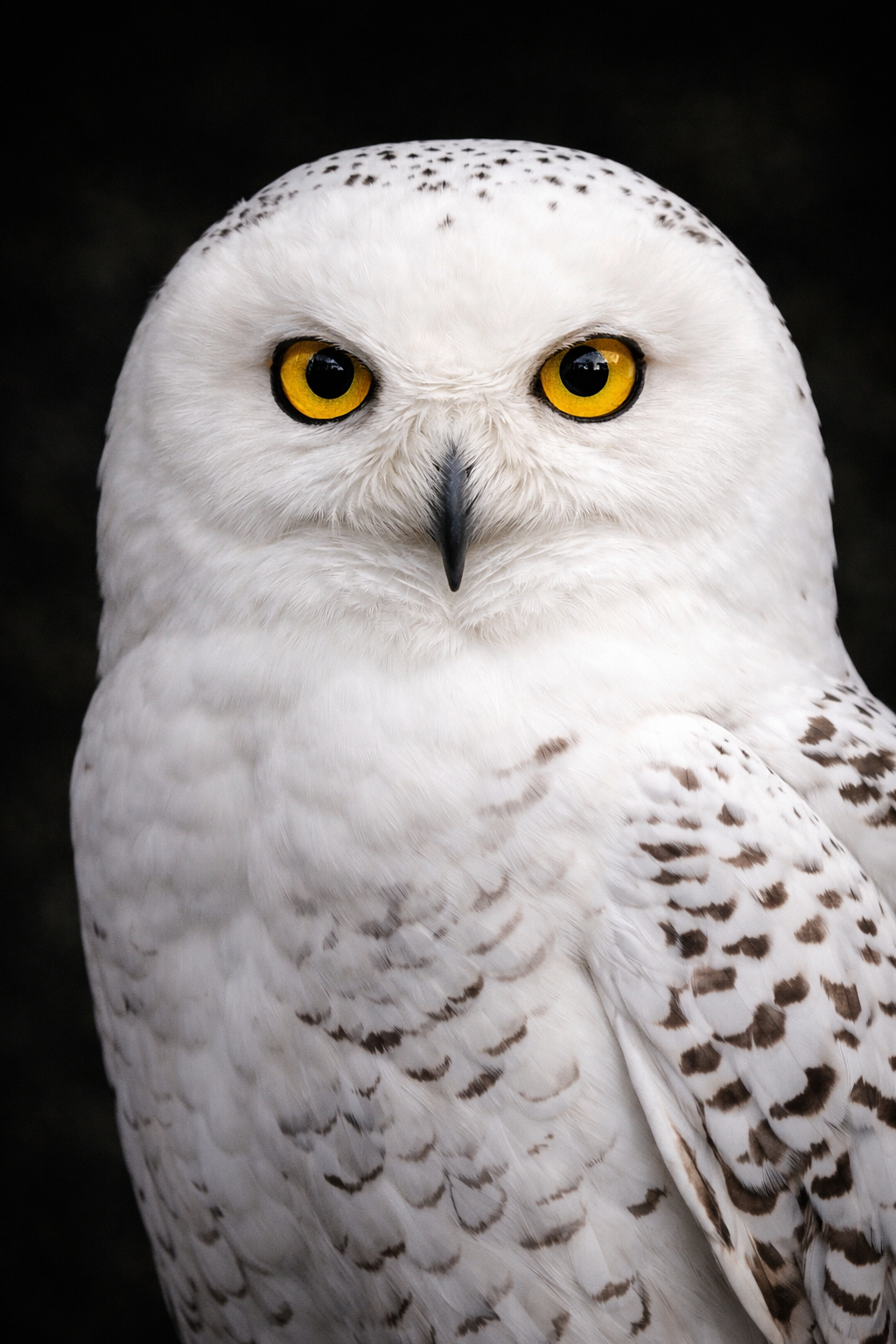
Snowy Owl portrait
Snowy Owl
Bubo scandiacus
Wild avg: 10 yrs Max recorded: 28 yrs Wingspan: 125–150cm Weight: 1.6–3.0kg
One of the largest and heaviest owls in the world, and the only truly diurnal owl species — active in full daylight, which makes sense given the Arctic summer's 24-hour sun. Snowy owls breed on the tundra, nesting directly on the ground, with breeding success tightly linked to lemming population cycles. When lemmings crash, snowy owls move south in dramatic winter "irruptions," appearing in unusual numbers across the northern US and sometimes further. A first global population assessment published in 2024 found the species had been badly overestimated for decades and had declined by approximately a third over 25–30 years.
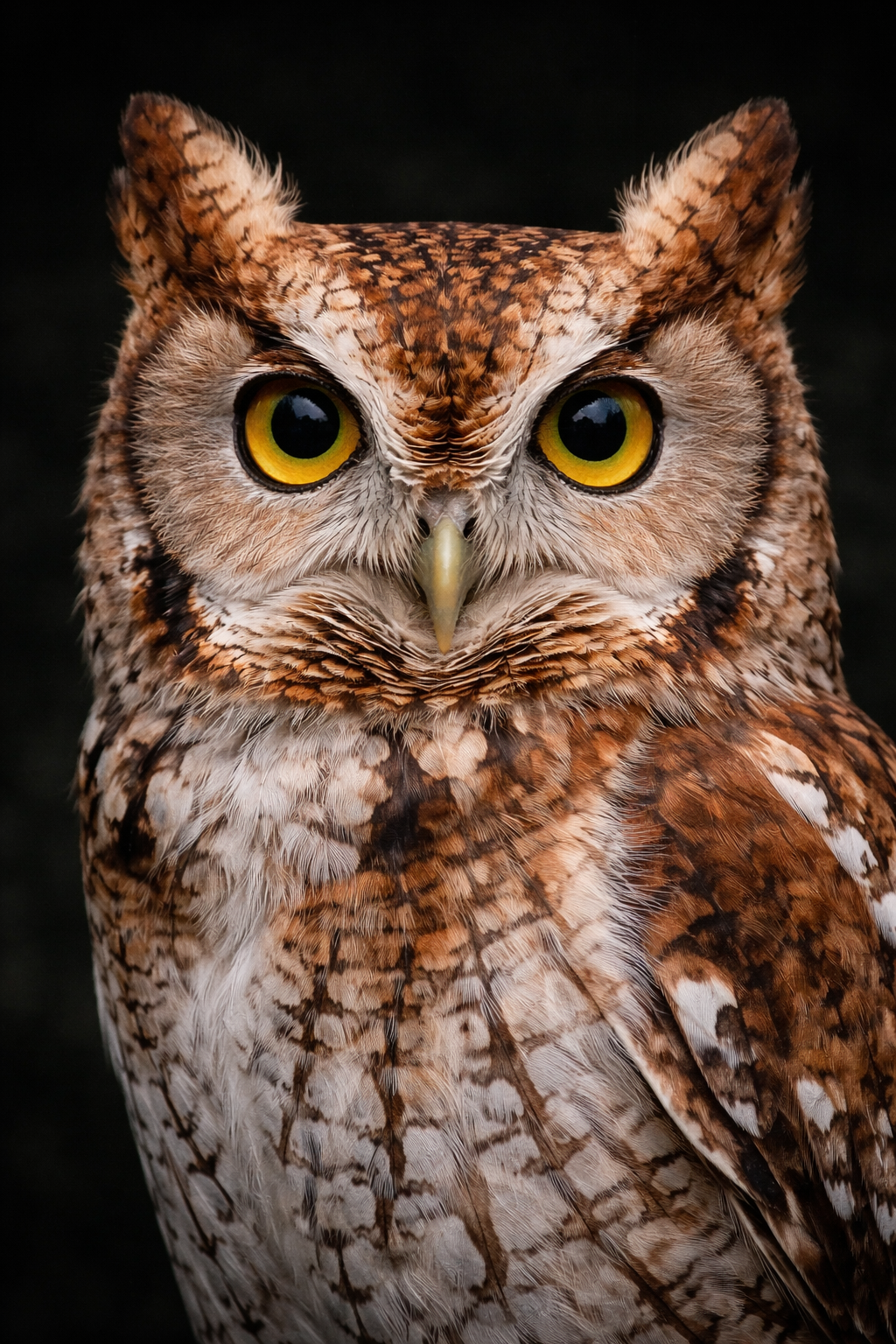
Screech Owl portrait
Eastern/Western Screech Owl
Megascops asio / kennicottii
Wild avg: 8 yrs Max recorded: 20 yrs Wingspan: 46–61cm Weight: 121–244g
Small, cryptically camouflaged owls that are far more common than most people realise — they nest in tree cavities in suburban gardens, parks, and woodland edges across most of North America, and their haunting descending whinny call is a common night sound that most people never connect to the tiny owl producing it. Available in two colour morphs — grey and rufous — with the rufous form particularly well-camouflaged against red-brown bark. They readily accept nest boxes and are among the easiest owls to attract to a garden. Their small size makes them particularly vulnerable to rodenticide poisoning.
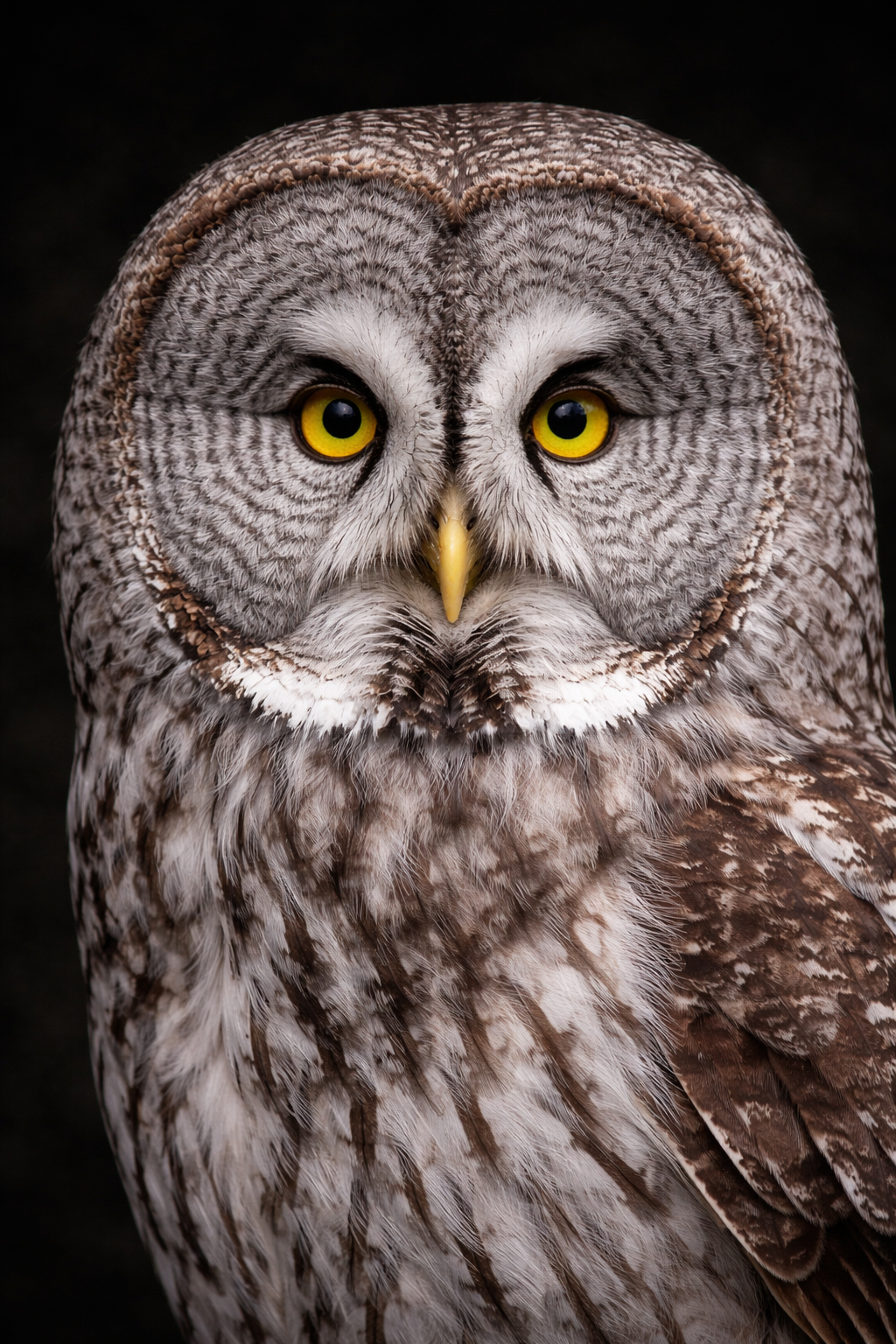
Great Grey Owl portrait
Great Grey Owl
Strix nebulosa
Wild avg: 12 yrs Max recorded: 40 yrs Wingspan: 127–152cm Weight: 580–1,900g
The largest owl by length — though much of that length is feathers; the great grey owl is considerably lighter than the great horned owl or snowy owl. What the great grey lacks in mass it more than compensates for with its extraordinary hearing: the enormous facial disc channels sound with such precision that a great grey owl can detect and precisely locate a vole moving under two feet of compacted snow, then plunge through the snow surface and catch it blind. They hunt boreal forest and mountain meadow edges, relying almost entirely on hearing rather than vision for winter hunting.
Elf Owl portrait
Elf Owl
Micrathene whitneyi
Wild avg: 5 yrs Max recorded: 6 yrs Wingspan: 27cm Weight: 31–55g
The smallest owl on Earth — roughly the size of a sparrow and weighing less than a golf ball. Elf owls inhabit the Sonoran Desert of the American Southwest and Mexico, nesting almost exclusively in old woodpecker holes in saguaro cacti. They are insectivores — eating scorpions (they remove the sting before eating), moths, beetles, and crickets. Entirely nocturnal, they migrate seasonally to avoid the harshest desert months. Their tiny size means they age fast and live brief lives by owl standards — most wild elf owls survive only 3–6 years. They are a world away from the great horned owl in almost every biological parameter while belonging to the same taxonomic order.

The Life Stages of an Owl

Owl life stages are broadly similar across species, though the timescales compress dramatically between long-lived species like the great horned owl and short-lived ones like the barn owl and elf owl. The core arc — helpless nestling, rapidly developing owlet, branching fledgling, dispersing juvenile, breeding adult — is shared across the order.

0–4 weeks
Nestling
Hatched blind, helpless, and covered in white down, owl nestlings are entirely dependent on both parents — one to brood and protect, one to hunt and deliver food. Great horned owls hatch in mid-winter; barn owls can hatch any month of the year. Growth is extraordinarily rapid — a great horned owlet can increase its weight tenfold in the first month. The nest is never cleaned; owls swallow prey whole and regurgitate compacted pellets of bone, fur, and feathers that accumulate in and below the nest. The oldest nestling in a clutch typically gets fed first and grows largest — in difficult years, the younger owlets may not survive.
4–10 weeks
Owlet / Brancher
Eyes open, flight feathers developing, the owlet begins exploring beyond the nest — moving to surrounding branches before it can fly. This "branching" phase is when most people encounter young owls on the ground: the owlet falls from its branch, sits confused and apparently helpless, and well-meaning humans often attempt to "rescue" it. In almost all cases, the parents are nearby and the owlet should be left alone — or at most returned to the nearest branch. If you find a young owl on the ground, observe from a distance before intervening. A feathered owlet with tail feathers developing is a brancher, not an abandoned chick.
10 weeks–6 months
Fledgling
Now flying but still dependent on parents for most food. The fledgling is learning to hunt — one of the most complex skills in the animal kingdom, requiring the integration of vision, hearing, flight control, and strike coordination. The parents continue to bring prey and may call the fledgling to feeding. Barn owl fledglings begin making their first solo hunts at around 10–13 weeks. Great horned owl fledglings may remain in loose association with parents for 5–6 months. First-year mortality is extremely high — the majority of owls that die in the wild do so in their first year, before hunting skills are fully developed.
6 months–1 year
Juvenile
Independent but still learning. The juvenile owl is establishing a territory and developing hunting efficiency. Juveniles are typically distinguishable from adults by residual fluffy plumage and behaviour — they tend to be more conspicuous and less cautious than experienced adults. Many dispersing juveniles cross roads and enter unfamiliar territories, which dramatically elevates their collision and predation risk. In irruptive species like the snowy owl, juvenile birds often form the majority of individuals seen far south of normal range during winter movements.
1–3 years
Sub-Adult
Most owl species reach sexual maturity by their second year, though larger species may take 2–3 years. The sub-adult owl is establishing a home territory — a process that may involve displacement by older, dominant individuals. Pair bonds in owls are strong and often monogamous over multiple breeding seasons, with pairs returning to the same nest site year after year. The first nesting attempt by a young pair often produces fewer eggs and lower fledgling survival than later attempts, as the birds learn to coordinate provisioning and nest defence.
3+ years
Breeding Adult / Elder
A seasoned adult owl is one of the most efficient predators in its ecosystem. An experienced great horned owl parent is capable of provisioning 2–3 growing owlets while maintaining territory defence and its own feeding needs — a hunting workload that researchers describe as extraordinary. Long-lived individuals — a great horned owl at 20+ years, a great grey at 30+ — have hunting territories memorised in extraordinary detail, responding to seasonal prey availability shifts that would require a younger bird to explore. The record for a wild great horned owl is 29 years; captive great horned owls have exceeded 50 years.

Owl Age to Human Years — Species Comparison

Owl AgeGreat HornedBarn OwlSnowy OwlScreech OwlLife Stage
HatchlingNewbornNewbornNewbornNewbornNestling
3 months~5 yrs~9 yrs~7 yrs~8 yrsFledgling — learning to hunt
1 year~10 yrs~21 yrs~12 yrs~16 yrsJuvenile/Sub-adult
3 years~22 yrs~42 yrs~29 yrs~35 yrsPrime adult — peak breeding
7 years~38 yrs~66 yrs~55 yrs~62 yrsMature adult
13 years~58 yrsElder~78 yrsElderSenior (great horned: average wild lifespan)
20 years~76 yrs~90 yrsElder great horned / snowy
29 years~90 yrs ♦Wild longevity record (great horned)

🦉 The extraordinary lifespan variation between owl species — barn owls averaging just 4 years while great horned owls average 13+ — reflects fundamentally different life history strategies. Barn owls are r-selected: they breed early, produce large clutches (4–7 eggs, sometimes twice per year), and compensate for high mortality with high reproduction. Great horned owls are more K-selected: they breed later, produce smaller clutches (1–3 eggs), invest heavily in parental care, and live longer. Both strategies work — barn owls are among the most abundant raptors globally despite their short lives; great horned owls are the most widespread owl in the Americas.

Owls — Major Stories of 2024–2026

The past two years have seen landmark owl conservation decisions, alarming new population data, and the deepening of one of ecology's most difficult dilemmas — when a native species becomes an invasive one somewhere else.

📰 2024 — Federal Action
The Plan to Kill 450,000 Owls to Save Another Owl Species

In August 2024, the US Fish & Wildlife Service finalised the Barred Owl Management Strategy — a landmark and deeply controversial plan to lethally remove approximately 450,000 barred owls from California, Oregon, and Washington over the next 30 years in an attempt to prevent the extinction of the northern spotted owl in its Pacific Northwest range.

The northern spotted owl was listed as threatened in 1990 — the listing that triggered decades of conflict between conservationists and the Pacific Northwest timber industry. Despite decades of forest protection, spotted owl populations have continued to decline. The culprit turned out not to be logging alone, but a competitor: the barred owl, native to eastern North America, which expanded westward through the 20th century by exploiting human-altered landscapes. Larger, more aggressive, and more adaptable than the spotted owl, the barred owl has outcompeted spotted owls for territory and prey across their shared range, driving spotted owl numbers down by more than 75% in two decades.

The management strategy — which began ramping up in spring 2025 — uses trained wildlife professionals to lethally remove barred owls from spotted owl habitat. It is not intended to eradicate barred owls from the West (an impossible task) but to "carve out space for a future where both spotted owls and barred owls continue to live in the West," according to FWS Barred Owl strategy lead Robin Bown. The ethical complexity is real: barred owls are native birds being killed to protect another native bird — the responsibility, conservationists argue, lies entirely with the human land-use changes that facilitated the range expansion in the first place.

📰 December 2024 — New Research
Snowy Owl Population Was Badly Overestimated — And Has Declined by a Third

For decades, scientists estimated the global snowy owl population at up to 290,000 individuals. A landmark study published in Bird Conservation International in December 2024 — the first-ever global status assessment for the species, involving 39 researchers from five countries — found that estimate was dramatically wrong.

The error stemmed from the snowy owl's highly nomadic behaviour: satellite tracking revealed that individual snowy owls routinely travel thousands of kilometres between breeding seasons, appearing repeatedly in population surveys and being counted multiple times. When researchers corrected for this, the true global population was substantially lower than previously believed — and the assessment found that snowy owl populations had declined by approximately a third over the past 25–30 years.

The causes of decline are multiple and interacting: climate change altering Arctic tundra habitat and disrupting the lemming population cycles that snowy owls depend on for breeding success; collision with vehicles and power lines during southern winter movements; and lead poisoning from ammunition in prey species. The study was released as open access to ensure its findings could reach conservation decision-makers globally without paywalls.

📰 December 2025 — New Research
The Barred Owl Is Eating 29 Protected Species — The Problem Is Bigger Than Anyone Realised

A major University of Wisconsin-Madison study published in late 2025 significantly expanded the known ecological damage of the barred owl's westward range expansion. By analysing the DNA of prey items in the digestive tracts of 788 individual barred owls from California, Oregon, and Washington, researchers found the birds were consuming 162 different prey species — including 29 species that hold federal or state conservation status.

These included at-risk frogs and salamanders; protected ringtails (raccoon-like carnivores); threatened coho salmon; bats, chipmunks, and quail with declining populations; and even other protected birds of prey including the long-eared owl and western screech owl. Some species were facing double pressure — eaten by barred owls while the barred owls simultaneously consumed the prey those species depended on.

Lead researcher Daniela Arenas-Viveros emphasised the urgency: "We are talking about barred owls affecting a whole ecosystem and all sorts of species. And this is time-sensitive, because they have not stopped expanding into new places." The findings suggest that current management plans focused primarily on protecting spotted owls may need to broaden to address the barred owl's wider ecological impact on Pacific Northwest biodiversity.

📰 Ongoing — The Rodenticide Crisis
Rat Poison Is Killing Owls Across North America — Even in Remote Areas

One of the least-publicised but most pervasive threats to owl populations across North America and Europe is secondary rodenticide poisoning — also called anticoagulant rodenticide toxicosis. Second-generation anticoagulant rodenticides (SGARs), used widely in homes, farms, and commercial properties to control mice and rats, accumulate in the livers of poisoned rodents. When owls catch and eat these poisoned rodents — often lethargic and easy prey precisely because they are already dying — the anticoagulant compounds accumulate in the owl's own liver.

The compounds prevent blood clotting. Affected owls suffer internal bleeding and die — often days after consuming the poisoned prey, and often far from the original rodenticide application site. Studies have found anticoagulant rodenticides in the majority of tested owls and other raptors across North America, including in birds from apparently remote wilderness areas far from residential rodenticide use. Barn owls — which hunt almost exclusively rodents — are particularly affected. The National Audubon Society has identified the saw-whet owl as a climate-vulnerable species additionally threatened by rodenticide exposure.

Conservation organisations encourage homeowners to use snap traps instead of rodenticide baits, and to install owl nest boxes to provide natural rodent control. A single barn owl family can consume 1,000+ rodents per year — making them the most cost-effective and ecologically sound rodent control available.

Things About Owls That Will Actually Surprise You

👁️ Eyes That Cannot Move
Owl eyes are not spherical — they are tubular cylinders, fixed rigidly in the skull by a ring of bone called the sclerotic ring. This design allows an enormous lens diameter relative to eye size, capturing vastly more light than a round eye — essential for low-light hunting. The tradeoff: owls cannot move their eyes at all. To look sideways, they rotate the entire head. The famous 270° head rotation (not 360° — that's a myth) is made possible by specialised vertebrae and a vascular system that prevents blood loss when the neck is twisted. An owl can also bob and tilt its head to use motion parallax — the same object from two different angles — to judge distance without stereoscopic vision from the front.
👂 Asymmetric Ears and 3D Hearing
Many owl species have asymmetrically placed ears — one higher on the skull than the other. This creates a vertical acoustic parallax: a sound reaching the higher ear at a slightly different time than the lower ear provides the vertical dimension of the sound source, in addition to the horizontal timing difference between left and right ears. Combined with the facial disc acting as a parabolic reflector, this gives owls the ability to locate prey in three dimensions by sound alone, with angular precision of about 1° in both horizontal and vertical planes. Barn owls can catch prey in complete darkness. Great grey owls can detect voles under two feet of compacted snow. Research on barn owl sound localisation has directly informed the design of military sonar systems.
🪶 Silent Flight Engineering
Owl flight feathers have three distinct noise-cancellation adaptations. First, comb-like serrations on the leading edge of primary flight feathers break turbulent airflow into micro-turbulence that dissipates silently before generating noise. Second, velvety micro-structures on the feather surface absorb sound waves in mid-frequency ranges. Third, flexible fringes on the trailing edge of flight feathers silence the trailing air wake. Together these adaptations reduce flight noise to near-zero — confirmed by acoustic measurements in laboratory wind tunnels. The near-silent flight serves two functions: it allows owls to hunt entirely by hearing without their own wing noise interfering, and it allows them to approach prey without acoustic warning. Aerospace engineers have studied owl wing structures to develop quieter aircraft and wind turbine blades.
💩 Pellets — The Owl's Food Diary
Owls swallow prey whole or in large pieces — they do not have a crop to pre-digest food as most birds do. Indigestible material (bone, fur, feathers, insect exoskeletons) passes into the gizzard, where it is compacted into a pellet that is regurgitated approximately once or twice per day. Owl pellets are extraordinarily useful to researchers — by dissecting them and identifying the bone fragments within, scientists can reconstruct exactly what the owl ate at that meal. Long-term pellet analysis from a single nest site builds a detailed record of local prey availability over years. Pellet dissection is also a classic educational activity — clean, safe, and providing genuinely useful scientific data when done systematically. A barn owl pellet typically contains 2–4 complete small mammal skulls.
🌍 Every Continent (Except One)
The order Strigiformes — comprising two families, Tytonidae (barn owls and allies, ~20 species) and Strigidae (typical owls, ~235 species) — is found on every continent except Antarctica. Owls inhabit Arctic tundra (snowy owl), temperate forest (great horned, tawny, barred), tropical rainforest (spectacled owl, Mayan owl), desert (elf owl, burrowing owl), grassland (short-eared owl), mountain (great grey), and oceanic island ecosystems. The burrowing owl is unique in nesting underground — in old prairie dog and ground squirrel burrows — and is active during the day. The fishing owls of Africa and Asia hunt fish from riverbanks like oversized kingfishers. Owls have independently evolved the same body plan and hunting strategy on six continents — a testament to how effective the design is.
🦅 The Great Horned Owl's Prey
The great horned owl has the broadest prey range of any North American raptor — it has been recorded killing and consuming over 250 different species. Its prey list includes: rabbits and hares (its primary prey in many areas), skunks (great horned owls have a very poor sense of smell), domestic cats, opossums, American crows (which respond to great horned owls with intense mob attacks for exactly this reason), ospreys, other hawks, porcupines (killed by attacking the face), ducks, turkeys, and road-killed deer. Their talon grip force exceeds that of a trained falconry bird by a significant margin. A great horned owl's talons close with approximately 300 PSI — roughly the grip force of a large dog's jaw.

The Barn Owl's Superpower — Total Darkness Hunting

Of all the extraordinary sensory feats performed by owls, the barn owl's ability to catch prey in complete, total darkness — zero light — is perhaps the most remarkable. Documented in controlled laboratory experiments where researchers systematically eliminated all light sources until not a single photon remained, barn owls continued to successfully catch live mice purely by sound. The heart-shaped facial disc — so distinctive it makes the barn owl instantly recognisable — acts as an enormous parabolic reflector, channelling sound toward the slightly asymmetrical ear openings. The entire skull has evolved around this acoustic system: the facial disc edges are rigid cartilage, the inner disc feathers have a specific density and arrangement tuned to reflect particular sound frequencies, and the ear openings themselves are covered by flaps of skin that can be moved to adjust the acoustic aperture. No other vertebrate hunts exclusively by sound with equivalent precision.

The Mythology of Owl Wisdom

Owls have been associated with wisdom, death, prophecy, and the supernatural across cultures worldwide for millennia — from Athena's owl in ancient Greece to various traditions across Africa, the Americas, Asia, and Australia. In western culture, the wisdom association dominates; in many other cultures, owls are feared as omens of death or as vehicles for spirits. A Biodiversity and Conservation review published in 2025 analysed decades of research on human-owl cultural interactions, finding that negative cultural beliefs — associating owls with death or witchcraft — remain a significant driver of owl persecution in many parts of the world, particularly across sub-Saharan Africa, parts of Latin America, and South and Southeast Asia. Owls are killed because people believe seeing or hearing one portends death or brings bad luck. Understanding and engaging with these cultural dimensions is now recognised as an essential component of owl conservation in regions where persecution rather than habitat loss is the primary threat.

🦉 Owl "ear tufts" — the upright feather tufts on the heads of great horned owls, long-eared owls, and several other species — have nothing to do with hearing. They are clusters of feathers with no acoustic function. Their purpose is debated: they may serve in species recognition, camouflage (breaking up the round silhouette of the head to resemble a broken branch), or social signalling. When an owl is alarmed, the ear tufts rise; when it is relaxed, they flatten. Great horned owls can be individually identified partly by the shape and positioning of their ear tufts. The actual ear openings are on the sides of the skull, hidden beneath the facial feathers — and in species with asymmetric hearing like the barn owl and great grey owl, one ear opening is significantly larger than the other.

What's Threatening Owls Today

Despite being apex predators in their ecosystems, owls face a growing array of human-caused threats that are pushing multiple species toward decline.

🐀 Rodenticide Poisoning — The Silent Killer

Second-generation anticoagulant rodenticides (SGARs) are now the most pervasive chemical threat to owl populations in North America and Europe. Studies consistently find these compounds in 70–90% of tested raptors, including species from remote wild areas. The pathway: poisoned rodents become lethargic and easy to catch; owls accumulate the anticoagulant in their livers; internal bleeding eventually kills them. What you can do: use snap traps instead of rodenticide bait stations; install owl nest boxes to encourage natural rodent control; advocate for SGAR restrictions in your jurisdiction.

🚗 Vehicle Collisions

Road and vehicle collisions are the single largest documented cause of owl mortality in many populations, particularly for barn owls and short-eared owls that hunt road margins and verges. Low-flying hunting patterns bring these species directly into the path of vehicle headlights at night. Studies in the UK found vehicle strikes accounted for approximately 50% of all documented barn owl deaths. Reducing road lighting in rural areas, maintaining roadside vegetation that discourages owls from hunting in the road corridor, and installing reflectors that discourage low flight have all shown effectiveness.

🏠 Habitat Loss and the Barn Owl Paradox

Barn owls — the species with "barn" in the name — have declined across Europe and North America as old barns are demolished or renovated, hedgerows and rough grasslands are converted to intensive agriculture, and the small mammal communities that barn owls depend on are reduced by pesticide use. The paradox: barn owls are globally abundant as a species but locally extinct or severely depleted across large parts of their historic range where land-use change has removed their hunting habitat. Nest box programmes — placing purpose-built nest boxes in suitable barns, churches, and large trees — have produced measurable population recoveries in several regions.

🌡️ Climate Change and Mismatched Timing

Climate change is altering the timing of prey population cycles that owls have evolved to track. For snowy owls, warming Arctic conditions disrupt the 3–4 year lemming population cycles that determine snowy owl breeding success — without lemming peaks, snowy owls produce few or no young. For species that depend on specific snow conditions for hunting — great grey owls plunging through snow to catch voles — changing snowpack depth, hardness, and duration is altering hunting success. For species that time their breeding to peak prey availability, earlier springs are creating phenological mismatches where owlets hatch before the prey peak rather than during it.

Other Birds & Wild Animals on PawClocks

Frequently Asked Questions

Owl eyes are tubular rather than spherical, fixed rigidly in the skull by a ring of bone called the sclerotic ring. This design allows an enormous lens diameter relative to eye size, capturing vastly more light than a round eye — essential for hunting in near-darkness. The tradeoff is that owls cannot rotate their eyes at all. Instead, they can rotate their entire head up to 270° in either direction (not 360° — that's a myth), and bob and tilt their heads to use motion parallax to judge distance.
Owl flight feathers have three noise-cancellation adaptations: comb-like serrations on leading edges break up turbulent airflow; velvety micro-structures on feather surfaces absorb sound waves; and flexible fringes on trailing edges silence the air wake. Together these reduce flight noise to near-zero, allowing owls to hunt by hearing without their own wing noise interfering, and to approach prey without acoustic warning. Aerospace engineers have studied owl wing structures to develop quieter aircraft and wind turbine blades.
No — owls are not considered particularly intelligent compared to corvids (crows, ravens, jays) or parrots, which demonstrate problem-solving, tool use, and social cognition that owls do not. Owls are highly specialised sensory hunters — their brains are heavily weighted toward processing visual and acoustic information for hunting rather than flexible cognition. The wisdom association dates to ancient Greece, where owls were symbols of Athena. It is a cultural projection rather than a biological reality.
Owls swallow prey whole or in large pieces. Indigestible material — bone, fur, feathers, insect exoskeletons — passes into the gizzard, where it is compacted into a pellet that is regurgitated once or twice per day. Owl pellets are scientifically valuable: by dissecting them and identifying bone fragments, researchers can reconstruct exactly what the owl ate. A barn owl pellet typically contains 2–4 complete small mammal skulls. Long-term pellet analysis from a single nest site builds a detailed record of local prey availability over years.
Rodenticide poisoning is one of the leading threats to owls across North America. Second-generation anticoagulant rodenticides (SGARs) used to control mice and rats accumulate in the livers of poisoned rodents. Owls that eat these lethargic, dying rodents accumulate the anticoagulant compounds in their own livers, causing internal bleeding and death. Studies find these compounds in 70–90% of tested raptors, including birds from remote areas. Using snap traps instead of rodenticide bait stations and installing owl nest boxes for natural rodent control are the most effective individual actions.
In almost all cases, leave it alone. Young owls in the "branching" phase regularly move to the ground before they can fly; this is normal. The parents are almost certainly nearby and actively monitoring. A feathered owlet with developing tail feathers is a brancher, not an abandoned chick — place it on the nearest low branch if it's in immediate danger (from pets or traffic), but otherwise observe from a distance. If the owl is clearly injured (drooping wing, unable to right itself, bleeding), contact a licensed wildlife rehabilitator. Never attempt to raise a young owl yourself — they have very specific dietary and handling needs and will not develop normal hunting behaviour without proper rehabilitation.
Barred owls are native to eastern North America but expanded westward through the 20th century by exploiting human-altered landscapes — fire suppression and bison eradication created forest corridors across the Great Plains that didn't previously exist. On the West Coast, barred owls have outcompeted the northern spotted owl (threatened since 1990) for territory and prey, driving spotted owl numbers down by more than 75% in two decades. The US Fish & Wildlife Service's 2024 Barred Owl Management Strategy calls for removing approximately 450,000 barred owls from California, Oregon, and Washington over 30 years to protect spotted owl habitat. Research published in 2025 found barred owls are also eating 29 other at-risk species — indicating the ecological damage extends well beyond spotted owls.