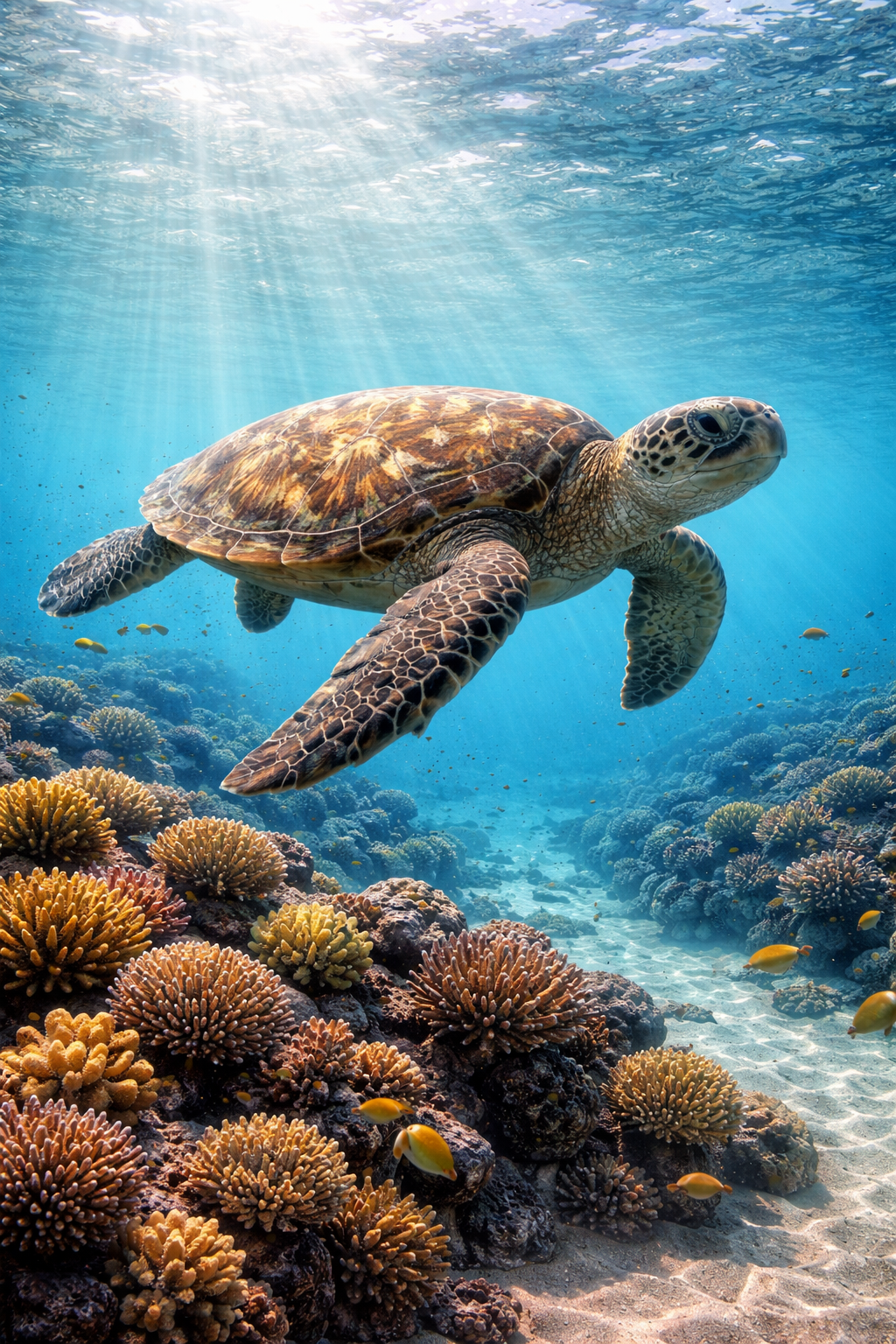
The Life Stages of a Sea Turtle
Sea turtles have one of the most extraordinary life histories in the animal kingdom. They spend virtually their entire lives at sea — the only time a sea turtle touches land is when a female hauls ashore to nest, a process she repeats every 2–5 years for decades. Everything else — feeding, migrating, sleeping, mating — happens in the ocean. And they do it guided by a biological magnetic compass that leads them unerringly back to the beach where they themselves hatched, sometimes after 30 years away.
Sea Turtle Age to Human Years Conversion
| Turtle Age | Green Turtle | Loggerhead | Leatherback | Life Stage |
|---|---|---|---|---|
| Hatchling | Newborn | Newborn | Newborn | Hatchling — "lost years" begin |
| 5 years | ~8 yrs | ~9 yrs | ~14 yrs | Juvenile — coastal feeding grounds |
| 10 years | ~14 yrs | ~16 yrs | ~24 yrs | Juvenile/Sub-adult |
| 20 years | ~26 yrs | ~29 yrs | ~42 yrs | Sub-adult / Approaching maturity |
| 30 years | ~38 yrs | ~42 yrs | ~58 yrs | Young adult — first nesting |
| 50 years | ~58 yrs | ~64 yrs | ~78 yrs | Prime adult — experienced nester |
| 70 years | ~74 yrs | ~79 yrs | Elder | Senior — still nesting |
| 100 years | ~90 yrs | Elder | — | Elder — exceptional longevity |
🐢 Sea turtle age in the wild is difficult to determine precisely. For living turtles, it is estimated using growth rates, mark-recapture data, and skeletochronology — counting growth rings in cross-sections of humerus bone, similar to tree rings. The 20–30 year journey to sexual maturity is one of the most important facts in sea turtle conservation: a female turtle nesting on a beach today hatched during or before the 1990s. Every adult turtle lost to bycatch or boat strike represents decades of ocean survival, and is essentially irreplaceable on any reasonable conservation timescale.
The Barnacle Problem — A Sign That Something Is Very Wrong
Barnacle removal is one of the most visually dramatic parts of sea turtle rehabilitation — and it tells the most complete story of what these animals go through. The three turtles released by the South Carolina Aquarium in March 2026 each arrived with barnacle-related complications. Camellia had barnacles covering her shell alongside pneumonia. Daffodil arrived with shell damage specifically caused by barnacle removal — evidence that someone had already attempted removal in the field without training, causing injuries that required months of additional healing. Daisy had heavy marine growth alongside bone infection that required surgery.
Search YouTube for "sea turtle barnacle removal" and you will find hours of carefully documented rehabilitation footage — some of it profoundly satisfying to watch, all of it a reminder of the quiet dedication of the people who do this work, and what sea turtles survive before they get a second chance at the ocean.
What started in 2000 as a makeshift hospital in the basement of the South Carolina Aquarium in Charleston — a kiddie pool and a scrawny 94-pound loggerhead named Stinky — has become one of the most sophisticated sea turtle rehabilitation facilities in the United States. The Zucker Family Sea Turtle Recovery™ operates in partnership with the SC Department of Natural Resources (SCDNR), which fields the first response to any sea turtle stranding along the South Carolina coast through a network of trained and permitted volunteers.
The facility features a CT scanner for detailed internal imaging without transporting turtles off-site, a modern operating room for surgical procedures, and — uniquely — an endless pool therapy tank with a continuous current that allows recovering turtles to exercise and build swimming strength before release. The SC Aquarium is believed to be the first sea turtle rehabilitation facility in the US to use this technology. The facility treats all seven sea turtle species and has nearly doubled its patient capacity since opening the Zucker Family expansion. Turtle patients are visible to aquarium visitors through one-way glass, with tablet displays sharing each individual's rescue story and recovery progress.
If you find a sick, injured, or stranded sea turtle in South Carolina, call the SCDNR stranding hotline: 1-800-922-5431. Do not move or touch the animal — just call and provide precise location information.
The most recent release, in March 2026, sent three turtles back to the ocean after months of intensive care — each one a case study in what sea turtle rehabilitation actually involves:
Visit the Zucker Family Sea Turtle Recovery at the South Carolina Aquarium in Charleston, or follow their patient updates at scaquarium.org/sea-turtle-care-center.
Sea Turtles — A Historic Conservation Win and Ongoing Challenges
2025 brought the biggest piece of sea turtle conservation news in decades, alongside a clearer picture of both the progress made and the challenges remaining.
At the IUCN World Conservation Congress in Abu Dhabi, the green sea turtle (Chelonia mydas) was officially reclassified from Endangered to Least Concern — one of the most dramatic status improvements ever recorded for a long-lived marine vertebrate, and the first change since the species was listed as Endangered in 1982.
The reclassification reflects a global population increase of over 28% since the 1970s, with four of five regional green turtle populations now growing. Notable recoveries include nesting populations in Mexico, Hawaii, Brazil, and the Caribbean. Loggerhead nests at Sal Island in Cape Verde surged from approximately 500 in 2008 to 35,000 in 2020.
The recovery is attributed to decades of legal protections, beach nesting protection programmes, reduced egg harvesting, elimination of commercial hunting, and adoption of turtle excluder devices in trawl fisheries. Scientists were careful to note the success is not grounds for complacency — green turtles still face serious threats from fishing bycatch, climate change, coastal development, and illegal take in some regions. Because sea turtles mature so slowly, "even small increases in mortality can quickly cause populations to decline again," warned conservationists. The work must continue.
A landmark study published in Nature Reviews Biodiversity by researchers from Deakin University and NOAA reviewed the global status of all seven sea turtle species — finding that significant population increases were six times more common than significant decreases in an updated 2024 analysis.
Over 40% of sea turtle populations are now considered low risk and low threat — up from just 23% in 2011. The research attributed recovery to the cessation of commercial harvesting and protection of nesting beaches, with conservation working most effectively where harmful human activities were curtailed earliest. Duke ecologist Stuart Pimm described it as "one of the real conservation success stories."
The significant exception: leatherback turtles are not recovering in line with other species. Many leatherback subpopulations remain critically endangered, with Pacific leatherback populations facing particularly severe threats from fishing bycatch on their transoceanic migrations. The study also flagged climate change as an emerging threat that existing conservation frameworks are not yet adequately addressing — rising temperatures skew hatchling sex ratios toward females, while sea level rise and storm intensity threaten nesting beach habitat.
The South Carolina Aquarium's Zucker Family Sea Turtle Recovery released its first three turtles of 2026 on March 3 — Camellia, Daisy, and Daffodil — into warm Florida waters after months of rehabilitation at the Charleston facility. The releases brought the aquarium's total to 480 sea turtles rescued, rehabilitated, and released since the programme's founding in 2000.
Each turtle's case illustrated the range of conditions that require professional rehabilitation. Camellia was cold-stunned with pneumonia and heavy barnacle growth. Daffodil arrived with shell damage caused by prior barnacle removal attempts in the field — a reminder that well-intentioned intervention without training can compound a turtle's injuries. Daisy required surgery to remove bone infected by osteomyelitis after arriving with heavy marine growth and multiple concurrent conditions including fungal pneumonia.
All three were discovered by members of the public along the South Carolina shoreline — demonstrating the critical role of public awareness in sea turtle rescue. Three additional turtles remain under rehabilitation at the facility.
An IUCN assessment involving nearly 150 sea turtle experts from 50 countries found that while threats have declined for the majority of sea turtle populations, fisheries bycatch remains the most pressing threat worldwide — alongside coastal development, ocean plastic pollution, climate change, and direct take of turtles and eggs in some regions.
The study evaluated 48 sea turtle populations across six species and found that over half now have declining overall threat levels. However, researchers stressed that the remaining at-risk populations — particularly Pacific leatherbacks — require urgent enhanced fisheries management, improved spatial protection, and sustained community-based conservation investment. New technologies including LED lights on fishing nets (shown to significantly reduce sea turtle bycatch without affecting fish catch) are showing promise but require wider adoption across diverse fishing communities to have population-level impact.
Things About Sea Turtles That Will Actually Surprise You
The Seven Sea Turtle Species
| Species | Size | Diet | IUCN Status | Notable Trait |
|---|---|---|---|---|
| Green (Chelonia mydas) | Up to 1.5m, 230kg | Seagrass, algae | Least Concern (2025) | Only herbivore; named for green-colored fat |
| Loggerhead (Caretta caretta) | Up to 1.1m, 180kg | Molluscs, crustaceans | Vulnerable | Powerful jaw; largest hard-shelled sea turtle |
| Leatherback (Dermochelys coriacea) | Up to 2.1m, 700kg | Jellyfish | Vulnerable (many DPS Critically Endangered) | Largest living reptile; no hard shell; deepest diver |
| Hawksbill (Eretmochelys imbricata) | Up to 1m, 80kg | Sponges | Critically Endangered | Distinctive beak; tortoiseshell trade drove near-extinction |
| Kemp's Ridley (Lepidochelys kempii) | Up to 0.7m, 45kg | Crabs, molluscs | Critically Endangered | Smallest sea turtle; mass nesting "arribadas" |
| Olive Ridley (Lepidochelys olivacea) | Up to 0.7m, 45kg | Invertebrates, fish | Vulnerable | Most abundant sea turtle; mass arribadas in Costa Rica |
| Flatback (Natator depressus) | Up to 0.9m, 90kg | Sea cucumbers, jellyfish | Data Deficient | Endemic to Australia; flattened shell; never leaves Australian waters |