Popular Pets
🐶 Dog 🐱 Cat 🐰 Rabbit 🐹 Hamster 🐾 Guinea Pig 🦜 Parrot 🦡 Ferret 🐀 Rat 🐭 Chinchilla 🦔 Hedgehog 🐟 Goldfish 🦜 Macaw
Farm & Large Animals
🐴 Horse 🐄 Cow 🐄 Highland Cow 🐷 Pig 🐑 Sheep 🐐 Goat 🐴 Donkey 🦙 Alpaca 🐐 Mountain Goat 🐔 Chicken 🦆 Duck 🦃 Turkey
Wild Animals
🐘 Elephant 🦁 Lion 🐯 Tiger 🐆 Leopard 🐺 Wolf 🐻 Bear 🐻‍❄️ Polar Bear 🦍 Gorilla 🐒 Chimpanzee 🦧 Orangutan 🦘 Kangaroo 🐾 Capybara 🦒 Giraffe 🦊 Fox 🦅 Raptor 🦉 Owl 🐧 Penguin 🦩 Flamingo 🐾 Hyena 🐾 Meerkat 🦥 Sloth 🦡 Badger 🐾 Wolverine 🐾 Armadillo
Ocean & Aquarium
🦈 Shark 🐋 Orca 🐬 Dolphin 🐋 Whale 🐋 Blue Whale 🐳 Beluga Whale 🦄 Narwhal 🐋 Bowhead Whale 🐾 Manatee 🐟 Manta Ray 🐟 Freshwater Fish 🐠 Saltwater Fish 🐴 Seahorse 🐟 Koi
Exotic & Weird
🐍 Snake 🐍 Ball Python 🦎 Bearded Dragon 🦎 Iguana 🦎 Komodo Dragon 🦎 Chameleon 🦎 Leopard Gecko 🐢 Tortoise 🐢 Snapping Turtle 🐢 Sea Turtle 🐊 Crocodilian 🕷️ Tarantula 🦎 Axolotl 🐙 Octopus 🌊 Jellyfish 🦞 Lobster 🐚 Quahog 🔬 Tardigrade
Info
About FAQ Contact
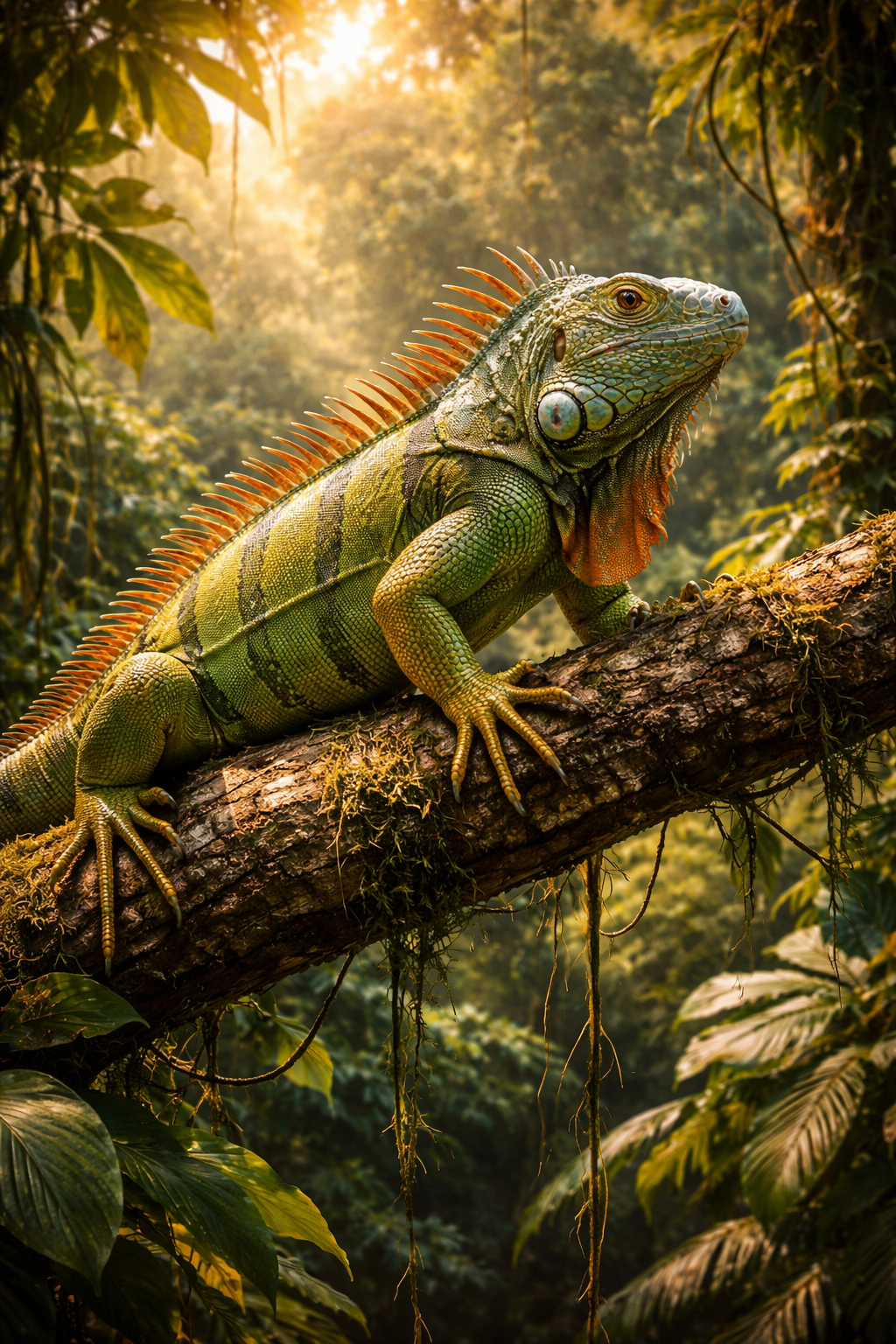
Photorealistic painting of a green iguana perched on a mossy rainforest branch in golden tropical light
🦎 Exotic Pets & Wild Animals

How Old Is an Iguana in Human Years?

📅 Updated March 2026 🌿 Central & South America (+ Florida) 🦎 Lifespan: 10–20 years

Iguanas have three eyes — yes, three. They can detach and regrow their tails. They are herbivores that look like tiny dragons. They have been living in Florida in their tens of millions for decades. And every winter, when a cold snap rolls through South Florida, the skies rain iguanas — thousands of them falling from the trees, frozen stiff, only to warm up and scurry away by noon.

Calculate Iguana Age →
🦎 Iguana Age in Human Years
in human years
Iguana age
Life stage
Species
🦎 What this age means

The Life Stages of a Green Iguana

Green iguanas follow a rapid early growth trajectory — they can triple in length in their first year — before slowing to a steady lifetime growth pattern. Unlike many reptiles, they remain socially complex throughout their lives, establishing hierarchies, communicating through colour and body language, and showing individual personalities that experienced keepers easily recognise.

0–6 months
Hatchling
Emerging from leathery eggs after 65–115 days of incubation, hatchlings are approximately 17–25cm long — bright green for camouflage in the rainforest canopy. They are immediately independent. In the wild, hatchlings spend their first months in dense vegetation, eating soft leaves, flowers, and fruit while avoiding an enormous list of predators including birds of prey, snakes, large lizards, and mammals. In captivity, hatchlings need frequent small feedings, high humidity, and access to UVB light from day one.
6 months–2 years
Juvenile
Growing rapidly — juveniles can reach 60–90cm by the end of their first year. The vibrant green of hatchlings is beginning to fade toward the more muted adult coloration, though males during breeding season may develop orange or gold tones. The dewlap — the extendable throat flap used for communication and thermoregulation — is becoming more pronounced. In captivity this is the period when most husbandry mistakes are made: enclosures that were adequate for a hatchling quickly become too small, and dietary errors during this critical growth phase can cause irreversible metabolic bone disease.
2–3 years
Sub-Adult
Approaching sexual maturity. The sub-adult iguana is establishing its social position — in both wild populations and multi-iguana households, hierarchies based on size and assertiveness are actively negotiated. Males begin displaying more intensely: head-bobbing, dewlap extensions, lateral compression to appear larger. The parietal eye (third eye) on top of the skull is fully functional, detecting light and shadow changes that warn of aerial predators — a critical survival tool in the rainforest canopy. The tail is now fully capable of autotomy — detachment as a predator-escape mechanism.
3–7 years
Prime Adult
Sexually mature and fully grown — females typically reach 1.2–1.5m; males 1.5–2m including tail. Adult males develop pronounced jowls, a larger dewlap, and vivid orange or gold coloring during breeding season. Wild female iguanas seek out sun-exposed sandy areas to lay clutches of 25–75 eggs — a significant energetic investment. In captivity, prime adults often become the most interactive and personality-rich phase of iguana keeping — settled, confident, habituated to their environment, and capable of recognising their keepers individually.
7–12 years
Mature Adult
Growth has slowed but continues. A well-cared-for captive iguana in this stage is an impressive animal — often 1.5–2 metres long including tail, with the full adult complement of spines, dewlap, and jowl development. Females continue to produce eggs seasonally even without a male, though unfertilised eggs are smaller and fewer. Older iguanas in the wild in Florida may reach this stage with no natural predators to concern them — contributing to their extraordinary reproductive success as an invasive species.
12–20+ years
Senior / Elder
A well-maintained captive iguana in senior years is a genuine testament to good husbandry. Iguanas at this stage may show signs of slowing — less activity, reduced appetite during certain seasons, possible development of age-related conditions. The longest-lived captive green iguanas have reached approximately 29 years. An iguana that has lived this long in human care has survived decades of potential husbandry errors, dietary challenges, and the physical demands of a complex reptile life — no small feat for either the animal or its keeper.

Iguana Age to Human Years Conversion Table

Iguana AgeGreen IguanaBlue IguanaRhinoceros IguanaLife Stage
HatchlingNewbornNewbornNewbornHatchling — immediately independent
6 months~5 yrs~4 yrs~3 yrsJuvenile — rapid growth phase
2 years~17 yrs~12 yrs~14 yrsSub-adult — approaching maturity
4 years~28 yrs~21 yrs~24 yrsPrime adult — fully mature
7 years~43 yrs~34 yrs~38 yrsMature adult
10 years~58 yrs~46 yrs~53 yrsSenior
15 years~78 yrs~65 yrs~70 yrsElder
20+ yearsElder~82 yrs~86 yrsRecord territory

🦎 The Grand Cayman Blue Iguana (Cyclura lewisi) is one of the rarest lizards on Earth — fewer than 1,000 individuals exist, and its captive lifespan can exceed 25 years, making it one of the longest-lived iguanid lizards. Conservation breeding programmes at the Blue Iguana Conservation programme in the Cayman Islands have raised the wild population from approximately 10–15 individuals in the 2000s to over 500 today — one of the most successful reptile recovery programmes in conservation history.

Iguana Rain — Florida's Most Surreal Weather Event

🌨️ It's Literally Raining Iguanas in Florida

Green iguanas are native to Central and South America — and they have no business being in Florida. Yet here we are. Through decades of escaped pets, deliberate releases, and the state's subtropical climate providing essentially no resistance to their establishment, tens of millions of green iguanas now inhabit South Florida. They are in the canals, the golf courses, the seawalls, the gardens, and most conspicuously — the trees.

The trees are where things get interesting every winter. Green iguanas are cold-blooded (ectothermic) — they cannot generate their own body heat. When Florida temperatures drop below about 50°F (10°C), iguanas enter a state called torpor: their metabolism slows, their muscles lose function, and they can no longer grip the branches they roost in. The result is spectacular — and slightly hazardous. They fall.

Thud. From canopy height. Apparently lifeless. Lying on sidewalks, driveways, golf course fairways, and the roofs of cars. Floridians have learned to watch their step on cold winter mornings. The iguanas are not dead — they recover fully as temperatures rise, sometimes warming up and becoming defensive before anyone realises they're conscious again.

5,000+
Removed in 2 days (Feb 2026)
8,000
Total estimated removed (Feb 2026)
50°F
Temperature at which torpor begins

During Florida's significant cold snap in late January–early February 2026, the Florida Fish & Wildlife Conservation Commission issued Executive Order 26-03 — temporarily allowing members of the public to collect live cold-stunned iguanas without a permit and deliver them to five designated drop-off sites across South Florida. In just two days, over 5,195 iguanas were turned in by members of the public, with private pest control services estimating a further 2,800+, for a combined removal of around 8,000. FWC Director Roger Young credited "the coordinated efforts of our staff, partners, and of course the many residents that took the time to collect and turn in cold-stunned iguanas from their properties."

Despite the scale of the removal effort, wildlife experts were quick to temper expectations. With estimated tens of millions of iguanas across the state, 8,000 removals represent a fraction of a percent of the population. "It certainly speaks to the number of these animals that are out there," said Zoo Miami wildlife expert Ron Magill. Every cold snap creates headlines — and every warm spring sees the population bounce back.

Florida's Iguana Problem — The Full Story

📰 February 2026 — Florida Cold Snap
"Iguana Rain" — Thousands Fall from Trees Across South Florida

As a significant cold front swept through South Florida in late January and early February 2026, dropping temperatures into the mid-30s°F, a phenomenon familiar to long-time Floridians unfolded across Miami-Dade, Broward, and Palm Beach counties: iguanas falling from trees by the hundreds.

Residents woke to find the cold-stunned reptiles sprawled across driveways, sidewalks, and lawns — some measuring over four and a half feet from nose to tail. Reports flooded social media. Private removal companies worked around the clock. One professional, Jessica Kilgore of Iguana Solutions, noted that iguanas near the beach were particularly hard-hit: "the air coming off the cold water is even colder for them, and the wind is stronger over there, so it knocks them out the trees."

The FWC issued Executive Order 26-03 allowing public collection without permits on February 1–2. 600 iguanas were dropped off at FWC facilities on Sunday alone, with 350 more by Monday afternoon — including 140 collected by Palm Beach County Parks and Recreation. One family turned the event into an educational outing: father Tim Arsenault and his five-year-old daughter Rory pulled a wagon around their neighbourhood, collecting iguanas and counting them aloud. "It was really fun," he said. The order expired Tuesday, February 3, with the FWC confirming it would no longer accept iguanas and reminding residents that transporting live iguanas remains illegal without a state permit.

📰 The Warning — Don't Bring Them Inside
They're Not Dead — And They Wake Up Fast

Every Florida cold snap comes with the same official warning: do not bring cold-stunned iguanas indoors or into your vehicle. The temptation to "rescue" what appears to be a dying lizard is understandable — but the reality is that iguanas can revive rapidly once exposed to warmth, and a suddenly-conscious 4-foot iguana in your car or living room is a serious problem.

Iguanas recovering from torpor can be aggressive and defensive — biting with sharp teeth, scratching with powerful claws, and whipping with a long tail capable of causing real injury. The FWC advised residents who find stunned iguanas to leave them alone and allow them to warm naturally, or to humanely euthanise them on their property if desired under existing state law. During the emergency window, collection required strict containment: sealed breathable cloth bags inside a locked secondary container labelled "Prohibited Reptiles."

Florida also reminded residents that iguanas are a Prohibited species — possession, transport, and sale require state permits. The cold snap paradoxically made them briefly the most collectible animal in Florida, then immediately made them illegal to transport again 48 hours later.

📰 The Ecological Damage
What Millions of Iguanas Are Actually Doing to Florida

The iguana-falling-from-trees story makes for entertaining news, but the underlying ecological reality in Florida is serious. Green iguanas are aggressive burrowers, capable of digging tunnels up to 50 feet (15 metres) underground. Those burrows undermine seawalls, collapse sidewalks, damage building foundations, and erode canal banks. The infrastructure cost runs into millions of dollars annually.

Ecologically, the damage is significant. Iguanas push burrowing owls out of their burrows — the owls are a protected species in Florida, and iguana competition for nest sites is a documented threat. During cold snaps, iguanas flee into gopher tortoise burrows — gopher tortoises are a keystone species whose burrows support over 350 other species. The iguanas eat native plants, compete with native wildlife for food, and have essentially no natural predators in Florida capable of controlling their population. Florida has documented over 600 nonnative species statewide — with 139 established and breeding — making it one of the most invaded ecosystems in the world. The iguana is among the most visible and disruptive.

📰 How Did This Happen?
From Pet Store to Invasive Plague — The Iguana's Florida Journey

Green iguanas first appeared in Florida in the 1960s — likely through escaped or deliberately released pets. For decades the population remained small, confined to the southernmost tip of the state. Then several factors combined to accelerate their spread dramatically.

The exotic pet trade brought millions of green iguanas into American homes through the 1990s and 2000s. Many owners discovered too late that a cute 6-inch hatchling grows into a 5-foot, 17-pound adult that requires a large dedicated enclosure, specialised lighting, and decades of care. Abandonment and release — illegal but rampant — seeded populations across South Florida. Hurricane Andrew in 1992 is also thought to have released large numbers from importation facilities. Florida's subtropical climate proved essentially indistinguishable from the iguana's native Central American range for most of the year.

Today, the FWC actively encourages removal and offers guidance on humane euthanasia. Homeowners are legally permitted to remove iguanas from their property without a permit. Professional iguana removal is now an established industry in South Florida, with dedicated companies, trapping services, and removal programmes operating year-round. The cold snap events — however dramatic — are not a management solution. The iguana is, in all practical terms, a permanent resident of Florida.

Things About Iguanas That Will Actually Surprise You

👁️ The Third Eye
Iguanas have a parietal eye — a genuine third eye — on the top of their head, visible as a small pale scale between the two regular eyes. This organ has a basic lens, retina, and direct nerve connection to the pineal gland, which regulates circadian rhythms, hormonal cycles, and seasonal behaviour. It detects changes in light intensity and direction but does not form images. In their natural arboreal habitat, the parietal eye is a critical early warning system for aerial predators — a hawk-shaped shadow moving across the sky triggers a defensive response before the iguana even looks up. It also regulates basking behaviour, helping the iguana optimise its sun exposure through the day.
🦎 The Detachable Tail
Iguanas can voluntarily detach their tail as a predator-escape mechanism — a process called autotomy. When grabbed by the tail, specialised fracture planes in the vertebrae allow a section to separate cleanly, the detached segment continuing to wriggle and distract the predator while the iguana escapes. The tail then regrows over several months, though the regenerated section is composed of cartilage rather than bone and rarely matches the original in length, colour, or texture. Iguanas can lose and partially regrow their tails multiple times during a lifetime. Owners should never grab or restrain an iguana by its tail for this reason — and also because a tail-whip from a large iguana is genuinely painful.
🌡️ Cold-Blooded in a Hot Climate
Iguanas are ectotherms — they rely entirely on external heat sources to reach and maintain their operating body temperature of approximately 35–40°C (95–104°F). This is why they spend significant portions of their day basking. In their native tropical range, ambient temperatures rarely drop low enough to cause problems. But in Florida, even a moderate cold front can drop overnight temperatures below the critical threshold, triggering the torpor response that causes the famous tree-falls. Iguanas do not hibernate — unlike true hibernators, they do not enter cold weather in a prepared, protected state. They simply stop functioning where they are, whatever that happens to be. Florida Fish & Wildlife recommends against moving stunned iguanas, as they recover faster than people expect.
🥗 Committed Herbivores
Green iguanas are among the most strictly herbivorous lizards in the world — their entire digestive system is adapted for plant material, with a long fermentation chamber (a modified large intestine) that uses symbiotic bacteria to break down plant cellulose. In the wild, they eat hundreds of different plant species — leaves, flowers, fruit, and growing tips — with a preference for young, nutrient-rich growth. The most common captive health problem — metabolic bone disease — results from dietary calcium deficiency and insufficient UVB exposure. It causes soft, malformed bones and is almost entirely preventable with correct husbandry, yet it remains the leading cause of early iguana death in captivity.
🐟 They Can Swim — Well
Iguanas are surprisingly capable swimmers — they can hold their breath for extended periods and propel themselves through water using powerful lateral undulations of their tail, with all four legs held against the body. In the wild, they regularly swim across rivers and between islands. Research published in Nature confirmed that iguanas colonised the Caribbean island of Anguilla after a 1995 hurricane by rafting across 300 kilometres of open ocean on floating vegetation — surviving at sea for weeks. In Florida, their swimming ability allows them to move freely between canal systems and waterways, making the network of South Florida's canals essentially an iguana highway system connecting the entire region.
🟠 Why Males Turn Orange
Male green iguanas turn vivid orange or gold during breeding season — a dramatic seasonal colour change driven by testosterone. The orange colouration signals reproductive fitness to females and dominance to rival males. The dewlap — the large throat flap — also becomes more prominent and heavily pigmented. Combined with head-bobbing displays, lateral compression to appear larger, and intensified territorial behaviour, a breeding-season male green iguana is a strikingly different animal from its usual muted green self. Captive males will display this seasonal colour change even without any females present, simply in response to seasonal hormonal changes triggered by changing light cycles — the parietal eye regulates the timing.

Common Iguana Species

SpeciesSizeLifespanOriginStatusNotable
Green Iguana (Iguana iguana)Up to 2m10–20 yrsC & S AmericaLeast Concern (Invasive in FL)Most common pet iguana; invasive in Florida, Hawaii, Puerto Rico
Grand Cayman Blue Iguana (Cyclura lewisi)Up to 1.5m25+ yrsCayman IslandsEndangeredRecovered from ~15 to 500+ wild individuals; one of rarest lizards
Rhinoceros Iguana (Cyclura cornuta)Up to 1.35m20+ yrsHispaniolaVulnerableNamed for horn-like protrusions on snout; very long-lived in captivity
Desert Iguana (Dipsosaurus dorsalis)Up to 60cm~10 yrsSW USA/MexicoLeast ConcernHeat-tolerant; active at temperatures lethal to most reptiles
Marine Iguana (Amblyrhynchus cristatus)Up to 1.7m~12 yrsGalápagos IslandsVulnerableOnly ocean-going lizard; dives to 30m to graze algae; can shrink body

Other Reptiles on PawClocks

Frequently Asked Questions

Green iguanas are cold-blooded — they cannot regulate their own body temperature. When Florida temperatures drop below about 50°F (10°C), iguanas enter torpor: their metabolism slows and they lose muscle control. Unable to grip branches, they fall from trees. They are not dead — they recover fully as temperatures rise, sometimes within hours. This happens during every significant Florida cold snap. With tens of millions of invasive iguanas established in South Florida, the spectacle of "iguana rain" has become an annual news event, with thousands falling from trees during significant cold fronts.
Yes — iguanas have a parietal eye on the top of their head, visible as a small pale scale between the two regular eyes. This organ has a basic lens and retina and detects light and shadow changes, but does not form images. It is connected to the pineal gland and regulates circadian rhythms, seasonal behaviour, and thermoregulation timing. In the wild, it functions as an early warning system for aerial predators — detecting a predator's shadow before the iguana even looks up.
Yes — iguanas can voluntarily detach their tail when grabbed by a predator (autotomy), and then regrow it over several months. The regenerated tail is composed of cartilage rather than bone and rarely matches the original in length, colour, or texture. Iguanas can lose and partially regrow their tails multiple times during a lifetime. Never grab or restrain an iguana by its tail — you risk triggering autotomy and causing a painful defensive response.
Iguanas can be rewarding pets for experienced reptile keepers but are frequently abandoned when owners discover their true requirements. Green iguanas need very large enclosures (minimum 6x6x4 feet for an adult), UVB lighting, basking temperatures of 35–40°C, a varied diet of dark leafy greens and vegetables, and daily social interaction. They grow to 1.5–2 metres and live 10–20 years. Wild-caught iguanas are particularly difficult to tame. The large number of released or escaped pet iguanas directly contributed to the Florida invasion.
Green iguanas are strict herbivores — their diet should consist of dark leafy greens (collard greens, mustard greens, dandelion greens), a variety of vegetables, and occasional fruit. They should not be fed spinach or excessive lettuce, and high-protein animal foods cause kidney disease. The most common captive health problem — metabolic bone disease — results from dietary calcium deficiency and insufficient UVB light. It is almost entirely preventable with correct husbandry but remains the leading cause of early iguana death in captivity.
Male green iguanas turn vivid orange or gold during breeding season — a testosterone-driven colour change that signals reproductive fitness to females and dominance to rival males. The dewlap (throat flap) also becomes more prominent and heavily pigmented. The timing of this seasonal change is regulated by changing light cycles detected partly through the parietal eye. Captive males will display this colour change even without any females present, purely in response to seasonal hormonal cycles.
Green iguanas first appeared in Florida in the 1960s through escaped and released pets. The exotic pet trade brought millions into American homes through the 1990s and 2000s, with many released when owners discovered the demands of caring for a large, long-lived lizard. Hurricane Andrew in 1992 is also thought to have released large numbers from importation facilities. Florida's subtropical climate proved essentially identical to the iguana's native range, allowing rapid population growth with no natural predators capable of controlling their numbers.