Popular Pets
🐶 Dog 🐱 Cat 🐰 Rabbit 🐹 Hamster 🐾 Guinea Pig 🦜 Parrot 🦡 Ferret 🐀 Rat 🐭 Chinchilla 🦔 Hedgehog 🐟 Goldfish 🦜 Macaw
Farm & Large Animals
🐴 Horse 🐄 Cow 🐄 Highland Cow 🐷 Pig 🐑 Sheep 🐐 Goat 🐴 Donkey 🦙 Alpaca 🐐 Mountain Goat 🐔 Chicken 🦆 Duck 🦃 Turkey
Wild Animals
🐘 Elephant 🦁 Lion 🐯 Tiger 🐆 Leopard 🐺 Wolf 🐻 Bear 🐻‍❄️ Polar Bear 🦍 Gorilla 🐒 Chimpanzee 🦧 Orangutan 🦘 Kangaroo 🐾 Capybara 🦒 Giraffe 🦊 Fox 🦅 Raptor 🦉 Owl 🐧 Penguin 🦩 Flamingo 🐾 Hyena 🐾 Meerkat 🦥 Sloth 🦡 Badger 🐾 Wolverine 🐾 Armadillo
Ocean & Aquarium
🦈 Shark 🐋 Orca 🐬 Dolphin 🐋 Whale 🐋 Blue Whale 🐳 Beluga Whale 🦄 Narwhal 🐋 Bowhead Whale 🐾 Manatee 🐟 Manta Ray 🐟 Freshwater Fish 🐠 Saltwater Fish 🐴 Seahorse 🐟 Koi
Exotic & Weird
🐍 Snake 🐍 Ball Python 🦎 Bearded Dragon 🦎 Iguana 🦎 Komodo Dragon 🦎 Chameleon 🦎 Leopard Gecko 🐢 Tortoise 🐢 Snapping Turtle 🐢 Sea Turtle 🐊 Crocodilian 🕷️ Tarantula 🦎 Axolotl 🐙 Octopus 🌊 Jellyfish 🦞 Lobster 🐚 Quahog 🔬 Tardigrade
Info
About FAQ Contact
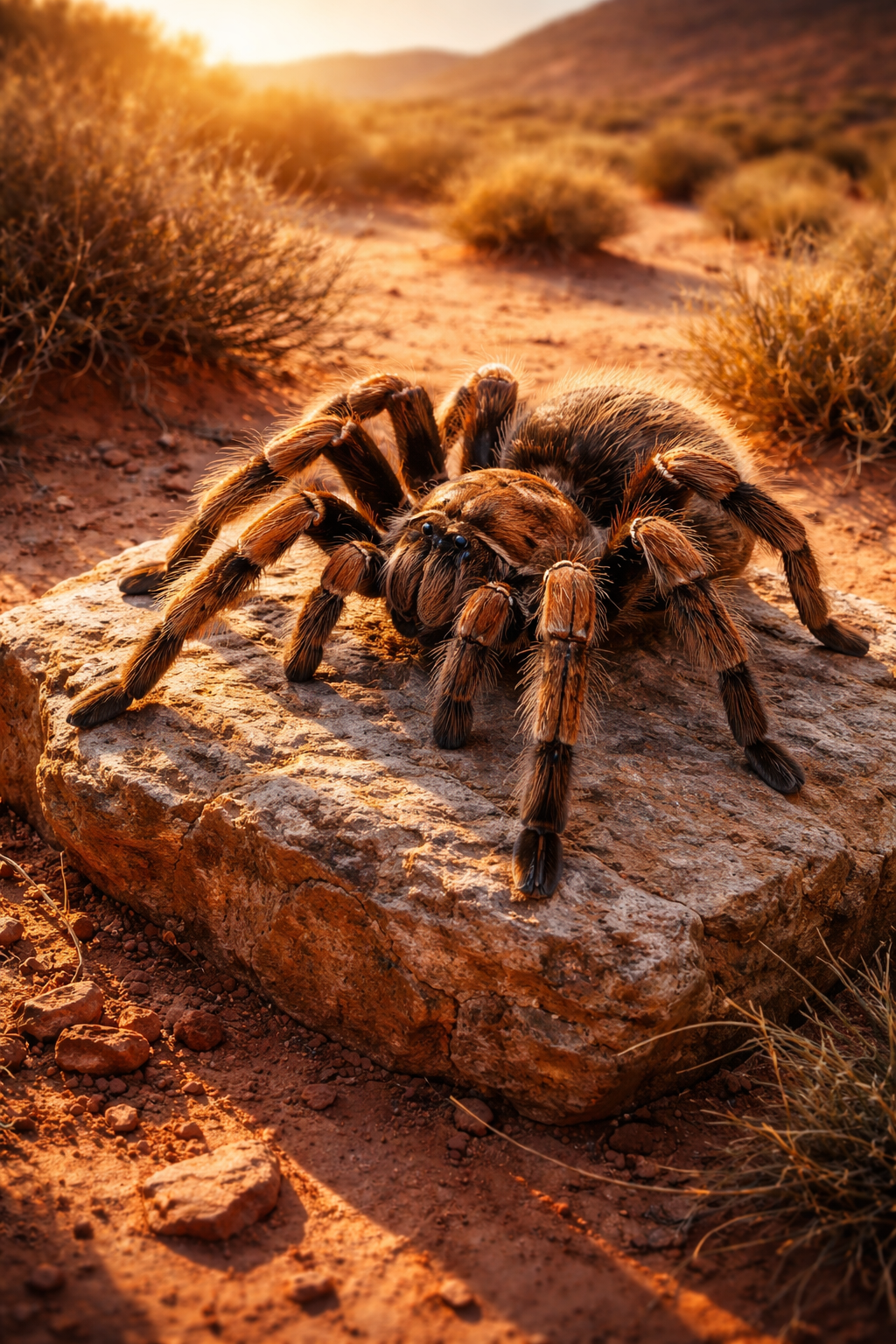
Photorealistic painting of a tarantula in desert landscape
🕷️ Exotic Pets

How Old Is a Tarantula in Human Years?

📅 Updated 🔬 ~1,000 species 🕷️ Females live 20–30 years

A female tarantula can live 30 years — longer than most cats. She extends her legs with hydraulics, not muscles. Her blood is blue. She can regrow a lost leg. And she will likely outlive the male of her species by two decades.

Calculate Tarantula Age →
🕷️ Tarantula Age in Human Years
in human years
Tarantula age
Life stage
Species
🕷️ What this age means
♀ vs ♂ — The Most Extreme Lifespan Gap in Pet Keeping
Female tarantulas and males of the same species live radically different lives. A female Mexican red knee can live 25–30 years. A male of the same species typically lives 4–7 years total — and after his final moult to sexual maturity (his "ultimate moult"), he has months to a few years at best before he dies. Males stop moulting after their ultimate moult — they cannot regenerate lost limbs and their exoskeleton slowly deteriorates. This is why a "juvenile" tarantula sold in a pet store that is later confirmed male is a different long-term commitment than a confirmed female. If you want a long-lived companion, confirm female — through a moult (look for spermathecae in the shed skin) or via experienced examination.

Six Tarantulas Worth Knowing

🕷️ Rose Hair / Chilean Rose
Grammostola rosea / porteri
Female lifespan15–20 yrs
TemperamentVery docile; most beginner-friendly
Notable quirkMay fast for months without cause
DifficultyBeginner
🕷️ Mexican Red Knee
Brachypelma hamorii
Female lifespan25–30 yrs
TemperamentCalm; will kick urticating hairs
StatusCITES Appendix II — protected
DifficultyBeginner
🕷️ Cobalt Blue
Cyriopagopus lividus
Female lifespan15–20 yrs
TemperamentDefensive, fast, Old World
VenomMore potent — no urticating hairs
DifficultyAdvanced
🕷️ Green Bottle Blue
Chromatopelma cyaneopubescens
Female lifespan12–14 yrs
TemperamentSkittish but not aggressive
ColourOne of the most vivid species
DifficultyBeginner–Intermediate
🕷️ OBT / Orange Baboon
Pterinochilus murinus
Female lifespan12–15 yrs
TemperamentHighly defensive; "Old World personality"
Keeper nickname"Pterror" for a reason
DifficultyIntermediate–Advanced
🕷️ Goliath Bird-Eating
Theraphosa blondi
Female lifespan20–25 yrs
SizeLeg span up to 30 cm — world's largest
Urticating hairsMost irritating of any species
DifficultyAdvanced

Female Rose Hair Tarantula — Age to Human Years

Tarantula AgeHuman EquivalentLife StageWhat's Happening
6 months~3 yrsSpiderlingTiny, fragile; moulting frequently
1 year~5 yrsJuvenileGrowing steadily; moulting several times per year
3 years~14 yrsSub-adultApproaching adult size; moulting less frequently
5 years~22 yrsYoung adultFully adult; annual moults typical
8 years~33 yrsPrime adultPrime of life; full adult behaviour
12 years~48 yrsMatureMature; moults may become less frequent
16 years~62 yrsSeniorSenior; careful monitoring of moult health
20+ years~74 yrsElderElder; remarkable longevity

🕷️ The longest-lived tarantula on verified record was a female Brachypelma (Mexican species, likely B. hamorii) that lived to at least 28–30 years in captivity. The oldest well-documented wild tarantula was a female in Mexico estimated at 43 years old based on tracking data, though this record is debated. Female tarantulas continue to moult throughout their lives — each moult can restore lost limbs and reset some physical condition. Males stop moulting after sexual maturity and cannot heal injuries.

The Life Stages of a Tarantula

Tarantulas have one of the most extreme lifespan sexual dimorphisms in the animal kingdom — females of some species live 20–30 years while males of the same species live only 3–7 years, dying shortly after their first mating. The female's life is a slow, methodical accumulation of moults, growth, and territory. The male's is a brief, urgent sprint toward reproduction — and then it ends.

0–3 mo
Spiderling
Hatches from an egg sac of 50–2,000 siblings, often dispersing immediately via ballooning (releasing silk threads to catch air currents). Tiny — 3–5mm. Moults within weeks. Eats micro-prey only — fruit flies, pinhead crickets. Highly vulnerable to desiccation, oversized prey, and temperature extremes. The majority of wild spiderlings do not survive their first year.
3 mo–1 yr
Juvenile
Growing rapidly through multiple moults — 4–8 moults per year in fast-growing species. Adult colouration beginning to show. Establishing burrow or arboreal retreat. The keeper gets the first real sense of the individual's personality — bold explorer or defensive retreater. Diet expanding to appropriately sized crickets and roaches.
1–3 yrs
Sub-adult
Approaching sexual maturity — sex identifiable by examining the shed moult under magnification for spermathecae (female) or their absence (male). Males develop tibial hooks at their penultimate moult, visible on the front legs. Both sexes still moulting regularly, 2–4 times per year in most species.
3–7 yrs (♂)
Mature Male
After the ultimate moult, the male's biology shifts entirely to reproduction. He stops moulting permanently, cannot heal injuries, and begins wandering in search of females — sometimes covering large distances. He may live 6–18 months after his ultimate moult. Whether or not he is eaten by his mate, he will die. This is not exceptional — it is the design.
3–10 yrs (♀)
Prime Female
Females continue moulting every 1–3 years throughout their adult lives — each moult resetting some physical condition and capable of regrowing lost limbs. At peak reproductive capacity: producing egg sacs of 500–2,000 eggs. The Goliath birdeater produces egg sacs of up to 400 eggs. A prime female is the most physically impressive specimen of her species.
10–20 yrs (♀)
Senior Female
Moult frequency slowing to every 2–3 years. Moult success requires monitoring — older individuals occasionally struggle with incomplete moults. Still capable of reproduction. Rose hair tarantulas are often at this stage for the majority of their captive lives. Their patience and stillness are extraordinary — they may not move for weeks.
20–30+ yrs (♀)
Elder Female
The oldest tarantulas ever recorded. A female Brachypelma verified at 28–30 years in captivity. A wild female in Mexico estimated at 43 years, though this record is debated. Every moult at this stage is a triumph of genetics and husbandry. They continue moulting, regrowing limbs, and — occasionally — producing viable egg sacs even at advanced age.

Things About Tarantulas That Will Actually Surprise You

🧲 Hydraulic Legs — No Extensor Muscles
Tarantulas have no extensor muscles in most leg segments — they extend their legs entirely by pumping haemolymph (spider "blood") into them under pressure, using it like a hydraulic system. Flexor muscles pull the legs in; pressure pushes them out. This is confirmed in biomechanical studies of spider locomotion and explains the "death curl" — without haemolymph pressure, legs contract to their resting flexed position. A tarantula in death curl (legs curled inward under the body) is in critical distress or dead. This is fundamentally different from the moulting position — lying flat on its back with legs extended outward — which is normal and must not be disturbed. The hydraulic system also limits how long tarantulas can run at speed before pressure drops and they must rest.
🔄 Moulting — Shedding and Regenerating
Every growth phase requires a full moult — the tarantula splits open the carapace, flips onto its back, and slowly pulls its entire body free from the old exoskeleton. The process takes 15 minutes to several hours depending on the individual. The new exoskeleton is pale, soft, and fragile — hardening over several days to two weeks. During this window the tarantula is entirely defenceless. Never feed during this period — a cricket can kill a freshly moulted tarantula. The remarkable bonus: lost limbs regrow. A leg severed by a predator or enclosure accident regrows as a smaller version at the next moult, reaching full size after several cycles. Females continue moulting throughout their entire lives — potentially 30 years of moults. Males moult for the last time at sexual maturity and never moult again.
🦔 Urticating Hairs — A Unique Weapon
New World tarantulas (Americas) evolved a defence unique among spiders: urticating hairs on the abdomen — barbed, microscopic bristles they rapidly kick toward threats using the hind legs. The hairs become embedded in skin, eyes, and mucous membranes, causing intense irritation lasting hours to days. They are chemically inert but physically devastating — the barbs prevent removal and work their way deeper with movement. The Goliath bird-eating tarantula (Theraphosa blondi) has the most irritating urticating hairs of any species — fine enough to cause severe respiratory distress if inhaled. A bald patch on the abdomen indicates recent hair-kicking. Always wash hands after handling and never touch your face. Old World tarantulas lack urticating hairs entirely — they rely on speed and more potent venom instead.
🕸️ Trip-Webs & Trichobothria
Tarantulas do not spin orb webs. Their silk is used for lining burrows, creating silk-mat trip-web entrances that transmit ground vibrations from approaching prey, and as a dragline safety line during movement. But their primary sensory system isn't the web — it's trichobothria: specialised hair-like sensory organs on the legs that detect air movement and vibration with extraordinary sensitivity. Trichobothria can detect the wing-beat disturbance of an insect flying several centimetres away — effectively giving the tarantula sonar-like prey detection in complete darkness. Arboreal species like Poecilotheria build complex tube-web retreats in tree hollows; burrowing species like the Goliath create silk-reinforced tunnel systems up to 30cm deep. A tarantula's burrow entrance web is effectively a seismic sensor.
📏 The Goliath — World's Largest Spider
The Goliath bird-eating tarantula (Theraphosa blondi) of the South American rainforest is the world's largest spider by mass — females weigh up to 175g with a leg span of 28–30 cm. The name comes from a Victorian-era engraving showing one consuming a hummingbird — a rare occurrence at best. Its actual diet is large insects, frogs, lizards, small snakes, and rodents. Its urticating hairs are so fine they cause respiratory distress if airborne. Its fangs (2.5–3.8cm) are large enough to pierce human skin but its venom is mild. The giant huntsman spider (Heteropoda maxima) of Laos has a wider leg span (30cm+) but far less mass. The Goliath produces an audible hissing sound by rubbing leg hairs together — a defensive stridulation that carries several metres.
🫀 Blue-Green Blood & Hydraulic Circulation
Tarantula haemolymph is blue-green — coloured by haemocyanin, a copper-based oxygen-carrier, rather than the iron-based haemoglobin of vertebrates. Their circulatory system is open: haemolymph is not enclosed in vessels but flows freely through body cavities, driven by a simple tubular heart. This system is efficient at low activity levels but fails rapidly under physical stress — a tarantula can literally run itself into haemolymph pressure failure. It also means abdominal rupture from falls is catastrophic and often fatal. Never allow a tarantula to climb higher than waist level — a fall that seems minor to a human can rupture the abdomen and cause death within hours from haemolymph loss. This is one of the most common causes of pet tarantula death, and one of the most preventable.

🕷️ The rose hair tarantula (Grammostola rosea / G. porteri) is famous among keepers for extended voluntary fasting — individuals have been documented going over 2 years without eating while remaining perfectly healthy. This is not illness; it is normal behaviour, possibly linked to seasonal cycles in their native Chilean habitat. Keepers who panic-handle, force-feed, or dramatically alter husbandry in response to a fasting rose hair frequently cause more harm than the fast itself. Offer food every 2–4 weeks, ensure water access, maintain stable temperatures, and wait. It will eat when it is ready.

Popular Pet Tarantula Species — At a Glance

With ~1,000 described species, choosing a tarantula involves understanding the dramatic differences in temperament, care requirements, and lifespan. Here are the most commonly kept species ranked roughly from beginner-friendly to advanced.

SpeciesCommon Name♀ LifespanTemperamentDefenceKeeper Level
Grammostola pulchripesChaco Golden Knee20–25 yrsVery docile; slow-movingUrticating hairs (mild)Beginner
Brachypelma hamoriiMexican Red Knee20–30 yrsDocile; occasionally flicks hairsUrticating hairsBeginner
Grammostola rosea / porteriRose Hair / Chilean Rose15–20 yrsDocile but unpredictable; famous fastersUrticating hairs (mild)Beginner
Chromatopelma cyaneopubescensGreen Bottle Blue (GBB)12–14 yrsFast; skittish; not for handlingUrticating hairs; speedIntermediate
Psalmopoeus cambridgeiTrinidad Chevron (OBT)12–15 yrsDefensive; fast; will biteSpeed; potent biteIntermediate
Haplopelma lividumCobalt Blue15–20 yrsHighly defensive; fast; aggressivePotent venom; speedAdvanced
Poecilotheria metallicaGooty Sapphire Ornamental12–15 yrsFast; defensive; stunning coloursMedically significant venomAdvanced
Theraphosa blondiGoliath Bird-Eater20–25 yrsDefensive; irritating urticating hairsSevere urticating hairs; stridulationAdvanced

🕷️ Poecilotheria species (Asian ornamental tarantulas) are listed on the IUCN Red List — several are Critically Endangered or Endangered due to deforestation in India and Sri Lanka. They are among the most medically significant tarantulas in captivity, with documented bites causing muscle cramps, vomiting, and prolonged pain. They are stunning animals — but strictly for experienced keepers with proper first-aid knowledge and a nearby medical facility.

Other Exotic Pets

Frequently Asked Questions

The most reliable method is examining a shed exoskeleton (moult) under magnification. In females, the inner surface of the abdomen's upper portion shows two small flap-like structures called spermathecae — sperm storage organs that appear as a small arrow or wishbone shape. Males lack these. After a male's ultimate moult, he also develops tibial hooks (small hooks on the front legs used during mating to hold the female's fangs) and boxing-glove-like palpal bulbs on the pedipalps — both clearly visible to the naked eye. Juveniles and spiderlings are difficult to sex accurately without magnification and a moult. Purchasing from a reputable seller who guarantees sex via moult examination is the most reliable route for those wanting a confirmed female.
For most healthy adults, no — but the distinction between New World and Old World species matters significantly. New World tarantulas (Americas) have mild venom and rely primarily on urticating hairs for defence — their bite is roughly equivalent to a wasp sting for most people, though individual allergic reactions can be more serious. Old World tarantulas (Africa, Asia, Europe) lack urticating hairs and have evolved more potent venom as their primary defence — species like the cobalt blue, king baboon, or Poecilotheria species (Asian ornamental tarantulas) can cause more significant envenomation symptoms including muscle cramps, nausea, and prolonged pain. No human death has been definitively attributed to any tarantula bite. Anyone experiencing unusual symptoms after a bite should seek medical attention.
Not necessarily — extended fasting is common and normal in tarantulas, particularly rose hairs (which may fast for 1–2+ years), and in any species approaching a moult, during cooler temperatures, or during seasonal cycles. The key indicators that distinguish normal fasting from a health problem are: weight loss (a fasting healthy tarantula maintains its body mass; a sick one loses weight and the abdomen shrivels), behavioural changes beyond just refusing food (lethargy beyond normal, unusual posture), and signs of dehydration (shrunken, wrinkled abdomen). Always ensure a clean water dish is available — even fasting tarantulas need water access. If the abdomen appears plump and the tarantula is otherwise behaving normally, a multi-month fast is almost certainly not cause for alarm.
The death curl refers to a tarantula's legs curling inward under the body — a posture caused by loss of haemolymph pressure in the legs. Since tarantulas extend their legs hydraulically (using internal fluid pressure rather than extensor muscles), when the pressure fails, the legs retract to their resting flexed position. This can be caused by dehydration, injury, toxin exposure, or death. A tarantula in death curl is in serious distress or already dead. It is critically important to distinguish this from the moulting position: a tarantula moulting lies flat on its back with legs extended outward and often twitching; a tarantula in death curl lies on its side or stomach with legs pulled inward. Never disturb a moulting tarantula — what looks alarming is a normal, vulnerable biological process.
As of 2025, approximately 1,000 described tarantula species are recognised within the family Theraphosidae, distributed across tropical and subtropical regions of every continent except Antarctica. New species are described regularly — the number has roughly doubled in the past 30 years as taxonomic work and field research has expanded. The greatest diversity is in South America and Southeast Asia. Theraphosidae is divided into numerous subfamilies; the New World / Old World distinction is geographically useful for keepers but not a formal taxonomic classification. Many species remain undescribed, particularly from poorly-surveyed regions of South America, Africa, and Southeast Asia.