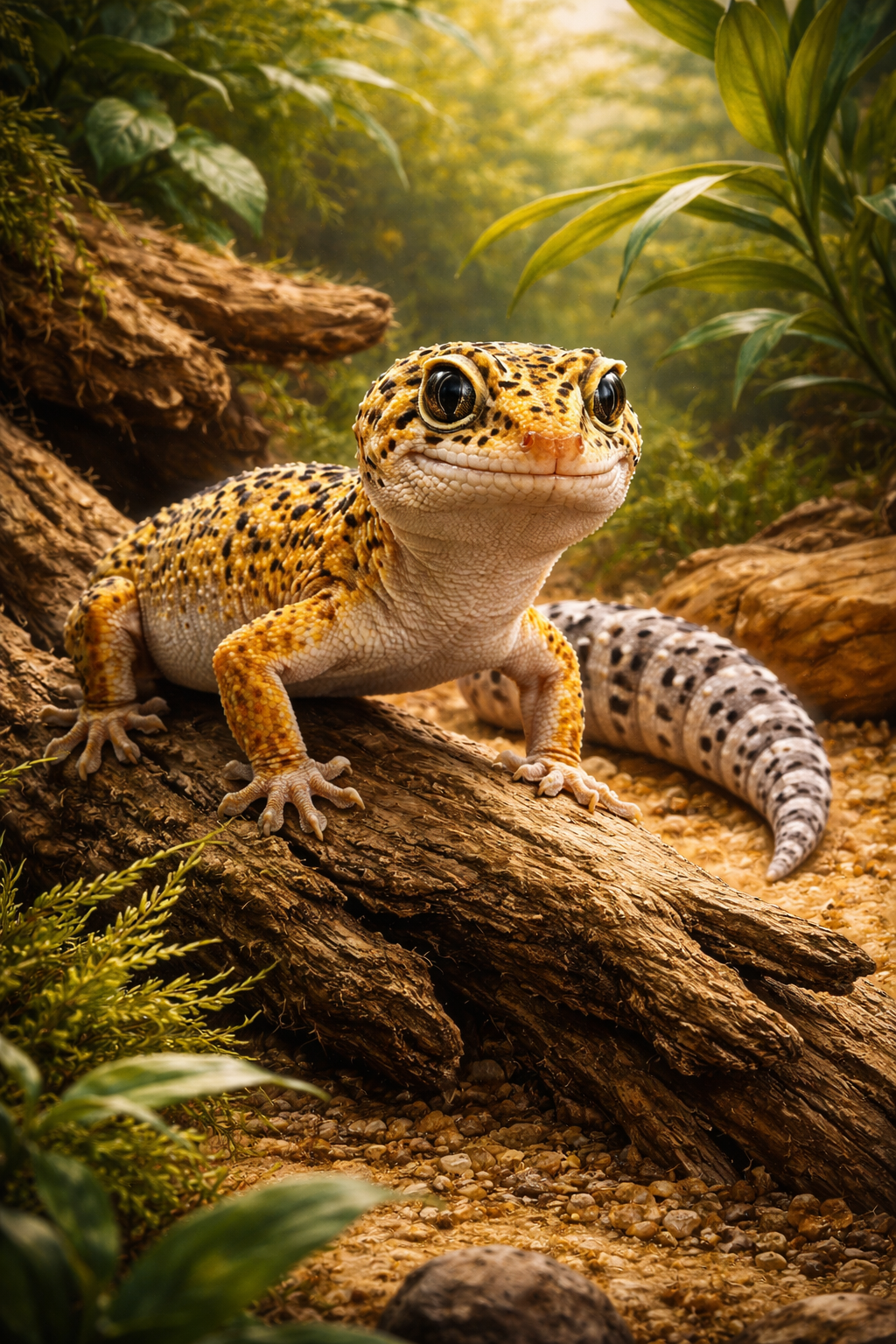
🦎 Leopard Gecko Age in Human Years
—
in human years
—
—
Gecko age
—
Life stage
—
Population
🦎 What this age means
—
Age Chart
Leopard Gecko Age to Human Years
| Age | Human Equivalent | Life Stage |
|---|---|---|
| Hatchling | Newborn | Just hatched — fully independent immediately |
| 6 months | ~12 yrs | Juvenile — growing rapidly |
| 1 year | ~18 yrs | Young adult — sexually mature |
| 3 years | ~28 yrs | Prime adult — full size attained |
| 7 years | ~42 yrs | Mature — mid-life for well-kept gecko |
| 12 years | ~58 yrs | Senior — exceptional for wild, normal for captive |
| 20 years | ~72 yrs | Elder — well-kept captive longevity |
| 28 years | Record | Verified captive record |
🦎 Leopard geckos are precocial — hatchlings emerge from the egg fully formed, fully scaled, and completely independent. Unlike mammals, there is no parental care at all after egg laying. A hatchling leopard gecko is immediately capable of hunting, hiding, and thermoregulating on its own. They reach sexual maturity at approximately 12 months, though responsible breeders wait until 18–24 months and a minimum weight of 45g before breeding females, as early breeding significantly reduces lifespan.
Fascinating Facts
Things About Leopard Geckos That Will Actually Surprise You
🦎 The Detachable Tail
Leopard geckos can voluntarily shed their tail in a process called autotomy. When threatened by a predator, the gecko contracts specific muscles that break the tail off at a pre-formed fracture plane between vertebrae — the detached tail then continues to wriggle for several minutes, distracting the predator while the gecko escapes. The tail is not just a decoy — it is also the gecko's primary fat storage organ. A healthy leopard gecko with a plump tail has substantial energy reserves; a thin tail indicates poor condition. The tail regrows over 30–60 days, but the regenerated tail is noticeably different — smoother, rounder, and lacking the original scale pattern, as it is formed from cartilage rather than bone.
👁️ Eyelids — The Unusual Gecko
Most gecko species lack eyelids entirely — they have a fixed transparent scale called a spectacle covering the eye, which they clean by licking. Leopard geckos are unusual among geckos in having fully functional movable eyelids — they can blink, close their eyes to sleep, and express emotional states through eye movements in ways most geckos cannot. This eyelid difference reflects leopard geckos' ground-dwelling, arid-environment lifestyle compared to the arboreal, humid-environment geckos that evolved the spectacle as protection against debris and moisture loss. Their large, striking eyes with vertical slit pupils are also adapted for their crepuscular and nocturnal lifestyle — excellent low-light vision for hunting in dim desert conditions.
🌡️ Temperature-Dependent Sex
In leopard geckos, the sex of hatchlings is determined not by chromosomes but by the temperature at which the eggs are incubated — a phenomenon called temperature-dependent sex determination (TSD). Eggs incubated at around 26–28°C produce predominantly females. Eggs incubated at around 31–33°C produce predominantly males. Eggs incubated at intermediate temperatures (around 29–30°C) produce a mix, often including females with male-typical behaviours. This system is found in many reptiles and is believed to have evolved because different temperatures offer different survival advantages for each sex. Climate change researchers study TSD species carefully, as warming temperatures can skew sex ratios in wild populations.
🏜️ Wild Origins
Wild leopard geckos (Eublepharis macularius) are native to the rocky dry grasslands and deserts of Afghanistan, Pakistan, northwest India, and Iran. They are ground-dwelling, hiding in rock crevices and burrows during the heat of the day and emerging at dusk to hunt insects. Despite being one of the most popular reptile pets globally — with millions kept in captivity — the wild population remains relatively healthy, though habitat loss and collection for the pet trade are monitored concerns. The captive population is now so large and well-established that most pet leopard geckos are captive-bred, reducing pressure on wild populations significantly compared to many other reptile species.
🎨 Morphs — Selective Breeding
Leopard geckos have been selectively bred in captivity since the 1980s, producing an extraordinary variety of colour and pattern morphs. The wild type is yellow with black spots — the classic "leopard" pattern. Captive breeding has produced albino morphs (three separate albino strains exist, genetically distinct), blizzard morphs (nearly patternless white or grey), tangerine morphs (intense orange), eclipse morphs (solid black eyes), and hundreds of combinations. Some morphs carry health concerns — the "enigma" morph, for example, is associated with a neurological condition causing spinning behaviour and loss of balance. Responsible breeders screen for and avoid perpetuating these issues. The morph market has made leopard geckos one of the most extensively bred reptile species in the world.
🦎 Vocalisation
Leopard geckos are one of the more vocal reptile species — they produce a range of chirps, squeaks, and clicking sounds that communicate specific information. Hatchlings and juveniles chirp when handled or stressed. Adults produce clicking sounds during territorial or mating interactions. A distinctive "bark" — a short, sharp sound — is produced when a gecko feels threatened and is preparing to defend itself. This level of vocal communication is unusual in reptiles, most of which are essentially silent. Experienced leopard gecko keepers learn to read these vocalisations and adjust handling accordingly — a chirping gecko is communicating discomfort clearly.
More Exotic Pets
Other Reptile Calculators
FAQ
Frequently Asked Questions
Leopard geckos are ectotherms — they cannot generate their own body heat and depend on external heat sources for digestion, immune function, and activity. In captivity, they require a thermal gradient: a warm side of their enclosure at 30–32°C and a cool side at 24–26°C, so they can move between temperatures to regulate their body temperature behaviourally. A under-tank heat mat connected to a thermostat is the most reliable method. Heat lamps can be used but must also be thermostat-controlled — uncontrolled overhead heat can quickly cause dangerous overheating. Unlike most reptiles, leopard geckos do not require UVB lighting (though recent research suggests it may be beneficial), making their lighting requirements simpler than many other reptile species.
Reduced appetite in leopard geckos has several common causes, most of which are not immediately concerning. Seasonal changes: leopard geckos often reduce feeding in autumn and winter, reflecting their wild seasonal behaviour — this is normal. Shedding: geckos typically stop eating for a few days before and during a shed. Stress: new environments, excessive handling, or changes to enclosure setup cause temporary appetite loss. Temperature problems: if the warm side of the enclosure is too cool, digestion slows and appetite drops — always check temperatures first. Breeding season: males especially may go off food during breeding season. If a gecko refuses food for more than 2–3 weeks outside of these normal contexts, especially if losing visible weight in its tail, a veterinary check is warranted to rule out parasites or other health issues.
Female leopard geckos can sometimes be housed together successfully if the enclosure is large enough and both animals are similar in size — but it is not recommended as a default, as even female cohabitation can lead to stress, competition for resources, and occasional fighting. Male leopard geckos must never be housed together — they are highly territorial and fights result in serious injury or death. A male and female should only be housed together intentionally for breeding, under supervision, and the female should be removed immediately after mating. The safest approach for any leopard gecko's health and wellbeing is individual housing — they are solitary animals in the wild and do not benefit socially from company of their own species.