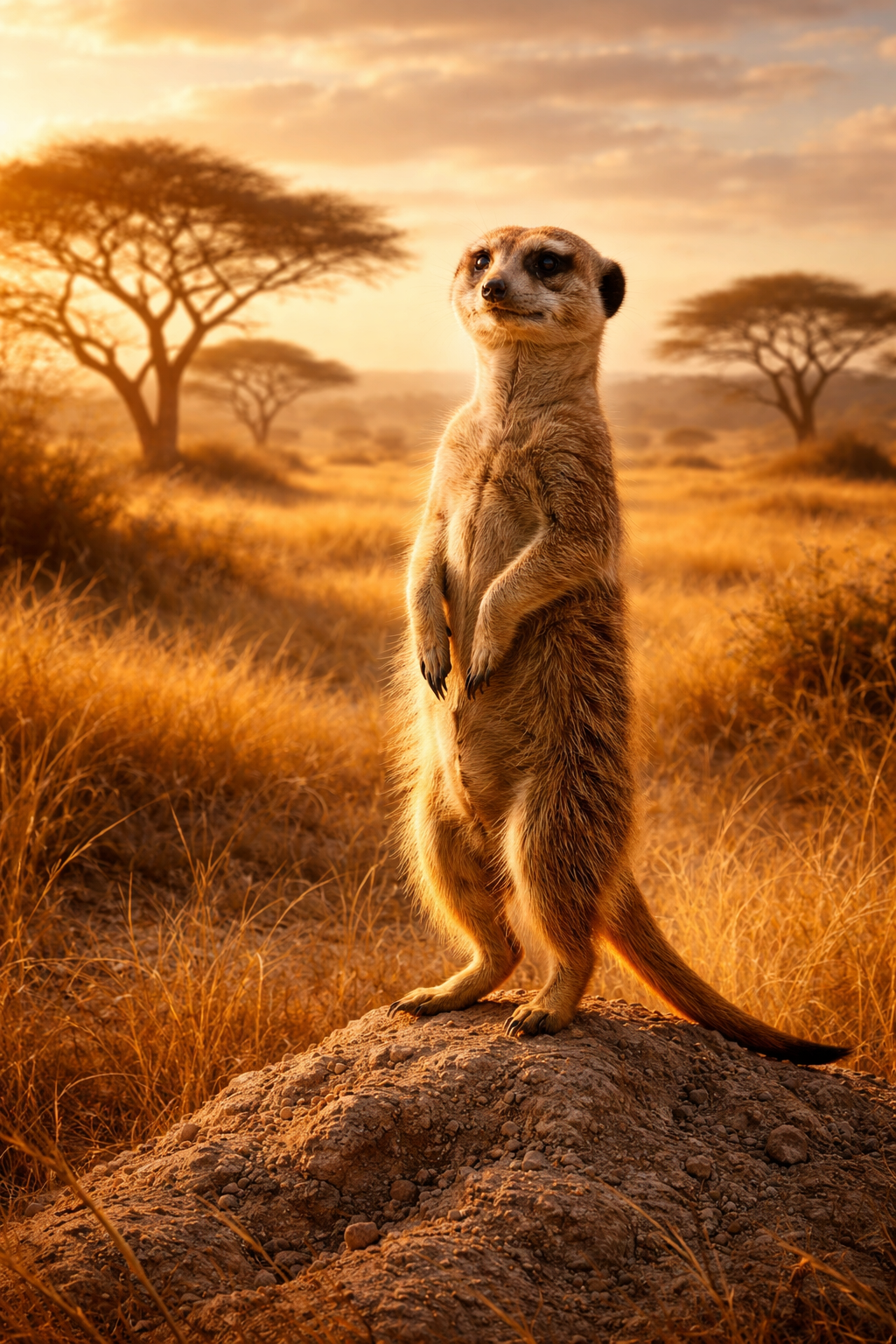
The Life Stages of a Meerkat
Meerkat development is rapid — they need to be contributing members of the mob as quickly as possible. Pups are born blind and helpless but develop fast: eyes open within two weeks, solid food begins at three weeks, and foraging lessons start at four weeks. By three months, a young meerkat is foraging independently alongside the mob. The urgency is real — every mob member who can forage and stand sentinel improves the survival odds of the whole group.
Meerkat Age to Human Years Conversion Table
| Meerkat Age | Wild Meerkat | Captive Meerkat | Life Stage | Key Milestone |
|---|---|---|---|---|
| Birth | Newborn | Newborn | Newborn pup | Born blind underground |
| 3 weeks | ~3 yrs | ~2 yrs | Learning pup | Eyes open; foraging lessons begin |
| 3 months | ~7 yrs | ~5 yrs | Juvenile | Independent foraging begins |
| 1 year | ~14 yrs | ~10 yrs | Sub-adult | Full mob duties; sentinel capable |
| 2 years | ~24 yrs | ~17 yrs | Young adult | Sexually mature; prime forager |
| 4 years | ~38 yrs | ~29 yrs | Prime adult | Experienced territory knowledge |
| 7 years | ~57 yrs | ~46 yrs | Mature adult | Senior mob member |
| 10 years | ~72 yrs | ~60 yrs | Elder | Rare in the wild |
| 14 years | ~80 yrs | ~76 yrs | Wild record territory | Exceptional longevity |
| 20 years | — | ~90 yrs | Captive record territory | Exceptional captive longevity |
🦡 The Kalahari Meerkat Project, running since 1993 in the Northern Cape of South Africa, is one of the world's longest-running animal behaviour studies. It has individually tracked hundreds of meerkats across multiple generations, providing the most comprehensive data on wild meerkat lifespan and behaviour available. Many of the facts on this page derive from research conducted by this project and published in leading scientific journals.
Things About Meerkats That Will Actually Surprise You
🦡 Meerkats have dark pigmentation around their eyes that functions like an athlete's eye black — reducing glare from the intense Kalahari sun and improving their ability to spot aerial predators against a bright sky. This is not decorative; it is a functional adaptation to one of the most sun-intense environments on Earth. Their eyes are also positioned to give a wide field of view with good depth perception — essential for spotting fast-moving raptors at distance while foraging with their heads down.
Meerkats vs Other Social Mammals
Meerkats sit at an unusual extreme of mammalian sociality. Here's how they compare to other social species on key measures.
| Species | Group Size | Cooperative Breeding | Teaching Behaviour | Wild Lifespan |
|---|---|---|---|---|
| Meerkat | 20–30 | Yes — whole mob | Yes — confirmed | 12–14 yrs |
| Wolf | 5–10 | Partial (pack helps) | Limited evidence | 6–8 yrs |
| Chimpanzee | 15–80 | No | Yes — tool use | 40–50 yrs |
| African Wild Dog | 10–20 | Yes — whole pack | Some evidence | 10–12 yrs |
| Naked Mole Rat | 20–300 | Yes — eusocial | Limited evidence | Up to 30 yrs |
| Lion | 4–30 (pride) | Yes — females share nursing | Some evidence | 10–14 yrs |