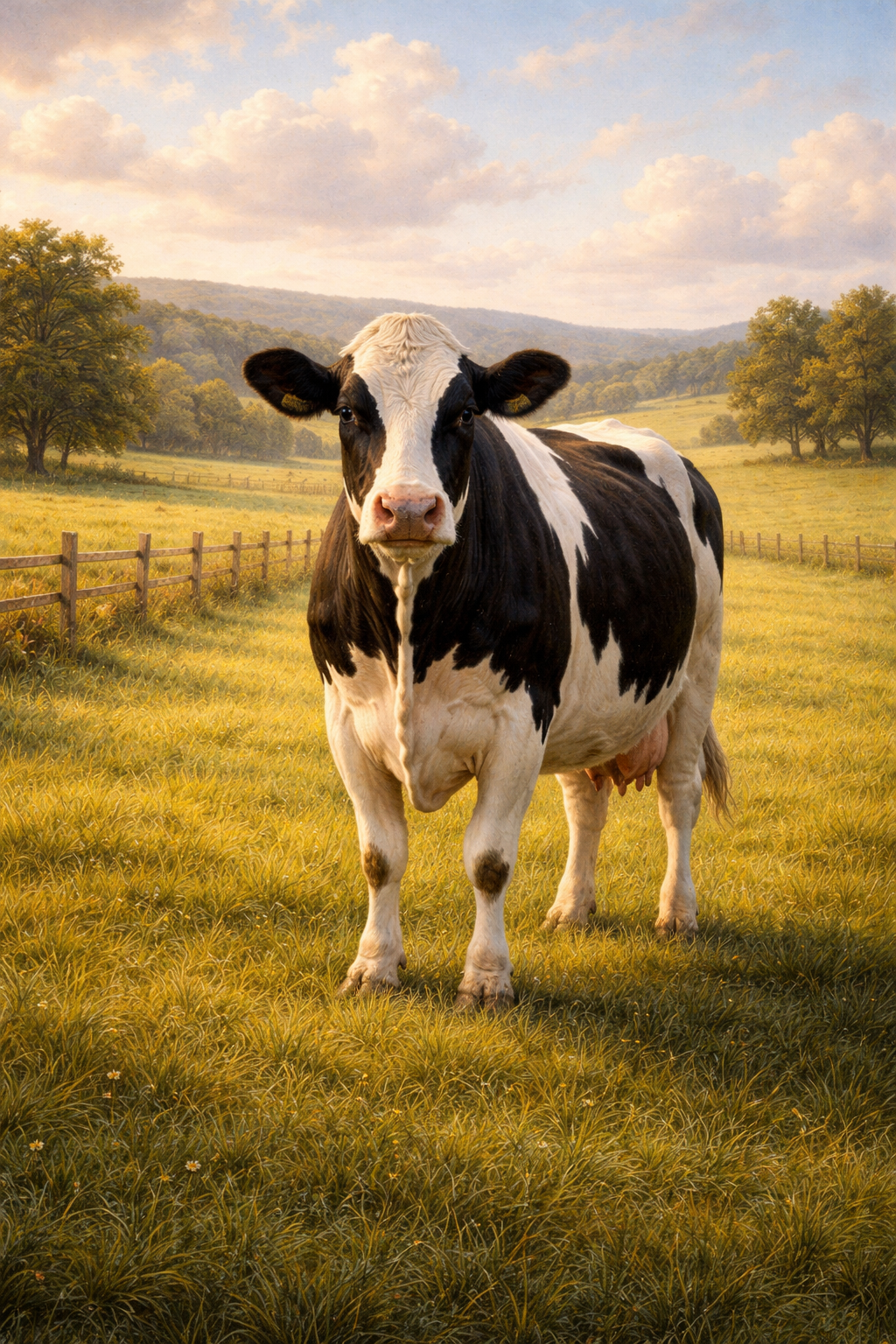
The Life Stages of a Cow
Cattle develop rapidly in their early years — they reach sexual maturity at around 12–15 months and can produce their first calf at about 2 years old. Under natural conditions or good farm management, a cow's prime years span roughly ages 3–10, with many individuals remaining healthy and productive into their teens.
Cow Age to Human Years Conversion
| Cow Age | Dairy Cow | Beef Cattle | Life Stage | Key Milestone |
|---|---|---|---|---|
| Birth | Newborn | Newborn | Calf | Stands within hours; strong bonding instinct |
| 3 months | ~3 yrs | ~3 yrs | Calf | Weaning; transitioning to forage |
| 1 year | ~11 yrs | ~11 yrs | Yearling/Heifer | Approaching puberty; herd integration |
| 2 years | ~21 yrs | ~21 yrs | First-calf Heifer | First calf; first lactation (dairy) |
| 4 years | ~31 yrs | ~33 yrs | Young Adult | Peak milk production approaching |
| 6 years | ~40 yrs | ~44 yrs | Prime Adult | Established herd member; 4th–5th lactation |
| 10 years | ~56 yrs | ~63 yrs | Mature/Senior | Often culled commercially; thriving naturally |
| 15 years | ~72 yrs | ~76 yrs | Elder | Well beyond commercial lifespan |
| 20+ years | ~84 yrs | ~86 yrs | Exceptional Elder | Record territory; the Big Bertha zone |
🐄 Commercial lifespan vs natural lifespan: The average commercial dairy cow is culled at just 4–5 years old — the equivalent of a human in their early 30s — primarily because milk production begins to decline and replacement heifers are economically preferable. Beef cattle are typically processed at 18 months to 2 years — the equivalent of a human teenager. A cow's natural lifespan of 18–22 years is almost never reached in commercial agriculture. Animal sanctuaries and small farms where cattle are kept as long-term companions regularly see cows living into their late teens and beyond.
Cattle — The Latest Science and Industry News
A landmark study from the University of Copenhagen, published in early 2025, successfully trained a machine-learning model to distinguish between positive and negative emotional states in seven ungulate species including cattle — achieving an impressive 89.49% accuracy by analysing the acoustic patterns of their vocalisations. It was the first cross-species study to detect emotional valence using AI, and a significant step toward objective, scalable animal welfare assessment.
The research builds on a growing understanding of bovine communication. Cows produce two distinct types of calls: low-frequency calls made with the mouth closed or partially closed, associated with close-range contact and positive or calm emotional states; and high-frequency open-mouth calls used for long-distance communication, typically associated with negative emotional states including distress, pain, and isolation. Researchers at Virginia Tech received a $650,000 USDA grant in 2024 to develop an acoustic tool to monitor cow wellbeing continuously on farms — moving from subjective observation to objective, real-time emotional monitoring.
Separately, the BovineTalk study published in Frontiers in Veterinary Science found that AI models could identify individual cows by their unique vocal "fingerprint" with up to 72.5% accuracy — confirming that each cow has a vocally distinctive identity, and that their calls contain rich information about both their individual identity and their current emotional state. "Vocalization is a major way cows express their emotions," said lead researcher James Chen of Virginia Tech. "It is about time to listen to what they're telling us."
The US beef cattle industry is navigating one of the most unusual market conditions in its history. The national beef cow herd has contracted for several consecutive years, driven by a combination of prolonged drought that forced widespread herd liquidation, high input costs, and a lack of heifer retention that means the herd cannot quickly rebuild. By 2025, the US beef herd had shrunk to levels not seen since the 1950s — the smallest herd relative to population in modern agricultural history.
The supply squeeze has driven cattle prices to extraordinary levels. Fed cattle averaged $224 per hundredweight in 2025 — up 20% from 2024 and approximately double the 2019–2023 average. Feeder steer prices at Oklahoma City National Stockyards exceeded $343 per hundredweight by August 2025. Young cows were fetching up to $5,000 at auction; even older "granny cows" brought $3,100 each — prices that would have been unthinkable five years ago. The New World Screwworm pest detection in Mexico in late 2024 closed the US-Mexico cattle border entirely, removing the 1.2 million Mexican feeder cattle that normally cross north each year, further tightening supply.
Despite record prices at the farm level, the benefits have not flowed equally through the supply chain. Beef packers have been operating at significant losses, with cattle slaughter running approximately 12% below prior-year levels. The long-term outlook depends on whether cow-calf producers begin retaining heifers to rebuild the herd — a process that, once started, typically takes 3–5 years to produce meaningful supply increases.
The scientific literature on bovine cognition has grown substantially in recent years, revealing a picture of cattle intelligence that is considerably more sophisticated than the popular "dumb cow" image. Research published in Animal Behavior and Cognition synthesised peer-reviewed studies demonstrating that cattle can have Eureka moments — measurable excitement (elevated heart rate, specific ear and body postures) when they successfully solve a problem and gain control over their environment, distinct from the response to simply receiving a reward passively.
Cattle can recognise up to 100 other cows by face and remember individuals long-term — including humans. They can distinguish between human faces and remember which humans have treated them gently or roughly, adjusting their behaviour accordingly. Studies have confirmed that cows form preferential social bonds ("best friends") — stable over time, associated with lower stress hormones, and associated with measurably better welfare outcomes. A cow kept with her preferred companion has lower heart rate and cortisol than a cow kept with unfamiliar animals.
Research has also found that cattle show cognitive biases — optimistic or pessimistic interpretations of ambiguous situations — that reflect their welfare state. Cows kept in better conditions show more optimistic cognitive biases; those in poor conditions show pessimistic biases. This "glass half full or half empty" measure has become a validated welfare assessment tool. And British researchers documented that cows in different geographic regions produce moos in slightly different regional accents — subtle variations in vocalisation that reflect the unique vocal environments and social learning of different herds.
The integration of AI and sensor technology into cattle farming — called Precision Livestock Farming (PLF) — is accelerating rapidly. Wearable sensors on cattle now continuously monitor rumination time, activity levels, body temperature, lying behaviour, and vocalisation, providing real-time data that flags health problems, predicts oestrus for breeding management, and monitors welfare indicators before issues become visible to the human eye.
Rumination monitoring has proved particularly valuable: a healthy dairy cow ruminates for 7–10 hours per day, and deviations from an individual cow's normal pattern are an early indicator of disease, nutritional stress, or social disruption. Computer vision systems now track individual cow movement within barns, automatically flagging lameness (one of the most common and costly dairy cow welfare problems) earlier than human observation typically detects it.
The same acoustic AI systems being developed for emotion detection are also being applied to disease detection — analysing cough patterns to identify respiratory disease, monitoring breathing sounds for early pneumonia detection, and tracking individual feeding sounds to detect digestive disorders. The next generation of dairy farm management is moving toward continuous, individual-level, AI-mediated monitoring of every animal in a herd simultaneously — a transformation in our ability to both improve productivity and monitor welfare at scale.
Things About Cows That Will Actually Surprise You
🐄 The aurochs — the wild ancestor of all domestic cattle — was a formidable animal: bulls stood 1.8 metres at the shoulder (taller than most humans) and weighed up to 1,000kg, with long forward-curving horns. Julius Caesar described aurochs in his accounts of the Gallic Wars, comparing them in size and ferocity to elephants. The last known aurochs died in Poland's Jaktorów forest in 1627 — it was a female, and her death marked the end of a species that had roamed Eurasia for hundreds of thousands of years. Modern cattle are descended from a domestication bottleneck so narrow — estimated at fewer than 80 founding individuals — that all 1 billion cattle on Earth today carry an extraordinarily small fraction of the genetic diversity of the original aurochs population.
Major Cattle Breeds
| Breed | Type | Origin | Notable For | Average Lifespan (commercial) |
|---|---|---|---|---|
| Holstein-Friesian | Dairy | Netherlands/Germany | Highest milk production of any breed; ~22,000 lbs/year average | 4–5 years (commercial) |
| Jersey | Dairy | Jersey (Channel Islands) | High butterfat milk; efficient; heat tolerant; docile temperament | 4–6 years (commercial) |
| Black Angus | Beef | Scotland | Polled (hornless); marbled beef; dominant US beef breed | Processed at 18–24 months |
| Hereford | Beef | England | Docile; efficient forager; well-suited to pasture systems | Processed at 18–24 months |
| Charolais | Beef | France | Large frame; fast growth; commonly used in crossbreeding | Processed at 18–24 months |
| Brahman | Beef | South Asia (via USA) | Extreme heat and parasite tolerance; distinctive hump; tropical regions | Processed at 24–30 months |
| Guernsey | Dairy | Guernsey (Channel Islands) | Golden milk rich in beta-carotene; gentle temperament | 4–6 years (commercial) |
| Highland | Heritage/Beef | Scotland | Cold hardiness; long horns; long shaggy coat; slow-maturing | 15–20 years (often kept longer) |