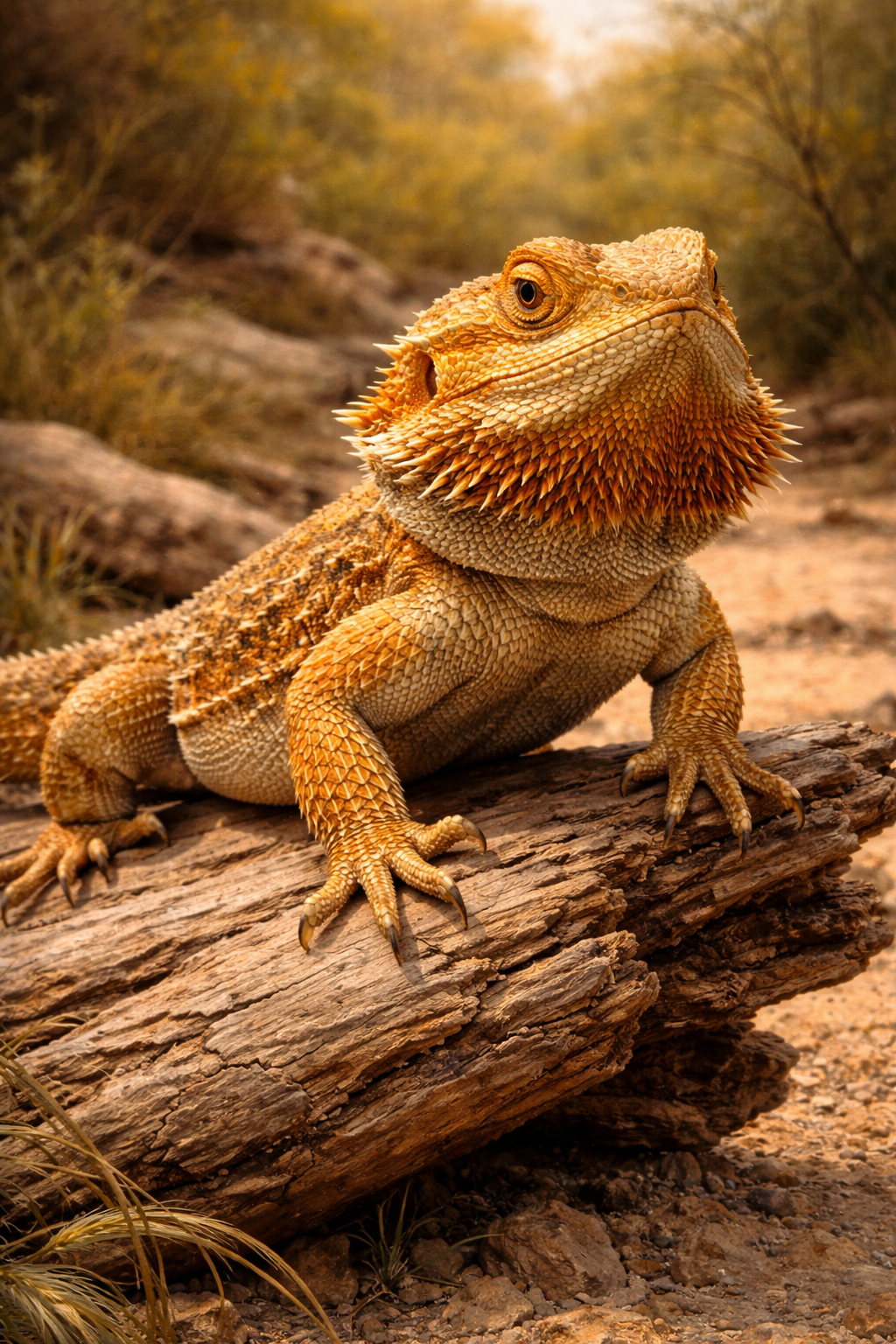
The Life Stages of a Bearded Dragon
Bearded dragons are among the fastest-maturing popular reptile pets — going from a 10cm hatchling to a sexually mature adult in under 18 months. But that fast growth curve comes with significant care demands in the early months that directly determine long-term health.
Bearded Dragon Age to Human Years
| Beardie Age | Human Equivalent | Life Stage | Key Milestone |
|---|---|---|---|
| Hatchling | Newborn | Hatchling | Self-sufficient from day one; parietal eye active |
| 3 months | ~5 yrs | Juvenile | Arm-waving and beard darkening appearing |
| 6 months | ~10 yrs | Juvenile | Diet shifting; sub-adult behaviours emerging |
| 1 year | ~18 yrs | Sub-Adult/Adult | Near full size; approaching sexual maturity |
| 2 years | ~28 yrs | Young Adult | Fully mature; full behaviour repertoire |
| 5 years | ~45 yrs | Prime Adult | Settled, confident, maximally interactive |
| 8 years | ~57 yrs | Mature Adult | Reduced activity; senior nutrition needs |
| 12+ years | ~72 yrs | Elder | Record territory; exceptional longevity |
🦎 The #1 cause of early death in captive bearded dragons is metabolic bone disease — caused by insufficient UVB and dietary calcium. It is almost entirely preventable. Replace UVB bulbs every 6 months even if they still produce visible light, as UVB output degrades before the visible spectrum does. Dust insects with calcium powder at every feeding for hatchlings and juveniles.
Bearded Dragons — The Latest Science
Researchers at the University of Illinois Urbana-Champaign performed MRI scans on seven bearded dragons to create the first high-resolution brain atlas for the species — a standardised reference map that will allow veterinarians to properly diagnose and treat neurological conditions in America's most commonly kept companion reptile.
The challenge: a clinical MRI scanner designed for humans lacks the resolution to reliably detect disease in an animal with a brain the size of a pea. The team solved this with an image averaging strategy — scanning multiple individuals and compiling the results into a single idealised model. The resulting atlas gives clinicians a reference against which any beardie's brain scan can be compared. A bearded dragon presenting with head tilt, seizures, or abnormal movement now has a diagnostic pathway that didn't exist before. The team also developed a new sedation protocol compatible with 1.5 and 3 Tesla MRI machines — the standard sizes found in veterinary practices.
A study in Applied Animal Behaviour Science provided the first experimental evidence that environmental enrichment improves bearded dragon welfare. Tested in barren standard enclosures, non-naturalistic enrichment, and naturalistic enrichment, beardies in enriched housing were more active, rested less, and showed significantly less stress behaviour — particularly the glass-scratching that is now understood as an enclosure stress indicator rather than curiosity.
When given a free choice between housing conditions, the bearded dragons actively chose enriched environments. In naturalistic enclosures they also ate the live plants and invertebrates in the substrate — natural foraging behaviour impossible in standard barren housing. With 1.3 million bearded dragons in UK households alone, the welfare implications are significant. Researchers recommended naturalistic enrichment as the target, with non-naturalistic enrichment as a minimum improvement over the barren industry standard.
The CDC documented a recurring multistate Salmonella Cotham outbreak linked to pet bearded dragons in 2024 — 27 cases across 13 states involving the same rare strain that caused a 2012–2014 outbreak of 160 patients. Whole genome sequencing confirmed the genetic link. Children under 5 accounted for 65% of confirmed cases, most of whom had no direct contact with the lizard — exposure was environmental, from contaminated surfaces, hands, and clothing.
The CDC's core safety recommendations: wash hands thoroughly after any contact with the dragon or its enclosure; prevent reptiles from roaming freely in areas used by young children; change clothes before holding infants. Bearded dragons are not recommended for households with children under 5. For other households, basic hygiene protocols make the risk manageable — but they must be consistently observed.
Research on wild Australian bearded dragons revealed a remarkable biological phenomenon: at high nest temperatures, chromosomally male (ZZ) individuals develop as females, overriding the chromosomal sex determination system entirely. These temperature-reversed females breed successfully and produce viable offspring. As Australian temperatures rise with climate change, more ZZ eggs are incubated at female-producing temperatures — potentially skewing wild population sex ratios in ways that could affect population dynamics over coming decades.
In captivity, this means incubation temperature is not a minor husbandry detail but a genuine biological variable that determines sex. Breeders controlling incubation temperature are determining offspring sex thermally rather than chromosomally — a reminder that the biology of this species interacts with even routine husbandry decisions in unexpectedly deep ways.
Things About Bearded Dragons That Will Actually Surprise You
🦎 There are eight species in the genus Pogona, all native to Australia. It is illegal to export Australian wildlife — all captive bearded dragons outside Australia descend from individuals exported before the ban. Selective breeding has produced captive colour morphs (red, orange, citrus, zero, silkback, translucent) that do not exist in wild Australian populations, making the captive population genetically distinct from its wild counterpart.
The Non-Negotiables of Bearded Dragon Care
| Requirement | Specification | Why It Matters |
|---|---|---|
| UVB Lighting | 10–12% UVB tube; replace every 6 months | Essential for D3 synthesis and calcium absorption. Without it, metabolic bone disease develops — the #1 cause of early death in captive beardies. |
| Basking Temperature | 38–42°C basking spot; 25–30°C cool end | Bearded dragons are ectotherms. Incorrect temperatures cause digestive failure, immune suppression, and death. |
| Enclosure Size | Minimum 120x60x60cm for adults | Sufficient space for a full thermal gradient. Too small prevents thermoregulation and causes chronic stress. |
| Diet — Hatchling/Juvenile | 70–80% insects; 20–30% vegetables | Rapid growth requires high protein. Calcium-dusted insects fed 2–3x daily. |
| Diet — Adult | 70–80% vegetables; 20–30% insects | High-insect diets in adults cause obesity and kidney disease. |
| Photoperiod | 12–14 hrs light in summer; 10–12 in winter | Regulates circadian rhythm, brumation cycles, and reproductive cycling via the parietal eye system. |