Popular Pets
🐶 Dog 🐱 Cat 🐰 Rabbit 🐹 Hamster 🐾 Guinea Pig 🦜 Parrot 🦡 Ferret 🐀 Rat 🐭 Chinchilla 🦔 Hedgehog 🐟 Goldfish 🦜 Macaw
Farm & Large Animals
🐴 Horse 🐄 Cow 🐄 Highland Cow 🐷 Pig 🐑 Sheep 🐐 Goat 🐴 Donkey 🦙 Alpaca 🐐 Mountain Goat 🐔 Chicken 🦆 Duck 🦃 Turkey
Wild Animals
🐘 Elephant 🦁 Lion 🐯 Tiger 🐆 Leopard 🐺 Wolf 🐻 Bear 🐻‍❄️ Polar Bear 🦍 Gorilla 🐒 Chimpanzee 🦧 Orangutan 🦘 Kangaroo 🐾 Capybara 🦒 Giraffe 🦊 Fox 🦅 Raptor 🦉 Owl 🐧 Penguin 🦩 Flamingo 🐾 Hyena 🐾 Meerkat 🦥 Sloth 🦡 Badger 🐾 Wolverine 🐾 Armadillo
Ocean & Aquarium
🦈 Shark 🐋 Orca 🐬 Dolphin 🐋 Whale 🐋 Blue Whale 🐳 Beluga Whale 🦄 Narwhal 🐋 Bowhead Whale 🐾 Manatee 🐟 Manta Ray 🐟 Freshwater Fish 🐠 Saltwater Fish 🐴 Seahorse 🐟 Koi
Exotic & Weird
🐍 Snake 🐍 Ball Python 🦎 Bearded Dragon 🦎 Iguana 🦎 Komodo Dragon 🦎 Chameleon 🦎 Leopard Gecko 🐢 Tortoise 🐢 Snapping Turtle 🐢 Sea Turtle 🐊 Crocodilian 🕷️ Tarantula 🦎 Axolotl 🐙 Octopus 🌊 Jellyfish 🦞 Lobster 🐚 Quahog 🔬 Tardigrade
Info
About FAQ Contact
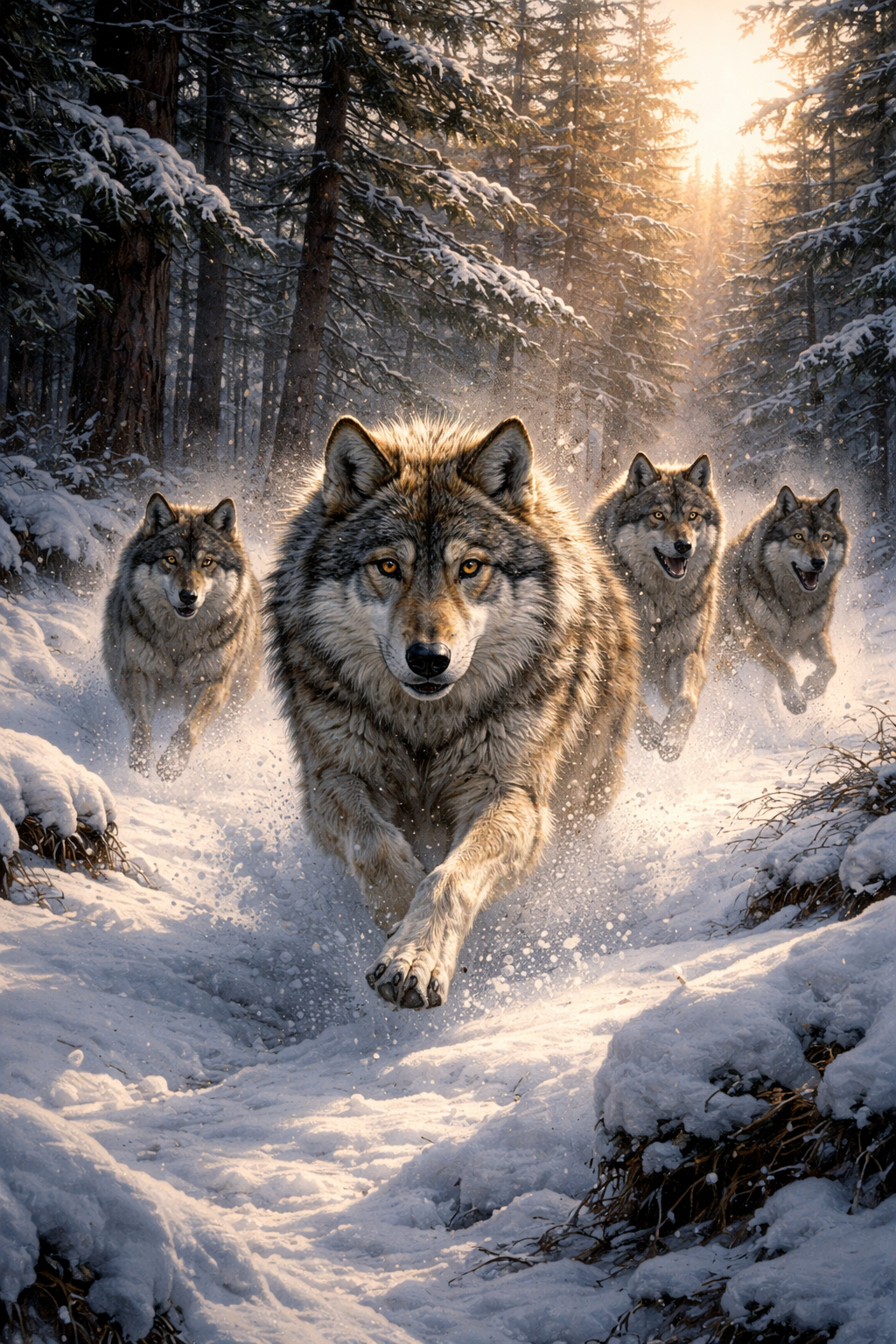
Photorealistic painting of a wolf
🐺 Wild Animals

How Old Is a Wolf in Human Years?

📅 Updated 🔬 Wild & captive covered 🐺 The alpha myth — debunked

The alpha wolf is a myth — invented from flawed captive studies and rejected by the scientist who coined it. Wolf packs are not dominance hierarchies. They are families. A breeding pair raises their young, the young help raise the next litter, and eventually they leave to start their own family. It is domesticity, not despotism. And a 5-year-old wolf is already in middle age.

Calculate Wolf Age →
🐺 Wolf Age in Human Years
in human years
Wolf age
Life stage
Population
🐺 What this age means

Wolf Species — How They Compare

🐺 Grey Wolf
Canis lupus
Wild lifespan6–13 yrs
RangeN. America, Europe, Asia
Pack size5–10 (up to 30+)
StatusLeast Concern (globally)
🐺 Arctic Wolf
Canis lupus arctos
Wild lifespan7–10 yrs
RangeCanadian High Arctic, Greenland
CoatAll-white; extra-thick double layer
StatusLeast Concern
🐺 Red Wolf
Canis rufus
Wild lifespan5–8 yrs
RangeEastern N. Carolina only
Wild population~20 wild individuals (2024)
StatusCritically Endangered
🐺 Ethiopian Wolf
Canis simensis
Wild lifespan8–10 yrs
RangeEthiopian Highlands only
Wild population~500 individuals total
StatusEndangered
🐺 The Alpha Wolf Myth — Corrected by Its Own Creator
The concept of the "alpha wolf" — a dominant individual that achieves pack leadership through aggression and fighting — was based on studies of unrelated wolves forcibly confined together in captivity. In captivity, wolves with no natural family structure do establish dominance hierarchies through conflict. But this has almost nothing to do with how wild wolf packs actually work. Wild wolf packs are family units: a mated pair (the breeding adults) and their offspring from successive years. The "alpha" is simply the parent — not a tyrant who fought to the top. L. David Mech, the researcher who introduced "alpha" terminology in 1970, has spent decades publicly calling for the term to be retired, publishing a paper in 1999 specifically to correct the misconception. He has stated that referring to wolf pack leaders as "alphas" is like calling human parents "the alpha male and female of the family." The concept has proven stubbornly resistant to correction in popular culture despite being rejected by virtually every wolf biologist.

Wolf Age to Human Years

Wolf AgeWild EquivalentCaptive EquivalentLife Stage
3 months~4 yrs~3 yrsPup — den-bound, nursing
6 months~8 yrs~5 yrsPup — joining pack hunts
1 year~13 yrs~9 yrsYearling — learning pack role
2 years~22 yrs~17 yrsYoung adult — may disperse
3 years~32 yrs~24 yrsPrime — may become breeding pair
5 years~48 yrs~38 yrsMid-life — peak of pack role
8 years~70 yrs~55 yrsSenior (wild) / Mature (captive)
12 yearsElder~74 yrsElder wild / Senior captive
20 yearsRecordOldest documented captive wolf

🐺 The oldest documented captive wolf lived to approximately 20 years. Wild wolves rarely exceed 13 years — the challenges of hunting large prey, territorial conflicts with other packs, and human pressure take a significant toll. The longest-lived wild wolves are typically breeding females in large, stable packs with reliable prey. The Yellowstone wolf reintroduction (1995–96) has provided some of the best longitudinal data on wild wolf lifespan — several Yellowstone wolves have been tracked into their mid-teens.

Wolf Subspecies — Range, Size & Status

The grey wolf (Canis lupus) has more recognised subspecies than almost any other large carnivore — estimates range from 5 to 38 depending on the classification system. Below are the most ecologically significant populations, spanning from the Arctic to the American South.

SubspeciesRangeWild PopulationBody WeightIUCN StatusNotable Fact
Grey Wolf C. l. lupusN. America, Europe, Asia200,000–250,00030–80 kgLeast ConcernMost widespread subspecies; Yellowstone reintroduction 1995
Arctic Wolf C. l. arctosCanadian High Arctic, GreenlandUnknown — remote25–45 kgLeast ConcernAlmost no human contact; tolerates −70°C; 5 months of darkness
Northwestern Wolf C. l. occidentalisNW USA, W. Canada~5,000+40–65 kgLeast ConcernLargest North American subspecies; reintroduced to Yellowstone
Mexican Wolf C. l. baileyiSW USA, N. Mexico~257 wild (2022)25–40 kgEndangeredRarest wolf in N. America; extinct in wild 1980, reintroduced 1998
Red Wolf Canis rufusE. North Carolina only~15–20 wild (2024)20–36 kgCritically EndangeredMost endangered canid in the world; hybridisation with coyotes threatens survival
Ethiopian Wolf Canis simensisEthiopian Highlands~500 wild11–19 kgEndangeredAfrica's rarest carnivore; feeds almost exclusively on Afroalpine rodents
Indian Wolf C. l. pallipesIndian subcontinent, Iran2,000–3,00018–27 kgEndangeredGenetically among the most ancient wolf lineages; highly persecuted

🐺 The Ethiopian wolf is Africa's only wolf species and the continent's rarest carnivore — with fewer than 500 individuals surviving in the fragmented highland meadows of Ethiopia. It is not closely related to the grey wolf despite its appearance, having diverged approximately 100,000 years ago. Rabies outbreaks — transmitted by domestic dogs in surrounding communities — can kill 70% of a local population in weeks, making vaccination of village dogs one of the most critical conservation interventions.

The Life Stages of a Wolf

Wolf life stages are closely tied to pack hierarchy and the annual breeding cycle. Wolves are born into a social structure — their developmental milestones are shaped by their rank, their pack, and the territory their family defends. A dispersing wolf leaving its natal pack at 2–3 years faces one of the most dangerous passages in any predator's life.

0–3 wks
Newborn Pup
Born blind and deaf in litters of 4–6. Fully dependent on mother. The whole pack gathers around the den — all members contribute to pup care through food regurgitation and guarding.
3–8 wks
Early Pup
Eyes and ears open. Beginning to explore the den entrance. First social interactions with the pack. Vocal learning begins — early howling attempts are a critical developmental milestone.
2–6 mo
Pup
Accompanying the pack to rendezvous sites away from the den. Learning to howl, play-fight, and understand pack hierarchy. Being educated in hunting by observation. Mortality is highest in this phase.
6 mo–2 yrs
Juvenile / Subordinate
Integrated into the hunting pack. Learning prey selection, coordinated chase tactics, and pack communication. Subordinate to all adults. Beginning to understand their place in the hierarchy.
2–3 yrs
Sub-adult / Disperser
The critical decision: remain in the natal pack as a subordinate, or disperse. Dispersing wolves travel alone — sometimes hundreds of kilometres — seeking a mate and unclaimed territory. The most dangerous phase of a wolf's life.
3–8 yrs
Prime Adult / Breeder
Established breeders lead their own pack. The breeding pair are typically the founding couple — experienced, coordinated hunters at peak physical condition. Their pups inherit the territory they fought to establish.
8–13+ yrs
Elder
Grey-muzzled and slower, but carrying irreplaceable knowledge of territory, prey patterns, and rival packs. In stable packs, elders are fed and protected. In Yellowstone, several wolves have been tracked into their mid-teens — among the longest wild lifespans on record. Captive wolves have reached 20 years.

Things About Wolves That Will Actually Surprise You

🎵 Howling — Not What You Think
Wolves do not howl at the moon — this is pure mythology. Wolves are crepuscular and nocturnal hunters, so they are simply more active at night, and howling at night is more audible in the stillness. Howling serves several functions: long-distance communication between separated pack members (a howl carries up to 10km in open terrain), advertising territorial boundaries to other packs, rallying the pack before a hunt, and reinforcing social bonds through chorus howling. Each wolf has a unique vocal signature — pack members can identify individuals by howl. Wolves will also howl in response to sirens, musical instruments, and other sustained tonal sounds that their auditory system classifies as a possible distant howl.
🦌 Ecosystem Engineers
Wolf reintroduction to Yellowstone in 1995–96 triggered one of ecology's most dramatic documented trophic cascades. Wolves reduced elk overgrazing, allowing riverbank vegetation to recover — the roots stabilised banks, rivers changed course, beaver populations recovered, fish populations increased, and songbird diversity expanded. This chain effect — predators reshaping an entire ecosystem including its physical geography — is called a trophic cascade. Wolves are considered a keystone species: their presence or absence has effects on the ecosystem far disproportionate to their biomass.
🐕 The Dog Connection
Dogs (Canis lupus familiaris) are a domesticated subspecies of the grey wolf, sharing over 99% of their DNA. Domestication occurred between 15,000 and 40,000 years ago — the exact timing and location remain debated — from a now-extinct wolf population. Dogs have evolved specific abilities to read human social cues that wolves lack: they follow human pointing gestures, make eye contact to solicit help, and orient to human faces in ways wolves do not, even wolf pups raised by humans. This suggests these abilities evolved during domestication, not simply through exposure to humans. Dogs also have genes enabling starch digestion that wild wolves lack — a direct adaptation to human agricultural diets.
🌍 Territory — Vast and Defended
Wolf territories range from 150 km² to over 1,000 km² depending on prey density and pack size. The pack marks and patrols this territory continuously — territorial boundaries are advertised through howling, scent marking (urine and scat), and physical presence. Territory is the primary source of conflict between packs — approximately 40% of wild wolf deaths are caused by other wolves defending or challenging territory. Dispersing young wolves (called dispersers) may travel over 1,000 km to find unoccupied territory or a mate, making wolves one of the widest-ranging land mammals on a per-individual basis.
❄️ The Arctic Wolf — Isolation Specialist
Arctic wolves (Canis lupus arctos) of the Canadian High Arctic are remarkable for their complete isolation from human persecution — their range is so remote that they have had almost no contact with humans for thousands of years and show almost no fear of people. They also endure 5 months of total Arctic darkness per year, survive on muskoxen and Arctic hares, and produce litters later in the year than other wolf subspecies to align with spring prey availability. Their all-white coat is thick enough to withstand temperatures of −70°C.
🔴 The Red Wolf — On the Edge
The red wolf (Canis rufus) is one of the world's most endangered canids — with an estimated fewer than 20 wild individuals remaining in a small area of eastern North Carolina as of 2024, down from a high of around 150 in the late 2000s. The primary threats are gunshot mortality (often misidentified as coyotes), vehicle strikes, and hybridisation with the expanding coyote population. A captive breeding programme maintains approximately 250 individuals. The red wolf was declared extinct in the wild in 1980, reintroduced in 1987, and has been declining again since the early 2010s due to reduced management protections. Its continued survival is genuinely uncertain.

Wolf Park, Indiana — Where Science Meets the Pack

🐺 Wolf Park in Battle Ground, Indiana is one of the most respected wolf research and education facilities in North America — and one of the few places in the world where the public can observe habituated wolves at close range in a naturalistic setting.

Founded in 1972 by biologist Erich Klinghammer, Wolf Park was established with a specific scientific mission: to study wolf behaviour, communication, and social dynamics through close observation of habituated animals. The facility's wolves are not pets and are not tame in the conventional sense — they are habituated to human presence from an early age, allowing researchers and educators to observe natural pack behaviours (hunting dynamics, play, howling, dominance interactions) at a proximity impossible with wild animals.

Over five decades, Wolf Park has contributed significantly to the scientific understanding of wolf communication — particularly howling, facial expression, and social bonding. The facility's research has informed wolf reintroduction programmes, captive management guidelines, and the public education that has been critical to changing attitudes toward wolf conservation across the United States.

📍 Location & Access
Wolf Park is located at 4004 East 800 North, Battle Ground, Indiana 47920 — about 10 miles north of Lafayette and 65 miles northwest of Indianapolis. The park is open to the public for guided tours and special howl nights. Check wolfpark.org for current hours, admission, and seasonal programming. The facility also hosts photography days that allow close-up access with professional guidance.
🔬 Research Legacy
Wolf Park's scientists have published peer-reviewed research on wolf vocalisation, social hierarchy, play behaviour, and the human-wolf relationship. The facility has been instrumental in correcting the "alpha dominance" myth — demonstrating through direct observation that wolf pack leadership is collaborative and family-based, not the result of constant fighting. Researcher L. David Mech, who coined the term "alpha wolf" and spent decades trying to retire it, has collaborated with facilities like Wolf Park whose observational data supports this revised understanding.
🌕 Howl Nights
Wolf Park's famous Friday and Saturday night howl sessions are among the most unique wildlife experiences available to the public anywhere in the Midwest. Visitors gather at the fence line after dark, and staff initiate howling — the wolves respond, and visitors are invited to join in. The resulting chorus can involve the entire pack and carries across the Indiana countryside. It is one of the few opportunities for members of the public to participate in genuine wolf vocal communication in real time.

🐺 Wolf Park also maintains a small population of bison and coyotes to study predator-prey dynamics and interspecies interactions. The facility's educational programmes have reached hundreds of thousands of students and adults over five decades. If you are within driving distance of central Indiana and have any interest in wolves — scientifically, ethically, or simply as remarkable animals — Wolf Park is worth the trip. Visit wolfpark.org to plan your visit.

Wolves in the Headlines

From dire wolf de-extinction controversy to climate resilience research and Endangered Species Act battles, wolves have been generating major news in 2025 and 2026.

Phys.org · February 2026
Fossil Evidence Shows Gray Wolves Adapt Diets to Climate Change — With a Cost
A University of Bristol study published in Ecology Letters used dental microwear analysis on wolf teeth from three different historical climate periods to show that gray wolves shift to harder foods — including bones — during warmer climate periods, working harder to extract nutrition as their prey becomes less accessible. Lead researcher Dr. Amanda Burtt said the findings challenge the assumption that wolves are resilient to climate change, and show warming temperatures should be a significant factor in long-term wolf conservation planning across Europe and beyond.
Read the full story →
NPR · August 2025
New Study Questions Whether Wolf Hunting Actually Protects Livestock
A study published in Science Advances found that public wolf hunting in Montana and Idaho — states that allow it — showed no measurable reduction in government wolf removals or livestock depredation compared to Oregon and Washington, which do not permit public hunting. Researchers calculated that you would need to kill roughly 14 wolves to save a single cow — making non-lethal strategies like fencing, flagging, and range riding significantly more cost-effective. The findings have reignited debate over wolf management policy across the American West.
Read the full story →
Northeastern University · April 2025
Colossal's "Dire Wolf" Is Really a Gene-Edited Gray Wolf — Experts Weigh In
When Colossal Biosciences announced it had brought back the dire wolf — using CRISPR technology to edit gray wolf DNA with traits from ancient dire wolf fossils — experts pushed back on the framing. Northeastern University ethicist Ronald Sandler called it "a genetically modified gray wolf with some amazing features" rather than a true species resurrection. The controversy raised deeper questions about whether biotechnology investment should focus on approximating extinct species or protecting the gray wolves, Mexican gray wolves, and red wolves that still exist but face serious threats today.
Read the full story →

Other Wild Animals

Frequently Asked Questions

A 5-year-old wild wolf is roughly equivalent to a 48-year-old human — mid-life, at the peak of their experience and pack role. For a wild wolf, 5 years is the period of maximum social investment: they are likely either a breeding pair member raising pups, or a high-ranking pack member playing a critical role in hunts and pup supervision. By 5 a wild wolf has survived years of prey hazards, territorial conflicts, and winters — this is a battle-tested, highly competent animal. A captive 5-year-old wolf is closer to 38 in human terms, with many years still ahead.
Yes — but "pack" as popularly understood overstates the complexity. Wild wolf packs are typically small family units of 5–10 animals: a breeding pair (sometimes called the "alpha pair," though researchers now prefer "breeding pair") and their offspring from the current and previous year or two. The offspring act as helpers — they assist in pup care, provisioning, and territory defence before eventually dispersing to find mates and establish their own packs, typically at 1–3 years old. Very large packs (20–30+) do exist in areas of abundant prey — Yellowstone's Druid Peak Pack famously reached 37 members — but these are exceptional. The core of every pack is always the mated breeding pair.
Howling serves multiple distinct functions. Pack assembly howls bring separated pack members together — a wolf that has lost contact with its pack will howl repeatedly, and pack members will respond to help it relocate. Territorial advertisement howls warn adjacent packs to stay out — when a pack hears an unfamiliar howl, it may counter-howl to assert presence or go silent to assess the threat. Social bonding howls — the chorus howling that packs engage in together before a hunt or after a reunion — appear to be functional equivalents of group rituals that reinforce cohesion. Wolves also howl in apparent distress after losing a pack member. The idea that wolves howl at the moon specifically is mythology — the lunar cycle has no documented effect on howling frequency.
The Yellowstone wolf reintroduction (14 wolves from Canada in January 1995, followed by additional reintroductions in 1995–96) is now one of the most studied ecological experiments in conservation history. Within a few years, wolves had reduced elk overgrazing in key areas — particularly along riverbanks where elk had previously grazed vegetation down to bare soil without the predation pressure that had historically kept them moving. Willows and aspens recovered along stream banks, which stabilised riverbanks and reduced erosion. Beaver returned to areas where they had been absent for decades; their dams created wetland habitat for fish, amphibians, and waterfowl. Song bird diversity increased. River channels physically narrowed and stabilised. This cascade of effects — a predator reshaping its ecosystem including the physical landscape — became the textbook example of a trophic cascade and of keystone predator ecology. The wolf population grew to over 500 in the Greater Yellowstone Ecosystem by the mid-2000s.
Yes — wolves and dogs can interbreed and produce fertile offspring (wolfdogs or wolf-dog hybrids). This is biological confirmation of their close relationship as subspecies of the same species. However, hybridisation in the wild is generally considered a conservation concern rather than a benefit — particularly for the red wolf, where hybridisation with coyotes is one of the primary threats to the remaining wild population. Wolfdog ownership is heavily regulated or prohibited in many jurisdictions because animals that combine wolf wariness with dog habituation to humans can be unpredictable and dangerous. The genetic similarity between wolves and dogs also means that genetic testing of alleged "pure" wolves sometimes reveals dog ancestry from historic hybridisation events, complicating conservation management.