📅 Updated March 2026🔬 Phylum Tardigrada🐻 0.1–1.5mm long
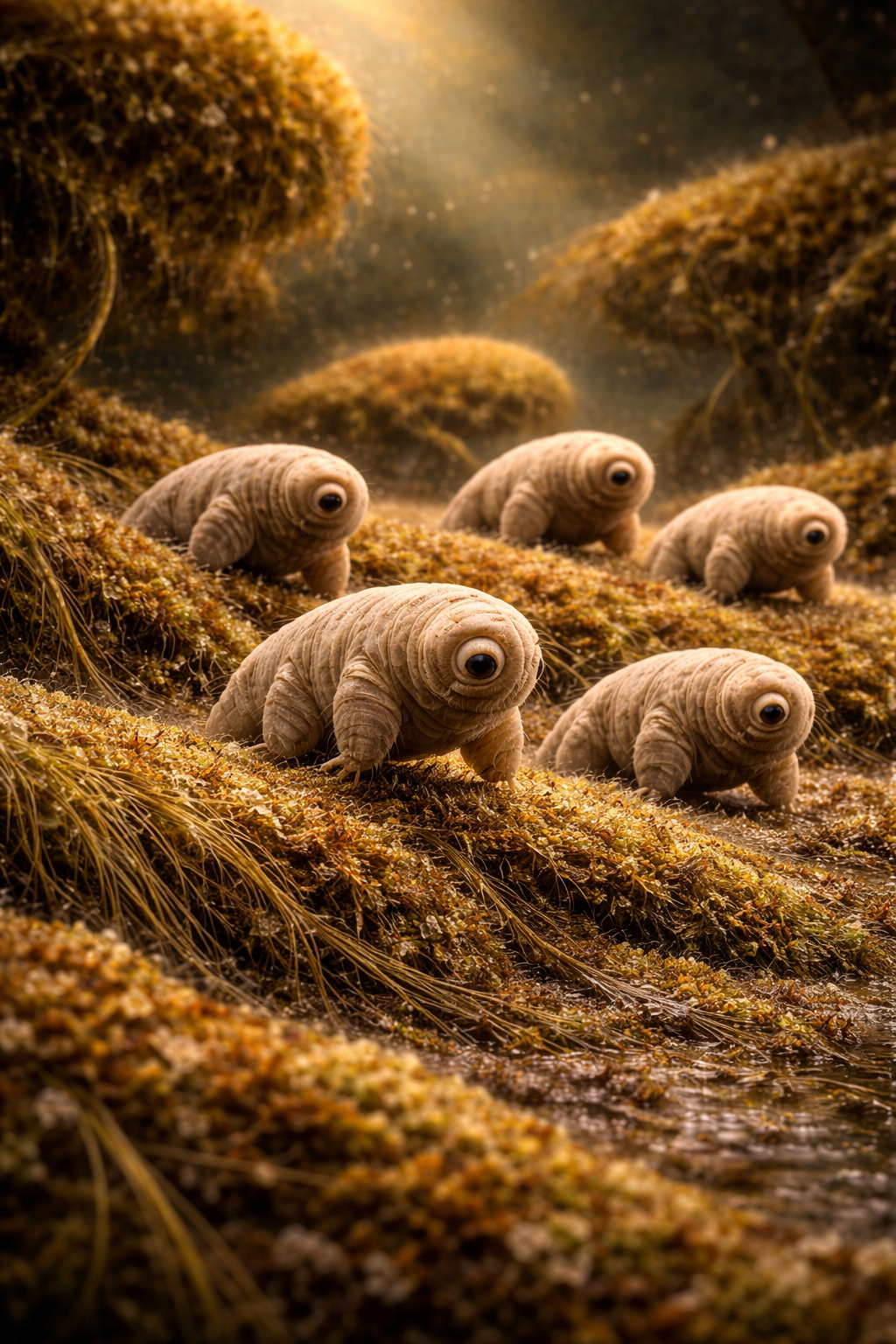
Tardigrades don't have an age in the conventional sense. When conditions become hostile — drought, extreme heat or cold, radiation, vacuum — they retract into a microscopic barrel shape called a tun, reduce their water content to 3%, and stop. No metabolism. No ageing. No time. They have been revived after 30 years of dormancy. They survived space. They will almost certainly outlast us.
In cryptobiosis (tun state). These are experimentally confirmed limits, not estimates.
151°C
Max heat
30 mins at 151°C. Survived.
−272°C
Min cold
1° above absolute zero. Survived.
6,000 Gy
Radiation
Lethal human dose: ~5 Gy. They survived 1,200× that.
0 atm
Vacuum
Full vacuum of space. Survived 10 days.
600 MPa
Pressure
6× the pressure at the bottom of the Mariana Trench.
30 years
Desiccation
Revived from 30-year dry storage. Successfully reproduced.
⚗️ Cryptobiosis — How Time Stops
When a tardigrade encounters hostile conditions — desiccation, extreme temperature, radiation, toxins — it performs an extraordinary transformation. It retracts its legs and head, contracts into a barrel-shaped tun, and initiates a biochemical shutdown sequence. Water content drops from ~85% to less than 3%. The tardigrade produces trehalose — a sugar that forms a glass-like matrix replacing water molecules around proteins and cell membranes, preventing them from collapsing or crystallising. It also produces unique proteins called Tardigrade-Specific Intrinsically Disordered Proteins (TDPs) that form a protective gel around cellular structures. DNA repair mechanisms are upregulated. Metabolism falls to less than 0.01% of normal. The animal is not technically alive in this state — but it is not dead. When water returns, the tun rehydrates within minutes to hours and the tardigrade resumes normal life, apparently unchanged. Crucially: it does not age during cryptobiosis. The biological clock simply does not tick.
Life Cycle
From Egg to Tun — The Tardigrade Life Cycle
Unlike most animals, tardigrades don't have distinct life stages tied to age. Their cycle is driven by environment — when conditions are good, they grow and reproduce; when conditions turn hostile, they pause everything indefinitely. The "tun" state is not a life stage — it is a suspension of all life stages.
Stage 1
🥚 Egg
Eggs are laid singly or in clusters, often inside the shed cuticle. Smooth-shelled eggs are typically laid in the environment; ornamented eggs are deposited in the moulted cuticle. Hatching occurs within days to weeks depending on temperature. Eggs themselves are also resistant to desiccation and can survive dry conditions.
Stage 2
🐣 Juvenile
Hatchlings emerge as miniature adults with a full complement of cells — tardigrades do not add new cells as they grow, they simply expand existing ones. Juveniles begin feeding immediately. They go through several moults (ecdysis), shedding their cuticle as they grow, reaching adult size after 3–4 moults.
Stage 3
🐻 Adult
Sexually mature adults reproduce by laying eggs. Many species can reproduce parthenogenetically (without fertilisation). Adults continue to moult throughout their lives. Under good conditions, active adults live 2–3 years. They feed, reproduce, and go about their lives in the water film around mosses and lichens.
Stage 4
🛑 Tun (Cryptobiosis)
When conditions deteriorate — drought, extreme cold or heat, toxic chemicals — the tardigrade enters cryptobiosis, forming a tun. This can happen at any life stage, including as an egg. Time stops. The tardigrade does not age, metabolise, or deteriorate. It waits. Days, years, or decades later, water returns and life resumes.
Extremophile Comparison
Tardigrade vs. Other Survivors
How does the tardigrade stack up against other famously tough organisms? The numbers are striking.
Organism
Max Heat
Min Cold
Radiation (Gy)
Vacuum
Without Water
Tardigrade
151°C
−272°C
6,000
Yes (10 days)
30+ years
Deinococcus radiodurans (bacterium)
~80°C
−15°C (active)
~30,000
Limited
Years (spore)
Brine shrimp (Artemia)
~105°C (cyst)
−190°C (cyst)
~4,000
No
Years (cyst)
Cockroach
~48°C
~−6°C
~1,000
No
~1 month
Human
~42°C (core)
~−1°C (core)
~5
No
~3–5 days
Fascinating Facts
Things About Tardigrades That Will Actually Surprise You
🚀 Confirmed Space Survivors
In September 2007, the European Space Agency's FOTON-M3 mission carried tardigrades into low Earth orbit and exposed them directly to the vacuum and UV radiation of open space for 10 days. Returned to Earth, a significant proportion survived — the first animals confirmed to survive unprotected space exposure. A 2019 Israeli lunar lander mission (Beresheet) crashed on the Moon, spilling thousands of dehydrated tardigrades across the lunar surface. Scientists believe many of these likely survived the impact in tun state and may persist on the Moon indefinitely.
🧬 Horizontal Gene Transfer
A 2015 genome analysis found that approximately 17.5% of tardigrade genes appeared to come from other organisms — bacteria, plants, fungi — rather than ancestral animal lineages. This was described as an extraordinary example of horizontal gene transfer. Some of these "borrowed" genes appear to help with desiccation resistance. Later analyses revised some findings, but tardigrades still show unusually high rates of foreign gene incorporation — apparently absorbing protective genetic machinery from the microorganisms they encounter during cryptobiosis.
🌍 Literally Everywhere
Tardigrades have been found on every continent including Antarctica, in ocean sediments at 5,000m depth, at elevations above 6,000m in the Himalayas, in hot springs, in ice cores, on rooftops, in gutters, on the bark of trees in city parks, and floating in the upper atmosphere. There are over 1,300 described species, though the true number is likely much higher. Any moss you have ever handled almost certainly contained tardigrades.
🏆 The "Last Survivors"
A 2017 study by David Sloan and colleagues at Oxford calculated that tardigrades are likely to be among the last animals surviving on Earth. The scenarios most likely to cause animal mass extinction (asteroid impacts, gamma-ray bursts, supernova proximity) would boil Earth's oceans — but even this would not eliminate tardigrades, since they can survive temperatures beyond 150°C. The study concluded that tardigrades are likely to survive until the Sun's expansion makes Earth uninhabitable in approximately one billion years.
🔬 True Animals, Tiny Scale
Despite being commonly described alongside bacteria and microbes, tardigrades are genuine animals — members of the kingdom Animalia, with brains, muscles, a complete digestive system, reproductive organs, and a nervous system. They moult like insects and spiders, shedding their cuticle as they grow. They lay eggs, which hatch into miniature adults. Some species have simple compound eyes. Their small size means their nutritional requirements are tiny — a single algal cell can sustain a tardigrade for an extended period.
💉 Medical Research Potential
The proteins that allow tardigrades to survive desiccation — particularly the TDPs — are of significant biotechnology interest. Research groups have explored using tardigrade proteins to preserve human vaccines, blood products, and transplant organs without refrigeration. In 2020, researchers at the University of Wyoming showed that inserting tardigrade proteins into human cells increased their resistance to desiccation by a factor of over 100. If the protective mechanisms can be transferred to biologics and medical products, it could transform cold-chain logistics for medicines in low-resource settings.
🐻 The most remarkable revival on record: in 2021, Japanese researchers from the National Institute of Polar Research revived two tardigrades and a viable egg from a sample of Antarctic moss frozen in 1983 — 30 years and 6 months of cryptobiosis. One of the tardigrades reproduced successfully after revival, producing eggs that hatched into normal offspring. The researchers noted that revival of such old specimens is likely limited more by the degradation of the surrounding biological material than by the tardigrade's own biological clock — which in cryptobiosis, essentially does not run.
Almost certainly yes — in tun state. When the Israeli Beresheet lunar lander crashed in April 2019, it was carrying thousands of dehydrated tardigrades in a time capsule payload. The impact velocity was estimated at around 500 km/h. Research modelling has suggested that tardigrades in tun state can survive impacts of this magnitude — the forces involved are within the range they have been experimentally shown to tolerate (up to ~800 MPa peak pressure was modelled). The Moon's surface has no liquid water, so the tardigrades cannot revive and are not "living" there in any active sense — they remain in permanent cryptobiosis. But they are almost certainly still intact, and would theoretically be revivable if ever retrieved and rehydrated. They will remain on the Moon indefinitely — nothing in the lunar environment can destroy them in tun state.
Finding your own tardigrades is genuinely straightforward. Collect a small amount of moss, lichen, or leaf litter — from a rooftop, a garden, a park, a forest floor, anywhere. Place it in a shallow dish and add a small amount of distilled or rain water. Leave it to soak for 3–24 hours. Use a dropper or pipette to transfer a small amount of the water to a microscope slide. View at 40–100× magnification. You will almost certainly see tardigrades. They are unmistakable — a chunky, eight-legged barrel shape lumbering slowly across the field of view. Any basic optical microscope will work. This is one of the most accessible citizen science experiences available — tardigrades are genuinely everywhere, waiting to be found by anyone with a microscope.
This is active and promising research, but not yet a deployed technology. Several research groups have demonstrated in laboratory settings that tardigrade-derived proteins (particularly TDPs) can protect biological molecules from desiccation damage. A 2020 paper showed that human cells expressing tardigrade proteins survived desiccation stress significantly better than normal human cells. Research at various institutions has explored applying this to vaccines, blood products, and potentially organs for transplant. The challenge is moving from proof-of-concept in laboratory conditions to reliable, scalable, regulatory-approved medical applications. The potential is real; the practical deployment is still years away.
Most tardigrades are herbivores or omnivores, feeding by piercing plant cells, algae, or bacteria with their hollow stylets and sucking out the contents using a muscular pharynx. Some species are carnivorous, feeding on other tardigrades, nematodes, or rotifers. Their complex mouth apparatus — stylets, buccal tube, and muscular pharynx — allows them to extract nutrients from a wide variety of sources. Some species that live in extremely nutrient-poor environments appear to be able to absorb dissolved organic molecules directly across their cuticle. Their small size means their nutritional requirements are tiny — a single algal cell can sustain a tardigrade for an extended period.
Estimates vary widely, but the number is almost incomprehensibly large. A single gram of soil or moss can contain hundreds to thousands of tardigrades. Given that tardigrades inhabit every continent and most terrestrial and aquatic habitats, global population estimates reach into the quintillions (10¹⁸) or higher. They are among the most numerous animals on Earth by individual count — vastly outnumbering humans, elephants, or any large vertebrate. The moss on a single rooftop likely contains millions. They are, by any reasonable measure, one of the most successful animal lineages that has ever existed.
Almost certainly not in any meaningful sense. Pain requires a nervous system complex enough to process nociceptive signals and generate a subjective experience of suffering. Tardigrades have a very simple nervous system — a brain ganglion and a ventral nerve cord — with no structures analogous to those associated with conscious pain experience in vertebrates. They do respond to harmful stimuli (moving away from damaging chemicals or UV light), but this is nociception — a reflex response — rather than pain as a felt experience. The current scientific consensus is that the neurological complexity required for subjective pain experience is absent in tardigrades. They are fascinating and resilient, but almost certainly not suffering in any way we would recognise.